
 Fences
 Gates
Gates Signage & Boards
 Car Parking Shades
 Block and Foundation
 Spare Parts
Container Parking in Dubai: A Guide to Shipping Container Storage Yards

Container parking is a dedicated area where shipping containers and related transport equipment can be stored when they are not moving between a port, warehouse, or customer site. Depending on the facility, a yard may also handle chassis, trucks, trailers, container loading, unloading, and other logistics activities.
In Dubai, container parking is closely linked with the city’s large logistics and shipping network. Jebel Ali, for example, is a major maritime and logistics hub with road, sea, and other transport connections.
A good container parking facility is more than an empty piece of land. It needs enough space, suitable ground conditions, safe vehicle movement, controlled access, and a layout that makes containers easy to locate and retrieve.
What Is Container Parking?
Container parking means keeping shipping containers in a designated container storage yard or secure storage yard until they are needed for their next movement.
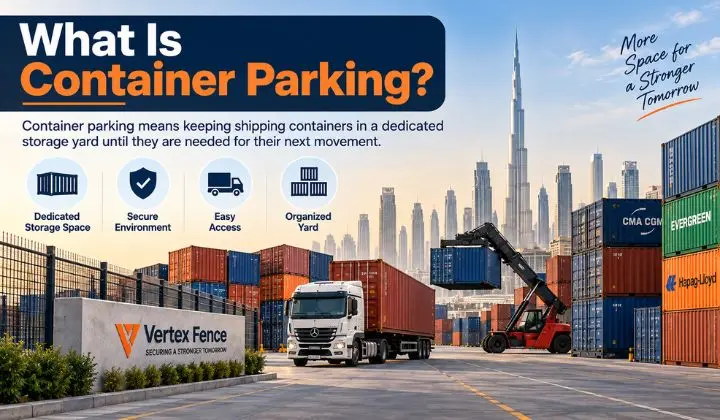
A facility may store empty containers, loaded containers where permitted, or equipment used to move containers. The exact services depend on the operator and the site’s intended use.
A container yard is commonly used as a place where ocean containers are received, stored, and later collected or moved onward.
This is different from normal car parking. A shipping container can be large and heavy, and moving it may require a truck, trailer, forklift, reach stacker, or other container handling equipment.
What does a container parking facility usually include?
Depending on its size and services, a facility may have:
- Marked container storage spaces
- Access roads for container trucks
- Areas for trucks and trailers
- Loading and unloading zones
- Controlled entry and exit
- Perimeter fencing
- Security gates
- CCTV and security lighting
- Equipment for container handling
- Space for inspection or minor services
The main goal is simple: keep containers in an organized place while allowing them to be moved in and out without unnecessary delays.
How Does a Container Parking Yard Work?
A well-managed container parking yard follows a planned process. The container should be easy to identify, safely positioned, and accessible when the customer needs it.
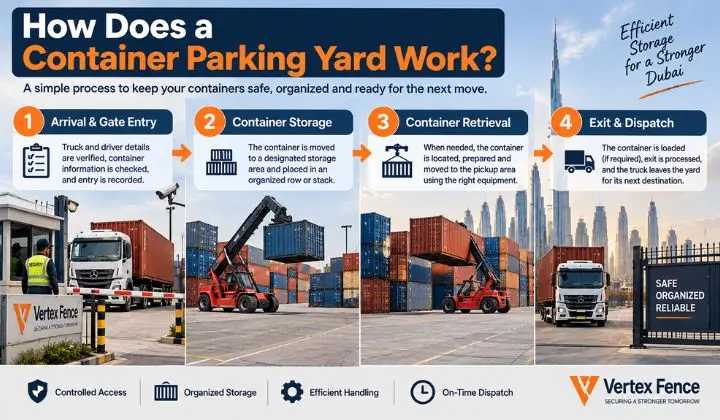
Container Arrival and Gate Entry
The process normally starts when a truck or semi-trailer arrives at the yard.
The operator may check the vehicle, driver, container number, delivery details, and booking or storage information before allowing entry. Larger facilities may also record the entry and exit time of each container.
Controlled access is especially important in busy logistics yards because many vehicles and containers can move through the same entrance during the day.
A strong entrance usually combines a suitable security gate, clear vehicle access, lighting, and an access-control process.
Container Storage and Yard Placement
After entering the yard, the container is moved to its assigned storage area or storage slot.
The location should be planned around container size, expected pickup time, and the equipment used to move it. For example, a 40ft container needs a different footprint and handling arrangement from a smaller container.
Dubai Ports Authority regulations use the term stacking area for a storage area where containers are stacked while waiting for onward movement, also referring to it as a container yard.
Good yard management also reduces unnecessary movement. If a container that needs frequent pickup is placed deep behind other containers, the operator may have to move several boxes just to reach it.
Container Retrieval and Exit
When the customer needs the container, the operator locates it, prepares it for collection, and coordinates its movement toward the exit.
The truck access, internal roads, turning areas, and storage layout all matter at this stage.
A poor layout can create delays even when the yard has enough total space. A well-planned layout makes it easier for a container truck, trailer, or handling machine to reach the required container.
What Can Be Stored in a Container Parking Yard?
The answer depends on the facility’s services and operating rules, but container parking can cover more than just empty steel boxes.
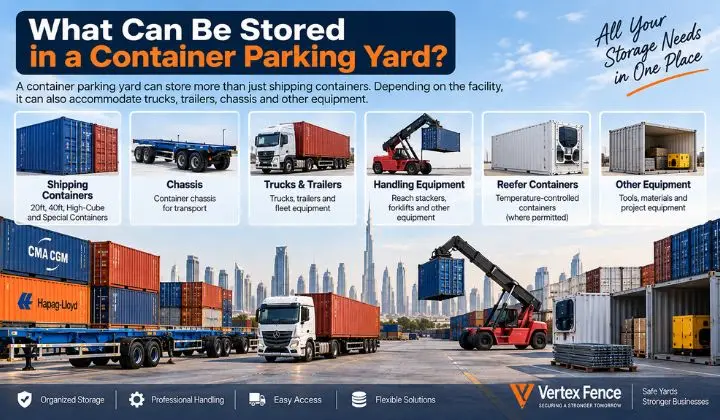
Shipping Containers
The most common item is the shipping container itself. Facilities may handle:
- 20ft containers
- 40ft containers
- high-cube containers
- Standard dry containers
- Empty containers
- Other specialized container types
Some UAE facilities also handle reefer and special-purpose containers. For example, MFC Container Solutions lists standard, reefer, offshore, and special equipment among its container services.
Chassis
A container chassis is the frame used to carry a container behind a truck. Some parking facilities can store chassis when they are not being used for transport.
Trucks and Trailers
Depending on the facility, space may also be available for trucks, trailers, and other fleet equipment. This is useful for logistics companies that need somewhere to hold vehicles between trips.
Handling Equipment
Larger operations may also have equipment such as reach stackers, top loaders, side loaders, or heavy-duty forklifts.
For example, an MFC depot near Jebel Ali uses reach stackers and heavy-duty forklifts for container movement and provides open and covered storage.
This shows why container parking should not be viewed only as “renting a piece of land.” The equipment and operating setup can have a major effect on how useful the facility is.
Container Parking vs Container Yard vs Container Depot
These terms are related, but they do not always mean exactly the same thing.
| Facility | Main Purpose | Typical Services |
| Container Parking | Holding containers or equipment | Storage and controlled access |
| Container Yard | Organized container storage and movement | Storage, stacking, staging and retrieval |
| Container Depot | Broader container services | Storage, inspection, repair, handling and other services |
A container yard is mainly concerned with receiving, storing, organizing, and moving containers. A depot can offer additional services such as inspection, repair, washing, certification, or container sales and leasing.
For example, MFC’s Dubai depot provides storage along with repairs, inspection, certification, container sales, washing, and other services.
So, if you only need a place to keep a container for a period of time, simple container parking may be enough. If you also need inspection, repair, handling, or other container services, a container depot may be a better fit.
Why Do Businesses Use Container Parking in Dubai?
Dubai’s role in international trade makes container movement a regular part of many logistics operations. Jebel Ali Port connects sea transport with road and other logistics networks, making nearby storage and handling facilities important to businesses moving cargo.
Limited Space at Business Premises
A warehouse or industrial site may not have enough room to keep several shipping containers.
Instead of filling valuable working space with containers, a company can use a separate container storage yard.
Short-Term Storage
Sometimes a container only needs to stay somewhere for a short period between delivery, collection, or another transport stage.
In this case, renting space can be more practical than keeping the container at a business location.
Long-Term Storage
Businesses may also need long-term container storage when containers are not being used regularly.
This can apply to logistics companies, container owners, construction businesses, and companies holding equipment for future projects.
Logistics and Freight Operations
A properly planned yard can help coordinate shipping, freight, trucking, pickup, delivery, and container movement.
The closer and easier the yard is to reach from the relevant transport routes, the more useful it can be for a business.
Construction and Industrial Projects
Construction companies sometimes use containers for storage, site offices, tools, or materials. A separate yard can provide space when the project site itself cannot safely hold additional containers.
How to Plan a Container Parking Yard
Planning a container yard starts with more than calculating how many containers can physically fit on the land.
You need to think about capacity, vehicle movement, container handling, ground conditions, drainage, safety, and future growth.
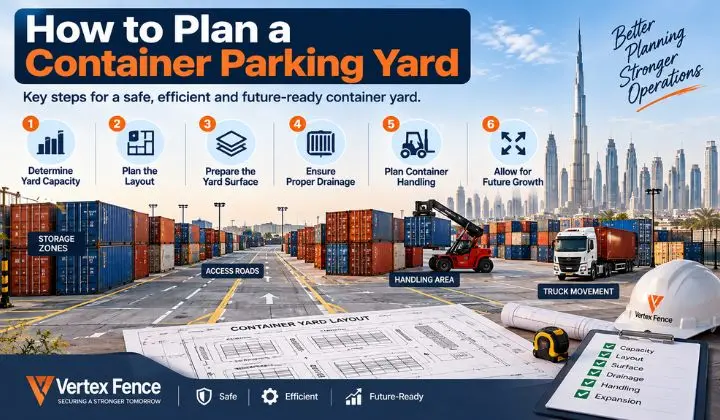
Determine Yard Capacity
Start by estimating how many containers the yard needs to hold.
Consider:
- Number of containers today
- Expected future demand
- 20ft vs 40ft containers
- Container stacking
- Required access lanes
- Space for trucks and handling equipment
- Loading and unloading areas
Do not use the entire site for storage slots. A working yard also needs movement space.
A yard packed to its maximum physical capacity may look efficient on paper but become difficult to operate in practice.
Create an Efficient Container Parking Layout
A good container parking layout should allow trucks and handling equipment to move safely around the site.
Storage rows should have suitable access paths, while the entrance and exit should support the expected vehicle flow.
Think about the complete movement:
Gate → inspection/check-in → storage area → retrieval → loading → exit
If a truck has to make unnecessary turns or wait for another vehicle to move before reaching a container, the yard loses efficiency.
For larger operations, clearly marked storage slots, rows, lanes, and traffic routes can make container identification and retrieval much easier.
Prepare the Yard Surface
Containers are heavy, and the yard must be able to support the expected loads and equipment.
A suitable hardstanding or paved surface can help provide a stable working area. Drainage is also important because standing water can damage surfaces and make vehicle movement harder.
The exact ground design depends on the container load, handling equipment, soil conditions, drainage needs, and site design.
This is one area where a site should be assessed properly rather than choosing a surface based only on appearance or initial cost.
Plan Container Handling
A yard also needs a plan for how containers will actually be moved.
Depending on the size and operation, this may involve:
- Forklifts
- Reach stackers
- Top loaders
- Side loaders
- Container trailers
The choice of equipment affects the required yard space, access lanes, turning areas, and storage arrangement.
For example, MFC’s Dubai depot uses reach stackers and heavy-duty forklifts and has wide access roads for container movement.
This is why equipment should be considered during the layout stage, not added as an afterthought.
Fencing and Gates for Container Parking Yards
Security should be planned from the boundary inward. A container yard may hold expensive containers, cargo, vehicles, and equipment, so leaving the site open can create unnecessary security risks.
A properly designed perimeter security system helps define the site and control who can enter or leave.
Why Perimeter Fencing Is Important
A strong container yard fencing system can help:
- Reduce unauthorized access
- Protect containers and equipment
- Separate the yard from public areas
- Guide vehicles toward controlled entry points
- Support CCTV and lighting
- Create a clear physical boundary
The right fence depends on the site’s security needs, available budget, required height, and the level of protection expected.
For a basic industrial yard, chain link fencing may be suitable. Where stronger resistance to climbing or forced entry is needed, welded mesh fencing or anti-climb fencing can provide a more security-focused boundary.
A company such as Vertex Fence can help businesses assess fencing options based on the site’s layout, security requirements, and type of industrial operation.
Container Yard Gates and Access Control
The gate is the main controlled point between the public road and the storage yard.
A suitable container yard gate should provide enough width for the largest expected truck or trailer while still allowing the operator to control access.
Common options include:
- Vehicle access gates
- Sliding gates
- Swing gates
- Automated gates
- Boom barriers
- Controlled entry and exit systems
For a busy facility, the gate should work together with CCTV, security lighting, visitor records, and vehicle access control.
The aim is not simply to install a large gate. The entrance should be designed around actual vehicle movement, including truck length, turning space, waiting areas, and the direction of traffic.
How Much Does Container Parking Cost in Dubai?
There is no single price for container parking rates in Dubai.
The amount you pay can depend on the container size, storage period, location, security, handling requirements, and services included by the yard operator.
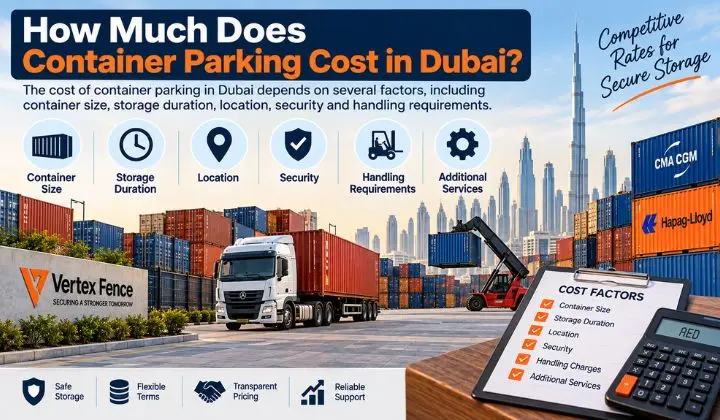
Main factors that affect container parking costs include:
Container size: A 40ft or high-cube container may require more yard space than a standard 20ft container.
Storage duration: A short-term arrangement may be priced differently from monthly or long-term storage.
Location: A yard closer to major logistics routes or port areas may have different pricing from a more remote industrial location.
Handling: If the operator needs to load, unload, stack, or move the container using specialized equipment, handling charges may apply.
Security: Facilities with controlled access, CCTV, security staff, lighting, and stronger security fencing may have higher operating costs.
Additional services: Inspection, repairs, washing, reefer services, documentation, or transportation can add to the total.
So, when comparing container parking rates, do not look only at the advertised storage price. Ask what is included and whether handling or access charges are billed separately.
Container Parking for Sale vs Renting Parking Space
The phrase container parking for sale can be confusing because a shipping container and a parking space are two different things.
If you buy a shipping container, you own the physical container. You still need a suitable place to keep it unless you have enough approved space at your own property.
Renting container parking means you pay an operator to use part of its storage yard for a specific period.
Renting may make more sense when:
- You only need storage for a limited period
- You do not own suitable industrial land
- You need controlled security
- You want access to container handling equipment
- You do not want to manage a yard yourself
Owning a container may make more sense when:
- You need the container for repeated projects
- You want to modify it for storage or another use
- You have a suitable location for it
- Long-term ownership is more practical for your business
Before buying a container, check where it will be stored and whether the intended site is suitable for that use.
How to Find Container Parking Near You in Dubai
Searching for container parking near me is only the first step.
The closest yard is not always the best option. A facility that looks nearby on a map may be difficult for a long truck or trailer to access during busy hours.
When comparing a facility, check these points:
1. Location and Road Access
Choose a location that works with your regular delivery and collection routes. Easy access to major roads can reduce unnecessary travel time.
2. Container Sizes
Ask whether the facility accepts your specific container type, such as a 20ft container, 40ft container, or high-cube unit.
3. Truck and Trailer Access
Make sure the entrance, internal roads, and turning areas can handle the vehicles used by your business.
4. Security
Ask about the perimeter fence, security gates, CCTV, lighting, access control, and monitoring arrangements.
5. Handling Services
If you do not have your own equipment, find out whether the yard provides container lifting, loading, unloading, or repositioning.
6. Pricing Terms
Ask for the full cost, including storage, handling, access, and any other applicable charges.
7. Site Suitability
The operator should be able to explain what the site is permitted and equipped to handle. For a business setting up its own yard, confirm applicable land-use and approval requirements before starting operations.
What Are Box Park Container Buildings?
Box park container buildings are structures made by using shipping containers as the base for commercial, retail, office, hospitality, or other spaces.
Unlike a normal container parking yard, the main purpose is not simply to store containers. The containers are usually modified or converted for people to use.
Common examples include:
- Container offices
- Retail units
- Cafés
- Restaurants
- Temporary commercial spaces
- Site offices
- Small workshops
A container used as a building may need modifications such as doors, windows, electrical systems, ventilation, insulation, flooring, and air conditioning.
Box Park vs Container Parking
The difference is simple:
Container parking is mainly about storing and managing shipping containers and related equipment.
Box park container buildings use containers as functional spaces for people, businesses, or commercial activities.
This distinction is important because the planning, construction, services, and approvals can be very different.
Insulation and Cooling in Dubai
Dubai’s hot climate makes temperature control especially important when a container is converted into an occupied space.
Depending on the intended use, the design may need suitable insulation, ventilation, air conditioning, electrical systems, and heat-control measures.
A basic steel container should not automatically be treated as a comfortable building. Its final performance depends heavily on how it is modified and fitted out.
What Should You Consider Before Setting Up Container Parking in Dubai?
Setting up a container parking lot requires more planning than simply finding an empty plot.
Start with the site’s intended use and make sure the location is suitable for the operation.
Consider these areas before development:
Location and permitted use: Confirm that the site can legally support the intended industrial or storage activity and check the requirements that apply to that property.
Yard capacity: Calculate how many containers, trucks, trailers, or other equipment you actually need to accommodate.
Access: Check whether the entrance and internal roads can safely handle the expected vehicles.
Ground conditions: The surface should be suitable for heavy containers and the equipment used to move them.
Drainage: Poor drainage can lead to standing water and surface problems.
Layout: Leave enough room for storage rows, vehicle movement, loading, unloading, and retrieval.
Security: Plan the boundary, security gates, CCTV, lighting, and controlled access together.
Future growth: If your business is likely to add more containers, leave room for expansion rather than designing only for today’s capacity.
For a professional setup, it is better to assess these factors before the yard starts operating than to fix major layout or access problems later.
How to Choose the Right Container Parking Facility
If you are renting space, use this checklist before signing an agreement:
- Is the location convenient for your regular routes?
- Does the yard accept your shipping container size and type?
- Is there enough space for your truck or trailer?
- Can containers be moved without unnecessary delays?
- Is the ground suitable for heavy equipment?
- Are the storage rows clearly organized?
- Is the yard protected by suitable industrial fencing?
- Are the gates wide enough for your vehicles?
- Is there controlled access?
- Does the facility use CCTV and adequate lighting?
- Are handling charges separate from storage charges?
- Are daily and monthly storage terms clear?
- Are there restrictions on access hours?
- Does the operator provide any inspection, repair, or other services?
- Is the site suitable for your intended use?
A cheaper yard may not always be cheaper overall if poor access, handling delays, or extra charges create problems for your operation.
Frequently Asked Questions
Can a container parking yard handle both empty and loaded containers?
Some facilities can handle both, while others may have restrictions based on their services, site setup, or operating rules. Always confirm whether loaded containers are accepted and whether additional handling or security charges apply.
How much space is needed to park a 20ft or 40ft shipping container?
The container’s own footprint is only part of the calculation. You also need space for access lanes, trucks, turning movements, handling equipment, loading areas, and safe retrieval.
What should I check before renting a container parking space in Dubai?
Check the location, accepted container sizes, truck access, security, storage terms, handling charges, operating hours, and site suitability. It is also worth asking what happens if you need to collect the container outside normal operating hours.
Can containers be stacked in a parking yard?
Yes, containers can be stacked in suitable operations, but stacking depends on the container type and condition, ground conditions, equipment, layout, and safe operating practices. The facility operator should determine an appropriate stacking arrangement rather than simply stacking containers to save space.
What security features should a container parking yard have?
A secure yard can combine perimeter fencing, controlled security gates, CCTV, security lighting, access records, and other access-control measures. The right combination depends on the value of the containers or cargo and the security risks at the site.
Conclusion
Good container parking in Dubai is not just about finding an empty space for a shipping container. The facility needs suitable access, a practical container yard layout, stable ground, organized storage, and a clear process for receiving and retrieving containers.
Security should also be part of the original design. A suitable fence, strong gate, controlled vehicle access, CCTV, and lighting can help create a more secure storage yard.
If you are comparing facilities, look beyond the basic parking price. Consider location, vehicle access, handling, security, additional charges, and whether the yard can support your business as it grows.
For businesses planning a new industrial or container storage area, professional fencing and gate solutions can also help create a controlled perimeter that matches the site’s operational needs.