
 Fences
 Gates
 Signage & Boards
 Car Parking Shades
 Block and Foundation
 Spare Parts
Barbed Wire Fence: Types, Installation, Prices and Uses

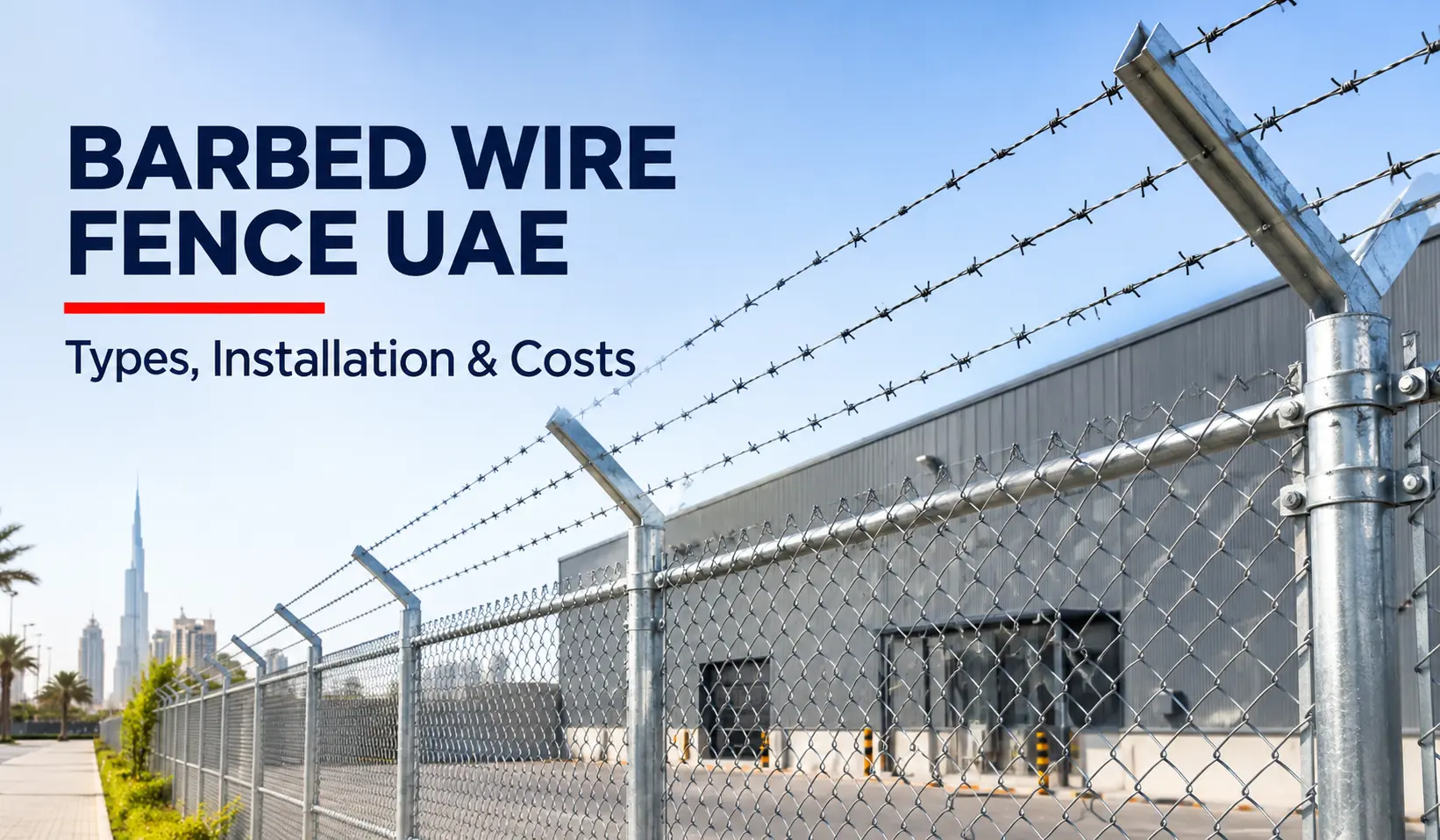
A barbed wire fence helps protect a property’s boundary by making it harder for people to climb over or enter a restricted area. It is commonly used around warehouses, factories, farms, construction sites and industrial properties across the UAE.
Selecting the right barbed wire depends on more than price. Wire thickness, coating, barb spacing and the supporting structure all affect its performance and suitability.
This guide covers the main types of barbed wire, important specifications, installation requirements, pricing factors and common uses to help you make an informed decision.
What Is a Barbed Wire Fence and How Does It Work?
A barbed wire fence consists of steel wire strands twisted together, with short, sharp points called barbs attached at regular intervals. These points make climbing over a boundary more difficult and help discourage unwanted access.
Its main components include:
- Line wires: The main strands that run along the fence.
- Barbs: Sharp wire points attached to the main strands.
- Posts and supports: The structure that holds the wire in position.
- Fixings: Brackets, clips or other fittings that secure the system.
Barbed wire often works best as an additional security layer. For example, a chain link fence with barbed wire provides a physical boundary while the wire along the top makes climbing more difficult.
Types of Barbed Wire Fencing Available in UAE
Barbed wire comes in different coatings and designs. Understanding these options will help you choose a product that suits your property and outdoor conditions.
GI (Galvanized Iron) Barbed Wire
GI barbed wire uses steel covered with a zinc layer to help protect it from rust. This galvanized coating makes it a common choice for outdoor boundaries, farms, warehouses and industrial sites.
When comparing products, check the coating specification. Different galvanizing processes provide different levels of protection.
PVC-Coated Barbed Wire
PVC-coated barbed wire has a galvanized steel core covered with a plastic layer. This outer coating adds surface protection and gives the wire a coloured finish, commonly green or black.
It can suit projects where appearance and additional surface protection matter. However, the quality of the steel core and PVC coating both affect its durability.
Traditional Twisted and Reverse-Twisted Barbed Wire
These terms describe how the main wire strands are joined together. Traditional twisted wire uses strands twisted around each other to hold the barbs in place, while reverse-twisted wire uses a different twisting arrangement.
The right design depends on the product specification and intended application.
Two-Point and Four-Point Barbed Wire
This classification refers to the number of sharp points on each barb.
- Two-point barbed wire: Each barb has two sharp points.
- Four-point barbed wire: Each barb has four sharp points arranged around the wire.
Compare the wire diameter, barb spacing and coating before choosing between these options. The number of points alone does not determine product quality.
Barbed Wire Fence Specifications to Consider
Two rolls may look similar but have different thicknesses, coatings and lengths. Always check the technical specifications before placing an order.
| Specification | What to check |
| Wire gauge and diameter | Thickness of the main wire and barb wire |
| Barb spacing | Distance between each set of barbs |
| Barb configuration | Two-point or four-point design |
| Coating | Galvanized or PVC-coated finish |
| Roll length | Total wire length supplied |
| Roll weight | Net weight of the roll |
Some manufacturers offer galvanized barbed wire with different wire diameters, barb spacing and roll lengths. These specifications vary between suppliers, so check the product datasheet before comparing prices.
Ask the supplier to confirm the wire diameter, coating type, barb spacing, roll length and weight. This will help you compare products fairly and calculate the material needed for your boundary.
Barbed Wire Fence Drawing and Design Options
A barbed wire fence drawing shows how the wire fits into the complete boundary system. It helps the property owner and contractor agree on the design before installation begins.
The drawing should show the fence height, support posts, brackets, wire arrangement and fixing points.
Barbed Wire on Chain-Link Fencing
Barbed wire can be installed above a chain-link fence using suitable support arms or brackets. This adds an extra security layer without replacing the existing mesh.
The drawing should show the fence height, number of strands and support arrangement.
Barbed Wire on Boundary Walls
Barbed wire can sometimes be fitted above a concrete or masonry boundary wall using suitable brackets. However, the wall must be strong enough to support the additional fittings.
A site inspection helps the contractor select an appropriate fixing method.
Horizontal and Angled Designs
Some fencing systems use horizontal wire strands, while others use angled support arms. The right arrangement depends on the property, supporting structure and approved design.
Barbed Wire Fence Installation: Process and Requirements
Good barbed wire fence installation starts with a proper site assessment. The installation method depends on whether the wire will go above a new fence, an existing chain-link system or a boundary wall.
A typical installation project includes these stages:
1. Site Inspection and Measurements
The contractor checks the boundary length, ground conditions, existing structure and site access. These details help determine the materials and installation requirements.
2. Selection of Posts and Supports
The installer selects suitable fence posts, brackets or extension arms according to the project design. Existing walls and posts should also be checked for their condition and strength.
3. Preparation of the Existing Fence
If the project involves an existing chain-link or metal fence, the contractor checks it for damaged posts, weak sections and loose fittings before adding the security topping.
4. Installation and Final Inspection
The team installs the wire according to the approved drawing and manufacturer’s instructions. Since barbed wire has sharp points, trained installers must use suitable protective equipment and follow site safety procedures.
After installation, the contractor checks the supports, fixings and wire alignment to make sure everything matches the agreed design.
For projects requiring professional support, you can explore Our fencing installation services.
Barbed Wire Fence Price and Installation Cost in UAE
The barbed fencing wire price depends on the product specification, roll size and supplier. The total barbed wire fence cost also includes supporting materials and installation work.
A small boundary with an existing fence may require less work than a large industrial site that needs new posts and foundations.
What Affects the Barbed Wire Fence Price?
The following factors influence the final quotation:
- Wire thickness: Different wire diameters and construction options have different material costs.
- Coating: GI and PVC-coated products may have different prices.
- Barb design: Two-point and four-point products can vary in price.
- Roll length and weight: Larger rolls may cost more but can cover a longer distance.
- Supporting materials: Posts, brackets, extension arms and foundations add to the project cost.
- Labour and site access: Ground conditions, installation time and access can affect labour charges.
Material Price vs Installation Cost
A roll price only covers the wire supplied. It does not necessarily include posts, brackets, transport, labour or other installation work.
When comparing a barbed wire fence price, check whether the quotation covers material supply only or a complete installation service.
For an accurate estimate, share your boundary length, preferred wire type, site location and details of the existing fence or wall with the contractor.
Barbed Wire vs Razor Wire vs Concertina Wire
Barbed wire, razor wire and concertina wire all support perimeter security, but they have different designs and uses.
| Feature | Barbed Wire | Razor Wire | Concertina Wire |
| Design | Steel strands with sharp points | Steel tape with sharp blades | Coiled razor tape |
| Main use | Boundary deterrence | Higher-security barriers | High-security perimeter protection |
| Appearance | Twisted wire strands | Flat or formed sharp tape | Circular expanding coils |
| Common locations | Farms and industrial boundaries | Restricted-access sites | Selected security and infrastructure sites |
Standard barbed wire may suit general boundary protection. A razor wire fence uses sharp metal blades, while concertina wire uses coiled razor tape to create a larger physical barrier.
These products are not interchangeable. Consider your site’s security needs, safety requirements and local approval conditions before choosing one.
Common Applications of Barbed Wire Fencing in UAE
Barbed wire fencing is used across several industries to add protection to existing boundaries.
Industrial Facilities and Warehouses
Factories, warehouses and storage yards use suitable perimeter fencing to discourage unauthorised access. Barbed wire can be added above industrial fencing to provide an extra security layer.
Construction Sites
Construction sites often store tools, machinery and building materials that need protection. A suitable fencing system helps control access and separate restricted work areas.
Farms and Agricultural Land
Farm owners may use barbed wire along suitable boundary fencing to mark property limits and discourage unwanted entry. The design should also consider livestock safety.
Infrastructure and Utility Sites
Utility facilities and infrastructure projects may need additional protection around equipment, storage areas and restricted sections. The final design should follow the project’s security plan and local requirements.
How to Choose the Right Barbed Wire Fence for Your Property
The right barbed wire fence should suit your property, work with its existing structure and meet your security requirements.
Consider these points before placing an order:
- Define your security needs: Decide whether you need a basic boundary deterrent or an additional layer for an existing fence.
- Check product quality: Compare wire diameter, barb spacing, construction and coating instead of choosing by price alone.
- Consider outdoor conditions: Humidity and coastal exposure can affect metal surfaces. Choose a suitable protective coating.
- Inspect the supporting structure: Make sure existing posts and walls can support the proposed system.
- Compare complete quotations: Check material quantity, roll length, supports, labour and transportation.
- Confirm local requirements: Check whether the proposed design needs approval from the relevant authority or property management team.
Local rules can vary by emirate, property type and location. For example, specific industrial-land guidelines in the Mussafah region of Abu Dhabi restrict certain uses of barbed or razor wire on boundary locations. Always confirm the requirements that apply to your own property before installation.
Get the Right Fencing Solution for Your Project
Choosing barbed wire involves more than selecting the cheapest roll. You need suitable materials, a strong supporting structure and an installation plan that meets your property’s requirements.
Vertex Fence provides fencing supply, installation and transportation services for residential, commercial and industrial projects across the UAE. Share your site measurements and project details with the team to discuss a suitable solution and request a quotation.
Frequently Asked Questions About Barbed Wire Fencing
1. How do you calculate the number of barbed wire rolls needed for a fence?
Calculate the total wire length by multiplying the boundary length by the number of planned strands. Divide that figure by the usable length of each roll, then allow extra material for overlaps and installation requirements.
2. Can barbed wire be added to an existing boundary wall or fence?
Yes, it can often be added using suitable brackets or support arms. However, a contractor should inspect the wall or fence first to check its condition and confirm that it can support the additional fittings.
3. What information should you provide when requesting a barbed wire fencing quotation?
Share the boundary length, site location, preferred wire specification and details of the existing wall or fence. Site photographs or a barbed wire fence drawing can also help the contractor understand the layout and prepare an accurate quotation.
4. Does barbed wire fencing require regular maintenance in the UAE?
Yes. Inspect the wire, coating, supports and fixing points for corrosion, loose fittings or physical damage. Coastal exposure and product quality can affect maintenance needs, so follow the supplier’s recommendations.
5. Can barbed wire fencing be used as a standalone security barrier?
It can act as a boundary deterrent, but it does not provide the same physical enclosure as chain-link or welded mesh fencing. Many properties use it as an additional security feature on a suitable fence or wall.