
 Fences
 Gates
Gates Signage & Boards
 Car Parking Shades
 Block and Foundation
 Spare Parts
Control Signs: Traffic Signs, Meanings & UAE Road Guide

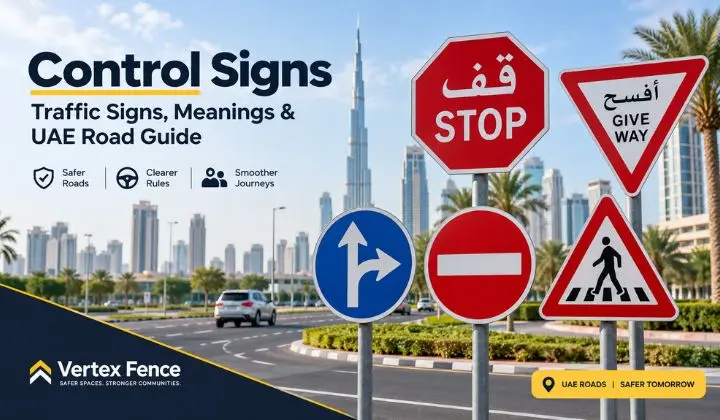
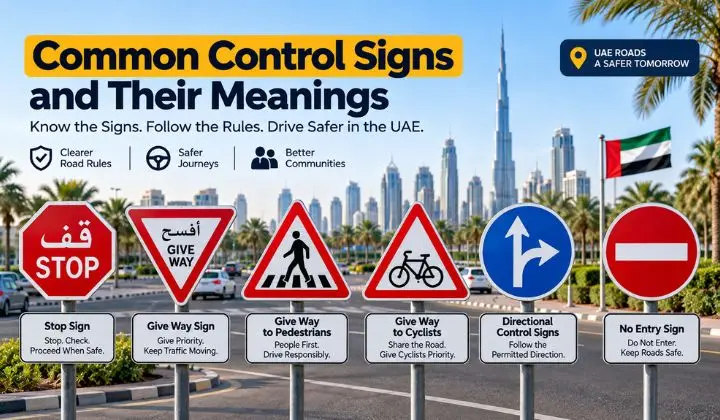
Control signs are regulatory road signs that help control who has priority and which direction vehicles should travel. In the UAE, the RTA describes control signs as signs that assign right-of-way priority or direction of travel. Common examples include Stop, Give Way, Give Way to Pedestrians, Give Way to Cyclists, No Entry, and directional signs.
Understanding traffic control signs is important because a driver needs to know not only what a sign looks like, but also what action to take when reaching it. A Stop sign, for example, requires a complete stop, while a Give Way sign means you must allow road users with priority to proceed first.
This guide explains control signs, their meanings, where they are used, and how they work on UAE and Dubai roads in simple terms.
What Are Control Signs?
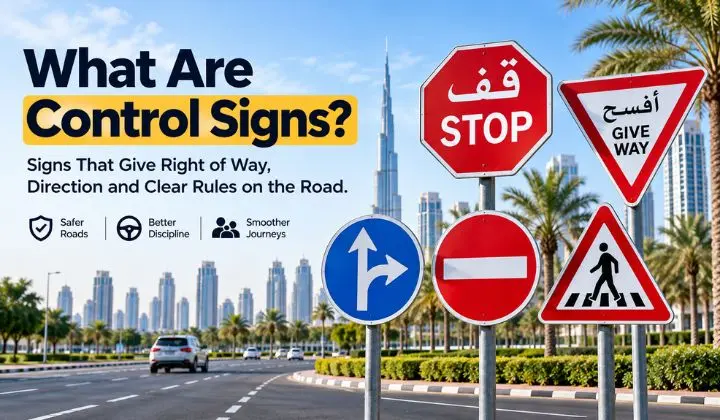
Control signs are a group of regulatory traffic signs used to manage right of way, traffic movement, and permitted directions on a road.
In simple words, these signs tell drivers who should go first or where they should go. They are especially important where different road users meet, such as at intersections, roundabouts, pedestrian crossings, and road entrances.
The Dubai RTA handbook separates regulatory signs into several groups, including control signs, mandatory signs, prohibitory signs, parking control signs, and freeway control signs. Within this system, control signs specifically deal with priority and direction of travel.
This is why control signs should not be viewed as just another collection of road symbols. They give drivers instructions that can directly affect the movement of vehicles and other road users.
What Do Control Signs Tell Drivers?
A control sign can tell a driver to:
- Stop before entering an intersection
- Give way to another vehicle
- Give priority to pedestrians
- Give priority to cyclists
- Follow a particular direction
- Avoid entering a particular road
- Follow the permitted flow of traffic
The main idea is simple: read the sign, understand the priority or direction, and take the correct action before continuing.
Dubai’s official road-safety guidance also describes control signs as immediate instructions, including Stop and Give Way.
For drivers, this makes control road signs especially important at locations where a wrong decision could create a conflict with another vehicle, cyclist, or pedestrian.
Common Control Signs and Their Meanings
There are several important control signs that drivers may see on UAE roads. Some are familiar to almost every driver, while others are easier to misunderstand when traffic is busy.
Knowing the meaning of each sign is more useful than simply memorising its shape.
Stop Sign
A Stop sign tells the driver to make a full and complete stop before proceeding.
A driver should not treat a Stop sign as a suggestion to slow down. The Dubai RTA guidance states that a vehicle must stop at the STOP LINE and should not continue until it is safe to do so.
After stopping, the driver should check the road and continue only when the movement is safe and permitted.
Stop signs are commonly used where traffic needs clear priority control, such as at certain intersections or approaches to other roads.
Simple rule:
Stop completely → check the road → proceed when safe.
Give Way Sign
A Give Way sign tells the driver to yield to traffic that has priority.
Unlike a Stop sign, a Give Way sign does not automatically mean that the vehicle must stop every time. The driver should slow down, check other road users, and give them priority when necessary.
For example, if another vehicle is already travelling on the road you are entering, you may need to wait before moving forward.
The key difference is:
- Stop: make a complete stop.
- Give Way: give priority to other road users and stop if needed.
Understanding this difference can help prevent sudden movements at junctions.
Give Way to Pedestrians
Some control signs specifically tell drivers to give way to pedestrians.
These signs are important around places where vehicles and people share or cross the same area. A pedestrian symbol may appear with a Give Way instruction to make the required priority clear.
When approaching such a location, drivers should reduce speed, watch for pedestrians, and allow them to cross when they have priority.
Dubai’s road-safety guidance lists Give Way as a control-sign instruction and notes that it requires yielding to other road users.
The important point is that drivers should look beyond the sign itself. Pedestrian crossings, road markings, visibility, and people already crossing all matter when deciding whether it is safe to move.
Give Way to Cyclists
A Give Way sign can also be used with a bicycle symbol to tell drivers to give priority to cyclists.
This matters particularly where a cycle lane, crossing, or shared movement area meets a vehicle route.
Drivers should check the area before moving across or into the cyclist’s path. A vehicle should not assume that it has priority simply because it is larger or moving faster.
The RTA’s Dubai driving handbook specifically includes Give Way to Cyclists among its examples of control signs.
A good driving habit is to check mirrors and blind spots before crossing a cycle route, especially where visibility is limited.
Directional Control Signs
Not all control signs are about stopping or giving way. Some control signs tell drivers which direction they must travel.
Examples can include:
- Straight ahead
- Turn left
- Turn right
- Other permitted directions of movement
The RTA handbook includes blue directional arrows among its examples of control signs and describes their purpose as directing road users where they must go.
These signs are useful at intersections, divided roads, channelised traffic areas, and other locations where vehicles need to follow a particular route.
For example, if a directional sign requires traffic to turn right, a driver should not continue straight simply because the road appears open.
This is one reason control signs Dubai drivers see on busy roads need to be understood together with lane markings, arrows, traffic signals, and the road layout.
No Entry Sign
A No Entry sign tells drivers that they must not enter the road or section of road from that direction.
The Dubai RTA handbook includes No Entry among its examples of control signs.
However, traffic-sign classifications can differ between specific manuals and systems, so it is better not to assume that every UAE authority groups every sign in exactly the same way. What matters for the driver is the instruction: do not enter where the sign prohibits entry.
A No Entry sign can be particularly important on one-way roads, restricted approaches, and areas where entering from the wrong direction could create a serious conflict with other traffic.
It should also not be confused with a road simply being closed or with a dead-end road. The sign gives a specific instruction about entry from that approach.
How Do Control Signs Work at Intersections and Roundabouts?
Intersections are some of the most important places for control signs because several traffic movements can meet at the same point.
A driver may need to decide:
- Who has priority?
- Should I stop?
- Should I give way?
- Which direction can I take?
- Is another vehicle already crossing my path?
- Is a pedestrian or cyclist using the crossing?
Control signs help answer these questions before vehicles enter the conflict area.
Stop-Controlled Intersections
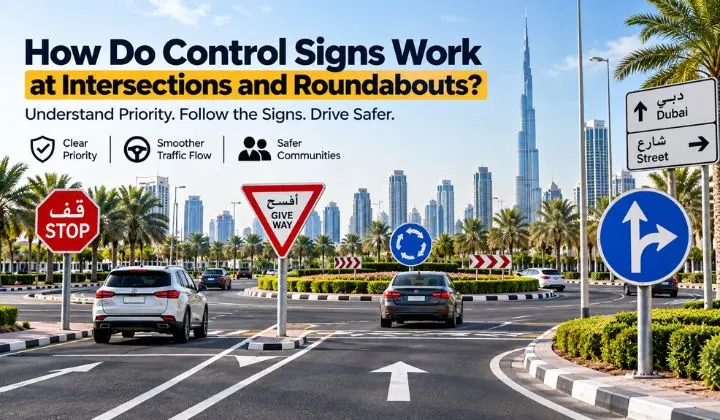
At a Stop-controlled intersection, the driver must come to a complete stop at the designated Stop line.
After stopping, the driver checks for approaching traffic and other road users. The vehicle should only proceed when the movement is safe and permitted.
The Stop instruction is therefore about more than reducing speed. It creates a clear point at which the driver must stop and assess the road.
Give Way Intersections
At a Give Way intersection, the approaching driver must yield to traffic that has priority.
This does not mean every vehicle must stop even when the road is completely clear. Instead, the driver should approach carefully, assess the traffic, and give way whenever another road user has priority.
This makes the Give Way sign particularly useful for controlling movement without requiring every vehicle to stop unnecessarily.
Control Signs at Roundabouts
Roundabouts rely heavily on right-of-way control.
A driver approaching a roundabout needs to pay attention to the signs, lane markings, road arrows, and other traffic already using the roundabout.
A common mistake is to focus only on the vehicle directly ahead. Drivers should also check the lanes and traffic movements around them before entering or changing position.
The exact lane arrangement can vary between roundabouts, so drivers should follow the signs and markings provided at that location rather than assuming every roundabout works in exactly the same way.
Why Right of Way Matters
The main purpose of these signs is to make road movements more predictable.
If every driver tried to decide priority independently, intersections would become difficult to manage. A Stop or Give Way instruction creates a clear rule that drivers can follow.
This is the real value of traffic control signs: they provide a common instruction so drivers know when to stop, when to yield, and where they can travel.
For anyone studying UAE road signs, this is an important point to remember:
Control signs are mainly about priority and direction.
That simple idea makes many individual signs easier to understand.
Control Signs vs Other Traffic Sign Types
It is easy to confuse different types of road signs because many of them use similar shapes, colors, or symbols. The main difference is the job each sign performs.
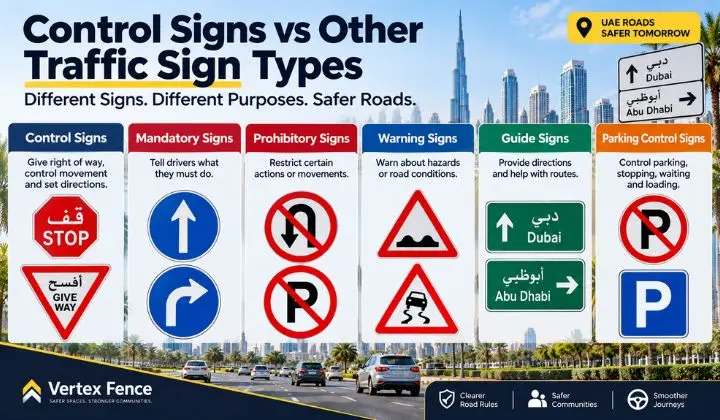
In the UAE, traffic signs are broadly divided into regulatory signs, warning signs, and guide signs. Regulatory signs include different groups such as control, mandatory, prohibitory, parking control, and freeway control signs.
| Sign Type | Main Purpose | Simple Example |
| Control signs | Set priority or direction | Stop, Give Way |
| Mandatory signs | Tell drivers what they must do | Required movement |
| Prohibitory signs | Restrict an action or movement | No Turn |
| Parking control signs | Control parking or stopping | No Parking |
| Freeway control signs | Identify or regulate freeway movement | Freeway-related signs |
| Warning signs | Warn about a hazard or road condition | Road works ahead |
| Guide signs | Help drivers find routes or destinations | Direction/destination signs |
The Dubai RTA handbook specifically describes control signs as dealing with right-of-way priority or direction of travel, while other regulatory groups deal with different restrictions or requirements.
This difference matters because seeing a traffic sign does not always mean the driver needs to stop. The correct action depends on what type of sign it is and what instruction it gives.
Parking, Lane and Freeway Control Signs
Not every type of traffic control has the same purpose. Some signs manage movement at intersections, while others deal with parking, lanes, or freeways.
Understanding these groups can make control signs UAE drivers see much easier to understand.
Parking Control Signs
Parking control signs regulate where and when vehicles can park, stop, wait, load, or unload.
You may see these signs around:
- Public parking areas
- Shopping centers
- Residential developments
- Commercial properties
- Loading areas
- Accessible parking spaces
- Restricted stopping zones
A parking sign may apply to a specific space, lane, road section, or time period. Drivers should therefore read the complete sign, including any supplementary plate, time restriction, symbol, or road marking.
For example, a sign showing a parking restriction may have additional information explaining when the restriction applies.
The important rule is simple: do not assume a parking area is unrestricted just because there is no physical barrier. Look for the signs and markings before leaving a vehicle.
Lane Control Signs
Lane control signs help drivers understand how a particular lane should be used.
They can be important when lanes have different directions or when traffic arrangements change because of road works, merging traffic, or other temporary conditions.
A driver may need to follow:
- Lane arrows
- Directional signs
- Lane-use restrictions
- Temporary traffic signs
- Road markings
- Traffic signals
Lane control becomes especially important on busy roads because choosing the wrong lane at the last moment can cause sudden lane changes.
A good habit is to check the signs and road markings early rather than waiting until the last few metres before an intersection.
Freeway Control Signs
Freeway control signs relate to roads that are classified as freeways and help drivers understand the rules or status of those routes.
The Dubai RTA handbook treats freeway control as a separate regulatory category from ordinary control signs. This is why it is useful to understand the difference rather than treating every regulatory sign as the same type.
Freeway environments usually involve higher speeds, multiple lanes, entrances, exits, and changing traffic conditions.
Because drivers have less time to react at higher speeds, signs need to be clear, visible, and easy to understand.
Control Signs in the UAE and Dubai
The UAE uses a structured system of traffic signs to help drivers understand road rules, warnings, directions, and traffic movements.
In Dubai, the Roads and Transport Authority (RTA) provides driving guidance covering the different groups of regulatory signs, including control signs. Dubai Police road-safety guidance also explains that control signs give drivers immediate instructions such as Stop and Give Way.
For drivers searching for control signs Dubai, the most useful approach is not to memorise isolated symbols. It is better to understand the instruction behind each sign.
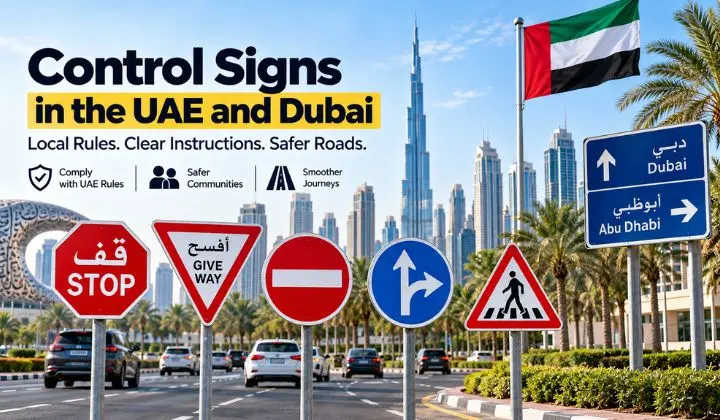
For example:
- Stop → come to a complete stop.
- Give Way → allow traffic with priority to proceed.
- Give Way to Pedestrians → give priority where the sign applies.
- Give Way to Cyclists → allow cyclists priority where indicated.
- Directional control → follow the permitted direction.
- No Entry → do not enter from that approach.
The exact arrangement of signs can vary depending on the road design. A sign should therefore be read together with lane markings, traffic signals, arrows, and other nearby signs.
UAE Road Signs and Local Authority Requirements
Drivers should also remember that road-sign systems are not only about symbols. Their placement, visibility, size, and relationship with the road layout all matter.
For businesses, property managers, contractors, and developers installing signs, the requirements can be more specific. The applicable authority standards should be checked before installing traffic-control devices on a public road or a site connected to public traffic.
Where Are Control Signs Used?
Control signs can be found anywhere drivers need clear instructions about priority or movement.
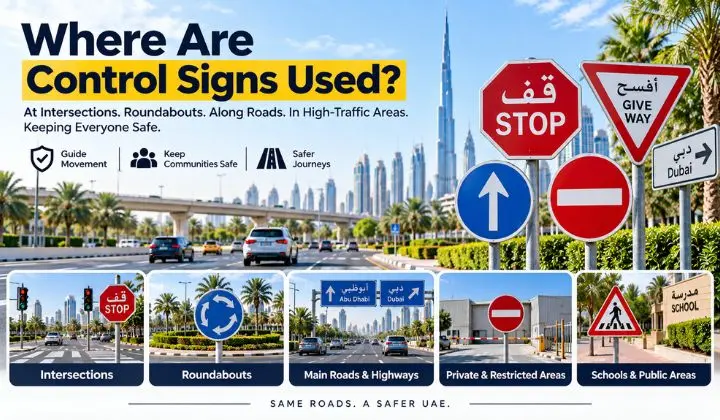
Intersections
Intersections are one of the most common locations. Stop and Give Way signs help establish which traffic movement has priority.
Roundabouts
Roundabouts use signs, markings, and road design to organize vehicle movements. Drivers should follow the instructions at the specific roundabout instead of assuming every roundabout has the same lane arrangement.
Pedestrian Crossings
Where pedestrians cross vehicle routes, signs can help tell drivers when they need to give way.
Parking Areas
Parking facilities can use parking control signs to manage spaces, stopping areas, loading zones, and restricted locations.
Commercial and Residential Developments
Large developments often have several internal roads, entrances, parking areas, pedestrian routes, and service areas. Clear signs can help drivers understand how traffic should move through these spaces.
Private Roads and Managed Sites
Traffic-control signage can also be relevant on private roads and managed properties, depending on how the road is used and which authority requirements apply.
The key goal is the same: give road users a clear instruction before they reach a point where they need to make a decision.
How to Choose Effective Traffic Control Signage for a Private or Commercial Site
Installing a sign is not simply about putting a board where people can see it. The sign needs to match the traffic movement and be easy to understand.
Here are the main things to consider.
Choose the Correct Sign for the Traffic Movement
Start with the problem you need to solve.
Do vehicles need to stop? Do they need to give way? Is a direction restricted? Does a parking area need a clear restriction?
Choose the sign based on the actual traffic movement rather than choosing a sign because it looks familiar.
Prioritize Visibility and Legibility
A sign should be easy to see and read from a suitable distance.
Avoid placing signs where they can be hidden by:
- Trees
- Parked vehicles
- Building structures
- Other signs
- Temporary objects
- Poor lighting
A clear sign gives the driver more time to understand the instruction and respond safely.
Consider Placement and Mounting
Correct placement matters just as much as the sign itself.
A sign that is too low, too high, too far from the decision point, or positioned behind an obstruction may not provide useful guidance.
The location should make sense from the driver’s approach. Drivers should be able to see the sign before they need to make the relevant decision.
Use Appropriate Materials for Outdoor Conditions
Outdoor signs need to handle sun, dust, moisture, wind, and everyday exposure.
For commercial properties, it is worth considering durable sign materials, suitable reflective finishes, secure mounting, and maintenance requirements.
This is especially relevant in the UAE, where strong sunlight and outdoor conditions can affect poorly selected materials over time.
Vertex Fence can be relevant for businesses looking at broader site-access and outdoor traffic-management solutions, where signs form part of a larger property-control setup.
Follow Applicable UAE/Dubai Requirements
This is one of the most important points.
A business should not assume that a sign used on one property can simply be copied onto another site. Requirements can depend on the road type, location, authority, traffic arrangement, and purpose of the sign.
For Dubai projects, applicable RTA requirements and traffic-control-device standards should be checked before installing signage that affects public-road traffic.
For private or commercial sites, also consider whether the road is private, publicly accessible, or connected directly to a public road.
When in doubt, getting guidance from the relevant authority or a qualified traffic/signage professional is better than guessing.
FAQs About Control Signs
Can a control sign change who has the right of way?
Yes. One of the main purposes of control signs is to establish right-of-way priority at places where vehicles or other road users may conflict.
For example, a Give Way sign tells the approaching driver to yield to traffic that has priority rather than assuming they can enter first.
Do you always have to stop at a Give Way sign?
No. A Give Way sign means you must yield to traffic that has priority, and you should stop when stopping is needed to give way safely.
This is different from a Stop sign, which requires a complete stop before the driver can proceed when it is safe and permitted.
Are control signs the same as mandatory or prohibitory signs?
No. They are different groups within the wider regulatory signs category.
Control signs mainly deal with priority or direction, while mandatory signs require a particular action and prohibitory signs restrict certain actions or movements.
What should you do if a control sign conflicts with a traffic signal or traffic officer?
If an authorised traffic officer is actively directing traffic, drivers should follow the officer’s instructions rather than relying only on a normal sign or signal.
In other situations, drivers should follow the applicable traffic signal, sign, road marking, and other traffic-control instructions for that location.
Can the same control sign have different practical applications depending on where it is installed?
Yes. The basic instruction shown by a sign remains important, but its practical use depends on the road layout, lane arrangement, markings, supplementary information, and surrounding traffic.
Drivers should therefore read the complete traffic-control setup instead of looking at one sign in isolation.
Are control signs used on private roads and commercial sites?
They can be used on private and commercial sites where traffic needs to be organised, directed, or controlled.
However, the correct sign and installation requirements depend on the site’s location, road status, traffic arrangement, and applicable UAE or local authority requirements.
Conclusion
Control signs help make road movements clearer by establishing priority and directing vehicles where they need to go. Stop and Give Way signs are some of the most familiar examples, but control signage can also cover pedestrian and cyclist priority and permitted directions.
For drivers, the most important thing is to understand the instruction behind the sign rather than memorising its appearance alone. Always consider the sign together with road markings, traffic signals, lane arrows, and the road layout.
For businesses and property managers, good traffic signage should be visible, readable, correctly positioned, and suitable for the site’s traffic needs. In the UAE, checking the applicable authority requirements is also an important part of planning a safe and effective signage system.
When these elements work together, traffic control signs can make movement around roads, parking areas, developments, and managed sites more organised and easier for road users to understand.