
 Fences
 Gates
Gates Signage & Boards
 Car Parking Shades
 Block and Foundation
 Spare Parts
PCC Concrete: Meaning, Mix Ratio, Calculation & Uses

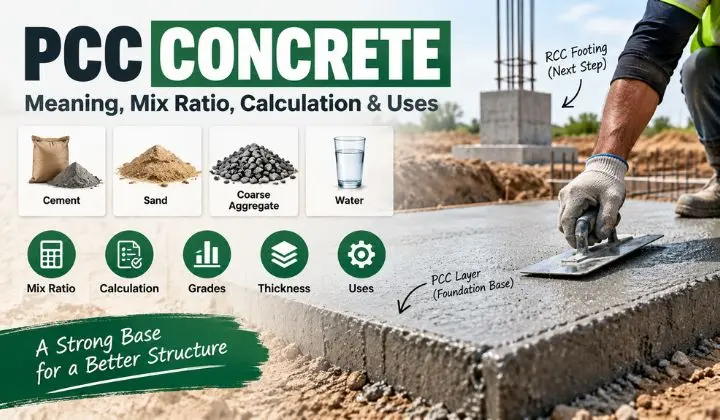
PCC concrete stands for Plain Cement Concrete. It is a mixture of cement, sand, coarse aggregate, and water, made without steel reinforcement. PCC is commonly used as a foundation bed, levelling course, flooring base, and blinding concrete before structural work.
Unlike RCC, PCC is not normally used where a concrete member needs reinforcement to resist significant tension and bending. Its main job is to provide a clean, level, and suitable base for the next stage of construction.
In this guide, you will learn the PCC concrete meaning, common PCC concrete mix ratio, how to perform PCC concrete calculation, common grades, density and thickness, and why PCC is often placed below RCC footings.
What Is PCC Concrete?
PCC concrete is Plain Cement Concrete, which contains cement, fine aggregate, coarse aggregate, and water but does not contain steel reinforcement.
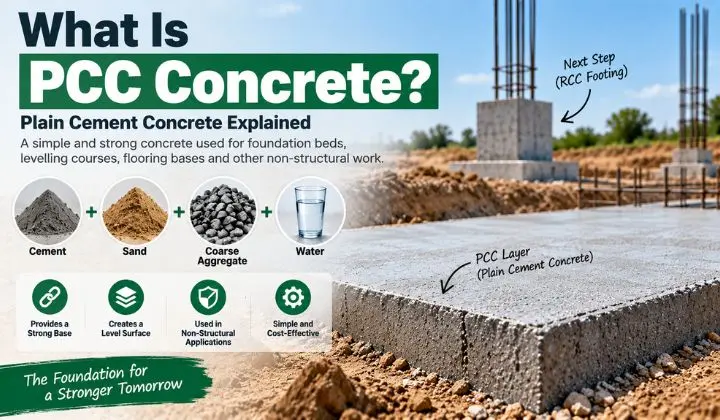
In simple words, PCC is basic concrete used mainly for work where reinforcement is not required for the intended application. It can form a firm and level surface before more important structural work starts.
The PCC meaning in construction is therefore more than just “concrete without steel.” Its value comes from where and how it is used. For example, contractors may place PCC below a footing to create a clean working surface between the prepared soil and the reinforced concrete footing.
What Is the Full Form of PCC?
The PCC full form is Plain Cement Concrete.
It is sometimes also called plain concrete. The term refers to concrete without embedded steel reinforcement. The exact mix, grade, thickness, and application should follow the project’s drawings and specifications.
What Is PCC Used For?
PCC is commonly used for:
- Foundation beds
- Footing blinding
- Levelling courses
- Flooring and floor bases
- Pathways and suitable pavements
- Providing a clean surface before structural concrete work
The exact application depends on the design and site requirements. PCC should not be selected simply because it is cheaper than reinforced concrete.
What Is PCC Made Of?
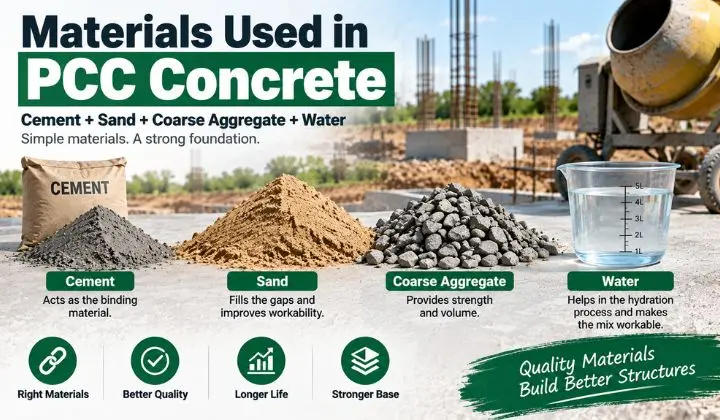
The basic PCC mix contains four main materials:
Cement
Cement acts as the binding material. When cement reacts with water, it forms a paste that binds the aggregate particles together.
The amount of cement depends on the required mix proportion or concrete grade. More cement does not automatically mean better concrete; the complete mix and workmanship also matter.
Fine Aggregate (Sand)
Fine aggregate, usually sand, fills spaces between larger aggregate particles. Good-quality sand with suitable grading helps produce a workable and compact concrete mix.
Dirty or poorly graded sand can affect the quality of the finished PCC.
Coarse Aggregate
Coarse aggregate provides much of the concrete’s volume and contributes to its compressive strength and stability.
The aggregate should be clean and properly graded. The size and type used should match the project specification and the required work.
Water
Water is needed for the cement hydration process and for making the mix workable enough to place and compact.
Adding extra water just to make PCC easier to spread is a common mistake. Too much water can increase porosity and reduce the quality of hardened concrete.
This is why the water-cement ratio needs proper control instead of adding water by guesswork.
PCC Concrete Mix Ratio
A PCC concrete mix ratio tells you the relative proportion of cement, sand, and coarse aggregate in a mix.
For example, a 1:4:8 PCC ratio means:
- 1 part cement
- 4 parts sand
- 8 parts coarse aggregate
The ratio is based on parts, not automatically on kilograms or cubic metres.
What Does 1:4:8 Mean in PCC?
The 1:4:8 ratio is a commonly referenced nominal proportion for plain concrete work. It represents cement, fine aggregate, and coarse aggregate in the proportion of 1:4:8.
However, it should not be treated as a universal recipe for every project. The required mix can change according to the specification, materials, required strength, exposure, and type of work.
For important construction work, follow the project drawings and approved concrete specification rather than choosing a ratio based only on a general internet table.
1:3:6 PCC Ratio
A 1:3:6 ratio represents:
1 part cement : 3 parts sand : 6 parts coarse aggregate.
It is another nominal proportion that may be used for certain plain concrete applications when specified.
1:2:4 PCC Ratio
A 1:2:4 ratio represents:
1 part cement : 2 parts sand : 4 parts coarse aggregate.
It contains a higher proportion of cement compared with 1:4:8. However, you should not assume that a particular ratio automatically equals a required concrete grade without checking the project’s specification or mix-design requirements.
Nominal Mix vs Design Mix
A nominal mix uses fixed proportions such as 1:4:8 or 1:2:4.
A design mix, on the other hand, is developed to achieve specified performance using the actual materials and required properties of the concrete.
This distinction is important because PCC concrete mix ratio and PCC concrete grade are not exactly the same thing.
PCC Concrete Calculation: Formula & Example
Correct PCC concrete calculation helps estimate the amount of concrete and materials required for a project.
The first step is to calculate the volume of the finished PCC.
PCC Volume Formula
The basic formula is:
PCC Volume = Length × Width × Thickness
Make sure all dimensions are converted into the same unit before calculating.
For example, suppose a PCC layer is:
- Length = 5 m
- Width = 4 m
- Thickness = 0.10 m
Then:
PCC Volume = 5 × 4 × 0.10
PCC Volume = 2.0 m³
So, the required finished PCC volume is 2 cubic metres.
How to Calculate PCC Material Quantity
After calculating the concrete volume, material quantities can be estimated according to the specified mix.
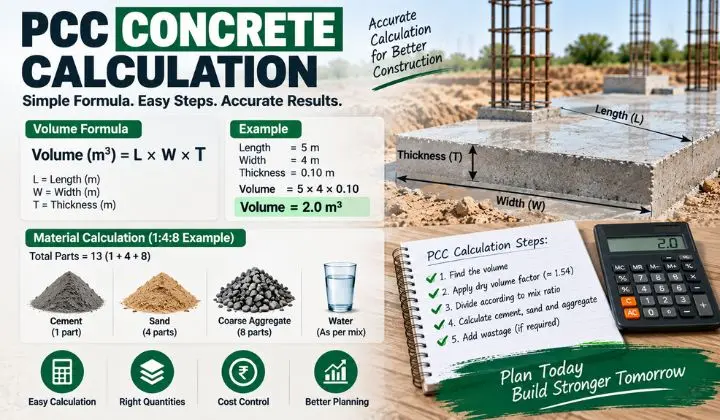
For a simple estimation, some construction calculations use a dry-volume factor to account for the fact that the loose ingredients occupy more volume before mixing than the finished concrete occupies after mixing.
A commonly used estimation factor is:
Dry material volume ≈ Wet concrete volume × 1.54
For our example:
2.0 × 1.54 = 3.08 m³
This gives an estimated dry constituent volume that can then be divided according to the selected mix proportion.
However, 1.54 is an estimation convention, not a universal physical constant. Actual material requirements depend on aggregate grading, moisture, batching method, mix design, compaction, and project requirements.
Example of Cement, Sand and Aggregate Calculation
Suppose the specified nominal proportion is 1:4:8.
Total parts:
1 + 4 + 8 = 13 parts
Using the estimated dry volume of 3.08 m³:
Cement volume = 3.08 × 1/13
Sand volume = 3.08 × 4/13
Aggregate volume = 3.08 × 8/13
This gives an initial estimate of the three ingredients. For actual procurement, the contractor should use the approved project mix, material moisture conditions, batching method, and specified allowances rather than relying only on a generic calculation.
PCC Calculation in Cubic Feet
If the dimensions are given in feet, you can calculate the volume directly:
PCC Volume = Length × Width × Thickness
For example:
- Length = 16 ft
- Width = 12 ft
- Thickness = 4 in
First convert 4 inches into feet:
4 ÷ 12 = 0.333 ft
Then:
16 × 12 × 0.333 ≈ 64 cubic feet
So the PCC volume is approximately 64 ft³.
This type of calculation is useful when estimating PCC quantity for smaller site works.
PCC Concrete Grade, Density & Thickness
Three terms often cause confusion when people search for PCC concrete grade, density, and thickness.
They describe different things:
- Grade relates mainly to specified concrete strength.
- Density describes the mass per unit volume.
- Thickness describes how deep the PCC layer is.
These should not be treated as interchangeable.
What Grade of Concrete Is Used for PCC?
Commonly referenced PCC grades include M5, M7.5, M10, and M15, depending on the type of work and project specification.
The “M” designation is associated with the characteristic compressive strength class of concrete at the specified testing age. The required grade should be selected according to the design, drawings, specification, and intended use.
For example, a simple levelling or blinding application may have different requirements from a more demanding concrete application.
So, there is no single concrete grade for PCC that is correct for every project.
What Is the Density of PCC Concrete?
The PCC concrete density depends on the materials used, especially the type and density of aggregate.
For normal-weight concrete, engineers often work with a value around 2,400 kg/m³ for preliminary calculations, but the actual density can vary.
This matters when calculating the approximate weight of a concrete element or checking material quantities.
What Is the Typical PCC Thickness?
There is no single PCC concrete thickness that applies to every construction job.
The required thickness depends on:
- Purpose of the PCC
- Ground conditions
- Structural details
- Required levels
- Project drawings
- Concrete specification
- Site conditions
For this reason, a contractor should not choose PCC thickness only from a general online recommendation. The project’s approved drawings and specifications should take priority.
Why Is PCC Used Before RCC Footings?
One of the most common questions about PCC is why PCC is required before RCC.
PCC is often placed below an RCC footing because it can provide a clean and level working surface for the structural work that follows.
It Provides a Clean Working Surface
Prepared soil can contain loose particles, dirt, or uneven areas. A properly placed PCC layer provides a cleaner surface on which the footing work can continue.
It Helps With Levels and Setting Out
A level PCC surface makes it easier for the construction team to establish the required footing dimensions and levels.
This can help with accurate setting out, especially where several footings must be constructed at specific locations and elevations.
It Helps With Reinforcement Placement
When the structural footing is built above a suitable PCC base, workers have a more controlled surface for placing reinforcement and carrying out related work according to the drawings.
The PCC layer itself is not the structural replacement for the RCC footing.
It Separates the Footing From the Prepared Ground
PCC can provide a defined concrete layer between the prepared subgrade and the reinforced footing.
This can make the construction process cleaner and easier to control, especially for foundation work.
PCC Construction Method: Step-by-Step
Good PCC construction is not only about choosing the correct mix. Ground preparation, placement, compaction, finishing, and curing all affect the final result.
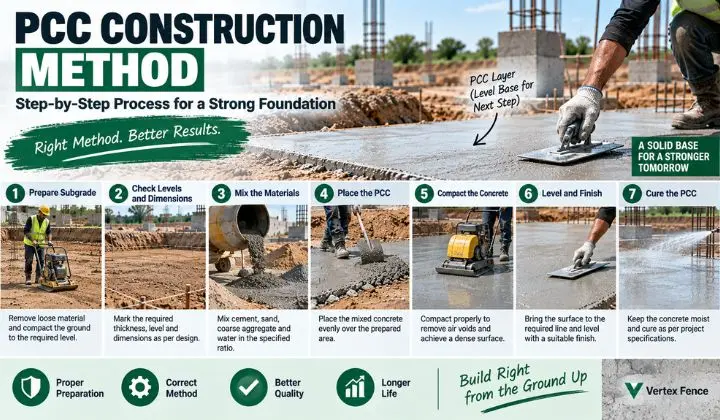
1. Prepare and Compact the Subgrade
First, remove unsuitable loose material and prepare the ground to the required level.
The subgrade should be stable and properly compacted. Any soft or weak area should be dealt with according to the project requirements before PCC is placed.
Pouring concrete over poorly prepared soil can lead to settlement, uneven thickness, or cracking.
2. Check Levels, Dimensions and Thickness
Before placing the concrete, check the required:
- Length and width
- Formation level
- PCC thickness
- Line and level
Proper checking at this stage reduces errors that are difficult to correct after the concrete hardens.
3. Batch and Mix the Materials
Cement, sand, and coarse aggregate should be measured according to the approved mix.
Water should be controlled carefully. The aim is to achieve the required workability without adding unnecessary water.
For larger projects, the approved batching and mixing procedure should be followed rather than relying on rough visual measurements.
4. Place the PCC
Place the mixed concrete over the prepared area and spread it evenly.
Avoid leaving large gaps or placing concrete in a way that creates segregation of the aggregate.
The concrete should reach the required thickness throughout the area.
5. Compact the Concrete
Proper compaction removes unwanted air pockets and helps the concrete become dense and uniform.
The method used depends on the size and type of PCC work. The goal is to achieve proper consolidation without causing segregation.
6. Level and Finish the Surface
After compaction, the surface should be brought to the required line and level.
For foundation blinding, the required finish may be different from a floor base or other visible concrete surface. The finish should therefore match the project’s intended use.
7. Cure the PCC
Curing gives the cement enough moisture and time to develop its required properties.
Poor curing can reduce concrete quality and increase the risk of surface defects and cracking.
The curing method and duration should follow the project specification and applicable concrete requirements.
Where Is PCC Used in Construction?
PCC concrete work is common in areas where a plain, firm concrete layer is needed but steel reinforcement is not required for the intended purpose.
The most common applications include foundation preparation, flooring bases, levelling work, and selected pavement or pathway applications.
Foundation Beds and Footing Blinding
PCC is often placed below an RCC footing as a blinding layer or foundation bed.
It creates a clean and level surface for setting out the footing and carrying out the next stage of construction. The required thickness and concrete grade should always follow the project drawings and specification.
Flooring and Floor Bases
PCC can be used as a floor base where a firm concrete layer is needed below the final floor finish.
It may be followed by tiles, stone, screed, or another specified flooring system. PCC should not automatically be treated as the same thing as a finished floor screed, because their purpose and material requirements can be different.
Levelling Courses
Uneven ground can make later construction difficult. A PCC levelling course can create a more controlled surface at the required elevation.
This is particularly useful when accurate levels are needed before another construction layer is installed.
Pavements, Pathways and Hardstanding
PCC may also be used for suitable pavements, pathways, sidewalks, or hardstanding where plain concrete is appropriate.
However, traffic loads, ground conditions, thickness, joints, drainage, and the required design strength should be considered before selecting plain concrete for a pavement.
Other Non-Reinforced Applications
Depending on the project, PCC may be suitable for other non-structural applications where a plain concrete layer is specified.
The key point is that PCC should be selected based on the job it needs to perform, not simply because it is a common concrete type.
PCC Concrete Tests & Quality Checks
Good PCC concrete starts with good materials, but checking the work during construction is just as important.
A simple quality-control process can help identify problems before the concrete becomes difficult to repair.
Check the Materials
Cement, sand, and coarse aggregate should meet the required project specifications.
Aggregates should be clean and suitable for concrete production. Contaminated or unsuitable materials can affect the finished concrete.
Check the Mix Proportion
The required mix proportion should be followed during batching.
Do not allow workers to add materials based only on rough visual estimates when the project requires controlled batching.
Control the Water
Water should be added according to the approved mix requirements.
Adding extra water because the concrete feels too stiff can change the water-cement ratio and affect the quality of the hardened concrete.
Check Thickness and Level
After placement, the PCC should have the required:
- Thickness
- Level
- Slope, where applicable
- Dimensions
- Surface finish
These checks are especially important for foundation beds and floor bases because an incorrect level can affect the work that comes after the PCC.
Check Compaction and Surface Condition
Proper compaction helps reduce unwanted voids and produces more uniform concrete.
The finished surface should also be checked for obvious defects such as excessive segregation, laitance, honeycombing, or areas that were not properly compacted.
Check Curing
Curing should begin and continue according to the project requirements.
The concrete needs suitable moisture and time to develop its required properties. Poor curing can contribute to surface problems and reduced concrete performance.
Concrete Strength Testing
Where required by the project, compressive strength can be checked through concrete testing such as cube testing.
Not every small PCC application will have the same testing requirements, so the applicable specification and quality-control plan should be followed.
PCC vs RCC: What’s the Difference?
The main difference between PCC vs RCC is reinforcement and the role the concrete is expected to perform.
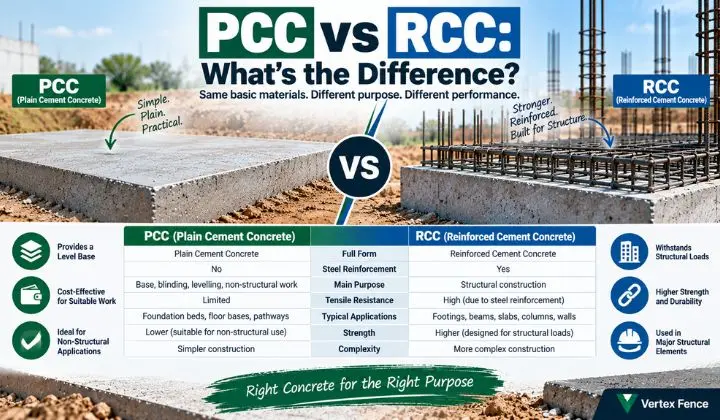
RCC means Reinforced Cement Concrete. It uses steel reinforcement with concrete so that structural members can resist the required loads, including tension and bending.
PCC does not contain this steel reinforcement.
| Feature | PCC | RCC |
| Full form | Plain Cement Concrete | Reinforced Cement Concrete |
| Steel reinforcement | No | Yes |
| Main role | Base, blinding, levelling and suitable plain-concrete work | Structural construction |
| Tensile resistance | Limited | Improved through reinforcement |
| Typical applications | Foundation beds, floor bases, pathways | Footings, beams, slabs, columns |
| Construction complexity | Generally simpler | More complex |
| Structural use | Limited | Commonly used for structural members |
Which Is Stronger: PCC or RCC?
For structural applications that require significant resistance to tension and bending, RCC is generally the appropriate system because the steel reinforcement works with the concrete to carry the required structural forces.
PCC and RCC should not simply be compared as “strong” and “weak.” They are normally selected for different purposes. PCC is useful where reinforcement is not required, while RCC is designed for structural members according to the required loads and design.
PCC vs Blinding Concrete: Are They the Same?
PCC and blinding concrete can overlap, but the terms do not describe exactly the same thing.
PCC describes the type of concrete, plain concrete without steel reinforcement. Blinding concrete describes a function: a relatively simple concrete layer used to create a clean, level working surface, often below foundations.
So, blinding concrete may be made using plain concrete, but the term “blinding” focuses on what the layer does, not just what it contains.
The safest approach is to follow the project’s drawings and specification for the required concrete grade, thickness, mix and application.
Advantages and Limitations of PCC
PCC can be a practical and economical material when it is used for the right purpose.
Advantages of PCC
1. Simple construction
PCC does not require steel reinforcement, which can make the work simpler for suitable applications.
2. Cost-effective for suitable work
Removing reinforcement from applications where it is not required can reduce material and installation costs.
3. Provides a level working surface
A properly finished PCC layer can provide a clean and controlled base for subsequent construction.
4. Useful for foundation preparation
PCC can make foundation work easier by providing a defined surface for setting out and subsequent RCC work.
5. Durable when properly constructed
Good materials, correct proportioning, proper compaction, and adequate curing can produce durable plain concrete for its intended application.
Limitations of PCC
1. No steel reinforcement
PCC does not have reinforcing steel to improve its ability to resist structural tension and bending.
2. Limited tensile and flexural capacity
Plain concrete is not normally selected for structural members that require significant tensile or flexural resistance.
3. Not suitable for every load condition
A plain concrete layer should not be used where the project requires a reinforced structural system.
4. Can crack or settle if poorly constructed
Poor subgrade preparation, excessive water, inadequate curing, uneven thickness, or settlement can cause problems in PCC.
Common PCC Construction Mistakes
Even a correct PCC concrete mix ratio can produce poor results if the construction work is not controlled properly.
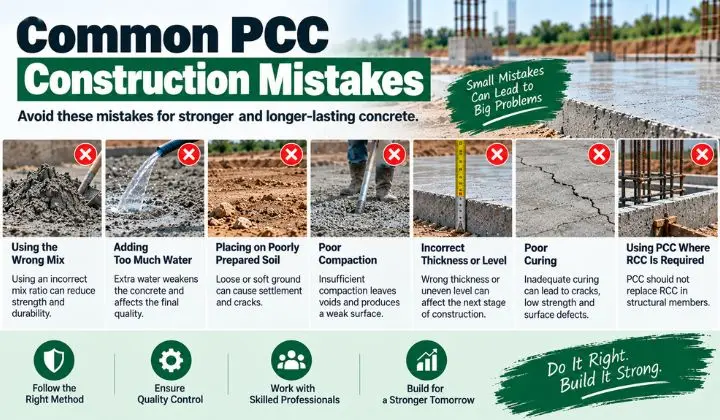
Using the Wrong Mix
Using a ratio simply because it is common online can be a mistake.
The required mix should come from the project’s specification, approved mix design, or other applicable construction requirements.
Adding Too Much Water
Extra water may make concrete easier to spread, but it can change the mix and reduce the quality of hardened concrete.
Workers should not use water as a quick fix for poor workability.
Placing PCC on Poorly Prepared Soil
Loose, soft, or uneven subgrade can cause settlement and uneven support.
The ground should be properly prepared and compacted before PCC placement.
Poor Compaction
Insufficient compaction can leave unwanted voids and produce an inconsistent surface.
The selected compaction method should suit the size and type of PCC work.
Incorrect Thickness or Level
If the PCC layer is thinner or thicker than specified, it can affect levels and the work that follows.
Checking the thickness and level during placement is much easier than correcting a hardened concrete surface.
Poor Curing
Concrete needs suitable curing after placement.
Ignoring curing can lead to surface defects and can prevent the concrete from developing its expected properties properly.
Using PCC Where RCC Is Required
This is one of the most serious mistakes.
PCC should not be substituted for a structurally designed RCC member simply because both materials contain cement, sand, aggregate, and water. Structural work must follow the approved design.
Frequently Asked Questions
Can PCC Be Used Without a PCC Layer Below Every RCC Footing?
No single construction method applies to every footing. Whether PCC is placed below an RCC footing depends on the structural drawings, project specification, soil conditions, and construction requirements.
It is commonly used to provide a clean and level working surface, but the project documents should decide whether it is required.
Can PCC Be Used as a Structural Slab?
Plain concrete can be used for some non-reinforced floor or slab-type applications, but it should not automatically be treated as a structural slab.
Where a slab must carry structural loads and resist bending and tension, the required structural design may call for RCC or another specified system.
What Happens If Too Much Water Is Added to a PCC Mix?
Too much water can make PCC easier to mix and place, but it can also increase the amount of pore space left after the concrete hardens.
This can reduce concrete quality and strength, so water should be controlled according to the approved mix rather than added simply to improve workability.
Can PCC Be Laid Directly on Loose or Uneven Soil?
PCC should not simply be poured over loose or poorly prepared ground. The subgrade needs to be prepared, brought to the required level, and compacted according to the project requirements.
If the supporting ground settles later, the PCC can develop uneven areas or cracks even if the concrete mix itself was properly made.
Does PCC Crack After Installation?
PCC can crack, and cracking does not automatically mean the concrete has completely failed. Possible causes include shrinkage, poor curing, excessive water, weak subgrade, settlement, uneven thickness, or poor workmanship.
The importance of a crack depends on its size, location, pattern, cause, and the purpose of the PCC layer. Significant or unexpected cracking should be assessed by a qualified construction professional.
Can the Same PCC Mix Ratio Be Used for Every Construction Project?
No. A ratio such as 1:4:8 should not be treated as a universal PCC recipe for every job.
The required concrete grade, mix proportion, aggregate, water content, thickness, exposure, and application can vary. Always follow the project’s approved drawings and concrete specification when they are available.
Conclusion
PCC, or Plain Cement Concrete, is a basic but important part of many construction projects. It is commonly used for foundation beds, blinding, levelling courses, flooring bases, and suitable plain-concrete applications where steel reinforcement is not required.
The most important thing is to understand that PCC is not defined by one fixed mix ratio, thickness, or application. The correct PCC concrete mix ratio, grade, quantity, and thickness depend on the project requirements.
For good PCC concrete work, start with a properly prepared subgrade, use the specified materials and proportions, control water, place and compact the concrete correctly, and follow the required curing process.
For construction projects such as foundation and fencing work, including work handled by Vertex Fence, the PCC layer should be selected and installed according to the project’s drawings, site conditions, and applicable specifications rather than using a generic online formula alone.