 Fences
 Gates
 Signage & Boards
 Car Parking Shades
 Block and Foundation
 Spare Parts
Fence Branding in UAE: Benefits, Types & Applications

What Is Fence Branding and How Does It Work?
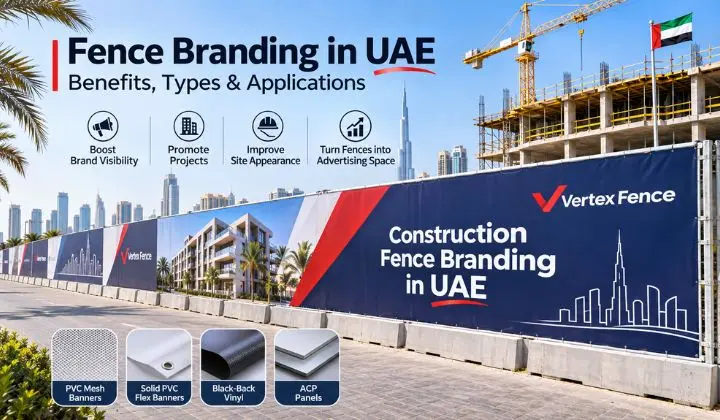
Fence branding is the process of adding printed graphics, logos, messages, and project details to a fence or site boundary. It helps businesses use their outdoor fence space to share information and promote their projects.
In the UAE, construction fence branding is commonly used around building sites, property developments, commercial areas, and public events. Instead of leaving a fence plain, businesses can use it to display their brand identity, project images, contact details, or promotional messages.
The branding method depends on the fence surface. For example, a PVC mesh fence banner can be attached to a suitable metal fence, while printed vinyl or rigid panels may be used on a solid hoarding surface.
The main steps usually include:
- Checking the fence type, size, and condition.
- Choosing a suitable branding material.
- Preparing artwork according to the fence measurements.
- Printing and finishing the graphics.
- Fixing the branding securely to the fence.
A good result depends on more than attractive artwork. The material, fixing method, fence structure, and site conditions all need to work together.
Fence Branding vs. Construction Hoarding
Fence branding and construction hoarding branding are closely related, but they are not exactly the same.
| Fence branding | Construction hoarding branding |
| Can be used on metal fences, mesh fences, and other suitable boundaries. | Usually applied to solid temporary or permanent panels around a construction site. |
| Often uses mesh banners, PVC banners, or printed coverings. | Often uses vinyl graphics or printed rigid panels. |
| Allows branding on existing fence structures when suitable. | Usually needs a suitable hoarding surface or panel system. |
The right option depends on the project. A site with an existing metal fence may only need a printed banner, while a large property development may need full construction site hoarding with aligned graphics across several panels.
How Printed Graphics Are Applied to Different Fence Types
Not every fence needs the same branding method. A chain-link fence has open spaces, while an ECO PVC fence or solid hoarding has a different surface.
For open metal fencing, a printed banner may be attached using eyelets, ties, or other suitable banner fixings. For solid panels, printed vinyl or another compatible graphic material may be applied to the surface after proper preparation.
Before choosing a method, check:
- Whether the fence can support the added material.
- Whether the surface is clean, dry, and suitable for the chosen graphic.
- Whether the fixing method can hold the banner or panel securely.
- Whether the branding will block access, visibility, or required safety information.
This early check can help avoid poor fitting, loose banners, and unnecessary replacement costs.
Benefits of Fence Branding for UAE Businesses
Fence branding can do more than cover an empty boundary. It can help a business share its message with people who pass the site every day. Its value depends on the location, design, audience, and quality of installation.
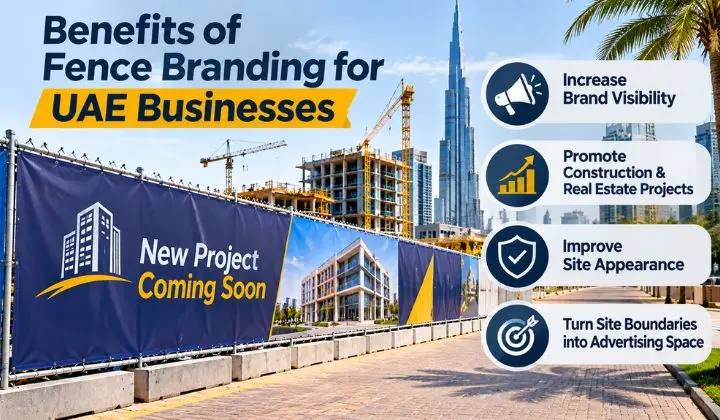
Increase Brand Visibility and Project Awareness
A fence around a busy road or commercial area can attract attention from drivers, pedestrians, visitors, and nearby businesses. Branded graphics make the site easier to recognise and help people connect it with the company or project behind it.
For example, a construction company can display its name and project identity on the site boundary. A property developer can use the same space to show project visuals and basic details.
Clear branding is more useful than filling every panel with text. A strong logo, readable headline, and simple message can make the design easier to understand from a distance.
Promote Real Estate and Construction Projects
Real estate developers can use real estate fence branding to introduce a project before its completion. Graphics may show building visuals, project names, key features, and approved contact details.
This is useful when a development is under construction and the site already has a boundary around it. Instead of using separate advertising space, the project can make its own boundary part of its communication plan.
However, any promotional claims, contact details, and property information should be checked before printing. The artwork should match the approved project information.
Improve Construction Site Appearance
A well-planned branded boundary can give a construction site a cleaner and more organised look. It can also hide some of the visual clutter behind suitable solid panels, where the site design and safety rules allow it.
For example, a series of matching site hoarding graphics can use the same colours, logo, and layout across the full boundary. This creates a consistent appearance instead of displaying unrelated banners on different sections.
Branding should never cover warning signs, access points, emergency information, or other required site notices.
Turn Site Boundaries into Advertising Space
A fence can be a useful place to display a brand message because it is already part of the site. Businesses may use this space for project information, company identity, event messages, or promotional graphics.
This approach is often called outdoor fence advertising. It works best when the message is short, easy to read, and relevant to the people who see it.
Types of Fence Branding Materials
Material selection is one of the most important parts of a branding project. The right choice depends on the fence surface, wind exposure, required privacy, print appearance, and expected use.
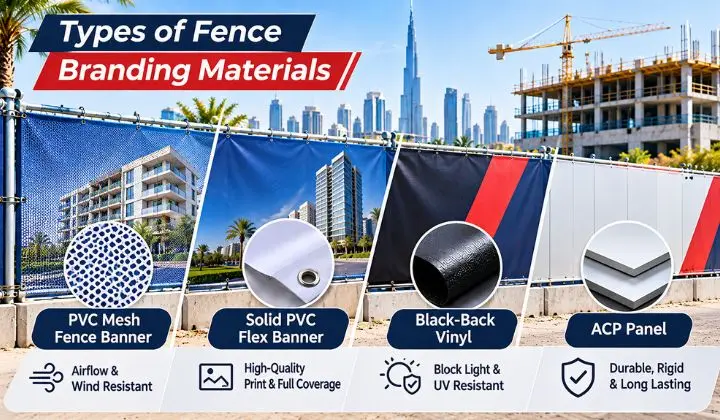
Here are common materials used for fence banner printing and hoarding graphics.
PVC Mesh Fence Banners
PVC mesh is a flexible material with small openings that allow some air to pass through. It is commonly considered for branding on suitable open fences, such as chain-link or welded mesh structures.
Its open design can help reduce wind pressure compared with a similar solid banner. However, it does not remove wind risk. The fence, support structure, banner size, fixing points, and site exposure still need to be assessed.
Best suited for:
- Suitable metal perimeter fences.
- Construction site boundaries.
- Outdoor event fencing.
- Projects where some airflow is useful.
Solid PVC Flex Banners
Solid PVC flex banners have a closed surface, so they provide stronger visual coverage than mesh. They are useful when a business wants bold colours, clear graphics, and less visibility through the banner.
They can be considered for suitable fence structures where a solid printed surface is required. However, a solid banner can catch more wind than mesh. Its size, fixing system, and support structure should be checked before installation.
Best suited for:
- Promotional fence graphics.
- Branding where visual coverage matters.
- Suitable supported surfaces and hoardings.
Black-Back Vinyl and ACP Panels
Black-back vinyl is a printed graphic material with a dark backing. It can help reduce light passing through the printed surface, depending on the product and installation.
ACP panels (Aluminium Composite Panels) are rigid panels with a flat surface. They can be used as part of a suitable hoarding system and provide a different finish from flexible banners.
These materials are not interchangeable. Vinyl is a flexible graphic covering, while ACP is a rigid panel product. The supporting structure, surface condition, fixing system, and project requirements should guide the choice.
Satin Fabric and German Knitted Polyester
Satin fabric offers a smooth finish and can be considered when the project needs a fabric-based printed appearance.
German knitted polyester is another fabric option used for certain display and outdoor branding applications. Its suitability depends on the exact fabric specification, printing process, finishing, and exposure conditions.
Do not choose a material only because of its name. Ask the supplier for the product specification and check whether it is suitable for the intended outdoor use.
Mesh vs. Solid PVC Fence Branding: Which Is Better?
Both materials can be useful, but they serve different purposes. The best choice depends on whether the project needs airflow, visual coverage, or a particular printed finish.
| Feature | PVC mesh | Solid PVC flex |
| Airflow | Allows some air to pass through | Blocks most airflow |
| Visual coverage | Some background may remain visible | Provides a more solid visual surface |
| Wind exposure | Can reduce wind pressure compared with solid material | Can catch more wind |
| Common use | Suitable open metal fences | Suitable supported surfaces and hoardings |
| Main consideration | Mesh quality and print visibility | Wind exposure and secure support |
Wind Exposure and Airflow
If a fence is exposed to open areas or strong winds, airflow should be considered before selecting the banner. Mesh allows some air to pass through its openings, while solid PVC does not provide the same airflow.
Still, mesh does not guarantee that a fence or banner will remain safe in all weather conditions. A large banner can place pressure on its supports, so the complete installation needs proper assessment.
Print Quality and Visual Coverage
Solid PVC usually provides a more continuous surface for graphics and text. This can be useful when the design needs strong visual coverage or when the background behind the banner should not be visible.
Mesh can also carry printed designs, but its openings and viewing distance may affect how the artwork appears. For this reason, the final design should be checked at a realistic viewing distance.
Best Applications for Each Material
Choose PVC mesh when airflow is an important consideration and the fence structure is suitable for banner installation.
Choose solid PVC when the project needs a more covered appearance and the support structure can handle the material and expected wind exposure.
The best fence branding material is not always the most expensive one. It is the material that fits the fence, location, design, and project needs.
Metal Fence Branding in UAE
Metal fences are commonly used to mark construction boundaries, control access, and separate work areas. With the right material and fixing method, some of these fences can also carry printed branding.
Metal fence branding in UAE may use banners attached to an existing fence or graphics designed for a suitable metal fence system. The correct approach depends on the fence type and its condition.
PPGI Temporary Fence Branding
A PPGI Temporary Fence uses pre-painted galvanised steel sheets and is designed for temporary site boundary applications. Branding may be added where the panel surface and project requirements allow it.
A printed graphic or compatible vinyl covering can be considered for a suitable surface. Before application, check the panel finish, surface condition, and compatibility of the adhesive or fixing method.
Branding on Chain Link and Welded Mesh Fences
Chain link fences and welded mesh fences have open structures, so printed mesh banners are often worth considering.
The banner needs suitable attachment points and even tension. Loose edges, weak ties, and poor fixing can affect the appearance and performance of the installation.
Branding Existing Metal Fences
Businesses do not always need a completely new fence for branding. An existing metal fence may be suitable if it is stable, in good condition, and compatible with the selected material.
Before starting, inspect the fence for rust, loose sections, damaged supports, and uneven surfaces. Also check whether the banner could affect gates, access routes, visibility, or safety requirements.
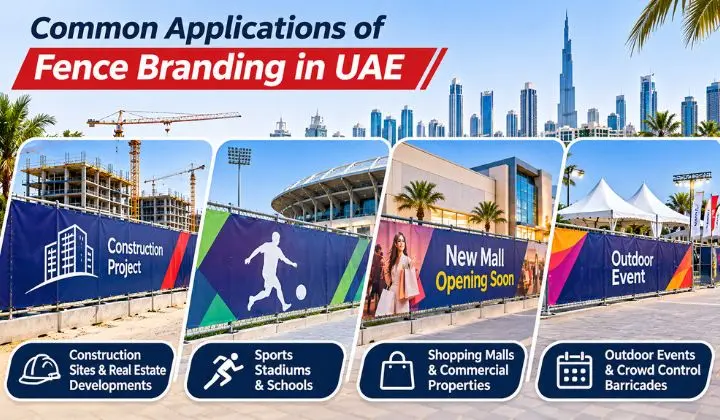
Common Applications of Fence Branding in UAE
Fence branding can serve different purposes across construction, property, commercial, and event projects. The design should match the location and the people who will see it.
Construction Sites and Real Estate Developments
Construction companies and developers can use branded hoarding to display project names, company logos, building visuals, and approved contact details.
For large developments, artwork can be planned across several panels so the design looks consistent along the site boundary.
Sports Stadiums and Schools
Sports grounds and schools may use fence graphics for event information, sponsor messages, branding, or general site communication. The material should suit the fence structure and should not block important signs or viewing areas.
Shopping Malls and Commercial Properties
Shopping malls and commercial properties can use branded panels during renovation, fit-out work, or temporary closures. Clear graphics can help maintain a professional appearance while informing visitors about the project or business.
Outdoor Events and Crowd Control Barricades
Event organisers may use barricade branding to display event names, sponsor logos, directions, and other useful information. The branding should not block emergency routes, access points, or safety notices.
How to Design and Install Construction Fence Branding
Good fence branding starts with proper planning. A design may look attractive on a computer screen but still look poor when printed across a long fence. Measurements, panel layout, artwork size, and fixing methods all matter.
Site Survey and Fence Measurements
Before printing, measure the fence carefully. Record its total length, height, panel sizes, gates, corners, and any areas that should remain uncovered.
Also check the fence condition and its support structure. This helps identify whether the selected material and fixing method are suitable.
For an accurate custom fence banner printing order, prepare:
- Total fence length and height.
- Individual panel measurements.
- Fence type and surface condition.
- Site location and installation access.
- Required branding material and artwork.
Artwork Design and Panel Alignment
For long construction hoarding branding projects, artwork should be planned as one complete layout rather than separate designs made without coordination.
Logos, faces, headlines, and important text should not fall across panel joints. Keep important information within the visible area of each panel.
A useful design should include:
- A clear company or project logo.
- A short and readable headline.
- High-quality images.
- Correct contact and project details.
- Consistent colours, fonts, and spacing.
If people will view the fence from a road, avoid small text and crowded layouts. The main message should be easy to understand in a few seconds.
Printing, Finishing and Installation
After the artwork is approved, the selected material can be prepared for printing. The printing method depends on the material and the required finish.
For banners, finishing may include reinforced edges, eyelets or grommets, and suitable attachment points. These features help prepare the banner for installation, but they do not replace proper structural support.
For panel-based branding, the installer should check the surface and use a suitable fixing method. During installation, graphics should be aligned properly, without unnecessary wrinkles or loose edges.
Maintenance and Branding Removal
Outdoor graphics can collect dust and dirt over time. Regular inspection helps identify loose edges, damaged fixing points, fading, and other problems.
When the branding is no longer required, removal should follow the material and fixing method used. Some banners can be detached from their fixings, while vinyl graphics may need careful removal to protect the surface.
How UAE Weather Affects Outdoor Fence Branding
Outdoor fence branding in the UAE needs to account for heat, sunlight, wind, and dust. These conditions can affect the printed material, its appearance, and the fixing system.
Heat and UV Exposure
Strong sunlight and high temperatures can affect some printing materials, inks, adhesives, and colours. The level of resistance depends on the product specification and the quality of the printing process.
Before ordering, ask about UV-resistant printing, the recommended outdoor use of the material, and any care instructions. Avoid assuming that every PVC banner or printed vinyl has the same level of UV protection.
Wind Pressure and Banner Fixings
Wind is an important factor when installing large outdoor banners. Solid materials can catch more wind because they block airflow, while mesh allows some air to pass through.
However, material choice alone cannot make an installation safe. The fence structure, support spacing, banner size, fixing points, and site exposure all need to be considered.
For large or exposed installations, seek a suitable structural assessment rather than relying only on the banner supplier’s material recommendation.
Dust and Outdoor Maintenance
Dust can build up on outdoor graphics and reduce their appearance. The cleaning method should match the material and printing finish.
Use the supplier’s cleaning instructions. Avoid harsh chemicals or rough cleaning tools unless the material manufacturer confirms they are suitable.
Rules and Permissions for Fence Branding in UAE
Before installing advertising graphics, check the rules that apply to the project location. Requirements may differ between emirates, free zones, development areas, and private properties.
In Dubai, Decree No. 6 of 2020 regulates advertisements and requires permits for advertisements displayed in advertising spaces. The responsible authority depends on the location and type of advertisement.
For example, the Dubai Development Authority lists construction fence advertising among the advertising permit categories within its jurisdiction.
Local Authority and Project Requirements
Before producing the graphics, confirm:
- Which authority manages the project location.
- Whether an advertising permit is required.
- Whether the property owner or developer needs to approve the design.
- Whether the artwork must follow specific size, language, or display rules.
- Whether the branding period has any restrictions.
Other emirates and free zones may have different application processes. Always check with the authority responsible for the specific site.
Branding Approval Before Installation
Do not assume that permission to install a temporary fence automatically allows advertising on it. The fence installation and the advertisement may have separate requirements.
Check the latest rules with the relevant authority before printing or fixing the graphics. This can help prevent delays, redesign costs, or the removal of unapproved advertising.
How Much Does Fence Branding Cost in UAE?
The cost of fence branding in UAE depends on the project size, selected material, printing requirements, and installation work. There is no single price that applies to every fence.
A small banner project will usually have different requirements from a large construction site with hundreds of metres of branded hoarding.
Material and Printing Costs
Different materials have different costs. PVC mesh, solid PVC flex, vinyl, fabric, and ACP panels are not priced in the same way.
The printing method, artwork requirements, material specification, and finishing options can also affect the quotation.
Fence Dimensions and Installation Charges
The total area is an important pricing factor. A supplier may calculate the required material using the fence’s length and height, then consider additional work such as:
- Site measurement and survey.
- Artwork preparation.
- Banner finishing and fixing.
- Transportation to the project location.
- Installation labour and access requirements.
Information Required for an Accurate Quotation
To receive a useful quotation from a fence branding supplier in Dubai or another UAE location, share your fence measurements, photographs, site location, preferred material, artwork, and installation needs.
Ask the supplier to explain what is included in the price. This makes it easier to compare quotations and avoid unexpected costs.
Why Choose Vertex Fence for Fence Branding in UAE?
Choosing a suitable supplier is important because fence branding involves more than printing a design. The material must match the fence, the artwork must fit the available space, and the fixing method must suit the site conditions.
When comparing fence branding services in UAE, consider these points:
- Material selection: Does the supplier explain which material is suitable for your fence?
- Design planning: Can the artwork be prepared according to actual fence and panel measurements?
- Finishing: Are suitable edges, eyelets, and fixing options available for the selected banner?
- Installation: Are the installation requirements and responsibilities clearly explained?
- Project communication: Can the supplier provide a clear quotation and explain the work included?
For your project, discuss the fence type, branding area, material choice, and installation requirements with Vertex Fence before confirming the order. This helps ensure the proposed solution matches the actual site conditions.
Frequently Asked Questions
Can fence branding be installed without drilling holes into the existing fence?
Yes, some banner systems can use ties, suitable clamps, or existing attachment points instead of drilling. The right method depends on the fence design, material, and required holding strength. The installer should check that the chosen method is secure and does not damage the fence.
How do you prevent logos and text from getting cut across fence panels?
Prepare the artwork using the actual panel measurements before printing. Keep logos, faces, and important text away from panel joints. For long hoardings, create a complete panel layout so the design looks consistent across the full fence.
Can fence branding be updated when a construction project’s details change?
Yes, depending on the branding material and installation method. Detachable banners can often be replaced more easily than graphics applied directly to a surface. Plan for possible updates when selecting the material, especially if project details may change.
What should be included in construction fence branding artwork?
A useful design may include the project name, developer or contractor logo, building visuals, approved contact details, website, and a QR code. Keep the message short and readable. Always check the information and any required approvals before printing.
Can fence branding be removed without damaging the original fence surface?
It depends on the material, adhesive, fixing method, and condition of the fence. Banners attached with removable fixings are generally easier to take down than directly applied vinyl. For adhesive graphics, careful removal is important to reduce the risk of surface marks or damage.