 Fences
 Gates
 Signage & Boards
 Car Parking Shades
 Block and Foundation
 Spare Parts
Construction Hoarding Dubai: Types, Materials, Requirements & Cost

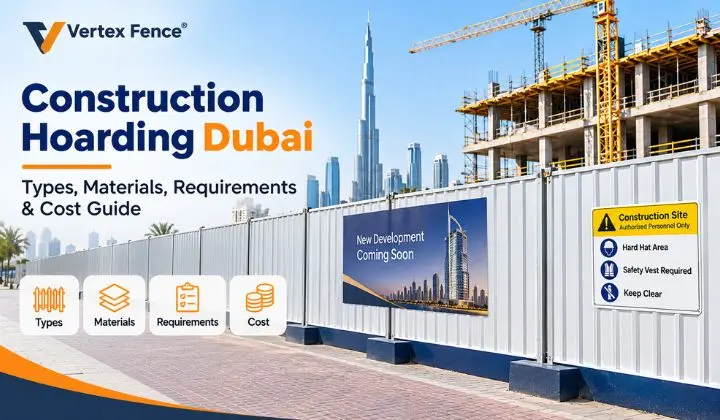
Construction sites need a secure boundary to separate building activities from public areas. Workers use heavy equipment, move materials and carry out tasks that may create risks for people nearby. A suitable hoarding system helps control access, protect pedestrians and keep the work area separate from its surroundings.
Choosing the right construction hoarding Dubai solution depends on several factors, including site size, project duration, required privacy, material quality and local authority requirements. Some projects need solid metal panels, while others may use mesh fencing or modular temporary fence panels.
This guide explains the different types of construction site hoarding, common materials, installation methods and important points to consider before selecting a supplier.
What Is Construction Hoarding?
Construction hoarding is a physical barrier installed around a construction or development site. Its main purpose is to separate the active work area from public spaces, nearby buildings, roads and pedestrian routes.
It can be made from materials such as PPGI panels, galvanized steel, PVC, plywood or other suitable materials. The selected system may be temporary or remain in place for a longer period, depending on the project.
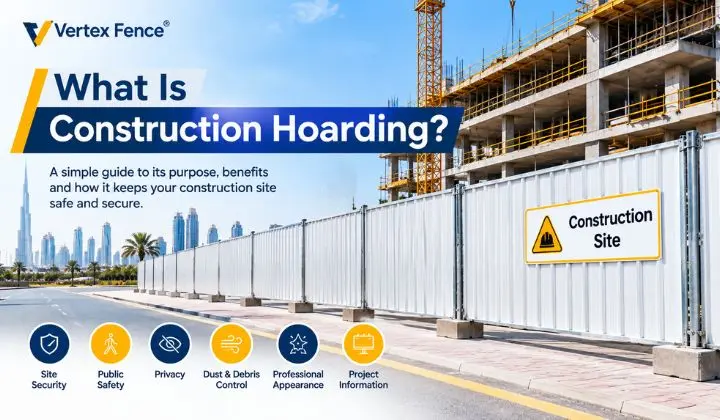
A properly planned hoarding system can help with:
- Site security: Limits access by people who are not authorised to enter the construction area.
- Public safety: Creates a boundary between construction activities and pedestrians.
- Privacy: Solid panels can block direct views into the work area.
- Dust and debris control: A suitable solid barrier can help reduce the movement of some dust and loose materials outside the site.
- Professional appearance: Creates a cleaner and more organised boundary around the project.
- Project information: Provides space for approved project signs and branding.
However, hoarding alone does not make a construction site safe. Contractors may also need warning signs, traffic controls, safe pedestrian routes, controlled gates and other safety measures.
Construction Hoarding vs. Temporary Fencing
The terms construction hoarding and temporary construction fencing are sometimes used in the same context, but they do not always describe the same type of barrier.
Construction hoarding usually refers to a solid or mostly solid boundary that provides privacy and blocks views into the site. Temporary fencing can also include open mesh panels that allow visibility and airflow.
For example, a building project in a busy commercial area may need solid panels for privacy. A roadwork project may use open fencing where visibility is more important.
The right option depends on the project’s safety needs, location and applicable requirements.
Types of Construction Hoarding in Dubai
Different construction projects have different boundary requirements. A residential development, commercial tower and road project may not need the same hoarding system.
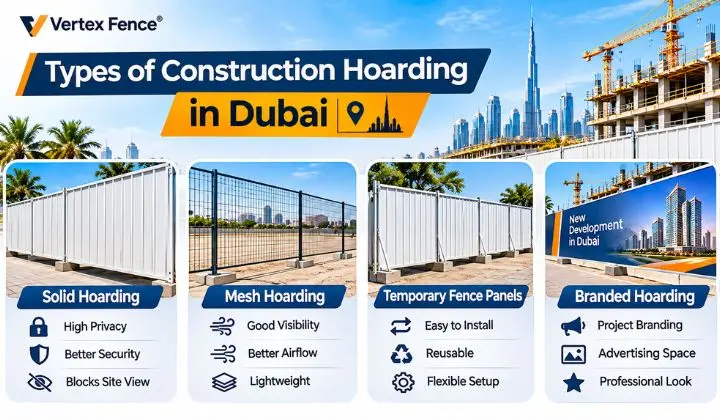
Here are four common options used for building site hoarding and temporary site boundaries.
1. Solid Construction Hoarding
Solid construction hoarding uses closed panels to create a continuous boundary around a site. It helps block direct views and provides a clear separation between construction activities and public areas.
Common materials include corrugated metal sheets, PPGI panels, plywood and other suitable solid boards.
This option can be useful for:
- Building and residential developments
- Commercial construction projects
- Sites that need visual privacy
- Projects where a clear physical boundary is required
One important point is wind exposure. Solid panels can catch more wind than open mesh fencing. Therefore, the supporting structure, foundation and fixing method must be suitable for the actual site conditions.
2. Mesh and Open Hoarding
Mesh or open fencing allows air and visibility to pass through the barrier. It is commonly considered for temporary work zones, infrastructure projects and locations where people need to see activity beyond the boundary.
Its main advantage is visibility. However, it does not offer the same level of privacy as solid hoarding.
Before choosing this option, consider the site’s security needs, surrounding pedestrian movement and the type of work being carried out.
3. Temporary Fence Hoarding Panels
Temporary fence hoarding panels are modular panels that can be connected to form a boundary around a construction site. They can be removed, shifted or reused when the project layout changes.
For example, Vertex Fence lists its PPGI Temporary Fence with a standard product size of 2m × 2m. Its published specifications include sheet thickness options from 0.40mm to 0.90mm and pipe thickness options from 1.2mm to 2.0mm. The listed support system includes concrete blocks and galvanized braces.
These are Vertex Fence’s product specifications, not universal dimensions or requirements for every Dubai construction project.
Modular panels can be a practical choice for contractors who need a boundary that can be moved or reused during different stages of construction.
4. Branded and Advertising Hoarding
Branded hoarding uses printed graphics and project information to improve the appearance of a construction boundary.
It may include:
- Developer and contractor logos
- Project names and contact details
- Building images and design renders
- Approved advertising messages
- Project information and direction signs
Construction site branding can make a development look more professional, especially when the site is located near busy roads or commercial areas.
However, printed designs should follow the applicable project and authority requirements. Branding should not cover safety information or create confusion with official road signs.
Construction Hoarding Materials: Which Option Is Right for Your Project?
The material you choose affects the appearance, strength, maintenance and overall cost of a hoarding system. Before making a decision, consider how long the system will remain in place, the level of privacy required and the conditions at the site.
1. PPGI and Galvanized Steel Panels
PPGI panels are made from pre-painted galvanized steel sheets. They are commonly used for temporary fencing and solid construction site boundaries.
The galvanized layer helps protect the steel against corrosion, while the paint coating provides an additional protective finish. The corrugated sheet profile also gives the panel its shape and stiffness.
Vertex Fence offers PPGI temporary and continuous fence systems. Its published temporary fence specifications include:
| Specification | Vertex Fence product details |
| Material | Pre-Painted Galvanized Iron (PPGI) |
| Standard panel size | 2m × 2m |
| Sheet thickness | 0.40mm–0.90mm |
| Pipe thickness | 1.2mm–2.0mm |
| Support system | Concrete blocks and galvanized braces |
These specifications are useful when comparing products, but the correct option should be selected according to the project’s requirements.
2. PVC and ECO PVC Fence Panels
PVC fence panels are a lightweight alternative to metal fencing. They do not rust like steel and can be easier to handle during installation and relocation.
Vertex Fence lists its ECO PVC Fence with a panel size of 500mm × 2400mm and a GI support pipe of 48mm outside diameter. The product information also lists white and off-white colour options.
PVC can be considered when low weight and a clean appearance are important. However, the selected system must still provide the required stability and suit the outdoor conditions of the project.
3. Plywood and Aluminium Composite Panels (ACM)
Plywood hoarding provides a solid surface that can be used for temporary boundaries and printed graphics. Its performance depends on the plywood grade, thickness, weather protection and supporting frame.
Aluminium composite panels (ACM) have a smooth surface that can support clean-looking designs and project branding.
Both materials may be suitable for specific applications, but contractors should check their durability, fixing details and suitability for the project before ordering.
4. PVC Banners and Mesh Graphics
PVC banners and mesh fabric are often used to display large printed designs on suitable frames or existing barriers.
PVC banners provide a more solid printed surface. Mesh graphics allow some air to pass through, which may be useful in certain exposed locations.
The right option depends on the frame, wind exposure, design and installation method. A printed banner or mesh graphic should not be treated as a complete structural hoarding system unless it is supported by a suitable structure.
How to Choose the Right Material
Use the following points when comparing materials:
| Project requirement | What to consider |
| Privacy | Solid panels rather than open mesh |
| Reuse and relocation | Modular panels and reusable supports |
| Maintenance | Material coating and outdoor durability |
| Project branding | A suitable surface for printed graphics |
| Wind exposure | Proper support, fixing and structural assessment |
| Long project duration | Material quality and regular inspection |
The cheapest material is not always the best choice. Select a system that meets the project’s actual needs and can be installed and maintained properly.
Construction Hoarding Requirements in Dubai
Before installing construction hoarding in Dubai, contractors should confirm which authority controls the project location and what approvals apply.
Requirements can differ according to the development area, project type and whether the hoarding affects a public road or footpath. A requirement that applies to one jurisdiction should not automatically be treated as a rule for every site in Dubai.
Dubai Municipality and Local Authority Requirements
Construction teams should check the current requirements of the relevant authority before selecting the hoarding system.
For example, Dubai Municipality has published guidance covering temporary construction-site fencing. Dubai Development Authority also has its own site signboard and hoarding guidance for developments under its jurisdiction.
These documents should be checked against the project’s location, permit conditions and any later updates. Do not assume that one panel size, colour or height applies to every project across Dubai.
Hoarding Height and Boundary Placement
The required construction hoarding height depends on the applicable authority requirements and project conditions.
Before installation, confirm:
- The required height for the project
- The approved boundary or plot line
- Whether any part of the hoarding affects a footpath or road
- Whether gates or openings need separate approval
- Whether project signboards have specific placement rules
It is also important to understand the difference between an individual panel’s dimensions and the height required for the complete site boundary.
For example, Vertex Fence’s 2m × 2m PPGI temporary fence panel is a product size. It should not be treated as a universal Dubai hoarding height.
Pedestrian Safety and Site Access
A hoarding system should not create new risks for people outside the construction site.
The project team should check that:
- Pedestrians have a safe and clear route.
- People are not forced into moving traffic.
- Site gates are visible and controlled.
- Delivery vehicles can enter and leave safely.
- Hoarding does not block important visibility near junctions or access points.
If the work affects a public road or right-of-way, the contractor should coordinate with the relevant authority and follow the approved traffic management arrangements.
Stability, Wind Exposure and Support
A hoarding system must remain stable under the conditions where it is installed. Wind exposure, ground conditions, panel dimensions, support spacing and fixing strength can all affect its stability.
A system may use GI support pipes, RCC foundation blocks, fence clamps and diagonal bracing to support its panels. However, these components must work together as a suitable system.
For example, a solid metal panel can catch more wind than an open mesh panel. Its support arrangement should therefore be selected with the site’s exposure and other conditions in mind.
Do not assume that a heavier panel or larger concrete block automatically makes a hoarding system safe. Structural requirements should be assessed by a qualified professional where necessary.
Construction Hoarding Installation Process
Good installation starts with proper planning. Before placing the first panel, the contractor should understand the site boundary, access points, ground conditions and support requirements.
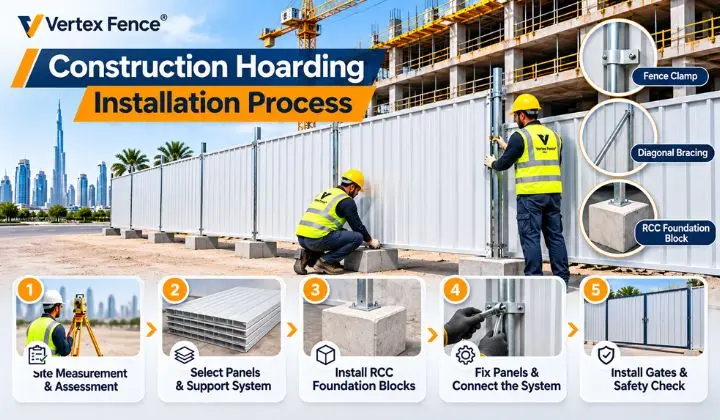
1. Site Measurement and Project Assessment
Start by measuring the complete site perimeter. Identify corners, gates, uneven ground, nearby roads and pedestrian routes.
Also confirm the required hoarding height and any project-specific conditions. Accurate measurements help estimate the number of construction hoarding panels, support pipes, clamps and foundation blocks needed.
2. Select Panels and Support Systems
Choose the panel material according to the project’s privacy, security and durability needs.
Then select compatible supports and fixing components. A PPGI system, for example, may include GI support pipes, concrete foundation blocks, clamps and braces.
Check that the selected components are suitable for the panel design and installation conditions.
3. Install RCC Foundation Blocks and Supports
RCC foundation blocks can provide a base for temporary fencing systems. Support pipes and braces help keep panels in position.
Their size, spacing and placement should follow the system design and site assessment. Avoid using the same support arrangement for every project without checking the conditions.
4. Fix Panels and Connect the System
Install the panels in the planned sequence and secure them with compatible fence clamps, couplers or other specified connectors.
Check that the connections are tight and that there are no unsafe gaps or sharp edges. Pay special attention to corners, panel ends and gate areas because they may need different support details.
5. Install Gates and Complete the Safety Check
Gates should suit the size and movement of vehicles and people using the site. Check the available opening space, visibility, locking arrangements and delivery vehicle movement.
Before handing over the system, inspect the complete boundary for loose panels, unstable supports, damaged components and blocked pedestrian routes.
The contractor should also arrange regular inspections during the project so that problems can be identified and corrected.
Construction Hoarding Maintenance, Repair & Relocation
Installing construction hoarding is only the first step. The system also needs regular inspection and maintenance throughout the project. Weather conditions, vehicle movement and daily construction activities can affect panels, supports and connections.
Proper maintenance helps keep the site boundary in good condition and reduces the risk of loose or damaged components.
Regular Inspection of Panels and Support Structures
Construction teams should inspect the hoarding system regularly, especially after strong winds, heavy rain or any incident that may affect its stability.
During an inspection, check:
- Loose or missing panel connections.
- Damaged or bent PPGI panels.
- Cracked or displaced RCC foundation blocks.
- Loose GI support pipes and braces.
- Gaps between panels.
- Damaged gates, locks and hinges.
- Sharp edges or parts that may create safety risks.
Any problem that affects stability or public safety should be addressed promptly.
Repairing or Replacing Damaged Components
A damaged panel should not be ignored because it is still attached to the fence. Loose connections and damaged supports can affect nearby panels as well.
Depending on the problem, maintenance may involve tightening connections, replacing damaged panels, repairing gates or changing unsuitable support components.
For example, if a panel becomes bent due to vehicle contact, the contractor should check both the panel and its supporting structure before putting it back into service.
Shifting and Reusing Construction Hoarding
Construction projects often change as work moves from one stage to another. A contractor may need to move the boundary to create a new access route, extend a work area or make space for deliveries.
Temporary fence panels can be useful in these situations because modular systems can be dismantled and installed again when their condition and design allow it.
Before shifting a system:
- Check the new boundary and site measurements.
- Identify any new gates or access points.
- Inspect panels, supports and connectors.
- Arrange safe dismantling and transportation.
- Reinstall the system according to the new site conditions.
- Complete another stability and safety inspection.
Reusing panels can reduce material waste, but damaged or unsuitable components should not be reused simply to save money.
Construction Hoarding Cost in Dubai: What Affects the Price?
The construction hoarding cost in Dubai depends on the size of the project and the system selected. There is no single price that applies to every construction site.
A small boundary with standard temporary panels will have different requirements from a large development that needs solid metal hoarding, multiple access gates and custom branding.
Before requesting a quotation, understand the main factors that affect the total cost.
1. Material and Panel Thickness
The selected material is one of the main pricing factors. PPGI panels, PVC panels, plywood and other materials have different product specifications and costs.
For metal fencing, sheet thickness, coating quality and supporting components can also affect the price.
A contractor should compare complete product specifications instead of choosing a panel based only on its appearance.
2. Required Height and Total Perimeter Length
The total length and height of the boundary determine how many panels are required.
For example, a project with a long perimeter will generally need more panels, supports and connectors than a smaller site.
Accurate measurements are important because incorrect estimates can lead to additional material and installation costs.
3. Foundation Blocks and Support Structure
A hoarding system may require RCC foundation blocks, support pipes, clamps and diagonal braces.
The number and type of these components depend on the selected system, ground conditions and site exposure. A suitable support arrangement should be included in the quotation rather than treated as an optional extra without technical review.
4. Installation, Transportation and Labour
The cost of a project may also include:
- Transportation of panels and accessories.
- Loading and unloading.
- Installation labour.
- Equipment required for installation.
- Gate fitting and adjustments.
- Dismantling after project completion.
For sites with difficult access or restricted working hours, additional planning may also be needed.
5. Branding, Printing and Custom Design
If the project needs branded hoarding, the quotation may include artwork preparation, large-format printing, banners, graphics and installation.
The final cost depends on the total printed area, material, design requirements and number of panels carrying graphics.
Rental vs. Purchase: Which Is Better?
Both options can work, depending on the project duration and future use.
| Factor | Rental | Purchase |
| Initial spending | Usually lower upfront commitment | Higher initial investment |
| Project duration | May suit short-term requirements | May suit longer-term use |
| Ownership | Supplier retains ownership | Contractor owns the system |
| Reuse | Depends on rental agreement | Can be reused if maintained |
| Maintenance | Depends on the rental terms | Owner manages maintenance |
Before choosing, compare the complete project cost. Ask whether transportation, installation, repairs and dismantling are included.
What Information Is Needed for an Accurate Quotation?
When contacting a construction hoarding supplier in Dubai, provide these details:
- Project location.
- Total site perimeter.
- Required hoarding height.
- Preferred material or panel type.
- Number and location of access gates.
- Expected project duration.
- Installation and transportation requirements.
- Branding or printing requirements.
Providing this information helps the supplier understand the project and prepare a more useful quotation.
Construction Hoarding Board Design and Branding
A construction boundary does not always need to look plain. With a suitable design, it can also display useful project information and improve the appearance of the site.
Construction hoarding board design is especially important for commercial developments, residential projects and construction sites located near busy public areas.
What Should a Construction Hoarding Board Include?
A well-planned hoarding board may include:
- Project name and developer logo.
- Contractor and consultant information.
- Project images or architectural renders.
- Contact information where approved.
- Safety messages and site information.
- Directional or informative signs where required.
The layout should be clear and easy to understand. Avoid adding too much text because people passing the site may only have a few seconds to read it.
Arabic and English Hoarding Designs
Dubai has a diverse population, so bilingual communication may be useful for projects serving different audiences.
A suitable Arabic and English hoarding design can make project information easier to understand. Both languages should have enough space and should remain readable from the intended viewing distance.
The design should also maintain the correct spelling of project names, company details and contact information.
Weather-Resistant Printing and Finishing
Outdoor graphics are exposed to sunlight, dust, heat and changing weather conditions. The printing material, ink and fixing method should be selected with these conditions in mind.
Options may include:
- Outdoor-grade printed vinyl.
- PVC banners.
- Mesh graphics for suitable frames.
- Protective laminate or anti-graffiti finishes where appropriate.
The printing supplier should explain the expected performance of the selected material and how it should be maintained.
Keep Branding Separate from Safety Information
Branding should never make important safety information difficult to see.
Keep project graphics, advertising and official notices organised. Also confirm whether the project location has specific restrictions on hoarding colours, artwork, signboards or advertising.
How to Choose the Right Construction Hoarding Supplier in Dubai
Choosing a supplier is not only about finding someone who can provide panels. You also need a company that understands the materials, support systems and installation requirements of your project.
Use the following points when comparing construction hoarding suppliers in Dubai.
1. Check Product Quality and Specifications
Ask for the actual panel specifications, including material, thickness, dimensions and finish.
For example, when comparing PPGI temporary fence panels, check the sheet thickness and support pipe specifications. Do not rely only on general descriptions such as strong, heavy-duty or premium quality.
2. Review Relevant Project Experience
Ask whether the supplier has worked on projects similar to yours. A company familiar with commercial developments may understand different access, delivery and boundary requirements.
You can also request product photographs, completed project examples or technical information to assess the quality of its work.
3. Confirm Installation and Transportation Services
Some suppliers only provide materials, while others offer a wider service that includes transportation and installation.
Confirm exactly what is included in the quotation. This helps prevent confusion about labour, delivery, gate installation and additional components.
4. Ask About Maintenance and After-Sales Support
Construction projects can last several months or longer. During this period, panels may need repairs, replacement or relocation.
Ask the supplier whether it can provide support if a component becomes damaged or the project boundary needs to change.
5. Compare Complete Quotations
Do not compare suppliers only by the final price. Check whether their quotations include the same materials, panel thicknesses, support components, transportation and installation services.
A lower quotation may not represent better value if important components or services are missing.
Why Choose Vertex Fence for Construction Hoarding in Dubai?
Selecting the right fencing system is an important part of preparing a construction site. Contractors need panels and supporting components that match their project requirements, along with clear product specifications and suitable supply services.
Vertex Fence offers fencing solutions for construction sites, including PPGI temporary fencing, continuous fencing, ECO PVC fencing and related accessories.
Its relevant product and service options include:
- PPGI Temporary Fence: Modular panels for temporary construction site boundaries.
- PPGI Continuous Fence: A fencing option for projects requiring a more continuous boundary.
- ECO PVC Fence: A PVC-based fencing option for suitable site applications.
- RCC Foundation Blocks: Supporting components used with compatible temporary fencing systems.
- Project Sign Boards: Signboard solutions for displaying project information.
- Fence Installation and Transportation: Services to help supply and install fencing at project locations.
- Fence Shifting: Support for projects that need to move their temporary fencing as work progresses.
Before placing an order, share your site measurements, required height, project duration and access requirements. This makes it easier to identify a suitable construction hoarding system for your project.
You can explore the available products and services on the Vertex Fence.
Frequently Asked Questions
What information should I provide to get an accurate construction hoarding quotation in Dubai?
Provide the project location, total perimeter length, required height, preferred material, number of gates and expected project duration. Also mention whether you need transportation, installation, branding or dismantling. These details help the supplier estimate the materials and services required.
Can construction hoarding panels be shifted when a project layout changes?
Yes, modular panels can often be dismantled and installed in another location if they are in suitable condition and the new arrangement meets project requirements. Before shifting them, inspect the panels, supports and connectors. The new location may require different measurements or support arrangements.
What should be checked before installing construction hoarding near a public road?
Check the approved site boundary, pedestrian routes, vehicle visibility, gate positions and nearby access points. Make sure the hoarding does not create unsafe walking routes or block important road visibility. If the installation affects a public road or footpath, coordinate with the relevant authority and follow the approved arrangements.
How can I prevent construction hoarding from becoming unstable during strong winds?
Start with a system suitable for the site’s wind exposure and ground conditions. Use compatible supports, foundation blocks, clamps and bracing according to the system design. Inspect connections regularly, especially after strong winds. A qualified professional should assess structural requirements where necessary.
What happens if construction hoarding panels or support components get damaged during a project?
The affected area should be inspected, and any component that creates a safety or stability risk should be secured or replaced promptly. Check nearby panels and connections as well, because damage may affect more than one section. Keep a record of repairs and inspect the system again before returning it to normal use.