
 Fences
 Gates
Gates Signage & Boards
 Car Parking Shades
 Block and Foundation
 Spare Parts
Concrete Block for Fence in UAE: Types, Benefits & Buying Guide

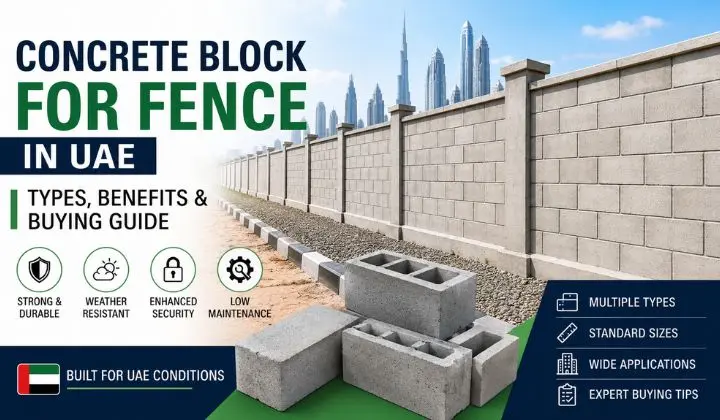
If you are planning to build a strong and secure fence, choosing the right Concrete Block for Fence is one of the most important decisions. A quality concrete block provides the strength needed to support your fence, improve stability, and protect your property for many years.
Whether you are building a Boundary Wall for a home, securing a warehouse, protecting a factory, or installing temporary fencing around a construction site, the right Concrete Blocks can make a big difference. They offer excellent durability, require very little maintenance, and perform well in the UAE’s challenging climate.
Unlike some fencing materials that can rust, rot, or weaken over time, concrete blocks are designed to withstand extreme heat, strong sunlight, sandstorms, and heavy use. This is why they are widely used for Residential Fencing, Commercial Fencing, and Industrial Fencing projects across the UAE.
Today, contractors, builders, and property owners choose Concrete Masonry Units (CMU) because they provide reliable Structural Strength, improve Perimeter Security, and offer excellent value over the long term.
This guide explains everything you need to know before choosing a Concrete Block for Fence, including its benefits, different types, standard sizes, common applications, and practical buying tips to help you make the right decision.
A Concrete Block for Fence is a strong building block used to support fencing systems, Boundary Walls, fence posts, and temporary barriers. It is manufactured using Cement, Sand, Aggregate, and water to create a durable Concrete Construction material.
These blocks are popular throughout the UAE because they are strong, weather-resistant, easy to maintain, and suitable for both residential and commercial projects. When installed correctly, they provide long-lasting Perimeter Protection, improve property security, and support different types of fencing systems.
Why Choose Concrete Blocks for Fencing?
A fence should do more than mark the edge of your property. It should keep your property secure, last for many years, and require as little maintenance as possible.
This is why many engineers, contractors, and property owners prefer Concrete Fence Blocks over other fencing materials. They provide a strong foundation, improve safety, and continue performing even in harsh outdoor conditions.
Let’s explore the main reasons why they are one of the best choices for fencing projects in the UAE.
High Strength and Long-Term Durability
One of the biggest advantages of Concrete Blocks for Fencing is their strength.
Unlike wood, which can rot over time, or untreated metal, which may rust, Concrete Blocks are built to handle heavy loads and daily wear. They maintain their shape and strength even after years of outdoor use.
Their high Compressive Strength makes them suitable for everything from small garden walls to large industrial boundaries.
A well-built concrete block fence can remain strong for decades with proper installation and basic maintenance. This makes it a cost-effective solution for long-term projects.
Better Security and Privacy
Security is one of the main reasons people invest in fencing.
A Concrete Block Wall creates a solid barrier that is much harder to damage than lightweight fencing materials. Its strong structure helps reduce unauthorized access while providing better privacy for homes, businesses, schools, warehouses, and factories.
For properties that require dependable Perimeter Security, concrete block fencing offers peace of mind without sacrificing durability.
It can also be combined with Mesh Fencing, steel panels, or other security systems to provide an even higher level of protection.
Designed for the UAE Climate
The UAE has one of the toughest climates for outdoor construction.
High temperatures, intense UV rays, sandstorms, humidity, and occasional heavy rain can damage many building materials over time.
High-quality Precast Concrete and Concrete Masonry Units are designed to resist these conditions. They do not warp like wood, they are less likely to corrode than untreated steel, and they maintain their Structural Stability even in demanding environments.
This makes them an excellent choice for both temporary and permanent fencing projects throughout the UAE.
Low Maintenance Requirements
Nobody wants to spend time and money repairing a fence every year.
One of the biggest benefits of Concrete Fence Blocks is that they require very little maintenance. Unlike timber fencing that needs regular painting or metal fencing that may require rust treatment, concrete blocks only need simple cleaning and routine inspections.
Their natural durability helps reduce repair costs while keeping the fence looking strong and professional for many years.
This is especially important for commercial properties where maintenance costs can quickly add up.
A Smart Long-Term Investment
Many people focus only on the purchase price when comparing fencing materials.
However, the real cost of a fence includes installation, maintenance, repairs, and replacement over its lifetime.
Although high-quality Concrete Blocks may cost more than some lightweight alternatives at the beginning, they usually last much longer. Their durability, low maintenance, and excellent weather resistance make them a smart financial investment.
Instead of replacing damaged fencing every few years, property owners can enjoy reliable performance with fewer repairs and lower long-term costs.
Flexible for Different Property Types
Another reason Concrete Blocks for Fence are so popular is their versatility.
They can be used for many different projects, including:
- Residential villas
- Private compounds
- Schools and universities
- Warehouses
- Factories
- Commercial buildings
- Construction sites
- Government facilities
They also work well with different fencing systems, making them suitable for both modern and traditional property designs.
Choosing the right block allows you to build a fence that matches your security needs, budget, and project requirements.
Types of Concrete Blocks for Fencing
Choosing the right type of Concrete Block for Fence is just as important as choosing the right fence design. Every project has different requirements. A villa boundary wall does not need the same block as an industrial warehouse or a temporary construction site.
Understanding the different types will help you choose a block that offers the right balance of strength, durability, cost, and performance.
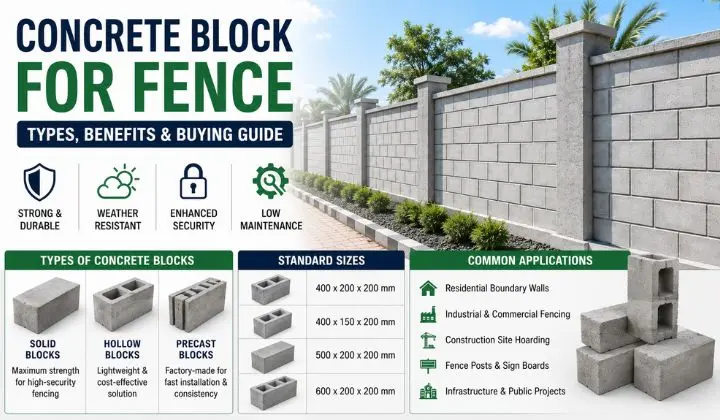
Solid Concrete Blocks
Solid Concrete Blocks are made with very few or no hollow spaces inside. Their dense design gives them excellent Load-Bearing Capacity, making them one of the strongest options available.
These blocks are commonly used where security and durability are the highest priorities. Because they are heavier, they provide better stability and can handle higher structural loads.
They are widely used for:
- High-security compounds
- Boundary Walls
- Industrial facilities
- Warehouses
- Government buildings
- Utility areas
Benefits of Solid Concrete Blocks
- Excellent Structural Strength
- High Compressive Strength
- Better impact resistance
- Improved sound insulation
- Longer service life
If your project requires maximum durability and long-term performance, solid concrete blocks are usually the best choice.
Hollow Concrete Blocks
Hollow Concrete Blocks contain one or more hollow cores. These spaces reduce the overall weight without significantly affecting structural performance.
Because they are lighter than solid blocks, they are easier to transport, handle, and install. The hollow sections can also be filled with Concrete or Steel Reinforcement when additional strength is required.
This makes them one of the most popular choices for modern fencing projects.
They are suitable for:
- Residential properties
- Commercial buildings
- Schools
- Villas
- Medium-height fencing
- Garden walls
Benefits of Hollow Concrete Blocks
- Easier installation
- Lower transportation cost
- Faster construction
- Good thermal performance
- Suitable for reinforced structures
Many contractors choose hollow blocks because they provide an excellent balance between performance and cost.
Precast Concrete Blocks
Precast Concrete Blocks are manufactured inside a controlled production facility before being delivered to the project site.
Unlike blocks that are produced on-site, factory-made precast blocks offer more consistent quality because every unit follows strict manufacturing standards.
This results in:
- Better dimensional accuracy
- Smooth surface finish
- Uniform quality
- Faster project completion
Because installation is quicker, precast blocks help reduce labour time on large projects.
They are commonly used for:
- Commercial developments
- Infrastructure projects
- Industrial compounds
- Temporary fencing
- Site hoarding
- Public facilities
Which Type Is Best for Your Project?
There is no single “best” block for every fencing project. The right choice depends on your security needs, budget, fence height, and expected lifespan.
The table below can help you make a quick decision.
| Project Type | Recommended Block |
| Residential Villa | Hollow Concrete Blocks |
| Private Compound | Hollow Concrete Blocks |
| Factory | Solid Concrete Blocks |
| Warehouse | Solid Concrete Blocks |
| Commercial Building | Solid or Precast Concrete Blocks |
| Construction Site | Precast Concrete Blocks |
| Temporary Hoarding | Precast Concrete Blocks |
Standard Concrete Block Sizes & Specifications
The size and specifications of a Concrete Block for Fence affect the strength, stability, and overall performance of the fencing system.
Using the correct block size also makes installation easier and helps the fence perform better over time.
Common Concrete Block Dimensions
Different projects require different block sizes.
Some of the most common Concrete Block Dimensions used in the UAE include:
| Block Size | Typical Application |
| 400 × 200 × 200 mm | Residential fencing |
| 400 × 150 × 200 mm | Garden walls |
| 500 × 200 × 200 mm | Commercial fencing |
| 600 × 200 × 200 mm | Heavy-duty projects |
| Custom Sizes | Special engineering projects |
Always select the block size according to the fence design and structural requirements rather than price alone.
Weight and Compressive Strength
Two important specifications should always be checked before purchasing concrete blocks.
Weight
Heavier blocks generally provide better stability for permanent fencing systems. They are especially useful in areas exposed to strong winds.
Compressive Strength
Compressive Strength measures how much pressure a block can withstand before it fails.
Higher compressive strength usually means:
- Better durability
- Higher load capacity
- Longer service life
- Improved structural performance
For commercial and industrial projects, this specification is especially important.
Concrete Grades
The quality of the Concrete Mix directly affects block performance.
Different projects require different Concrete Grades, depending on the expected load and environmental conditions.
Higher concrete grades generally provide:
- Better strength
- Improved durability
- Better resistance to weather
- Longer service life
For projects in the UAE, selecting the correct grade helps the fence perform well in hot temperatures and demanding outdoor conditions.
Surface Finish Options
Concrete blocks are available in different finishes to suit both functional and decorative needs.
Common options include:
- Smooth finish
- Textured finish
- Split-face finish
- Decorative finish
- Exposed aggregate finish
The surface finish does not only improve appearance. It can also affect maintenance requirements and overall project aesthetics.
Common Applications of Concrete Blocks
One reason Concrete Blocks remain popular is their versatility.
They can support many different fencing systems across residential, commercial, industrial, and public projects.
Residential Boundary Walls
Many homeowners choose Boundary Wall Blocks because they provide excellent privacy and security.
Concrete block walls also improve the appearance of the property while requiring much less maintenance than many other fencing materials.
They are commonly installed around:
- Villas
- Private homes
- Residential compounds
- Gated communities
Commercial and Industrial Fencing
Businesses often require stronger fencing than residential properties.
Heavy-Duty Concrete Blocks are widely used for:
- Warehouses
- Factories
- Manufacturing plants
- Distribution centres
- Commercial buildings
- Logistics facilities
These blocks provide reliable Perimeter Protection and can be combined with Mesh Fencing, steel panels, or Security Fencing systems for added protection.
Temporary Site Hoarding
Construction projects often need temporary fencing to protect workers, equipment, and the public.
Heavy Temporary Fence Blocks provide a stable base for temporary fence panels without the need for permanent foundations.
This makes them easy to install, move, and reuse on future projects.
They are commonly used for:
- Construction sites
- Road works
- Public events
- Infrastructure projects
Fence Posts and Sign Boards
Concrete blocks are also used to support:
- Fence posts
- Project sign boards
- Direction signs
- Safety boards
- Temporary advertising panels
Their weight provides excellent stability, helping signs remain secure even in windy conditions.
Infrastructure and Public Projects
Large public developments also rely on Concrete Blocks because they offer long-term durability and dependable structural performance.
They are commonly used in:
- Airports
- Schools
- Hospitals
- Government facilities
- Utility compounds
- Transport infrastructure
These projects require materials that can perform reliably for many years with minimal maintenance.
How to Choose the Right Concrete Block for Your Fence
Choosing the right Concrete Block for Fence is not only about price. The best block depends on your project type, security needs, weather conditions, and long-term maintenance goals.
A block that works well for a small villa may not be suitable for a warehouse or an industrial facility. Before buying, consider where the fence will be installed, how long it should last, and the level of protection you need.
Here are the most important factors to help you make the right decision.
For Residential Properties
If you are building a fence around a villa, private home, or residential compound, you need a block that offers both strength and a clean appearance.
In most cases, Hollow Concrete Blocks are a practical choice because they are easier to install, cost-effective, and provide enough Structural Strength for residential fencing.
When choosing blocks for a home, consider:
- Fence height
- Privacy requirements
- Overall appearance
- Future maintenance
- Local building requirements
If you plan to add decorative finishes or paint later, make sure the block surface is suitable for the selected finish.
For Commercial and Industrial Projects
Commercial and industrial sites usually require stronger fencing because they protect valuable equipment, inventory, and restricted areas.
For these projects, Solid Concrete Blocks or Precast Concrete Blocks are often the better choice because they provide higher Load-Bearing Capacity, improved Perimeter Security, and better long-term durability.
They are commonly used for:
- Warehouses
- Factories
- Manufacturing plants
- Logistics centres
- Storage facilities
For high-security projects, many property owners combine Concrete Block Walls with Mesh Fencing, steel panels, or other security systems to improve protection.
For Temporary Fencing Projects
Construction sites, roadworks, and public events often need fencing that can be installed quickly and removed later.
For these projects, Precast Concrete Blocks are usually the preferred solution.
They offer several advantages:
- Quick installation
- Easy transportation
- Stable support
- Reusable design
- Lower long-term project costs
This makes them an efficient choice for temporary Site Hoarding and safety barriers.
Factors to Consider Before Buying
Before purchasing any Concrete Block for Fence, compare more than just the price.
Ask yourself these questions:
Is the block strong enough?
Always check the Compressive Strength to ensure the block can support the planned fence.
Is it suitable for the UAE climate?
Choose blocks designed to resist heat, moisture, and outdoor exposure.
High-quality Concrete Construction materials perform better in extreme weather.
Does it match the project budget?
The cheapest block is not always the most economical.
A higher-quality block often lasts much longer and reduces repair costs over time.
Will it require frequent maintenance?
Choose a product that offers long-term durability with minimal maintenance.
This helps reduce future expenses while keeping the fence in excellent condition.
Is the supplier reliable?
Always buy from an experienced manufacturer that follows quality standards and provides consistent products.
Reliable suppliers also offer technical advice and help you choose the right block for your project.
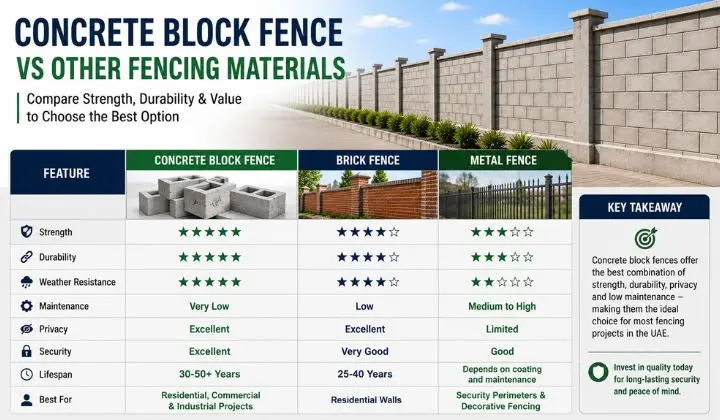
Concrete Block Fence vs Other Fencing Materials
Every fencing material has its own strengths and limitations.
Comparing them side by side makes it easier to choose the right option for your project.
| Feature | Concrete Blocks | Brick | Metal Fence |
| Strength | ⭐⭐⭐⭐⭐ | ⭐⭐⭐⭐ | ⭐⭐⭐ |
| Durability | ⭐⭐⭐⭐⭐ | ⭐⭐⭐⭐ | ⭐⭐⭐ |
| Weather Resistance | ⭐⭐⭐⭐⭐ | ⭐⭐⭐⭐ | ⭐⭐ |
| Maintenance | Very Low | Low | Medium to High |
| Privacy | Excellent | Excellent | Limited |
| Security | Excellent | Very Good | Good |
| Lifespan | 30–50+ Years* | 25–40 Years* | Depends on coating and maintenance |
| Best For | Residential, Commercial & Industrial Projects | Residential Walls | Security Perimeters & Decorative Fencing |
Actual lifespan depends on material quality, installation, environmental conditions, and maintenance.
Concrete Blocks vs Brick
Both materials are durable, but Concrete Blocks are often preferred for larger fencing projects because they are bigger in size and faster to install.
Concrete blocks also reduce labour time, making them a practical option for commercial and industrial construction.
Brick walls provide a classic appearance but usually require more installation time and skilled labour.
If speed and structural performance are important, concrete blocks are often the better choice.
Concrete Blocks vs Metal Fencing
Metal fencing is popular because it is lightweight and allows visibility.
However, it does not provide the same level of privacy as a Concrete Block Wall.
Although quality metal fencing can last for many years, it may require periodic inspection and protective maintenance depending on the environment.
Concrete blocks offer:
- Better privacy
- Higher impact resistance
- Lower maintenance
- Improved noise reduction
- Greater structural stability
Many commercial properties combine concrete block walls with metal or mesh fencing to enjoy the benefits of both systems.
Concrete Blocks vs Precast Concrete Panels
Both Concrete Blocks and precast panels are durable solutions, but they are designed for different applications.
Concrete block walls provide greater flexibility because they can be built in different heights, layouts, and designs.
Precast panels, on the other hand, are manufactured as large ready-made sections that allow faster installation on suitable projects.
If your project requires easy customization or future extensions, concrete blocks are usually the more flexible option.
Installation & Maintenance Tips
A high-quality block alone cannot guarantee a strong fence.
Proper installation and regular maintenance play an important role in achieving long-lasting performance.
Following a few simple practices can help your fence remain safe, stable, and attractive for many years.
Best Installation Practices
For the best results:
- Prepare a stable and level foundation.
- Use the correct Concrete Mix and mortar.
- Check block alignment regularly during construction.
- Allow proper curing time before applying heavy loads.
- Follow the recommendations of your contractor or structural engineer.
Correct installation improves Structural Stability and reduces the risk of future repairs.
Maintenance Tips
Concrete block fences require very little maintenance, but simple inspections can help extend their lifespan.
Good maintenance practices include:
- Clean dirt and dust when needed.
- Check for small cracks after extreme weather.
- Repair minor damage before it becomes larger.
- Keep drainage areas clear to prevent water build-up.
- Inspect joints and finishes during routine property maintenance.
These small steps help preserve both the appearance and strength of the fence.
Common Mistakes to Avoid
Many fencing problems happen because of avoidable mistakes during planning or installation.
Try to avoid these common errors:
- Choosing blocks based only on price.
- Ignoring the required Compressive Strength.
- Using poor-quality materials.
- Skipping proper foundation preparation.
- Not considering future maintenance.
- Hiring inexperienced installers.
Avoiding these mistakes helps improve safety, reduce repair costs, and increase the overall life of your fencing system.
Why Choose Vertex Fence?
Choosing the right supplier is just as important as choosing the right Concrete Block for Fence. A trusted manufacturer helps ensure that you receive quality materials, professional guidance, and reliable support from start to finish.
At Vertex Fence, we understand that every project has different requirements. Whether you need fencing for a residential property, commercial building, industrial facility, or construction site, our team helps you select the right solution based on your project needs rather than a one-size-fits-all approach.
Quality Materials You Can Trust
A durable fence starts with quality materials.
We focus on supplying concrete products that meet high construction standards, offering excellent Structural Strength, Weather Resistance, and long-term performance. This helps reduce maintenance costs and gives property owners greater confidence in their investment.
Solutions for Different Projects
Every project is different.
Whether you are securing a villa, warehouse, factory, school, or temporary construction site, choosing the correct fencing solution is essential for safety and durability.
Along with Concrete Block for Fence solutions, we also supply RCC Blocks for projects that require dependable structural support and long-lasting performance.
Professional Support from Start to Finish
Selecting the correct block size, type, and specifications can sometimes be confusing.
Our experienced team provides practical guidance to help customers choose products that match their project requirements, budget, and expected lifespan. This reduces costly mistakes and helps ensure the right solution is selected from the beginning.
Serving Projects Across the UAE
If you are looking for reliable Fence Suppliers in UAE, choosing an experienced company can make the entire process easier.
From product selection to project support, our goal is to deliver dependable fencing solutions that meet the needs of residential, commercial, and industrial customers.
As one of the Best Fence Manufacturer in UAE, we continue to focus on quality, customer satisfaction, and long-lasting fencing systems designed for local conditions.
Frequently Asked Questions
Can concrete block fences increase property value?
Yes. A well-built Concrete Block Fence can improve security, privacy, and the overall appearance of a property. These benefits often make residential and commercial properties more attractive to potential buyers or tenants.
Do concrete block fences require planning approval in the UAE?
Approval requirements can vary depending on the emirate, project size, and local municipality regulations. Before starting construction, it is always a good idea to check the latest building requirements with the relevant local authority or your contractor.
Can a concrete block fence support metal or mesh fencing?
Yes. Many projects combine a Concrete Block Wall with Mesh Fencing or steel panels. This creates a stronger fencing system that offers both privacy and enhanced security while maintaining a professional appearance.
What factors affect the lifespan of a concrete block fence?
The lifespan depends on several factors, including material quality, installation, foundation design, weather conditions, drainage, and regular maintenance. Using high-quality blocks and proper construction methods helps the fence last much longer.
Can concrete block fences be customized with different finishes?
Yes. Concrete block fences are available with different surface finishes, colours, and decorative coatings. This allows property owners to match the fence with the style of their home, business, or industrial facility without affecting durability.
Conclusion
Choosing the right Concrete Block for Fence is an investment in the safety, durability, and long-term value of your property. The right block not only supports your fencing system but also helps reduce maintenance costs and improves overall performance in the UAE’s demanding climate.
Before making your final decision, compare the block type, size, Compressive Strength, project requirements, and expected lifespan instead of focusing only on the initial price. A well-planned fencing project can provide reliable Perimeter Security, better privacy, and years of dependable service.
Whether you are building a residential Boundary Wall, securing a commercial property, or protecting an industrial site, selecting quality materials from an experienced supplier will help you achieve the best results.