
 Fences
 Gates
Gates Signage & Boards
 Car Parking Shades
 Block and Foundation
 Spare Parts
Temporary Fence vs Continuous Fence in UAE: Which Is Better

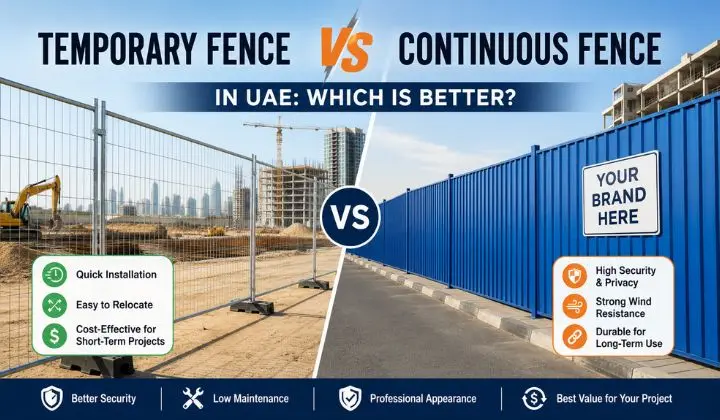
If your project needs a fence for a short period, a Temporary Fence is usually the better choice because it is easy to install, move, and reuse. If your project requires better security, privacy, and long-term protection, a Continuous Fence is the better option. The right choice depends on your project duration, security needs, budget, and site conditions. This guide compares both fencing systems to help you choose the best solution for your project in the UAE.
Key Takeaways
- Temporary Fence is ideal for short-term construction projects and events.
- Continuous Fence provides better privacy, security, and wind protection.
- Temporary Fence is faster to install and easier to relocate.
- Continuous Fence offers better long-term value for ongoing projects.
- The best option depends on your project type, budget, and required level of perimeter security.
Choosing the right fence is an important decision for any construction, commercial, or infrastructure project. A good fencing system protects your site, controls access, improves safety, and creates a professional appearance. However, many contractors and project owners are unsure whether a Temporary Fence or a Continuous Fence is the better investment.
Although both systems are designed to protect a construction site, they work in different ways. A temporary system focuses on flexibility and quick installation, while a continuous system is built for stronger site security, better privacy, and improved durability.
In the UAE, weather conditions, project duration, and security requirements all affect the right choice. Factors such as wind resistance, corrosion resistance, project size, and future relocation should also be considered before making a decision.
This guide compares both fencing systems side by side, including their features, applications, installation, durability, maintenance, and cost. By the end of this article, you will know which fencing solution is the right fit for your project.
Temporary Fence vs Continuous Fence: Quick Comparison
| Feature | Temporary Fence | Continuous Fence |
| Best For | Short-term construction projects, events, maintenance work | Long-term construction and infrastructure projects |
| Security | Good | Excellent |
| Privacy | Low | High |
| Installation | Very fast | Moderate |
| Portability | Excellent | Limited |
| Durability | High | Very High |
| Maintenance | Low | Low |
| Reusability | Excellent | Good |
| Wind Resistance | Moderate | Excellent |
| Branding Options | Limited | Excellent for project branding |
| Typical Material | Galvanized Steel, mesh panels | PPGI, GI Sheets, Corrugated Steel Sheets |
| Appearance | Open design | Solid Site Hoarding panels |
Which Fence Should You Choose?
Choose a Temporary Fence if your project requires fast installation, easy relocation, and multiple reuse. It is commonly used for short-term construction site fencing, maintenance work, and outdoor events.
Choose a Continuous Fence if your priority is security, privacy, professional branding, and long-term boundary protection. It is widely used for commercial buildings, infrastructure projects, industrial facilities, and large construction sites.
What Is a Temporary Fence?
A Temporary Fence is a movable fencing system designed to secure a site for a limited period. It is commonly used on construction sites, roadworks, public events, industrial maintenance projects, and emergency work areas where a permanent fence is not required.
Unlike permanent fencing, temporary fence panels are installed without digging foundations or pouring concrete. The panels are connected using clamps and supported by heavy bases, making the system quick to assemble, remove, and relocate. This flexibility helps contractors save both time and labor costs.
For projects in the UAE, many companies choose Galvanized Steel temporary fencing because it offers excellent corrosion resistance, requires minimal maintenance, and performs well in harsh outdoor conditions. It also allows contractors to secure a site while keeping the option to move the fencing as the project progresses.
Businesses looking for a reliable solution often choose PPGI Temporary Fence because it combines durability, easy installation, and a professional appearance for construction and industrial projects.
Common Applications of Temporary Fence
Temporary fencing is widely used for:
- Construction site security
- Road construction projects
- Infrastructure development
- Industrial maintenance work
- Public events and exhibitions
- Emergency work zones
- Restricted access areas
- Perimeter security during short-term projects
Advantages of Temporary Fence
- Fast installation with minimal labor.
- Easy to relocate as the project expands.
- Cost-effective for short-term use.
- Reusable for multiple projects.
- Requires little maintenance.
- Helps improve site safety and access control.
What Is a Continuous Fence?
A Continuous Fence is a solid fencing system designed for long-term site protection. Instead of separate mesh panels, it uses connected steel sheets that create a continuous barrier around the project. This design provides higher levels of privacy, security, and protection from dust and wind.
Continuous fencing is widely used across the UAE for commercial developments, residential projects, infrastructure works, warehouses, factories, and government construction sites where long-term boundary protection is required.
Most continuous fencing systems are manufactured from PPGI, GI Sheets, or Corrugated Steel Sheets. These materials offer excellent strength, weather resistance, and long service life while maintaining a clean and professional appearance.
For projects requiring strong privacy and branding opportunities, many contractors install PPGI Continuous Fence because it provides a durable barrier that can also display company branding, safety information, and project details.
Common Applications of Continuous Fence
Continuous fencing is suitable for:
- Long-term construction projects
- Commercial developments
- Residential communities
- Industrial facilities
- Warehouses
- Government infrastructure projects
- Site hoarding
- Permanent perimeter security
Advantages of Continuous Fence
- Higher level of security.
- Better privacy than mesh fencing.
- Strong wind resistance.
- Professional appearance.
- Suitable for company branding.
- Excellent durability in UAE weather.
- Low maintenance throughout the project lifecycle.
Temporary Fence vs Continuous Fence: Detailed Comparison
Security & Privacy
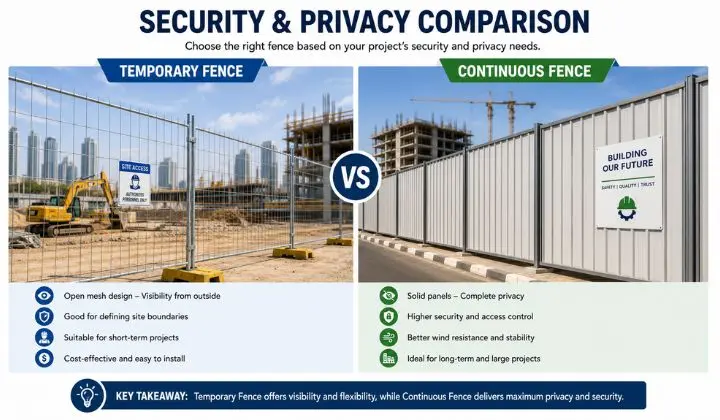
When comparing security, a continuous fence offers a clear advantage. Its solid panels prevent outsiders from seeing inside the site, reducing the risk of theft and unauthorized access. This makes it an excellent choice for projects that require high levels of site security and controlled visibility.
A temporary fence, on the other hand, provides reliable protection for short-term projects but does not completely block visibility because of its open mesh design. It is highly effective for defining work zones, controlling entry points, and improving construction site safety, but it offers less privacy than a solid fencing system.
If your project involves valuable equipment, confidential work, or long construction timelines, a continuous fence generally provides stronger access control, enhanced boundary protection, and greater peace of mind.
Installation & Portability
One of the biggest differences between these two fencing systems is how they are installed and moved.
A Temporary Fence is designed for speed and flexibility. Most systems can be installed without excavation or concrete foundations. The fence panels are connected with clamps and supported by weighted bases, allowing contractors to secure a site within a short time. If the project layout changes, the panels can easily be removed and installed in a new location.
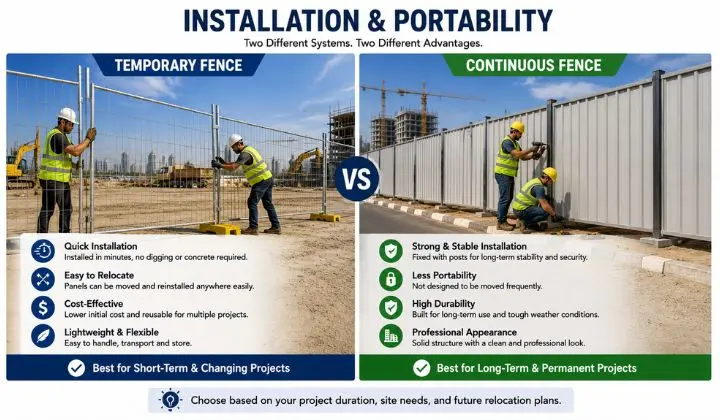
This flexibility makes temporary fencing a preferred choice for projects where work areas change frequently, such as road construction, utility maintenance, and short-term building projects.
A Continuous Fence, however, requires a more structured installation process. Steel sheets are fixed to support posts, creating a solid and continuous barrier. Although installation takes longer, the finished fence is stronger and more stable, making it suitable for projects expected to continue for several months or years.
Winner
- Short-term projects → Temporary Fence
- Long-term projects → Continuous Fence
Durability & Maintenance
Durability is another important factor when choosing between these fencing systems.
A quality temporary fence made from Galvanized Steel can withstand regular outdoor use and can be reused across multiple projects. Its protective coating helps resist rust, corrosion, and normal weather exposure. Regular inspections and occasional cleaning are usually enough to keep the fence in good condition.
A continuous fence is built for long-term performance. Manufactured from PPGI, GI Sheets, or Corrugated Steel Sheets, it provides excellent resistance against harsh UAE weather, including intense sunlight, dust, and strong winds. Because the structure is fixed and more robust, it generally requires less maintenance over its service life.
If durability over an extended project period is your priority, a continuous fence is usually the better investment.
Cost & Long-Term Value
Budget is always an important consideration, but choosing the cheapest option is not always the most cost-effective decision.
A temporary fence typically has a lower initial installation cost because it requires fewer materials and less labor. Since the panels are reusable, contractors can move them between projects, improving the overall return on investment.
A continuous fence usually involves a higher upfront cost because of the additional materials and installation work. However, for long-duration projects, it delivers greater long-term value by offering improved security, privacy, and reduced maintenance.
Choose based on project duration:
- Less than 6 months: Temporary Fence is generally the more economical option.
- More than 6–12 months: Continuous Fence often provides better long-term value.
Wind Resistance & UAE Weather
The UAE’s climate creates unique challenges for outdoor fencing. High temperatures, dust storms, humidity in coastal areas, and strong winds all affect fence performance.
A temporary fence performs well under normal site conditions, but because it is designed to be movable, it may require additional support in areas exposed to strong winds.
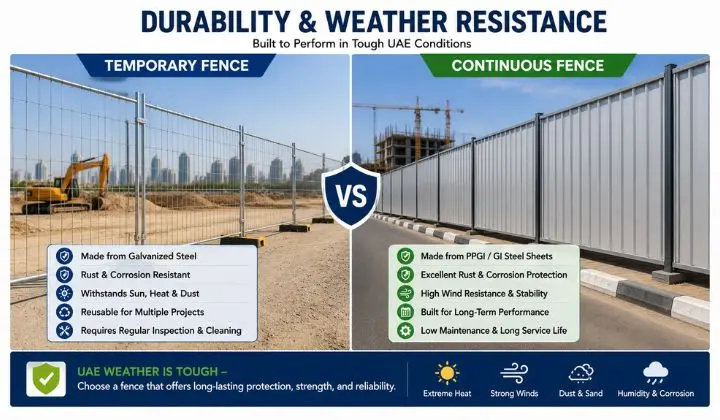
A continuous fence performs better in demanding weather conditions. Its connected steel panels create a stronger structure with improved wind resistance, making it suitable for open construction sites where weather protection is essential.
Using high-quality coated steel also improves corrosion resistance, helping the fence maintain its appearance and structural integrity for years.
Which Fence Is Best for Different Project Types?
| Project Type | Recommended Fence |
| Residential Construction | Temporary Fence |
| Commercial Building Projects | Continuous Fence |
| Infrastructure Projects | Continuous Fence |
| Road Construction | Temporary Fence |
| Industrial Facilities | Continuous Fence |
| Public Events | Temporary Fence |
| Warehouse Development | Continuous Fence |
| Emergency Work Zones | Temporary Fence |
There is no single fencing solution that works for every project. The best choice depends on your project timeline, required level of site security, environmental conditions, and available budget.
Common Mistakes When Choosing a Fence
Many project owners focus only on price, which can lead to unnecessary expenses later. Avoid these common mistakes:
- Choosing a temporary fence for projects that will continue for years.
- Paying for a continuous fence when a short-term project only needs temporary protection.
- Ignoring local weather conditions and wind load requirements.
- Overlooking future site expansion and relocation needs.
- Selecting low-quality materials instead of durable coated steel.
- Forgetting about access control, worker safety, and project visibility requirements.
Evaluating these factors before installation helps reduce maintenance costs and improves project efficiency.
Frequently Asked Questions
Do temporary and continuous fences require municipality approval in the UAE?
Approval requirements vary depending on the project location and the relevant local authority. Before installation, contractors should check with the municipality or project consultant to ensure the fencing system complies with local regulations.
Can a continuous fence be relocated after a project is completed?
Yes, but it is not as convenient as relocating a temporary fence. Continuous fencing is designed for long-term installation, so dismantling and reinstalling it usually requires more time and labor.
How do you choose the right fence height for a construction site?
The ideal height depends on the project’s security requirements, surrounding environment, and local regulations. Higher fences generally provide better privacy, site security, and restricted access.
Can temporary and continuous fences be customized with company branding?
Yes. Continuous fencing is especially suitable for displaying company logos, project information, safety messages, and promotional graphics because of its solid panel design. Temporary fencing can also support banners and signs, although branding options are more limited.
What factors should you consider before choosing a temporary or continuous fence?
Consider your project duration, security needs, privacy requirements, weather conditions, budget, maintenance expectations, and whether the fencing will need to be relocated in the future.
Conclusion
Both fencing systems offer valuable benefits, but they are designed for different purposes.
If you need a flexible, reusable, and cost-effective solution for a short-term project, a Temporary Fence is the better choice. Its quick installation and portability make it ideal for construction sites, events, and temporary work zones.
If your project demands higher security, improved privacy, stronger wind resistance, and long-term performance, a Continuous Fence is the smarter investment. Its solid design creates a professional appearance while providing reliable protection throughout the project.
Before making your decision, evaluate your project timeline, budget, security requirements, and environmental conditions. Choosing the right fencing system from the beginning can improve safety, reduce long-term costs, and keep your project running efficiently.