
 Fences
 Gates
Gates Signage & Boards
 Car Parking Shades
 Block and Foundation
 Spare Parts
What Are Solid Concrete Blocks? Benefits, Uses & Key Specifications

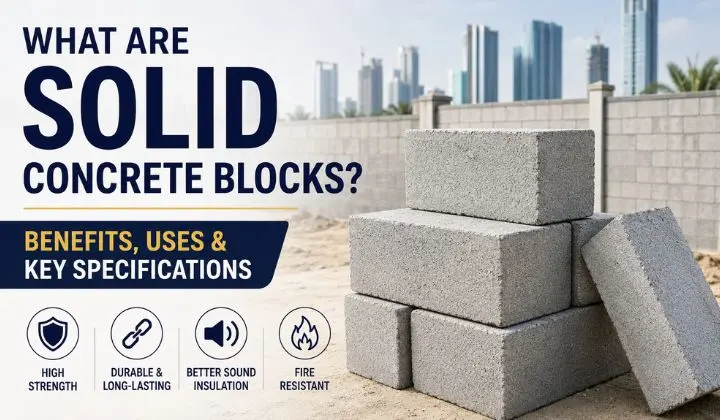
Solid concrete blocks are among the most trusted building materials used in modern construction. From residential homes and commercial buildings to retaining walls and security fences, these blocks provide the strength and durability needed for long-lasting structures.
Many people know that solid concrete blocks are strong, but they often do not understand why builders, engineers, and contractors choose them for important construction projects. The answer lies in their high density, excellent load-bearing capacity, and ability to perform well in different weather conditions.
In the UAE, where buildings must withstand extreme heat, strong winds, and long-term environmental exposure, solid concrete blocks remain a popular choice for masonry construction, boundary walls, foundations, and industrial projects.
This guide explains what solid concrete blocks are, how they are made, their specifications, benefits, and the most common applications in construction.
What Are Solid Concrete Blocks?
Solid concrete blocks are dense rectangular building units made from a mixture of Portland cement, sand, aggregates, and water. Unlike hollow concrete blocks, they have little or no internal cavities, which makes them heavier and stronger.
These blocks are also known as Concrete Masonry Units (CMU), masonry blocks, solid cement blocks, and structural concrete blocks in the construction industry.
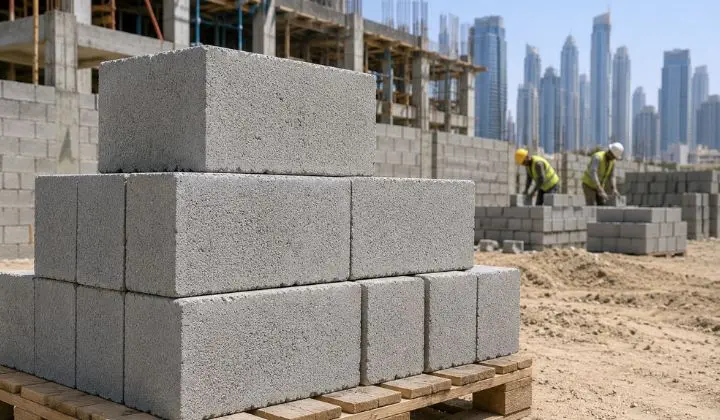
Because of their dense structure, solid concrete blocks provide excellent compressive strength, making them suitable for projects where structural stability and long-term performance are important.
A simple way to understand the difference is this:
- A hollow block contains large empty spaces inside.
- A solid block is mostly solid material throughout the block.
This extra material increases the block’s weight and strength, allowing it to support greater loads.
Why Are Solid Concrete Blocks Important in Construction?
Modern construction projects require materials that can handle pressure, weather changes, and daily wear without losing strength.
This is where dense masonry units become valuable.
Their strong structure helps improve:
- Load-bearing capacity
- Structural integrity
- Building lifespan
- Weather resistance
- Fire performance
Because of these qualities, solid concrete blocks are commonly used in load-bearing walls, foundations, retaining walls, and infrastructure projects.
What Are Solid Concrete Blocks Made Of?
Understanding the materials used in a block helps explain why it performs so well.
Most solid concrete blocks are manufactured using four main ingredients:
Portland Cement
Portland cement acts as the binding material. It holds all ingredients together and gives the block its strength after curing.
Manufacturers may use:
- Ordinary Portland Cement (OPC)
- Sulphate Resistant Cement (SRC)
The type of cement selected depends on project requirements and environmental conditions.
Sand
Sand fills the gaps between larger particles and improves the consistency of the concrete mixture.
It helps create a smoother, more uniform block structure.
Aggregates
Aggregates include materials such as:
- Gravel
- Crushed stone
- Stone chips
These materials provide bulk and strength to the block.
The quality of the aggregates directly affects the final strength and durability of the finished block.
Water
Water activates the cement through a process called hydration.
Proper water content is essential because too much or too little water can reduce the quality of the final product.
How Are Solid Concrete Blocks Manufactured?
The manufacturing process is straightforward but requires precision.
- Cement, sand, water, and aggregates are mixed together.
- The mixture is placed into molds.
- The molds are compacted using vibration and pressure.
- The blocks are removed from the molds.
- They are cured for a specific period to develop strength.
After curing, the blocks achieve the required compressive strength, density, and durability needed for construction projects.
Key Specifications of Solid Concrete Blocks
The performance of a solid concrete block depends on factors such as size, density, weight, and strength.
Understanding these specifications helps builders choose the right block for a project.
Standard Solid Block Sizes in UAE
One of the most searched questions is about solid block size in UAE.
The most common face dimension used in UAE construction is:
400 mm × 200 mm
These blocks are available in different thicknesses depending on project requirements.
| Block Size | Common Application |
| 400 × 200 × 100 mm | Partition walls |
| 400 × 200 × 150 mm | Boundary walls |
| 400 × 200 × 200 mm | Load-bearing walls |
| 400 × 200 × 250 mm | Heavy-duty structural work |
Choosing the correct size improves wall performance, strength, and material efficiency.
Density and Weight
Density plays an important role in the strength of a block.
Typical normal weight solid blocks have a density of approximately:
2100–2200 kg/m³
These blocks are considered high-density concrete blocks and provide excellent durability.
Common weights include:
| Size | Approximate Weight |
| 400 × 200 × 100 mm | 17 kg |
| 400 × 200 × 150 mm | 25 kg |
| 400 × 200 × 200 mm | 34 kg |
| 400 × 200 × 250 mm | 42 kg |
Higher density generally means better structural stability and improved sound insulation.
Compressive Strength
One of the most important specifications is compressive strength.
Compressive strength measures how much pressure a block can withstand before failure.
For quality solid concrete blocks, compressive strength commonly ranges between:
10–12.5 N/mm²
This level of strength makes them suitable for:
- Load-bearing walls
- Foundations
- Retaining walls
- Industrial construction
- Commercial structures
High compressive strength is one of the main reasons why engineers prefer solid concrete blocks for structural projects.
Concrete and Cement Types (OPC & SRC)
Manufacturers generally use two cement options:
Ordinary Portland Cement (OPC)
Used for most residential and commercial construction projects.
Sulphate Resistant Cement (SRC)
Used in environments where sulphate attack may occur.
SRC provides better durability in challenging ground conditions and is often preferred in specific infrastructure projects.
Benefits of Solid Concrete Blocks
The popularity of solid concrete blocks comes from the combination of strength, durability, and long-term value.
High Compressive Strength
One of the biggest advantages is their excellent compressive strength.
Because they contain very few voids, they can withstand heavy loads and structural pressure more effectively than many lightweight alternatives.
This makes them suitable for load-bearing walls, foundations, and retaining structures.
Excellent Structural Stability
The dense composition improves structural integrity and reduces the risk of movement over time.
Buildings constructed with structural concrete blocks often maintain their performance for decades when properly installed.
Long Service Life
A well-built wall using solid concrete blocks can last for many years with minimal maintenance.
Their resistance to wear makes them a practical choice for long-term construction projects.
Fire Resistance
Concrete is naturally non-combustible.
This means solid concrete blocks can help slow the spread of fire and improve overall building safety.
For commercial and industrial facilities, this is a significant advantage.
Acoustic Insulation
Because they are dense, solid concrete blocks provide good acoustic insulation.
They help reduce the transmission of sound between spaces.
This makes them useful for:
- Residential properties
- Commercial buildings
- Schools
- Industrial facilities
- Boundary walls
Thermal Mass Benefits
A major advantage often overlooked is thermal mass.
Dense materials absorb heat during the day and release it more slowly.
In hot climates such as the UAE, this can help stabilize indoor temperatures and improve energy efficiency.
Low Maintenance
Unlike many other building materials, solid concrete blocks require very little maintenance.
Once installed correctly, they continue to perform effectively without frequent repairs.
What Are Solid Concrete Blocks Used For?
One of the most common questions people ask is:
What are solid concrete blocks used for?
Because of their strength and durability, they are used in a wide range of construction applications.
Load-Bearing Walls
Perhaps the most common use is in load-bearing walls.
These walls support structural loads from roofs, floors, and other building components.
The high load-bearing capacity of solid blocks makes them ideal for this purpose.
Foundations and Basements
Strong foundations are essential for any building.
Solid concrete blocks are often used in foundation systems because of their ability to handle heavy loads and provide long-term stability.
They are also commonly used in basements where durability is critical.
Retaining Walls
A retaining wall must resist pressure from soil and water.
The strength of dense concrete blocks helps them perform effectively in these demanding applications.
Boundary Walls and Compound Walls
In the UAE, boundary walls and compound walls are among the most common uses of solid blocks.
Their strength helps improve security while also providing privacy and noise reduction.
This is one reason why many contractors and companies such as Vertex Fence prefer solid block construction for perimeter protection projects.
Commercial and Industrial Buildings
Factories, warehouses, storage facilities, and commercial buildings often use concrete masonry blocks because of their durability and long service life.
The blocks can withstand heavy use while maintaining structural performance.
Infrastructure Projects
Many infrastructure developments rely on solid concrete blocks because they provide:
- Strength
- Reliability
- Durability
- Cost-effectiveness
They continue to be one of the most trusted building materials in UAE construction projects.
Why Solid Concrete Blocks Are Ideal for Boundary Walls and Fencing
When building a boundary wall, strength and durability are usually the top priorities. A wall must withstand strong winds, daily wear, accidental impacts, and changing weather conditions for many years.
This is where solid concrete blocks perform exceptionally well.
Their dense structure provides better resistance to external pressure compared to many lightweight wall materials. Because of their high compressive strength and structural stability, they are widely used in compound walls, security walls, and perimeter fencing projects.
Better Security
A strong boundary wall is the first line of defense for a property.
Since solid concrete blocks contain little or no void space, they are harder to damage and provide greater protection than lightweight alternatives.
Wind and Weather Resistance
In the UAE, walls are exposed to extreme heat, dust, and strong winds.
The high density of solid cement blocks helps them maintain their strength even in demanding environments. This is one reason they are commonly used in boundary wall construction in Dubai and other parts of the UAE.
Noise Reduction
Another advantage is acoustic insulation.
Because the blocks are dense, they help reduce noise coming from roads, industrial areas, and neighboring properties.
This makes them a practical choice for residential communities, schools, commercial buildings, and industrial facilities.
Long-Term Value
Although solid concrete blocks may cost slightly more than some lightweight alternatives, their durability often reduces repair and maintenance costs over time.
For long-lasting fencing and perimeter protection projects, many contractors choose solid concrete blocks as their preferred material.
For projects that require additional structural reinforcement, RCC Blocks are also used in specific applications where higher structural loads must be supported.
Solid Concrete Blocks vs Hollow Concrete Blocks
One of the most common questions in construction is whether to choose solid concrete blocks or hollow concrete blocks.
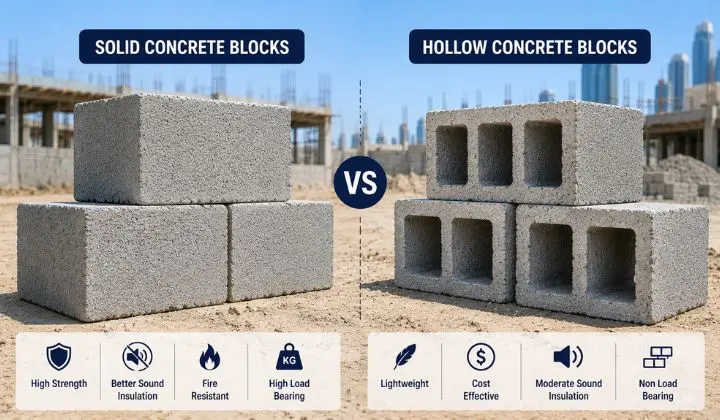
Both have advantages, but the right choice depends on the project.
| Feature | Solid Concrete Blocks | Hollow Concrete Blocks |
| Structure | Dense with little or no cavities | Contains internal voids |
| Weight | Heavier | Lighter |
| Strength | Higher compressive strength | Moderate strength |
| Durability | Excellent | Good |
| Sound Insulation | Better acoustic insulation | Moderate |
| Thermal Mass | Higher | Lower |
| Installation | More labor required | Easier handling |
| Cost | Usually higher | Usually lower |
| Best Use | Load-bearing walls, foundations, retaining walls, fencing | Partition walls, lightweight construction |
When Should You Choose Solid Concrete Blocks?
Choose solid concrete blocks when:
- High strength is required
- The wall will carry structural loads
- Security is important
- Long-term durability is a priority
- Building retaining walls or boundary walls
When Should You Choose Hollow Concrete Blocks?
Choose hollow concrete blocks when:
- Reducing wall weight is important
- Faster installation is needed
- Running pipes or electrical wiring through walls
- Building non-load-bearing structures
Both options are useful, but for demanding structural applications, solid concrete blocks are generally preferred.
Normal Weight vs Lightweight Solid Concrete Blocks
Not all solid concrete blocks are the same.
Manufacturers commonly produce two categories:
- Normal Weight Solid Blocks
- Lightweight Solid Blocks
Understanding the difference helps builders select the right product.
Normal Weight Solid Blocks
These blocks are manufactured using dense aggregates and usually have a density of around 2100–2200 kg/m³.
Benefits include:
- Higher compressive strength
- Better durability
- Greater structural integrity
- Improved resistance to heavy loads
They are commonly used in:
- Foundations
- Load-bearing walls
- Retaining structures
- Industrial buildings
Lightweight Solid Blocks
These blocks use lightweight aggregates and generally have a density around 1400 kg/m³.
Benefits include:
- Easier handling
- Faster installation
- Reduced structural load
- Lower transportation costs
They are often used in:
- Residential construction
- Non-critical structural applications
- Interior wall systems
Which One Is Better?
There is no universal answer.
If strength and durability are the priority, normal weight solid blocks are usually the better choice.
If reducing weight and improving installation efficiency is more important, lightweight concrete blocks may be the better solution.
The decision should always depend on project requirements and engineering recommendations.
How to Choose the Right Solid Concrete Block for Your Project?
Choosing the right solid concrete block is not only about size. Several factors affect performance and long-term value.
Consider Load-Bearing Requirements
For structural applications, always choose blocks with adequate compressive strength.
Heavy-duty structures generally require stronger and denser blocks.
Consider Wall Type
Different wall types require different block specifications.
For example:
- Partition walls often use thinner blocks.
- Boundary walls typically require thicker blocks.
- Foundations may require larger and stronger blocks.
Consider Project Budget
Budget is always an important factor.
While solid concrete blocks may cost more initially, their durability often reduces future maintenance expenses.
This can result in lower overall lifecycle costs.
Consider UAE Climate Conditions
The UAE experiences:
- High temperatures
- Strong sunlight
- Wind exposure
- Dust storms
Choosing quality concrete masonry units with proper density and strength helps improve long-term performance in these conditions.
Select the Correct Block Size
The correct solid block size in UAE depends on the intended application.
As a general guideline:
- 100 mm blocks for partitions
- 150 mm blocks for boundary walls
- 200 mm blocks for load-bearing walls
- 250 mm blocks for heavy-duty structural projects
When in doubt, consult a qualified engineer or trusted supplier before making a final decision.
Frequently Asked Questions
What is the lifespan of a solid concrete block wall?
A properly constructed wall made from solid concrete blocks can last for several decades. Its lifespan depends on block quality, installation methods, environmental conditions, and maintenance practices.
Can solid concrete blocks withstand extreme weather conditions?
Yes. Because of their high density and strength, solid concrete blocks perform well in harsh environments. They can withstand strong winds, high temperatures, and heavy rainfall when installed correctly.
Which solid block size is best for boundary walls?
The most commonly used solid block size in UAE for boundary walls is 400 × 200 × 150 mm. However, the ideal size depends on wall height, design requirements, and engineering specifications.
Do solid concrete blocks provide sound insulation?
Yes. Their dense structure offers good acoustic insulation, helping reduce external noise. This makes them suitable for residential compounds, schools, offices, and industrial facilities.
Are RCC Blocks and solid concrete blocks the same?
No. RCC Blocks are made using reinforced cement concrete and may contain steel reinforcement for additional strength. Solid concrete blocks are dense masonry units without built-in reinforcement, although both are used in structural construction applications.
Conclusion
Solid concrete blocks remain one of the most reliable and widely used building materials in modern construction. Their combination of high compressive strength, durability, fire resistance, and long service life makes them suitable for a wide range of projects.
From foundations, basements, and retaining walls to boundary walls, commercial buildings, and infrastructure developments, these concrete masonry units (CMU) provide the strength and stability required for long-term performance.
For construction projects in the UAE, choosing the correct solid block size, density, and strength grade is essential. Understanding the difference between solid concrete blocks, hollow concrete blocks, and RCC Blocks helps ensure that the right material is selected for the job.
Whether you are planning a residential compound wall, a commercial facility, or a large-scale infrastructure project, investing in quality masonry blocks can improve safety, durability, and overall project value. As a trusted Fence Manufacturer in UAE, companies such as Vertex Fence often use high-quality solid concrete blocks in fencing and perimeter wall solutions because of their proven performance, security benefits, and ability to withstand demanding environmental conditions.