 Fences
 Gates
 Signage & Boards
 Car Parking Shades
 Block and Foundation
 Spare Parts
Sign Board Design Ideas: 3D Styles, Templates & Examples

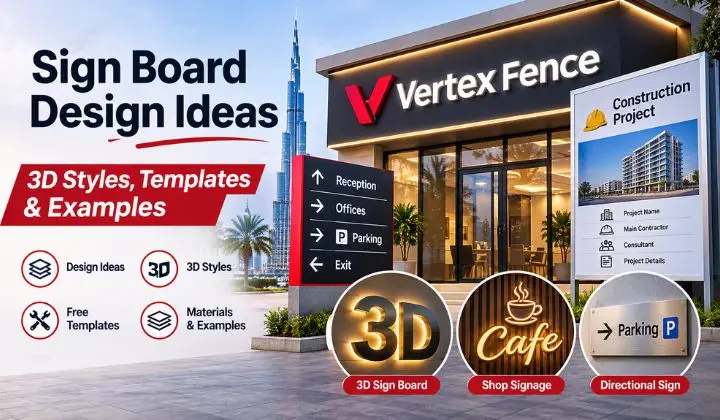
A good sign board does more than display a business name. It helps people recognise a brand, find a location and understand a message quickly. Whether you need a shop sign, an outdoor display, a direction board or a construction project sign, the right design can make a big difference.
There are many types of sign board design ideas, from simple printed layouts to modern 3D sign board designs with lighting. You can also create a basic layout online using design tools and ready-made templates.
But choosing an attractive design is only the first step. You also need to think about the sign’s location, size, material, visibility and purpose. This guide explains these points in simple terms and helps you choose a design that works in real life.
What Is Sign Board Design and What Makes It Effective?
Sign board design is the process of planning the text, images, colours, layout and other visual elements used on a sign. The goal is to make the message easy to notice and understand.
A professional design should match the place where the sign will be installed. For example, a retail shop may need a bold display with its business name, while a parking area needs clear words and simple direction symbols.
Essential Elements of a Professional Sign Board
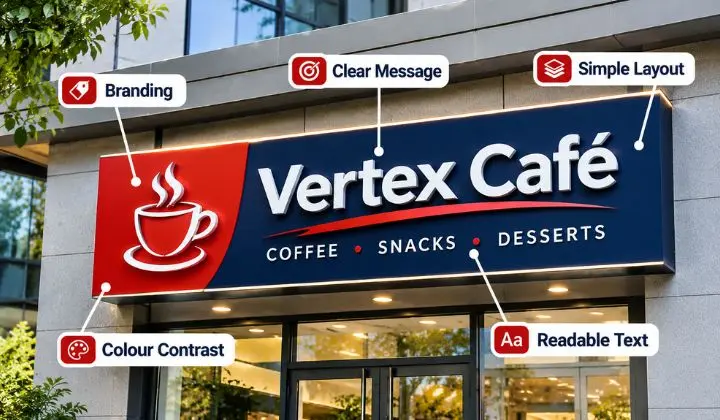
A well-planned sign board usually includes these elements:
- Clear message: Show the most important information first, such as a business name, service or direction.
- Readable text: Choose fonts that people can read without standing too close.
- Good colour contrast: Use colours that make the text stand out from the background.
- Simple layout: Keep enough space between the logo, text and other elements.
- Suitable graphics: Use images and symbols only when they help explain the message.
- Consistent branding: Match the sign with the business’s logo, colours and overall identity.
Avoid adding too much information. A sign filled with small text, several fonts and too many colours can be difficult to understand, especially from a distance.
Typography, Colours and Visual Hierarchy
Typography means the style and appearance of text. Your main heading or business name should be easy to notice. Supporting details can be smaller, but they must remain readable.
Colour choice also matters. For example, dark text on a light background can create strong contrast. However, the best combination depends on the sign’s location, lighting and brand colours.
Use visual hierarchy to guide the reader’s eyes. Place the most important message in the most noticeable position, followed by supporting information. This makes the sign easier to understand at a glance.
Designing for Visibility, Location and Purpose
Before creating a design, ask three simple questions:
- Where will the sign be installed?
- How far away will people view it?
- What information should they understand?
An outdoor sign may need larger lettering and materials suited to the local weather. An indoor sign can focus more on room names, directions or brand details.
For busy roads and entrances, keep the message short. People may only have a few seconds to read it.
Modern Sign Board Design Ideas and Examples
Modern sign boards often use clean layouts, simple fonts and balanced colours. The best design is not always the most complex one. It is the design that communicates its message clearly.
Here are some useful sign board design ideas for different locations.
Attractive and Minimalist Sign Board Designs
A minimalist sign uses only the elements needed to communicate the message. It may include a business name, logo and one short line of supporting text.
This style works well for offices, showrooms, reception areas and modern retail spaces. A simple layout can also make a brand look organised and professional.
For an attractive sign board design, focus on:
- One clear main message.
- Two or three suitable brand colours.
- Easy-to-read typography.
- Enough empty space around the text.
- A logo that remains clear at the final sign size.
Outdoor Sign Board Design Ideas
An outdoor sign board design needs to be clear in changing light and weather conditions. It should also suit the building, entrance or area where it will be displayed.
Popular options include building fascia signs, entrance signs, wall-mounted signs and freestanding displays. Some businesses use LED light sign board designs to improve visibility in low-light areas.
When planning an outdoor sign, consider sunlight, rain, dust, viewing distance and the method of installation. A design that looks good on a computer screen may need changes before manufacturing.
Shop and Business Sign Board Designs
A shop sign should help customers identify the business quickly. The business name and logo should usually receive the most attention.
For example, a clothing store may use a clean layout with its brand colours, while a grocery store may need a bold name that is easy to spot from the street.
You can explore shop sign board design examples for inspiration, but avoid copying another business’s branding. Create a layout that reflects your own products, audience and location.
Office and Corporate Signage
Office signs help visitors identify entrances, departments, meeting rooms and reception areas. They should follow a consistent style across the building.
Use the same font family, colour palette and logo treatment across different signs. This creates a connected look and makes the workplace easier to navigate.
3D Sign Board Design: Popular Styles and Materials
A 3D sign board design uses raised letters, logos or shapes to create depth. Unlike a flat printed sign, dimensional lettering can create shadows and make a business name stand out from its background.
The final appearance depends on the material, letter thickness, finish, lighting and installation method.
Acrylic and Metal 3D Signage
Acrylic signage is popular for its smooth finish and range of colours. It can be used for raised letters, logos and reception signs.
Metal signage, including stainless steel and aluminium, can give a strong and professional appearance. The finish may be brushed, polished or painted, depending on the design.
The choice between acrylic and metal depends on the desired look, installation location and project requirements.
LED and Backlit Sign Board Designs
LED lighting can make a sign easier to notice in the evening or in low-light locations. Common styles include front-lit letters, backlit letters and halo-lit lettering.
A backlit sign board uses light behind the sign or letters to create a glow. In a halo-lit design, light appears around the edges of raised letters.
Choose lighting based on the viewing environment. A sign in a bright outdoor area may need a different lighting approach from one installed inside a reception area.
Digital Sign Board Designs
A digital sign board design uses an electronic display to show content such as announcements, promotions, schedules or changing information.
It is different from a traditional printed sign. Digital displays can update messages without replacing the full sign, but they need suitable power, display equipment and content management.
2D vs 3D Sign Board Designs
| Feature | 2D sign board | 3D sign board |
| Appearance | Flat printed or applied design | Raised letters or shapes |
| Visual effect | Simple and direct | Adds depth and dimension |
| Common use | Information and promotional signs | Business names and branded displays |
| Lighting | Can use external lighting | Can include built-in lighting |
| Design choice | Often simpler to produce | Depends on letter shape and construction |
Neither option is right for every project. A flat sign may be suitable for a simple information board, while raised letters may better suit a building entrance or reception area.
How to Create Sign Board Design Online for Free
You do not always need professional design software to prepare a basic sign layout. Online tools can help you create an initial design, test colour combinations and arrange text before sending the artwork for production.
If you search for sign board design online free, you will find tools and resources that offer templates or simple editing features. Check their current free-plan limits and export options before starting.
Best Free Online Sign Board Design Tools
Some useful options include:
- Canva: Helpful for beginners who want to arrange text, images, shapes and logos using ready-made layouts.
- Adobe Express: Useful for creating simple promotional graphics and branded designs.
- Vecteezy: Offers vector graphics and design resources. Always check the licence before using an asset commercially.
- Pinterest: Useful for finding visual inspiration and comparing different styles.
- Behance: Helps you explore professional design portfolios and examples.
These platforms serve different purposes. Some help you create a design, while others are mainly useful for finding ideas or graphic assets.
How to Create a Sign Board Using Canva
Follow these basic steps to prepare a first design:
- Open Canva and start a custom-size design.
- Enter the required sign dimensions.
- Choose a suitable template or begin with a blank layout.
- Add your business name, logo and main message.
- Select readable fonts and colours with good contrast.
- Check spacing and alignment.
- Review the design at its intended size.
- Export the artwork in a format accepted by your sign manufacturer.
Remember that an online design is not automatically ready for production. The manufacturer may need a vector file, specific dimensions, outlined fonts or other artwork settings.
Free Templates, Mockups and Design Resources
A sign board design template gives you a starting layout that you can edit. It can save time when you need to arrange a business name, logo, contact details or directions.
A mockup is different. It shows how a design might look on a building, wall or sign structure. It is useful for reviewing the appearance, but it does not replace the final production artwork.
If you search for sign board design template free, check whether the resource allows commercial use. Free access does not always mean unrestricted permission to print or sell the design.
Preparing Your Design for Professional Printing
Before sending your artwork for production, check the following:
- Confirm the final width and height.
- Use high-quality images and logos.
- Keep important text away from the edges.
- Check spelling, phone numbers and other details.
- Confirm the required file format with the manufacturer.
- Ask for proof before production begins.
For large signs, a low-resolution image may look blurry when enlarged. Vector artwork is often useful for logos and text because it can be resized without losing sharpness.
Direction Sign Board Design Templates and Examples
A direction sign helps people reach the right place without confusion. These signs are commonly used in offices, shopping areas, parking spaces, roads, buildings and construction sites.
A good direction sign board design template should use clear words, simple arrows and recognisable symbols. Keep the layout consistent when several signs are used in the same location.
Entrance, Exit and Parking Sign Templates
Entrance and exit signs should communicate their purpose quickly. Use clear labels and arrows where needed. Parking signs may include information about visitor parking, reserved spaces or restricted areas.
Do not rely on colour alone to communicate a direction. Use readable text or familiar symbols so the message remains clear to different users.
Road and Construction Site Direction Signs
A road sign board design needs to be easy to understand from an appropriate distance. Avoid decorative fonts and unnecessary information.
Construction sites may need signs that direct visitors, workers and delivery vehicles to the correct entrance or access point. The layout should suit the site’s traffic and safety requirements. Any mandatory road or safety signage must follow the applicable local rules.
Arrows, Symbols and Readability in Directional Signage
Arrows should point clearly towards the intended route. Place them close to the message they support, and use a consistent style across the sign system.
For better readability:
- Use short direction labels.
- Keep arrows large and easy to recognise.
- Maintain strong text-background contrast.
- Avoid placing too many directions on one board.
- Check the sign from the actual approach direction.
A well-planned directional system saves time and helps visitors move around a site more confidently.
Sign Board Design Ideas for Different Businesses
Every business has different signage needs. A supermarket needs clear product and entrance information, while a salon may focus more on its brand name and appearance.
The right sign board design should match the business, its customers and the place where the sign will be installed.
Supermarket and Grocery Signage
A supermarket sign board design should make the store easy to identify from the street. Use a large business name, readable lettering and colours that match the store’s branding.
For grocery stores, separate signs can help customers find different sections, such as fresh food, dairy products, bakery items and checkout counters.
For a smaller grocery shop, a simple grocery sign board design with a clear name and logo may be enough. Avoid adding too many product names to the main outdoor sign.
Café and Cafeteria Signage
A cafe sign board design should reflect the atmosphere of the business. A modern café may use clean lettering and simple colours, while a traditional café may prefer a warmer style.
A cafeteria sign board design can include the business name, menu information or directional signs. Keep the main outdoor sign simple and place detailed menu information on a separate board.
Beauty Salon and Dental Clinic Signage
A beauty salon sign board design often uses elegant fonts, balanced colours and a clear business name. The design should look professional without making the text difficult to read.
A dental sign board design should communicate trust and professionalism. A simple logo, clinic name and relevant contact information can help visitors identify the practice.
For both businesses, make sure the sign is easy to read from the entrance and nearby walking areas.
Car Wash, Retail Shop and Office Signage
A car wash sign board design can use bold lettering and simple graphics related to vehicle cleaning. Important services can be displayed on separate boards instead of crowding the main sign.
Retail shops may use illuminated letters, printed signs or raised lettering, depending on their branding and location.
For offices, a sign board design for the office should support the building’s identity. Reception signs, floor directories and room labels should follow a consistent style.
Sign Board Materials: Which One Should You Choose?
Material selection affects the appearance, cost, weight and expected service life of a sign. The right option depends on the design, installation location and environmental conditions.
Here are some commonly used sign board materials and their typical applications.
ACP and Aluminium Sign Boards
Aluminium Composite Panel (ACP) consists of aluminium sheets bonded to a core material. It is commonly used as a flat surface for printed graphics, business names and outdoor displays.
Aluminium is also used in sign structures, panels and frames. It is relatively lightweight and can be shaped for different applications.
Both options can work for outdoor signage, but the final choice should consider panel thickness, support, fixing method and exposure to weather.
Acrylic and Stainless Steel Signage
Acrylic sign boards offer a smooth surface and are available in different colours and finishes. They are commonly used for business signs, reception displays and raised letters.
Stainless steel signage provides a metal finish that can look modern and professional. It is often used for building names, logos and dimensional lettering.
The choice depends on the required appearance, location and maintenance needs.
Wooden and Flex Sign Board Designs
A wooden sign board design can give a natural and traditional appearance. It may suit cafés, restaurants, shops and businesses that want a warm visual style.
A flex sign board design uses printed flexible material, often stretched over a supporting frame. It can be useful for promotional displays and large-format graphics.
For outdoor use, check the material quality, printing suitability and mounting method before ordering.
Material Comparison for Indoor and Outdoor Applications
| Material | Common applications | Main consideration |
| ACP | Outdoor business signs | Panel thickness and support |
| Aluminium | Frames and sign panels | Finish and fixing method |
| Acrylic | Raised letters and indoor signs | Thickness and surface finish |
| Stainless steel | Premium branding and lettering | Grade and finish |
| Wood | Decorative and indoor signs | Moisture protection and maintenance |
| Flex | Promotional and large printed signs | Print quality and frame strength |
There is no single best material for every sign. Compare the expected use, design, budget and installation conditions before making a decision.
Construction Project Sign Board Design in UAE
Construction sites often need large information boards to identify a project and provide important details to visitors and other stakeholders.
A construction sign board design should be organised, readable and suitable for the site environment. It should also reflect the project’s branding and provide the required information in a clear layout.
In the UAE, outdoor construction boards may face strong sunlight, heat, dust and wind. Therefore, the design and supporting structure should be planned for the actual site conditions.
Essential Information on Construction Project Boards
A project information board may include:
- Project name and description.
- Developer or project owner’s name.
- Main contractor’s name.
- Consultant details, where applicable.
- Company logos and branding.
- Contact information, where required.
- Other project details based on the applicable requirements.
The exact information depends on the project and relevant local authority requirements. Confirm mandatory details before finalising the artwork.
Project Layout, Branding and Sign Board Dimensions
A professional sign board design for a project should organise information into clear sections.
For example, the project name can appear at the top, followed by company logos and project details. Supporting information should be smaller but still readable.
Before choosing dimensions, consider the available installation space, viewing distance and amount of information. A board placed near a site entrance may need a different layout from one viewed by people passing on a nearby road.
Do not simply enlarge a small design. Adjust the text size, spacing and layout for the final dimensions.
Outdoor Durability, Printing and Support Structures
A construction sign needs more than attractive artwork. The panel, frame, fixing points and support structure must suit the installation environment.
Consider these points:
- Weather exposure: Select suitable materials and finishes for the site’s conditions.
- Wind load: The structure and anchoring should be assessed for expected wind conditions.
- Printing quality: Text and logos should remain clear at the final viewing distance.
- Mounting: Use an appropriate frame and fixing method for the surface and location.
- Maintenance: Plan how the board can be inspected and maintained during the project.
Structural requirements should be checked by a qualified professional where necessary. Do not rely on appearance alone when planning a large outdoor board.
Custom Project Sign Boards by Vertex Fence
A construction project board should represent the project clearly while keeping important information easy to read.
Vertex Fence offers a relevant option for businesses and project teams looking for construction-related sign board solutions in the UAE. When planning a custom board, share the project details, required dimensions, design preferences and installation conditions to help define the right solution.
How to Choose the Right Sign Board Size and Manufacturer
Choosing a sign board involves more than selecting a design. You also need to confirm its dimensions, readability, material and production quality.
A good manufacturer should understand your requirements and explain the available options before production begins.
Sign Dimensions and Viewing Distance
There is no universal size that works for every sign. A small indoor room label and a large outdoor business sign have very different requirements.
Use these factors when selecting dimensions:
- Available wall or installation space.
- Distance between the sign and its audience.
- Amount of text and number of visual elements.
- Height and angle of installation.
- Surrounding buildings, objects and lighting.
For example, a sign viewed from a nearby entrance may use smaller lettering than one intended to be read by people across a large parking area.
Font Size, Visibility and Installation Requirements
Text should remain readable from the expected viewing distance. Use simple fonts, suitable letter spacing and strong contrast between the text and background.
Before approving the final artwork, review a design proof. Check the spelling, logo placement, dimensions and overall layout.
Also confirm the installation method. Wall-mounted signs, freestanding boards and raised lettering may need different support and fixing arrangements.
What to Check Before Ordering a Custom Sign Board
Before choosing a sign manufacturer, ask about:
- Available materials and finishes.
- Custom design and artwork requirements.
- Final dimensions and production specifications.
- Printing and finishing quality.
- Installation and mounting options.
- Maintenance and after-sales support, if offered.
Ask for a quotation that clearly explains what is included. This makes it easier to compare suppliers and avoid unexpected costs.
Frequently Asked Questions
How much text should be included on a sign board?
Include only the information people need to understand the sign. For a business sign, this usually means the business name and logo. Add a short tagline or service description only if it improves understanding. Too much text can make the design difficult to read.
What file format should I send for professional sign board printing?
Ask the manufacturer which file format they accept. Vector formats such as AI, EPS, SVG and vector PDF are often suitable for logos, lettering and large signs. High-resolution raster images may also be accepted for printed graphics, depending on the production requirements.
Can the same sign board design be used for different sizes?
Yes, but the design may need adjustments. A layout that works on a small board may look crowded when enlarged or poorly balanced when reduced. Review the text size, logo proportions, spacing and margins for every final size.
How can I check whether my sign board design will be readable before manufacturing?
Review the artwork at its intended size and consider the actual viewing distance. Check the font, colour contrast and amount of text. You can also request a digital proof or physical sample where appropriate before approving full production.
What makes a sign board visible during both day and night?
Visibility depends on the sign’s position, colour contrast, lighting and surroundings. During the day, a clear layout and suitable contrast help the message stand out. At night, external lights, LED illumination or backlit letters may improve visibility, depending on the sign type and location.
Conclusion
A successful sign board combines a clear message, suitable materials, readable text and a design that matches its location. From modern shop displays and 3D lettering to directional signs and construction project boards, every design should serve a clear purpose.
Before choosing a sign, consider who will read it, where it will be installed and how much information it needs to display. Compare materials, review the artwork at its final size and confirm production requirements with your manufacturer.
With the right planning, you can create a sign board that looks professional, communicates clearly and supports your business or project identity.