
 Fences
 Gates
Gates Signage & Boards
 Car Parking Shades
 Block and Foundation
 Spare Parts
Road Barriers in UAE: Types, Uses, Plastic, Concrete & Crash Barriers

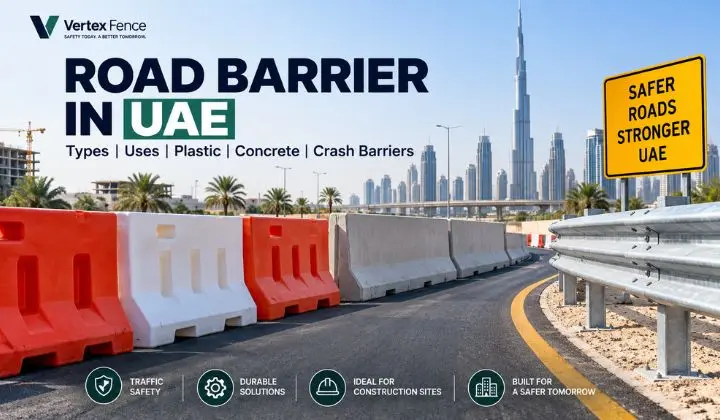
Road barriers are used to separate traffic, guide vehicles, protect work areas, and control access on roads and construction sites. In the UAE, you can see different types of barriers around road projects, construction zones, temporary diversions, medians, parking areas, and other sites where traffic needs to be controlled safely.
The right road barrier depends on the job. A lightweight plastic barrier may work well for temporary traffic control, while a concrete or engineered steel system may be needed where stronger vehicle containment or vehicle redirection is required.
In this guide, we will explain the main types of road safety barriers, how plastic, concrete, and steel barriers differ, what crash barriers are used for, and what you should check before choosing a barrier for a UAE project.
What Is a Road Barrier?
A road barrier is a physical safety device used to control or separate vehicles, pedestrians, or work areas. Its purpose can range from guiding traffic around a construction zone to creating a strong physical separation between vehicles and a roadside hazard.
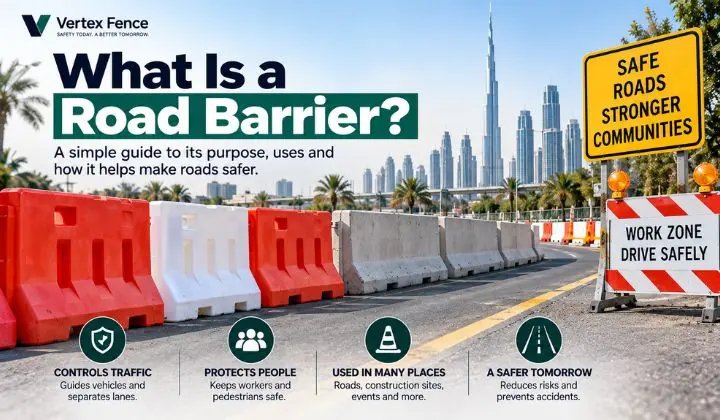
The term road barrier covers several different products. These can include plastic road barriers, concrete barriers, steel guardrails, temporary barriers, and engineered crash barriers.
However, these products do not all provide the same level of protection.
For example, a lightweight plastic unit may be designed mainly for traffic channelization or visibility. It should not automatically be treated as a vehicle restraint system simply because it is called a safety barrier.
For vehicle-impact applications, the complete barrier system matters. Its design, connections, installation, and tested performance all need to match the intended use.
What Is the Barrier on the Road Called?
There is no single name for every type of barrier found on a road.
Depending on its purpose and design, it may be called a traffic barrier, safety barrier, crash barrier, guardrail, barricade, or road divider.
These terms are related, but they are not interchangeable.
A guardrail or crash barrier is generally intended to manage vehicle impacts, while a temporary barricade may mainly warn drivers, close a road section, or guide traffic.
This difference is important when selecting a product. A barrier designed for visibility and traffic guidance may not provide the protection required from an errant vehicle.
What Are the Different Types of Road Barriers?
Road projects have different safety needs, so there is no single barrier that works for every situation.
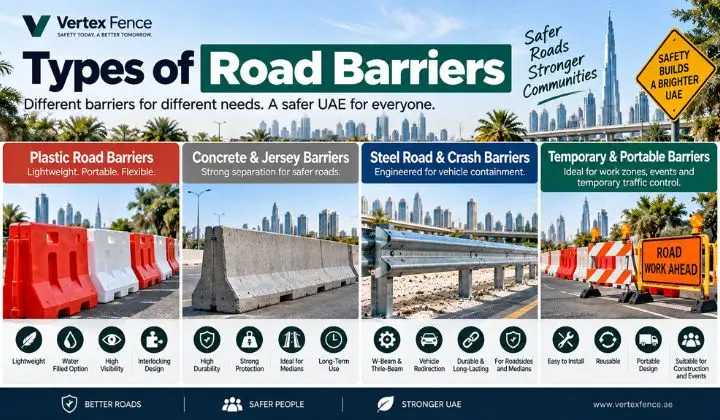
The most common types include plastic, concrete, steel, and temporary or portable systems.
Plastic Road Barriers
Plastic road barriers are commonly manufactured from HDPE (high-density polyethylene) or other durable polyethylene materials. They are widely used for temporary traffic control because they are much easier to move and transport than heavy concrete barriers.
Some designs are made as water-filled road barriers. The empty barrier is relatively easy to transport, and water is added at the site to increase its weight and stability.
Common features can include:
- Water ballast
- Interlocking sections
- High-visibility colors
- Reflective markings
- Lightweight construction
- Easy transportation
- Stackable designs
- Reusable construction
- UV resistance
- Weather resistance
Plastic barriers can be useful for temporary road barriers, construction zones, lane separation, pedestrian protection, and traffic management.
Their lightweight design is one of their biggest advantages. A project team can move them more easily when the work-zone layout changes.
However, buyers should check the exact purpose of the product. Not every plastic road barrier is designed for vehicle impact protection. Some are intended for channelization, while specially engineered systems may provide vehicle restraint when they have the required testing and are installed correctly.
Concrete & Jersey Barriers
Concrete road barriers are heavy-duty barriers made from precast or reinforced concrete. Their high mass provides strong physical separation and makes them useful for applications where a lightweight barrier would not be suitable.
A Jersey barrier is a common concrete barrier profile designed to help redirect vehicles after an impact when properly designed and installed.
Concrete barriers can be used for:
- Road medians
- Construction zones
- Long-term traffic separation
- Infrastructure projects
- High-risk work areas
- Security applications
- Temporary or permanent separation
One of the main benefits of concrete is its weight. It is difficult for normal traffic to move a properly installed heavy concrete barrier.
The same weight, however, creates a handling challenge. Moving concrete road barrier blocks normally requires suitable lifting equipment, transportation planning, and trained workers.
Concrete barriers are therefore better suited to projects where strong physical separation is more important than easy relocation.
Steel Road & Crash Barriers
Steel road barriers are commonly used in engineered vehicle restraint systems. They can be installed along roadsides, medians, bridges, curves, and other locations where an errant vehicle may encounter a roadside hazard.
Common steel barrier designs include W-beam crash barriers and Thrie-beam crash barriers.
Steel systems are not simply a metal rail placed beside the road. Posts, rails, spacers, terminals, connections, anchoring, and installation are all part of the system.
This is why a buyer should not select a road barrier steel system only by looking at the thickness or appearance of the steel.
For vehicle restraint applications, the complete system should meet the required performance level for the project.
Temporary & Portable Road Barriers
Temporary road barriers are designed for projects where traffic arrangements may change during construction or maintenance work.
They are commonly used for:
- Road construction
- Road maintenance
- Lane closures
- Temporary diversions
- Utility work
- Construction site access
- Events
- Pedestrian separation
- Work-zone traffic control
Portable road barriers are useful when the site team needs to move, remove, or reposition the barrier as the project progresses.
Plastic systems are often convenient for this type of work because they can be transported empty and, where designed for it, filled with water after installation.
Road Barrier vs Barricade vs Crash Barrier vs Safety Fence
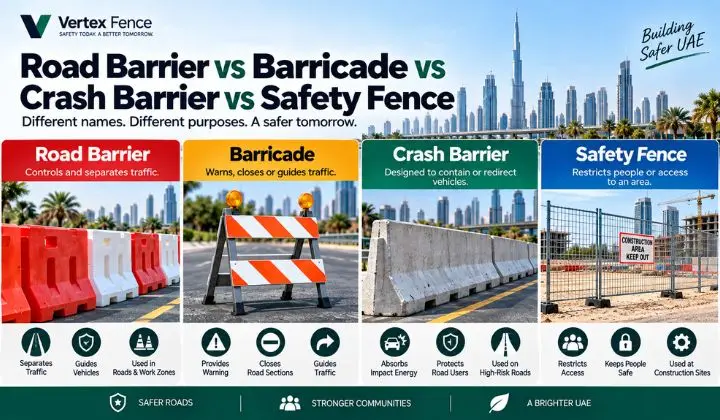
The terms road barrier, barricade, crash barrier, and safety fence are sometimes used as if they mean the same thing. They do not.
| Type | Main purpose | Common application |
| Road barrier | Separation and traffic control | Roads and work zones |
| Barricade | Warning, closure or channelization | Road closures and temporary works |
| Crash barrier | Vehicle containment or redirection | Roadsides and high-risk areas |
| Safety fence | Restrict people or access | Construction sites and perimeters |
A safety fence is mainly used to prevent people from entering a restricted area. It can protect a construction site from unauthorized access, but it is not automatically a vehicle restraint system.
A barricade can also have a different purpose. It may indicate that a road is closed, guide vehicles around a work area, or separate pedestrians from traffic.
A crash barrier, on the other hand, is designed for a much more specific safety function. Its purpose is to manage the movement and energy of an impacting vehicle.
This distinction matters on construction projects.
For example, a road work barrier may be suitable for directing traffic around an active work zone, while an engineered crash barrier may be required to protect workers from an errant vehicle.
Plastic vs Concrete vs Steel Road Barriers: Which Should You Choose?
There is no universal “best” road barrier.
The right option depends on the project’s purpose, traffic conditions, required protection, available space, installation method, and how long the barrier will remain in place.
| Factor | Plastic | Concrete | Steel |
| Mobility | High | Low | Medium |
| Empty weight | Low | Very high | Medium |
| Temporary use | Excellent | Possible | Possible |
| Long-term use | Depends on design | Excellent | Excellent |
| Water ballast | Some models | No | Usually no |
| Visibility | Usually high | Moderate | Moderate |
| Vehicle restraint | Only approved systems | Designed systems available | Designed systems available |
| Handling | Easy | Requires equipment | Requires installation |
| Typical use | Temporary traffic control | Strong separation | Vehicle restraint |
When Should You Choose a Plastic Road Barrier?
A plastic road barrier can be a practical choice when the main requirement is temporary traffic control, lane separation, work-zone channelization, or a barrier that can be moved easily.
Water-filled designs can also be useful when you need a barrier that is easy to transport before installation but becomes heavier after filling.
Plastic barriers are especially useful when a project layout changes regularly.
When Should You Choose a Concrete Road Barrier?
A concrete barrier can be suitable when strong physical separation and high mass are important.
It may make sense for long-term projects where barriers do not need to be moved frequently.
The trade-off is handling. Concrete requires more planning for transportation, lifting, placement, and removal.
When Should You Choose a Steel Road Barrier?
A steel system may be appropriate when the project requires engineered vehicle containment or vehicle redirection.
However, choosing steel alone does not mean the barrier is automatically suitable for crash protection.
The complete system needs to be designed, tested, and installed for its intended application.
A Simple Way to Choose
As a starting point:
Temporary traffic control → Plastic
Frequent relocation → Portable/modular barrier
Heavy physical separation → Concrete/Jersey barrier
Vehicle restraint or redirection → Engineered crash barrier
The final selection should always follow the project’s traffic-management plan and applicable road authority requirements.
What Is a Crash Barrier in Road Safety?
A crash barrier is a vehicle restraint system designed to help contain or redirect an errant vehicle and reduce the chance of the vehicle reaching a more dangerous area.
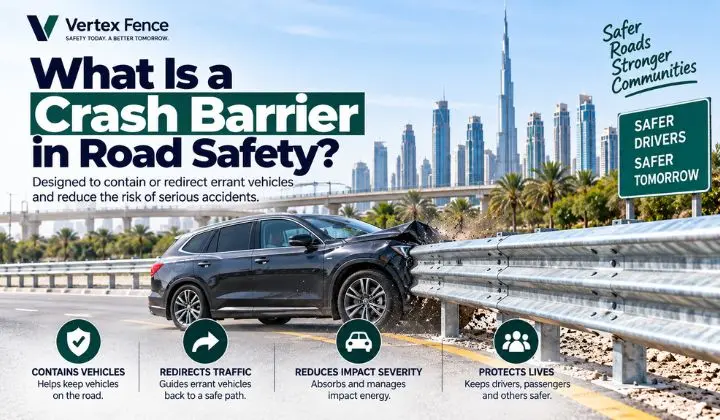
This makes it different from a simple warning device or lightweight traffic barricade.
Crash barriers can include steel guardrails, concrete barrier systems, and certain specially designed water-ballasted plastic systems. The actual performance depends on the complete system, including its connections and installation.
For this reason, a product should not be called “crashworthy” simply because it is heavy, made from steel, or filled with water.
W-Beam Crash Barriers
A W-beam crash barrier uses a steel rail with a W-shaped profile.
It is a common type of guardrail system used to help redirect vehicles away from roadside hazards.
The rail works together with posts and other components. The spacing, connections, terminals, anchoring, and installation all affect the way the system performs.
W-beam systems may be used along roadsides, curves, medians, and other locations where vehicle protection is required.
Thrie-Beam Crash Barriers
A Thrie-beam crash barrier has a deeper profile than a standard W-beam.
Its design can provide different containment characteristics and may be selected for applications where a more robust barrier arrangement is required.
The choice between W-beam and Thrie-beam should be based on the project’s design requirements, vehicle conditions, road layout, and required performance rather than appearance alone.
Road Median Barriers
A road median barrier separates opposing directions of traffic.
Its main purpose is to reduce the chance of a vehicle crossing the median and entering the path of opposing traffic.
Median barriers may use concrete, steel, or other approved systems depending on the road design.
Factors such as traffic speed, available median width, road geometry, vehicle types, and required containment level should be considered when selecting the system.
Crash Cushions
A crash cushion, also called an impact attenuator, is designed to manage the energy of a vehicle impact with a fixed hazard.
Unlike a normal longitudinal barrier, a crash cushion is often placed in front of objects such as barrier ends, structures, or other hazards that could create a severe impact.
These systems are engineered products. Their approved components, installation arrangement, and maintenance requirements should be followed carefully.
Road Barrier Dimensions, Weight and Specifications
There is no single standard size or weight for every road barrier. Dimensions depend on the material, design, manufacturer, and intended application.
When comparing products, do not look at length alone. A barrier’s height, base width, weight, connection system, and ballast capacity can all affect how it works on site.
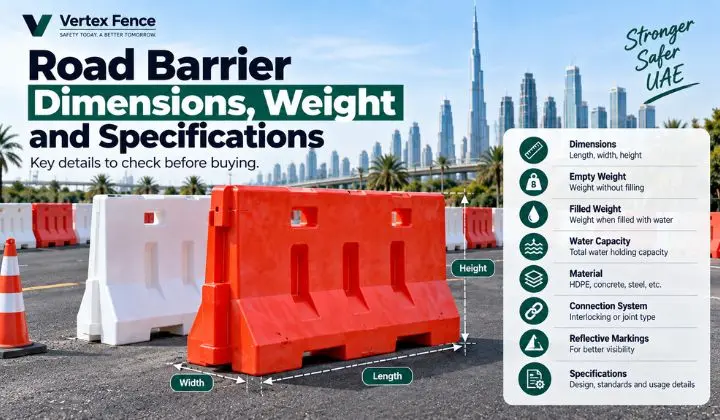
For plastic road barrier dimensions, check the following specifications:
- Overall length
- Height
- Base width
- Empty weight
- Filled weight
- Water capacity
- Connection or interlocking system
- Filling and drainage openings
- Reflective markings
- Material type
For concrete road barrier dimensions, also check the barrier profile, segment length, height, width, reinforcement, lifting points, connection method, and total weight.
These details are important when planning transportation and installation.
Why Does Road Barrier Weight Matter?
Weight affects how a barrier is transported, moved, installed, and kept stable.
A plastic barrier may be relatively light when empty. If it is designed as a water-filled unit, its weight increases after filling, which can improve stability.
Concrete barriers are heavy from the beginning. They normally require suitable lifting equipment for loading, transportation, placement, and removal.
This is why you should always use the manufacturer’s stated weight instead of estimating it from the barrier’s appearance.
What About Concrete Road Barrier Weight?
Concrete road barrier weight depends on its length, width, height, profile, concrete density, and reinforcement.
There is no universal weight for every concrete barrier. Two barriers with the same length can weigh very differently if their cross-sections are different.
The same applies when someone asks about the weight of a 20 ft concrete barrier. The length alone is not enough to calculate an accurate weight.
For transport and lifting, use the supplier’s actual product specification, including lifting points and handling requirements.
How Much Does a Road Barrier Cost in UAE?
The cost of a road barrier in the UAE depends on the product and the requirements of the project.
For plastic road barriers price, the main factors can include:
- Material quality
- Barrier dimensions
- Water capacity
- Quantity required
- Reflective markings
- Interlocking design
- Custom colors
- Delivery distance
- Installation
- Project duration
For concrete road barriers prices, additional factors may include the concrete specification, reinforcement, mould design, segment size, lifting requirements, transportation, and installation.
This is why there is no single price that applies to every road barrier.
If you are comparing concrete road barriers for sale or plastic road barriers for sale, compare the complete offer rather than only the price per unit.
For example, one supplier may quote only the barrier, while another may include delivery, accessories, installation, or other required components.
What Can Make a Road Barrier More Expensive?
A larger or heavier barrier usually needs more material and can also cost more to transport.
Special features can also affect the price. These may include reflective markings, custom dimensions, special connections, water-filling systems, lifting points, or project-specific requirements.
For larger projects, quantity can also affect the final quotation.
The best approach is to give the supplier the project details and request a quotation based on the exact application.
How to Choose the Right Road Barrier for Your Project
Start by asking one simple question:
What does the barrier need to protect or control?
The answer will help narrow down the right system.
For Temporary Traffic Control
A plastic road barrier may be suitable when the main purpose is to guide traffic, separate lanes, protect a temporary work area, or control movement around a construction zone.
If the layout changes often, plastic barriers can also be easier to move than concrete systems.
For Frequent Relocation
Choose a portable road barrier or modular system when the project requires barriers to be moved or repositioned regularly.
This can be useful for road maintenance, changing work zones, events, and temporary construction layouts.
For Heavy Physical Separation
Concrete or Jersey barriers may be more suitable when high mass and strong physical separation are required.
They can be useful for long-term applications where frequent relocation is not expected.
For Vehicle Containment
If the barrier needs to protect road users or workers from an errant vehicle, the requirement is different.
You need an engineered road safety barrier system that has the appropriate performance for the application.
Do not assume that a normal plastic barrier can replace a concrete or steel crash barrier.
Some specially designed plastic systems can be used for vehicle restraint when they meet the required testing and installation requirements, but this must be confirmed for the specific product.
Check These Factors Before Ordering
Before ordering, check:
- Road speed — The required barrier system can change as vehicle speed increases.
- Traffic conditions — Consider traffic volume and vehicle types.
- Work-zone layout — Make sure there is enough space for the barrier and required clearance.
- Barrier purpose — Channelization and vehicle restraint are different requirements.
- Dimensions — Confirm the barrier fits the available space.
- Connection system — Check how individual sections connect.
- Visibility — Consider high-visibility colors and reflective markings.
- Installation — Understand how the barrier must be placed, filled, connected, or anchored.
- Authority requirements — Follow the relevant project and road authority requirements.
- Maintenance — Have a plan for inspecting damaged or displaced barriers.
This checklist can prevent a common mistake: buying a barrier based only on price or appearance without checking whether it is suitable for the actual site.
How to Choose a Road Barrier Supplier in UAE
Choosing among road barriers suppliers should involve more than comparing unit prices.
A reliable supplier should be able to explain the product’s material, dimensions, weight, intended use, connection method, and installation requirements.
If you are looking for plastic road barriers suppliers in UAE, ask whether the product is intended for:
- Traffic channelization
- Temporary road works
- Pedestrian separation
- Lane separation
- Vehicle restraint
These applications are not the same.
If you need a concrete road barriers supplier in UAE, ask for the exact dimensions, weight, reinforcement details where relevant, lifting points, connection method, transportation requirements, and installation details.
For a crash barrier, ask for the relevant test or approval information rather than relying only on descriptions such as “heavy duty,” “strong,” or “high strength.”
What Should You Check Before Buying?
Use this quick supplier checklist:
- Product material
- Actual dimensions
- Empty and filled weight
- Water capacity, if applicable
- Connection method
- Reflective markings
- Intended application
- Technical documentation
- Test or approval information where required
- Delivery capacity
- Installation support
- Available quantity
- Replacement or after-sales support
This helps you compare suppliers based on product suitability, not just price.
For UAE construction and site projects, a supplier such as Vertex Fence can be considered alongside other local suppliers, but the barrier should always be matched to the project’s actual traffic-management requirements.
FAQs
Can Plastic Road Barriers Be Filled With Water?
Yes. Some water-filled road barriers are specifically designed to be filled with water to increase their weight and stability.
However, not every water-filled barrier is designed for vehicle impact protection, so its intended application and performance should be checked before use.
Can Road Barriers Be Reused After a Construction Project?
Yes, many modular plastic barriers can be reused if they are still in good condition and suitable for the next application.
Before reuse, inspect them for cracks, deformation, damaged connections, missing parts, and other damage that could affect stability or performance.
What Should I Check Before Ordering Road Barriers in the UAE?
Check the barrier’s purpose, material, dimensions, weight, connection system, visibility features, delivery requirements, and required performance level.
For road-work projects, also confirm that the selected system matches the approved traffic-management plan and applicable authority requirements.
Why Do Road Barriers Need to Be Connected Together?
Connecting individual barrier sections can create a continuous system and help the barriers work as designed.
For vehicle-restraint applications, the connection method is especially important, so sections should be connected according to the manufacturer’s instructions or the applicable project requirements.
Can a Plastic Road Barrier Replace a Concrete or Steel Crash Barrier?
Not automatically. A standard plastic barrier may be suitable for temporary traffic control, channelization, or separation, but a vehicle-restraint application requires a system designed for that purpose.
Some specially engineered plastic barriers can provide vehicle restraint when they meet the required testing and installation requirements.
Conclusion
Choosing the right road barrier is about matching the barrier to the job.
Plastic barriers are useful for many temporary applications because they are lightweight, portable, highly visible, and available in water-filled designs. Concrete and Jersey barriers provide high mass and strong physical separation, while engineered steel systems can provide vehicle restraint and redirection where required.
Before buying, check the barrier’s dimensions, weight, material, connection system, intended use, installation method, and required safety performance.
If you are comparing road barriers for sale in the UAE, do not choose only by the lowest price. Compare the complete product, its specifications, delivery requirements, and whether it is suitable for the conditions of your project.
The safest approach is to select a barrier that matches the project’s traffic-management requirements and use a supplier that can provide clear specifications and appropriate support.