
 Fences
 Gates
 Signage & Boards
 Car Parking Shades
 Block and Foundation
 Spare Parts
Precast Concrete: Types, Uses, Benefits & Applications in UAE

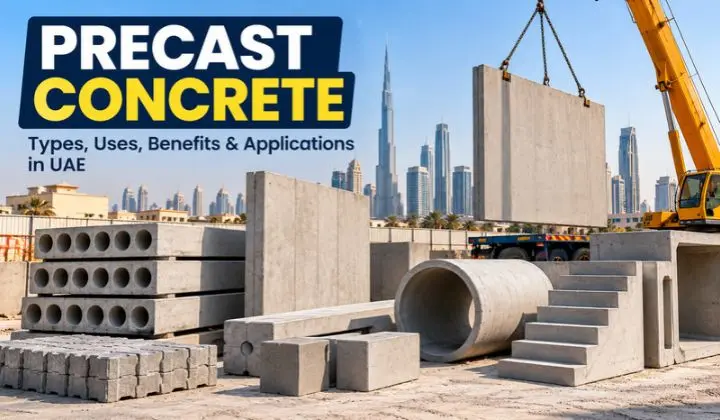
Precast concrete is a type of concrete that is made, poured and cured in a controlled factory or production facility instead of being cast directly at the construction site. Once the concrete becomes strong enough, the finished product is transported to the project location and installed.
It can be used to make many building and infrastructure products, including precast concrete walls, precast panels, beams, columns, slabs, stairs and drainage products. These components are produced according to project drawings and required measurements.
Unlike traditional site-cast concrete, precast products are made before they are needed at the construction site. This can help contractors complete projects faster because several components can be manufactured while other site work is still in progress.
How Does Precast Concrete Work?
The process starts with a design. Engineers prepare drawings that show the product’s size, shape, reinforcement and load requirements. The factory then prepares a mould and places the required steel reinforcement inside it.
Concrete is poured into the mould, compacted and allowed to cure. After it reaches the required strength, workers remove the product from the mould and inspect it. The finished component is then delivered to the construction site.
At the site, a crane or other suitable equipment may be used to lift and position larger components. Workers connect them according to the approved installation drawings.
For example, a project may use factory-made wall panels instead of building every wall with blocks and mortar on-site. This can reduce some on-site work, but the design, transport and installation still need careful planning.
What Materials Are Used in Precast Concrete?
The main materials are cement, water, fine aggregate such as sand, and coarse aggregate such as gravel or crushed stone. Some mixes also contain concrete admixtures to improve workability, setting time or other required properties.
Steel reinforcement, such as reinforcing bars (rebar) or welded steel mesh, may be added when the product needs to resist tensile forces. Some structural products also use prestressed concrete technology, where steel strands are tensioned to improve performance under load.
The exact concrete mix design depends on the product, its intended use, exposure conditions and engineering requirements. Not every precast product uses the same mix or reinforcement.
How Is Precast Concrete Manufactured?
Precast concrete is manufactured through a planned production process. Factory production allows manufacturers to control materials, moulds, measurements and curing conditions more closely than is usually possible with uncontrolled site casting.
The exact process may differ depending on whether the factory is making a wall panel, slab, beam, pipe or another component.
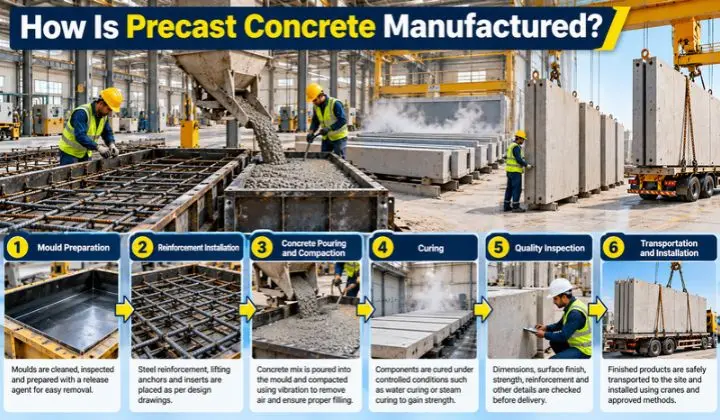
Mould Preparation and Reinforcement
First, workers select a mold based on the approved product design. The mould is cleaned, checked and prepared with a suitable release agent so the finished concrete can be removed without unnecessary damage.
Next, workers place the steel reinforcement according to the design drawings. They also position lifting anchors, connection plates, inserts or other required fittings.
Correct placement matters. Reinforcement must have the specified cover and position to help protect the steel and provide the strength required by the design.
Concrete Pouring, Compaction and Curing
The concrete mix is prepared using the specified materials and proportions. Workers pour it into the mould and use suitable vibration or compaction methods to remove trapped air and help the concrete fill the mould properly.
After pouring, the concrete is cured under controlled conditions. Concrete curing helps the cement react with water and allows the material to develop strength.
Some factories use water curing, curing compounds or controlled steam curing, depending on the product and production method. The component should not be removed, lifted or transported until it has reached the required strength for that operation.
Quality Inspection, Transportation and Installation
After curing, the product is removed from the mold and inspected. Checks may include dimensions, surface condition, visible cracks, reinforcement details and test results required by the project specification.
The product is then marked, stored and prepared for delivery. During transportation, components need proper support and secure loading to prevent damage.
At the construction site, the installation team checks the foundations, lifting arrangements, alignment and connection details. Larger components may require cranes and temporary supports. Precast concrete installation should follow approved drawings and the manufacturer’s instructions.
Different Types of Precast Concrete
Precast concrete is available in many shapes and sizes. The right product depends on the building design, expected loads, site conditions and purpose of the project.
Here are some common precast concrete products used in construction and infrastructure.
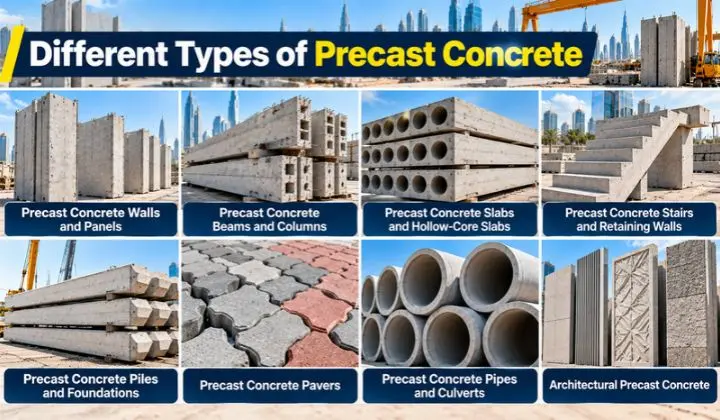
Precast Concrete Walls and Panels
Precast concrete walls are manufactured in a factory and delivered to the site as finished wall sections. They can be used for building walls, industrial buildings, boundary walls and perimeter security systems.
Precast concrete panels may be solid, insulated or designed with decorative finishes. Their thickness, reinforcement and connection details depend on the required structural performance.
For projects that need a clear and durable boundary, precast wall systems can offer a practical alternative to building a wall entirely on-site. However, the foundation and panel connections must be designed for the site conditions and expected loads.
Precast Concrete Beams and Columns
Precast concrete beams and columns are structural components used to support floors, roofs and other parts of a building.
Beams transfer loads to columns, while columns carry those loads down to the foundations. These elements are designed according to the building’s structural requirements.
They are often used in warehouses, factories, commercial buildings and other projects where a planned structural system can help speed up construction.
Precast Concrete Slabs and Hollow-Core Slabs
Precast concrete slabs are floor or roof components manufactured before delivery to the site. They can reduce the amount of concrete casting and formwork needed on-site.
Hollow-core slabs contain long internal voids that reduce their weight while providing an efficient structural form. They are commonly used in suitable floor and roof systems.
The span, thickness, loading capacity and support details must be checked by a qualified structural engineer before selecting a slab.
Precast Concrete Stairs and Retaining Walls
Precast concrete stairs are factory-made stair sections or flights that can be installed as part of a building. They help reduce the need to cast staircases on-site and can provide consistent dimensions.
Precast retaining walls are used to hold back soil where there is a difference in ground level. Their design must consider soil pressure, drainage, foundation conditions and stability.
Precast Concrete Piles and Foundations
Precast concrete piles are manufactured structural elements driven or installed into the ground to transfer building loads to stronger soil or rock layers.
Precast concrete foundation products may also include specially designed footings or other foundation components. Their use depends on the soil investigation, structural design and construction method.
These products are not suitable for every site. A geotechnical and structural assessment is needed to select the correct foundation system.
Precast Concrete Pavers, Pipes and Culverts
Precast concrete pavers are individual units used for walkways, outdoor areas, parking spaces and suitable paved surfaces. They are available in different shapes, sizes and finishes.
Precast concrete pipes are used in drainage and underground water systems. Precast concrete culverts allow water to pass beneath roads, embankments and other structures.
Other related products include manholes, cable trenches and drainage channels. Their specifications depend on the expected loads, water flow and installation conditions.
Architectural Precast Concrete
Architectural precast concrete is made for both appearance and building performance. It may include decorative wall panels, façade elements, textured surfaces and custom shapes.
Manufacturers can produce different colours, patterns and finishes using suitable moulds and surface treatments. This gives architects more design options while keeping production in a controlled facility.
Applications of Precast Concrete in UAE
Precast concrete is used in many types of construction across the UAE. Its factory-based production can be useful for projects that need repeated components, planned installation and consistent product dimensions.
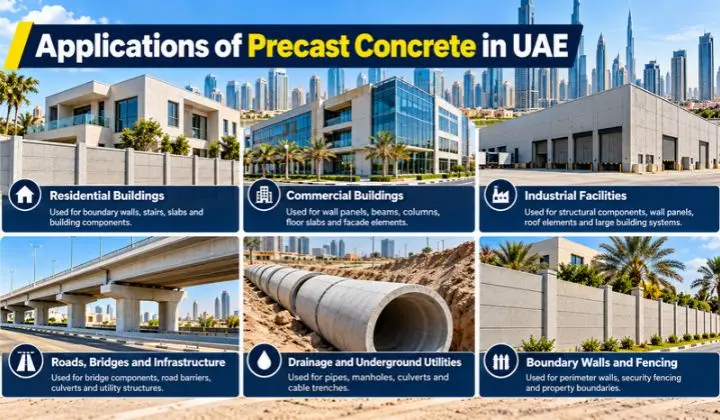
Residential and Commercial Buildings
In residential projects, precast products may be used for wall panels, stairs, slabs, boundary walls and other building components.
Commercial buildings can use precast beams, columns, floor slabs and façade panels. These products may help contractors organise construction work and reduce some on-site activities.
Industrial Facilities and Warehouses
Factories, warehouses and logistics facilities often need large structural spaces and repeated building components. Precast beams, columns, roof elements and wall panels can be suitable for these projects.
The final design must consider the building’s loads, equipment requirements, fire safety and other project conditions.
Roads, Bridges and Infrastructure
Precast concrete is also used in infrastructure projects. Common examples include road barriers, bridge components, drainage products, culverts and utility structures.
Factory-made components can be useful where construction work needs to follow a planned schedule or where reducing on-site casting is important.
Drainage and Underground Utilities
Underground infrastructure uses products such as precast pipes, manholes, inspection chambers and cable trenches. These components help create access points and routes for drainage and utility networks.
Correct product selection is important because underground components may face soil pressure, groundwater, traffic loads and exposure to different environmental conditions.
Boundary Walls and Fencing
Boundary walls and perimeter fencing are relevant applications of precast concrete in residential, commercial and industrial properties.
Precast wall panels can be installed between suitable support structures to create a defined boundary. The design should account for wall height, wind loads, foundation strength, panel connections and site conditions.
For fencing projects, it is also important to distinguish between a complete precast wall system and individual concrete support or foundation products. Companies such as Vertex Fence work in the fencing and boundary solutions space, where the correct supporting products and installation method should match the project requirements.
Advantages and Disadvantages of Precast Concrete
Precast concrete offers several benefits, but it also has limitations. Understanding both sides helps property owners, contractors and project managers choose the right construction method.
Key Advantages of Precast Concrete
1. Faster Construction
Factory production can take place while foundations or other site work are being completed. Once the components are ready, they can be delivered and installed according to the project schedule.
2. Consistent Product Quality
A controlled production facility can help maintain consistent mix proportions, mould dimensions and curing conditions. Regular inspection and testing also help manufacturers check whether products meet the required specifications.
3. Less On-Site Work
Because components are manufactured before delivery, some activities such as formwork, pouring and curing can be reduced at the construction site. This may also help reduce site waste and labour needs.
4. Better Control Over Finishes
Factory-made products can be produced with smooth, textured or decorative finishes. Reusable moulds can also help manufacturers maintain similar shapes and surface details across repeated units.
5. Suitable for Repeated Designs
Precast systems can be useful when a project requires many similar walls, slabs, beams or other components. Repeating the same design can make production and installation easier to plan.
Common Disadvantages and Challenges
1. Transportation Limitations
Large or heavy components need suitable vehicles, loading arrangements and delivery routes. Transport restrictions may affect the size of products that can be delivered to a site.
2. Need for Lifting Equipment
Many structural components require cranes or other lifting equipment. This adds planning, access and equipment costs, especially where the site has limited space.
3. Limited Changes After Manufacturing
Once a component has been cast and cured, changing its size, openings or reinforcement can be difficult. Design details should be checked and approved before production starts.
4. Connection and Joint Requirements
Precast components must be connected correctly to work as part of a complete structure. Poorly designed or installed joints can cause alignment, water leakage or structural problems.
5. Higher Initial Planning Needs
Precast construction requires early coordination between designers, manufacturers, transport teams and installers. For small or highly customised projects, this planning may make precast less practical than casting concrete on-site.
The best choice depends on the project design, location, quantity of components, transport access, budget and construction schedule. Precast concrete is not automatically cheaper or better for every project.
Precast Concrete vs Cast-in-Place Concrete
Precast concrete and cast-in-place concrete are two common construction methods. The main difference is where the concrete is poured and cured.
Precast concrete is manufactured in a factory and transported to the site. Cast-in-place concrete is poured directly into formwork at the construction site and allowed to harden there.
Both methods have their own benefits. The right option depends on the project design, construction schedule, site access and budget.
Key Differences in Construction, Cost and Quality
| Comparison | Precast Concrete | Cast-in-Place Concrete |
| Production | Made in a factory | Poured at the construction site |
| Quality control | Controlled factory conditions | Depends on site conditions and supervision |
| Construction speed | Can reduce on-site construction time | Requires on-site pouring and curing |
| Transportation | Finished components must be delivered | Raw materials are delivered to the site |
| Equipment | May need cranes and lifting equipment | May need formwork, pumps and other equipment |
| Design changes | Changes after production can be difficult | Some changes may be easier before pouring |
| Best suited for | Repeated or planned components | Custom shapes and site-specific structures |
Cost also depends on more than the concrete itself. Precast construction may reduce some site labour and formwork costs, but transportation, lifting and installation can increase the total expense. Cast-in-place concrete may be more practical where transport access is limited or the design requires complex shapes.
Which Construction Method Is Better?
Neither method is always better. Precast concrete can be a good choice when a project needs many similar components, a controlled production process or a shorter on-site construction period.
Cast-in-place concrete may be more suitable for irregular shapes, complex foundations or projects where transporting large components is difficult.
Before choosing, compare the complete project cost, structural requirements, site conditions and construction schedule. A qualified engineer should review the design before the final decision.
Precast Concrete Cost in UAE: What Affects the Price?
The cost of precast concrete in the UAE depends on the type of product, its size, design, quantity and installation requirements. A standard concrete block, a large structural wall panel and a custom architectural element will not have the same price.
There is no single price that applies to every project. The best way to estimate the cost is to prepare a clear specification and request quotations from suitable manufacturers.
Material, Design and Manufacturing Costs
Several factors affect the manufacturing price:
- Concrete grade: The required concrete strength and mix design can affect material costs.
- Product dimensions: Larger or thicker components generally require more material.
- Steel reinforcement: The amount and type of reinforcement affect the final price.
- Product design: Custom shapes, special finishes and built-in fittings may require additional work.
- Order quantity: Large orders may offer production efficiencies, depending on the factory and design.
- Quality requirements: Testing, inspection and certification requirements may add to the production cost.
For example, a standard precast concrete slab and a custom-designed architectural panel need different production processes. Their prices should not be compared without checking their specifications.
Transportation and Installation Costs
Manufacturing is only one part of the total cost. Finished components must be moved safely from the factory to the project site.
Transportation costs may depend on the distance, product weight, dimensions, vehicle type and delivery route. Large components may need special transport arrangements.
Installation costs can include cranes, lifting equipment, skilled workers, temporary supports, connection materials and site preparation. Difficult access or limited working space may also increase the expense.
When requesting a quotation, ask the supplier to separate manufacturing, delivery and installation charges. This makes it easier to compare different offers and understand the full precast concrete price.
Leading Precast Concrete Manufacturers in UAE
The UAE has several companies involved in precast concrete manufacturing. They serve different market segments, including structural components, architectural products, hollow-core slabs and infrastructure systems.
The following are examples of established companies to consider when researching suppliers. This is not a ranking or an endorsement. Product availability, current certifications and project suitability should be checked directly with each company.
Major Precast Manufacturers in Dubai and Abu Dhabi
1. Gulf Precast
Gulf Precast operates manufacturing facilities in Abu Dhabi and Dubai. Its website describes production facilities for different precast systems, including hollow-core products. The company also lists residential, commercial and infrastructure work among its areas of activity.
2. Dubai Precast LLC
Dubai Precast provides precast concrete solutions and publishes information about its quality management and project inspection processes. Its stated quality system covers engineering, design, procurement, production, installation and inspection.
3. Al Wathba Cement Industries
Al Wathba Cement Industries is based in Abu Dhabi and describes its work as engineering, manufacturing and installation of precast concrete products. Its website lists infrastructure products such as culverts, tunnels, underpasses and MSE walls.
4. Alcon Concrete Products
Alcon is based in Dubai Industrial City. Its website highlights architectural precast elements and concrete street furniture, making it relevant for projects that require decorative or specially designed concrete products.
Precast Manufacturers in Other Emirates
Companies operating in the UAE may serve projects across different emirates, depending on their product range, transport arrangements and production capacity.
For example, Hi-Tech Concrete Products lists its location in the Industrial City of Abu Dhabi. Buyers looking outside Dubai and Abu Dhabi can also search for local manufacturers and concrete product factories in Sharjah, Ajman and Ras Al Khaimah.
However, a company’s location does not automatically mean it supplies every type of precast product. Always confirm its current product range and delivery coverage before including it in a project shortlist.
How to Choose the Right Precast Concrete Supplier
Choosing a supplier involves more than comparing quotations. A suitable manufacturer should be able to meet the project’s technical, quality and delivery requirements.
Use this checklist before placing an order:
- Check product experience: Ask whether the manufacturer has produced similar components for previous projects.
- Review technical drawings: Confirm dimensions, concrete specifications, reinforcement and connection details.
- Ask for quality documents: Request relevant test reports, inspection records and applicable certificates.
- Check production capacity: Make sure the factory can complete the order within the required schedule.
- Confirm delivery arrangements: Discuss transport, unloading, storage and access to the construction site.
- Understand installation support: Confirm whether the supplier provides installation or works with a separate contractor.
- Compare complete quotations: Review manufacturing, transportation, lifting and installation costs instead of comparing only the unit price.
A reliable supplier should be able to explain how its products meet the project’s drawings and specifications.
Precast Concrete Quality Standards and Testing
Quality is important because precast components may support buildings, carry loads or form part of infrastructure systems. A product should meet the requirements set by its approved design, relevant technical specifications and local regulations.
In Dubai, Dubai Municipality provides certification and factory assessment requirements for certain concrete products and manufacturing activities. These requirements are product-specific, so buyers should check which rules apply to the product they plan to purchase.
Concrete Strength and Compressive Testing
Compressive strength testing checks how much compressive force a concrete sample can withstand before failure. It helps determine whether the concrete meets the strength requirements in the project specification.
Depending on the product and project, manufacturers may also carry out checks on fresh concrete, such as workability, and maintain records of the concrete mix and curing process.
Test samples, testing ages and acceptance limits should follow the applicable project specification and testing standard. A test result should not be treated as proof that every part of a finished component is defect-free.
Reinforcement, Dimensions and Quality Inspection
Quality checks should cover more than concrete strength. They may include:
- Reinforcement inspection: Checking bar size, position, spacing and concrete cover against approved drawings.
- Dimensional inspection: Measuring length, width, thickness and other specified dimensions.
- Surface inspection: Checking for visible cracks, honeycombing, chips or other defects.
- Connection inspection: Checking lifting anchors, inserts, plates and connection details.
- Final inspection: Confirming that the component is correctly identified, stored and prepared for delivery.
For structural precast elements, the Dubai Building Code provides design requirements and refers to ACI 318-19 and the Precast/Prestressed Concrete Institute (PCI) Design Handbook. The applicable requirements depend on the project and the relevant authority’s approval.
Buyers should request the manufacturer’s inspection and test records and confirm that the products meet the approved project specifications before accepting delivery.
Frequently Asked Questions
Can Precast Concrete Be Customized for Different Project Requirements?
Yes. Precast concrete can be manufactured in different sizes, shapes, thicknesses and surface finishes. Manufacturers can also include openings, lifting points and connection fittings according to approved drawings. However, custom designs should be finalized before production because changes after casting can be difficult and expensive.
What Should You Check Before Ordering Precast Concrete Products?
Check the product dimensions, concrete strength, reinforcement details, approved drawings and quality documents. You should also confirm delivery charges, installation arrangements, production time and whether the supplier can meet the project’s requirements. For structural products, have the specifications reviewed by a qualified engineer.
Can Precast Concrete Be Used for Small Residential Projects?
Yes. Precast products can be used in suitable residential projects, including stairs, boundary walls, paving, slabs and drainage systems. However, the order quantity, transportation cost and access to lifting equipment should be considered. For a small project, casting concrete on-site may sometimes be more practical.
How Are Joints and Connections Between Precast Concrete Elements Sealed?
The method depends on the joint design and the purpose of the structure. Connections may use grout, sealants, gaskets, welded plates or mechanical fittings. Some joints also need water-resistant details to prevent leakage. The connection should follow the approved engineering drawings and manufacturer’s installation instructions.
Can Damaged Precast Concrete Elements Be Repaired or Replaced?
Minor surface damage may sometimes be repaired using an approved concrete repair material. However, deep cracks, exposed reinforcement, damaged connections or structural damage need professional inspection. A qualified engineer should decide whether the component can be repaired safely or needs replacement. Repairs should never hide a structural problem without addressing its cause.