 Fences
 Gates
 Signage & Boards
 Car Parking Shades
 Block and Foundation
 Spare Parts
Palisade Fence: Metal Security Fencing & Fence Panels in UAE

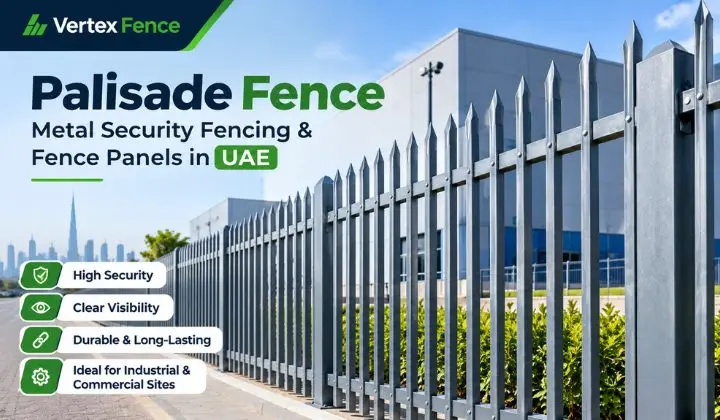
A palisade fence is a strong metal fencing system designed to protect commercial, industrial and restricted areas. It uses vertical steel pales connected to horizontal support rails and fixed to strong posts. Its design helps discourage climbing, control access and create a clear boundary around a property.
In the UAE, businesses often need reliable perimeter security for warehouses, factories, construction sites and other commercial facilities. Metal palisade fencing is one option worth considering because it combines a strong steel structure with a design that allows visibility through the fence.
However, choosing the right system involves more than selecting its height or appearance. Buyers should also consider the steel profile, pale thickness, protective coating, post design, ground conditions and installation requirements.
This guide explains how palisade fencing works, the different types of palisade fence panels, their main components and what buyers should check before choosing a system.
What Is Palisade Fencing?
Palisade fencing is a type of security fencing made from vertical metal sections called pales. These pales are attached to horizontal rails, which connect to supporting fence posts. The upper ends of the pales may have pointed or specially shaped designs to make climbing more difficult.
Unlike some solid boundary walls, a metal palisade fence allows people to see through the structure while still creating a strong physical barrier. This makes it useful for properties where security and visibility are both important.
The system is commonly used around industrial sites, warehouses, factories, utilities and commercial properties. Its height, profile, spacing and finish can be selected according to the property’s security needs and site conditions.
A palisade security fence is not automatically suitable for every security risk. Its actual performance depends on the complete system, including material quality, design, fixings, foundations and installation.
Main Components of a Metal Palisade Fence
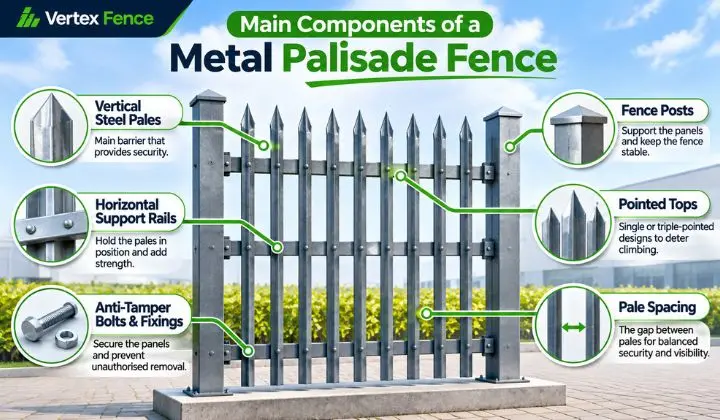
A palisade fence is made from several connected parts. Each component supports the strength, stability and function of the complete system.
1. Vertical Steel Pales
Steel pales are the vertical sections that form the main barrier. They are fixed to horizontal rails and arranged at suitable intervals along the fence.
Their profile, thickness, height and spacing can affect the overall design and security performance. Some systems use W-section pales, while others use D-section profiles.
2. Horizontal Support Rails
Horizontal support rails hold the vertical pales in position and connect them to the fence posts. They help distribute loads across the panel and support the overall structure.
The number and dimensions of rails depend on the fence design and its required height.
3. Fence Posts
Fence posts support the panels and transfer loads to the ground or supporting surface. They may use different designs depending on the installation method and system requirements.
Correct post spacing, alignment and foundation design are important for a stable fence.
4. Anti-Tamper Bolts and Fixings
Anti-tamper bolts, security nuts and other specialist fixings connect the pales, rails and posts. Some systems use tamper-resistant or breakaway fasteners to make unauthorized removal more difficult.
The fixing type should match the manufacturer’s system specifications.
5. Pale Spacing and Pointed Tops
The pale spacing determines the gaps between the vertical sections. The top design may include single-pointed, triple-pointed or other shapes.
These design details affect the fence’s appearance, visibility and climbing deterrence. They should be selected according to the property’s security requirements.
Types of Palisade Fence Panels
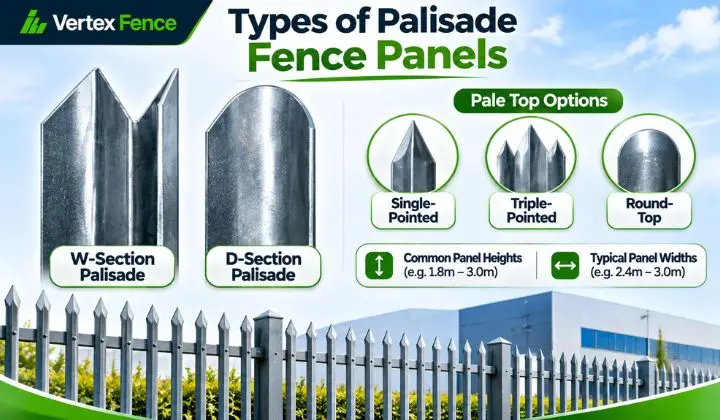
Different palisade fence panels are available to suit different security requirements and site designs. The main differences include pale profiles, top designs, panel dimensions and protective finishes.
W-Section Palisade Fencing
W-section palisade fencing uses pales with a W-shaped profile. The folded steel shape gives each pale a formed structure and creates the traditional appearance associated with many steel palisade systems.
It is commonly considered for industrial and commercial perimeter protection. Its suitability depends on the steel thickness, panel design, fixing method and complete system specifications.
D-Section Palisade Fencing
D-section palisade fencing uses pales with a D-shaped profile. The curved profile gives the fence a different appearance from W-section systems.
Both profiles can be used in security fencing, but buyers should compare their actual material specifications and construction rather than assuming one is always stronger than the other.
Single-Pointed and Triple-Pointed Pales
Palisade pales can have different top designs, including:
- Single-pointed pales: A simple pointed finish at the top.
- Triple-pointed pales: Multiple pointed tips that create a more aggressive security appearance.
- Round-top pales: A rounded finish where a less pointed appearance is required.
The choice should consider the required security level, site use and applicable safety requirements.
Different Fence Heights and Security Configurations
Palisade systems can be designed in different heights and configurations. A higher fence may be considered for locations that require stronger perimeter control, but height alone does not determine security.
Post strength, pale thickness, fixing details, foundations and site conditions also matter. Always confirm the available dimensions and configurations with the fencing supplier.
Palisade Fence Specifications: What Should Buyers Check?
Before purchasing steel palisade fencing, compare the technical specifications rather than relying only on photographs or general product descriptions.
Here are the main details to review:
| Specification | What to check |
| Fence height | Whether it suits the site’s security requirements |
| Panel width | The width of each panel or bay |
| Pale profile | W-section, D-section or another design |
| Pale thickness | The specified steel thickness |
| Steel quality | Material grade and supporting documentation |
| Rail dimensions | Size and construction of horizontal rails |
| Post dimensions | Post type, size and installation method |
| Fixings | Bolt type and tamper-resistance features |
| Protective finish | Galvanising, powder coating or another specified treatment |
Also ask for a clear product specification sheet. It should identify the materials, dimensions, finish and fixing arrangement being supplied.
This helps buyers compare different palisade fencing panels on a like-for-like basis. It also reduces the risk of receiving a system that differs from the one described in the quotation.
Benefits of Palisade Security Fencing
A well-designed palisade security fencing system can provide several benefits for industrial and commercial properties.
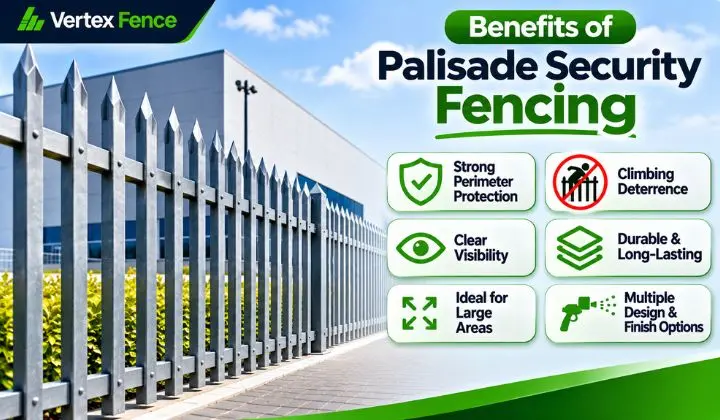
Strong Perimeter Protection
Steel pales and supporting rails create a physical barrier around the property. When correctly specified and installed, the system can help control access to restricted areas.
Climbing Deterrence
The vertical pale arrangement and selected top designs can make climbing more difficult. However, no standard fence should be described as completely climb-proof.
Visibility Through the Fence
Unlike a solid wall, palisade fencing allows visibility through the gaps between pales. This can help security staff monitor the surrounding area.
Suitable for Large Properties
The panel-based design makes it useful for warehouses, factories, industrial estates and other sites with long boundaries.
Different Design and Finish Options
Buyers can select different pale profiles, heights and protective finishes according to their project requirements and the manufacturer’s available options.
Where Is Industrial Palisade Fencing Used in UAE?
Industrial palisade fencing is commonly considered for properties that need a defined boundary and controlled access. Its suitability depends on the security requirements, site layout and selected system.
Warehouses and Factories
Warehouses and factories often store equipment, materials and valuable goods. A suitable palisade security fence can help protect their outer boundaries and separate restricted areas.
Construction Sites and Compounds
Construction sites may contain tools, machinery and building materials. Palisade fencing can help create a secure perimeter around these areas, subject to the project’s safety and access requirements.
Industrial Estates and Logistics Facilities
Large industrial and logistics properties may have long boundary lines and several access points. A modular steel fencing system can help organise these boundaries and support controlled entry.
Power Stations and Utility Facilities
Power stations, substations and water treatment facilities may require fencing around sensitive equipment and restricted zones. The required security specification should be based on a professional site assessment.
Commercial Properties and Schools
Some commercial premises and educational facilities use metal security fencing to define their boundaries and manage access. The design should also consider pedestrian safety, visibility and the needs of people using the site.
Galvanised vs Powder-Coated Palisade Fencing
The protective finish is an important factor when choosing metal palisade fencing, especially for outdoor projects in the UAE. Heat, humidity, dust and coastal conditions can affect exposed steel over time. The right coating helps protect the steel and supports its long-term performance.
Galvanised Steel Palisade Fencing
Galvanised steel palisade fencing uses a zinc coating to protect steel against corrosion. In hot-dip galvanising, steel components are coated with zinc through a controlled dipping process.
This protective layer helps reduce direct contact between the steel and moisture. It is commonly considered for outdoor industrial and commercial fencing.
When comparing products, ask whether the complete fence components are galvanised and request details of the coating specification. The quality and thickness of the zinc coating matter.
Powder-Coated Palisade Fencing
Powder-coated steel has a dry coating applied to its surface and cured to create a finished layer. It is available in different colours, making it useful for projects where appearance is also important.
A powder-coated finish can be applied over a suitable prepared metal surface. The preparation and coating process should follow the manufacturer’s specifications to support proper adhesion and protection.
Which Finish Is Suitable for UAE Conditions?
Both finishes can be suitable for outdoor fencing, but the right choice depends on the project location, exposure and maintenance needs.
For example, a fence near the coast may face greater salt exposure than one installed in an inland area. Buyers should ask about the corrosion protection system, surface preparation and coating documentation before selecting a product.
Do not judge a fence only by its colour or appearance. Check the actual protective finish and its specifications.
Palisade Fence Installation: What Should You Know?
Correct palisade fence installation is important for the strength, alignment and stability of the complete system. Even a well-made fence can perform poorly if its posts, foundations or fixings are not installed correctly.
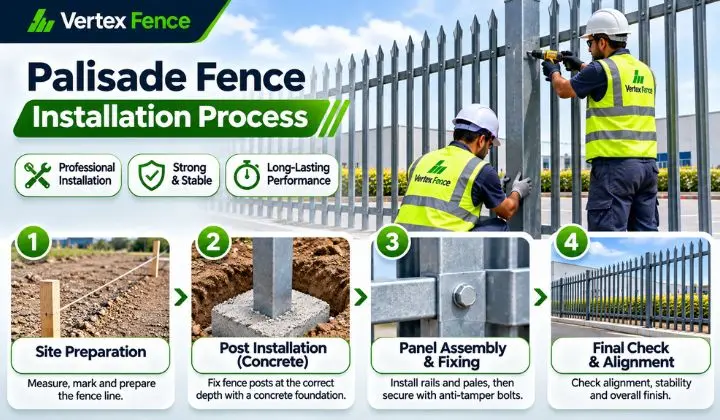
Here are the main stages to consider.
1. Site Inspection and Ground Preparation
The installation team should inspect the boundary before work begins. They need to check ground conditions, boundary measurements, underground services, access points and any obstacles.
Proper ground preparation helps determine the correct foundation and post arrangement.
2. Dig-In Posts vs Bolt-Down Posts
Two common installation methods are:
- Dig-in posts: These are placed into prepared holes and secured with suitable concrete foundations. They are commonly considered for installations in soil or ground where suitable foundations can be created.
- Bolt-down posts: These use base plates and suitable anchors to secure the posts to an existing concrete surface or foundation.
The correct option depends on the ground condition, concrete quality, expected loads and manufacturer’s design.
3. Concrete Foundations and Post Alignment
Posts must be installed at the correct positions and spacing. Their alignment and foundation depth should follow the approved design.
Poor alignment can create problems when fitting the panels and may affect the stability of the fence.
4. Installation on Sloping or Uneven Ground
Sites with uneven ground need careful planning. Depending on the slope and system design, installers may use stepped panels or a suitable self-raking arrangement.
The best method depends on the fence system, ground profile and required clearance. Confirm the available installation options with the supplier.
5. Panel Assembly and Security Fixings
After the posts are prepared, the rails, pales and approved fixings are assembled according to the manufacturer’s instructions.
The installation team should check panel alignment, connections, spacing and gate positions before completing the work.
Palisade Fence Gates and Access Control
A complete palisade security fencing system may also require gates for people, vehicles and maintenance access. Gates should match the fence design and provide suitable access control.
Pedestrian Palisade Gates
Pedestrian gates provide access for employees, visitors and authorised personnel. Their size, locking system and opening direction should suit the location and daily use.
Vehicle Access Gates
Vehicle gates are useful for warehouses, factories, industrial compounds and logistics facilities. Depending on the site, buyers may consider single-leaf or double-leaf gate designs.
Gate Locking and Access Control Options
Gates can be designed with suitable locks and access control equipment. Options may include key-operated locks, electronic access systems or other controlled-entry solutions.
Always check gate dimensions, post support and hardware compatibility before ordering.
How Much Does Palisade Fencing Cost in the UAE?
The cost of palisade fencing in the UAE depends on the project specifications and installation conditions. There is no single price that applies to every property.
A small boundary with standard panels may have different costs from a large industrial project that requires taller fencing, special finishes and multiple gates.
Main Factors Affecting Palisade Fencing Prices
The main cost factors include:
| Cost factor | How it affects the price |
| Fence height | Taller systems may require more material and stronger support components |
| Steel thickness | Material thickness affects the amount of steel used |
| Pale profile | Different profiles and designs may have different costs |
| Protective finish | Galvanising and powder coating affect material and processing costs |
| Posts and foundations | Post type, spacing and ground conditions affect installation costs |
| Gates | Pedestrian and vehicle gates add materials and hardware |
| Installation | Labour, equipment, site access and project complexity affect the total |
| Delivery | Transport distance and order size can influence delivery costs |
How Much Would 20 Metres of Fencing Cost?
To estimate a 20-metre fence, first confirm the required panel or bay width.
For example, if the selected system has a panel width of 2.5 metres:
20 metres ÷ 2.5 metres = 8 panel bays
This gives an initial estimate of eight bays. However, the final layout may also require end posts, corner posts, additional support posts and gate openings.
The actual quotation should account for all materials, foundations, finishes, installation and delivery. Therefore, a site-specific measurement is the best way to calculate the total project cost.
If you are comparing palisade fencing prices, make sure every supplier is quoting for the same fence height, steel thickness, coating and installation scope.
Advantages and Disadvantages of Palisade Fencing
Before choosing a metal palisade fence, it is useful to understand both its benefits and limitations.
Advantages of Palisade Fencing
- Strong physical barrier: Steel pales and support rails create a defined boundary around a property.
- Climbing deterrence: Selected pale designs can make unauthorised climbing more difficult.
- Visibility: Gaps between the pales allow visibility through the fence.
- Flexible configurations: Different profiles, heights and finishes are available depending on the product range.
- Suitable for industrial sites: It can be used around warehouses, factories, utilities and other commercial properties.
- Repair options: Some panel-based systems allow individual components or sections to be replaced, subject to their design.
Disadvantages of Palisade Fencing
- Initial investment: It may cost more than some basic boundary fencing options.
- Industrial appearance: Its design may not suit properties that need a decorative or residential look.
- Installation requirements: Proper foundations, post alignment and secure fixings are essential.
- Corrosion protection: Damaged or unsuitable coatings may require inspection and maintenance, especially in exposed environments.
Considering these points helps buyers decide whether palisade fencing matches their property’s needs and budget.
How to Choose the Right Palisade Security Fence
Choosing the right palisade security fence requires more than comparing product prices. Buyers should consider the property’s security needs, site conditions and expected use.
Use this checklist before making a decision:
- Identify the security requirement: Decide whether the fence is intended for a warehouse, factory, construction site or restricted facility.
- Choose the right height: Select a height that suits the site’s boundary and security requirements.
- Compare pale profiles: Review W-section and D-section options and their actual specifications.
- Check steel thickness and quality: Request product details instead of relying only on general descriptions.
- Select a suitable finish: Consider galvanising or powder coating based on the property’s exposure and appearance requirements.
- Review the ground conditions: Confirm whether dig-in or bolt-down posts are suitable.
- Plan gates and access points: Include pedestrian and vehicle access in the initial layout.
- Compare complete quotations: Check materials, posts, fixings, foundations, delivery and installation.
If you are searching for palisade fences for sale or palisade fencing installers, ask suppliers for product specifications, installation details and a clear project quotation. This makes it easier to compare different options.
Why Choose Vertex Fence for Palisade Fencing in UAE?
Selecting a suitable fencing supplier is an important part of any perimeter protection project. Buyers should look for clear product information, suitable design options and support with project requirements.
Vertex Fence provides fencing solutions for commercial and industrial applications in the UAE. When discussing a palisade fencing project, share your site measurements, required fence height, preferred profile, protective finish and access requirements.
Before placing an order, ask for the relevant product specifications and confirm the available panel designs, post arrangements, gate options and installation scope.
A clear quotation based on your actual site requirements can help you understand the materials and work included in the project.
Contact Vertex Fence to discuss your fencing requirements and request a project quotation.
Frequently Asked Questions
Can palisade fence panels be replaced individually if one section gets damaged?
In many modular systems, a damaged panel or individual component can be replaced without removing the entire fence. However, this depends on the panel design, fixing arrangement and availability of compatible replacement parts. Ask your supplier whether individual sections can be replaced.
What should I check before accepting a palisade fencing quotation?
Check the fence height, panel width, pale thickness, steel profile, protective coating, post dimensions, fixings and foundation requirements. Also confirm whether gates, delivery, installation and any additional site work are included in the quoted price.
Can palisade fencing be installed on an existing concrete wall or surface?
It may be possible using bolt-down posts and suitable base plates. However, the concrete must be strong enough to support the fence and its expected loads. A site inspection should confirm the surface condition, anchor suitability and post arrangement.
Does the spacing between palisade fence pales affect security?
Yes. Pale spacing affects the size of the gaps between vertical sections and can influence climbing opportunities and visibility. The correct spacing should follow the fence system’s design and the property’s security requirements.
Can palisade fencing be extended or modified after installation?
In some systems, additional panels, replacement sections or gates can be added later. However, the existing posts, foundations, panel dimensions and fixing arrangements must be compatible with the proposed changes. A supplier or installer should assess the existing fence before modifications are made.