
 Fences
 Gates
 Signage & Boards
 Car Parking Shades
 Block and Foundation
 Spare Parts
Fence Wind Load Calculation: Formula, Factors & Examples

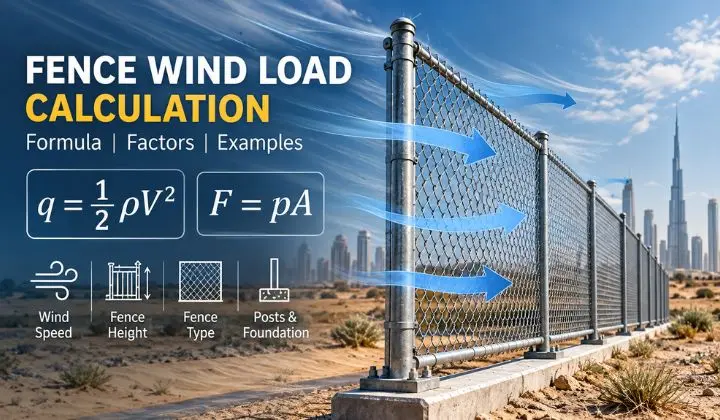
Wind can put strong sideways pressure on a fence. If the fence, posts or foundation cannot handle this force, the structure may bend, lean or fail. This is why fence wind load calculation is an important part of fence design, especially for tall fences, solid panels and fences installed in exposed areas.
A proper wind load on fence assessment considers wind speed, site exposure, fence height, surface area and the type of fence. The result helps engineers assess the loads on fence panels, posts, connections and foundations.
In this guide, you will learn the fence wind load formula, how to calculate wind force step by step, and how the result affects the fence structure. You will also learn why the same calculation method may not suit every fence.
What Is Fence Wind Load Calculation?
Fence wind load calculation is the process of estimating the force that wind applies to a fence. This force usually acts sideways against the fence surface. Engineers use it to check whether the fence and its supporting parts can safely resist the load.
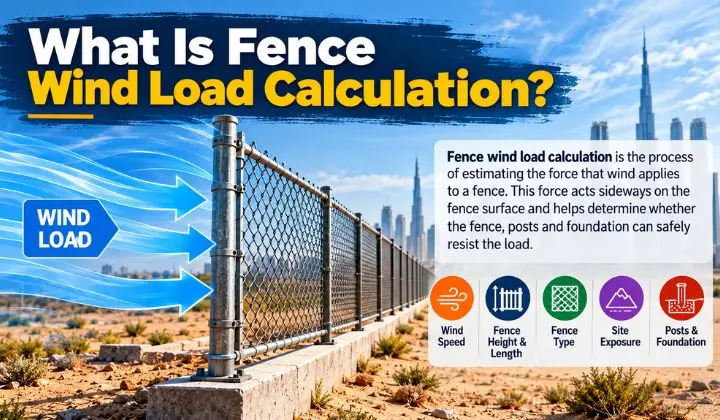
Wind does not affect every fence in the same way. A solid metal fence blocks most of the wind across its surface, while a chain-link fence allows air to pass through its openings. This difference can change the way wind loads are assessed.
A proper wind load calculation for fences should consider:
- Wind speed: The design wind speed selected for the site.
- Fence height and length: These dimensions help determine the exposed area.
- Fence porosity: The amount of open space in a mesh or panel.
- Wind pressure: The pressure used to assess the force on the fence.
- Structural support: The capacity of posts, rails, connections, anchors and foundations.
An incorrect estimate of the wind pressure on fence surfaces may lead to an unsuitable design. However, calculating wind pressure alone does not prove that a complete fence is safe. The supporting structure and ground conditions also matter.
Fence Wind Load Calculation Formula
There is more than one wind load calculation formula. The correct method depends on the purpose of the calculation, the fence configuration and the design standard that applies to the project.
1. Basic Wind Pressure Formula
For a simple physics estimate, wind pressure can be calculated using:
[
q=\frac{1}{2}\rho V^2
]
Where:
- (q) = basic dynamic wind pressure in pascals (Pa)
- (\rho) = air density in kilograms per cubic metre (kg/m³)
- (V) = wind speed in metres per second (m/s)
This formula shows an important relationship: wind pressure increases with the square of wind speed. If wind speed doubles, the basic dynamic pressure becomes four times as high, assuming air density stays the same.
However, this is a basic physics formula, not a complete structural design method. It does not automatically include exposure, topography, directionality or the force coefficients required for a specific fence.
2. Calculate Wind Force
For a simple example with uniform pressure over an exposed surface, use:
[
F=pA
]
Where:
- (F) = total force in newtons (N)
- (p) = pressure acting on the surface in pascals (Pa)
- (A) = exposed surface area in square metres (m²)
This is a useful wind force calculation relationship. For example, if a verified pressure acts uniformly over a known area, multiplying the pressure by that area gives the total force.
For a real fence design, the pressure must come from the appropriate design method. The engineer must also check whether the pressure is uniform and whether the selected area and force coefficients are suitable for the fence.
3. Code-Based Wind Pressure
Structural design standards use additional factors to account for site conditions and the behaviour of different structures. Under ASCE/SEI 7, wind design provisions depend on the type of structure and the procedure being used. The standard includes specific provisions for freestanding walls and other structures, so a building-wall equation should not automatically be applied to a fence.
A code-based assessment may consider:
| Factor | Why it matters |
| Basic design wind speed | Sets the starting wind condition |
| Exposure category | Represents the surrounding terrain |
| Topographic effects | Accounts for wind speed-up over certain landforms |
| Directionality | Accounts for the selected code’s treatment of wind direction |
| Force or pressure coefficient | Represents how the structure responds to wind |
| Fence openings | May affect the applicable method and loading |
Do not combine equations or coefficients from different editions of a standard without checking their compatibility. For example, the ASCE 7-16 method for wind loads on freestanding walls includes a force coefficient and specific conditions for solid walls and signs. That method should not be assumed to apply unchanged to every open mesh fence.
How to Calculate Wind Load on a Fence Step by Step
Follow these steps to understand the calculation process. A final structural design should use the applicable code and verified site information.
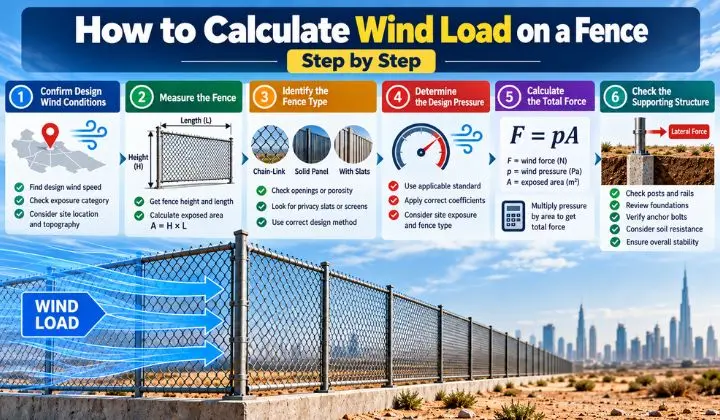
Step 1: Confirm the Design Wind Conditions
Find the required design wind speed for the project location and identify the applicable standard. Consider the site’s surrounding terrain and any relevant topographic effects.
Do not choose a wind speed simply because it is common in another project. The required value depends on the location, governing requirements and design conditions.
Step 2: Measure the Fence
Record the fence height and length. For a simple rectangular panel, calculate the gross area using:
[
A=H\times L
]
For example, a fence that is 2 metres high and 2.5 metres long has a gross area of 5 m².
This is the gross geometric area. For an open fence, the area and coefficients used for design must follow the applicable method; do not assume that mesh openings can always be handled by simply subtracting their area.
Step 3: Identify the Fence Type
Determine whether the fence is solid, partially open or made from chain-link mesh. Check for privacy slats, solid inserts, screens or other features that may change how wind acts on the fence.
The correct wind load on steel fence or chain-link system depends on its configuration, not only its material.
Step 4: Determine the Design Pressure
Use the applicable standard to determine the design pressure or force coefficient for the fence type and site conditions. Keep track of the units and the assumptions used.
Do not use a generic online pressure value as a substitute for a verified design value. A simple calculator can help explain the physics, but it may not cover all structural design requirements.
Step 5: Calculate the Total Force
When the selected method supports a uniform pressure assumption, multiply the pressure by the relevant area:
[
F=pA
]
The result is the estimated total force on that area. If pressure varies across the structure, or the design method requires a different procedure, the engineer must use that method instead.
Step 6: Check the Supporting Structure
The total force is only one part of the assessment. Engineers also need to evaluate the load on individual posts, bending, connections, anchorage and foundation stability.
The aim is not just to find a number. It is to check whether the whole fence system can safely resist the design load.
Fence Wind Load Calculation Example
Consider a simple example to understand the arithmetic behind a fence wind load calculation example.
Assume the following dimensions and pressure:
| Input | Example value |
| Fence height | 2 m |
| Fence length | 2.5 m |
| Gross area | 5 m² |
| Assumed uniform pressure | 0.8 kN/m² |
Important: The pressure of 0.8 kN/m² is an assumed value for demonstrating the calculation only. It is not a verified design pressure for the UAE or any specific project.
Step 1: Calculate the Area
[
A=2\times2.5=5\text{ m}^2
]
Step 2: Calculate the Force
Using (F=pA):
[
F=0.8\times5=4\text{ kN}
]
The calculated force is 4 kN, under the assumptions used in this example.
This does not mean that every 2 m × 2.5 m fence panel experiences 4 kN of wind force. The result changes with the actual design pressure, the applicable coefficients and the fence configuration.
What About the Load on Each Post?
You should not automatically divide the total force by the number of posts and treat the result as the final design load. The load carried by each post depends on post spacing, panel layout, end conditions and the structural system.
Wind Load Calculation for Different Fence Types
The correct fence wind load design method depends on the fence material, openings and support system. A chain-link fence and a solid steel fence may have the same height, but they can respond differently to wind.
Chain-Link Fence Wind Load Calculation
A chain link fence wind load calculation must account for the mesh openings and the way the fence is installed. Air can pass through an open mesh, but this does not mean the fence experiences no wind load.
Important factors include:
- Fence porosity: The amount of open space in the mesh.
- Solidity ratio: The proportion of the gross area occupied by solid material, as defined by the selected method.
- Mesh size and wire arrangement.
- Privacy slats, fabric or other additions that block the openings.
- The applicable design standard and force coefficients.
A chain link fence wind load calculator can help with an initial estimate if its calculation method matches the fence configuration. Before using the result for construction, check its assumptions and confirm whether the method is suitable for your project.
Steel and Solid Fence Wind Load Calculation
A solid or sheeted steel fence can expose a large surface to the wind. Its assessment must consider the panels, posts, rails and connections that transfer the force into the ground.
A steel fence wind load calculation should not rely on material strength alone. Steel panels may be strong, but the supporting posts or connections could still be weak points.
For a solid fence, engineers must use the applicable method for wind loads on freestanding walls or the relevant structure type. An open steel fence may require a different assessment based on its openings and configuration. Do not automatically use the same coefficients for both systems.
How Wind Load Affects Fence Posts and Foundations
Wind force travels from the fence panels into the rails, posts, connections and foundation. The ground must then resist the forces transferred through the foundation.

A complete fence structural engineering assessment looks at the full load path, not just the pressure on the fence surface.
Post Spacing and Bending Moment
Fence post spacing affects how the load is shared between posts. Each post supports a portion of the fence, depending on the layout and structural system. The tributary area helps engineers estimate the area contributing load to a particular support.
Wind force can also create a bending moment because it acts above ground level. A taller fence may create a greater overturning effect, depending on the pressure distribution and support conditions.
Foundation, Anchors and Soil
The fence foundation design must account for the forces transferred by the posts. Depending on the system, the assessment may include:
- Post embedment depth and foundation dimensions.
- Soil resistance and ground conditions.
- Anchor bolts and base plates.
- Concrete strength and connection capacity.
- Post bending and lateral deflection.
A stronger post cannot automatically fix an undersized foundation. Similarly, a strong foundation does not make a weak panel connection safe. Each component must work as part of the complete structure.
Wind Pressure Conversions and Common Calculation Mistakes
Wind pressure can be shown in different units. Converting between them helps readers understand calculations and compare results from different sources.
| Pressure | Approximate equivalent |
| 20 psf | 958 Pa or 0.958 kPa |
| 2,400 Pa | 2.4 kPa or 50.1 psf |
| 1 kPa | 1,000 Pa or 20.89 psf |
For example, if a uniform pressure of 2,400 Pa acts on an area of 5 m², the simple force calculation gives:
[
F=pA
]
[
F=2,400\times5=12,000\text{ N}=12\text{ kN}
]
This is a mathematical example, not a recommendation to use 2,400 Pa as the design pressure for a fence.
Common Mistakes to Avoid
- Confusing wind speed with wind pressure: They are related, but they are not the same measurement.
- Using the wrong exposed area: Gross area and effective design area may not be interchangeable.
- Ignoring fence openings: Chain-link mesh, privacy slats and solid panels may require different treatment.
- Mixing design standards: Equations and coefficients from different editions may not be compatible.
- Ignoring structural supports: A pressure calculation does not verify posts, anchors, foundations or soil.
- Trusting a calculator without checking its method: Always review its assumptions and limitations.
A wind speed to PSF calculator can provide a basic physics estimate, while a wind load calculator Excel sheet may help organize inputs and calculations. A fence wind load calculation PDF or wind load calculation example PDF is useful only if it explains its method, assumptions, units and applicable standard.
Tools and downloadable examples can support preliminary calculations, but they should not replace a required engineering review.
Fence Wind Load Design Considerations in the UAE
For fence wind load calculation UAE projects, the design should be based on the actual project location, applicable local requirements and the relevant engineering standard.
Fencing in open desert areas may have fewer nearby obstacles to interrupt the wind. However, the correct exposure classification must be determined from the actual surroundings and the rules of the applicable standard. Do not assume that every desert site has the same wind conditions.
For industrial perimeter fencing, consider the fence height, mesh or panel type, post spacing, gate openings and foundation conditions. A fence installed on exposed ground may need a different assessment from one in a built-up area.
For chain link fencing UAE projects, the mesh configuration and any privacy screens should be checked. For steel fencing UAE installations, the panels, posts, connections and foundations should be assessed as one system. Corrosion protection also matters for long-term durability, but it does not replace structural checks for wind load.
Before fence installation UAE, confirm the relevant local authority requirements and project specifications. ASCE/SEI 7 is a recognized structural loading standard, but its use should not be assumed to be mandatory for every UAE project. The governing project requirements determine the applicable method.
At Vertex Fence, fence selection should match the project’s intended use and site conditions. Where structural verification is required, a qualified engineer should confirm the design wind parameters, supporting system and foundation requirements.
Frequently Asked Questions
How Do Privacy Slats Affect Wind Load on a Chain-Link Fence?
Privacy slats block some of the openings in a chain-link fence, which changes how wind passes through the mesh. The wind-load assessment may need to be updated using a method suitable for the modified fence.
Does a Fence Corner or End Require a Different Wind-Load Assessment?
It can. Corners, returns and end conditions may change how forces are distributed through the fence and its supports. The design should reflect the actual layout rather than assume every fence section behaves in the same way.
What Information Is Needed Before Calculating Wind Load on a Fence?
You will generally need the project location, required design wind parameters, fence height and length, fence type, openings, post spacing and applicable design standard. Foundation and soil information is also needed to assess whether the supporting structure can resist the load.
Can Stronger Fence Posts Compensate for an Undersized Foundation?
No, not automatically. Strong posts may still fail if the foundation, anchors or surrounding soil cannot resist the forces transferred into them. The entire fence support system needs to be checked.
Should Wind Load Be Reassessed After Adding Panels or Privacy Screens to an Existing Fence?
Yes, a reassessment may be necessary because new panels or screens can increase the area exposed to wind. Before making changes, check whether the existing posts, connections and foundations are suitable for the modified fence.
Conclusion
Accurate fence wind load calculation starts with the right design conditions, fence dimensions and calculation method. The basic formula (F=pA) explains how pressure creates force, but a real fence design may require additional coefficients and checks under the applicable standard.
The fence type, post spacing, connections, foundation and soil all affect structural performance. For projects in the UAE, verify the required design parameters and local requirements instead of relying on generic wind-pressure values.
A useful calculation should do more than produce a number. It should help ensure that the complete fence system is suitable for its intended location and use.