
 Fences
 Gates
 Signage & Boards
 Car Parking Shades
 Block and Foundation
 Spare Parts
Hollow Blocks in UAE: Sizes, Types, Uses & Benefits

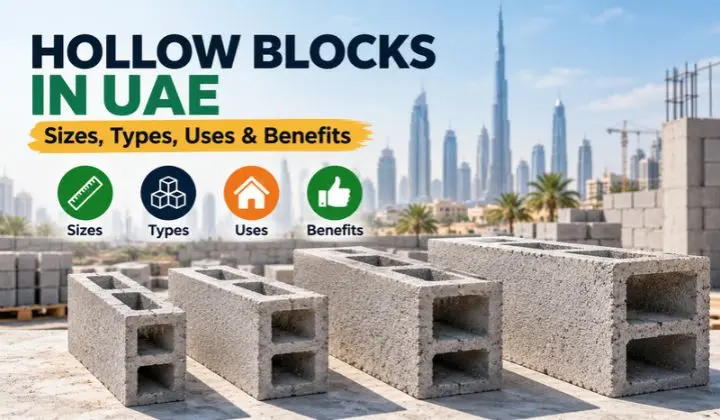
Hollow blocks are concrete building units with hollow spaces inside them. They are usually made from cement, water, sand, and aggregates. Some manufacturers use different materials or additives to meet specific product requirements.
These blocks are placed in rows, called courses, and joined with mortar to build walls. Their hollow cores reduce the amount of solid material in each unit compared with a similar-sized solid block. Depending on the block design, the cores may also provide space for reinforcement or grout.
Hollow concrete blocks are used for partition walls, infill walls, and other suitable masonry applications. Some products can also be used in load-bearing walls, but this depends on their tested strength, the wall design, and the project’s structural requirements.
The term hollow block construction covers different types of masonry work. A block suitable for an internal partition should not automatically be considered suitable for a structural wall. Always check the manufacturer’s specifications and the approved project drawings before choosing a product.
Hollow Block Sizes in UAE: Dimensions and Weight
The right hollow block size depends on the wall’s purpose, required thickness, and construction design. UAE suppliers offer blocks in different sizes, so confirm the actual dimensions before placing an order.
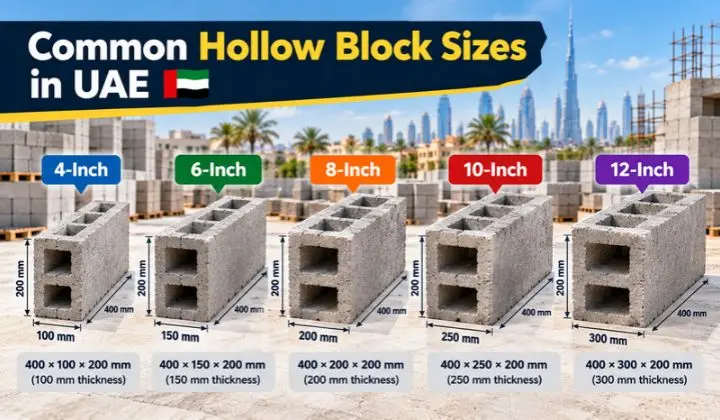
Common 4-Inch, 6-Inch and 8-Inch Hollow Block Sizes
Four-inch, six-inch, and eight-inch hollow blocks are common trade descriptions. These names generally refer to the block’s nominal thickness, not its full length, width, and height.
The table below shows example sizes listed by a UAE supplier. Product availability and specifications can vary between manufacturers.
| Common name | Example dimensions (L × W × H) | Approximate thickness |
| 4-inch hollow block | 400 × 100 × 200 mm | 100 mm |
| 6-inch hollow block | 400 × 150 × 200 mm | 150 mm |
| 8-inch hollow block | 400 × 200 × 200 mm | 200 mm |
| 10-inch hollow block | 400 × 250 × 200 mm | 250 mm |
| 12-inch hollow block | 400 × 300 × 200 mm | 300 mm |
When checking a hollow block size in UAE, confirm which measurement represents length, thickness, and height. Also ask whether the listed measurements are actual dimensions or nominal dimensions used for planning.
For example, an eight-inch block generally refers to a nominal thickness close to 200 mm. Its full length and height are separate measurements. Understanding this difference helps you estimate wall area and order the correct quantity.
Hollow Block Dimensions, Weight and Strength
Block dimensions affect wall thickness, handling, transportation, and the number of units needed. Weight and strength also matter, especially when blocks are intended for walls with specific structural requirements.
Here are example weights published for hollow blocks by Bucomac:
| Block size | Example dimensions | Listed weight |
| 4-inch hollow block | 400 × 100 × 200 mm | 14 kg |
| 6-inch hollow block | 400 × 150 × 200 mm | 18 kg |
| 8-inch hollow block | 400 × 200 × 200 mm | 23 kg |
These figures apply to the listed supplier products. Other manufacturers may offer blocks with different weights.
The hollow block weight in kg helps with delivery planning, unloading, and safe handling. However, a heavier block is not automatically stronger, and a lighter block is not automatically better.
Before buying, check the product’s compressive strength, dimensions, and other specifications required by your project. A manufacturer’s technical data sheet or test report provides more useful information than a general claim that a block is strong or durable.
Some product listings also include density, water absorption, fire performance, and thermal transmittance, known as the U-value. These measurements describe different properties. For example, a lower U-value indicates lower heat transfer through the tested product or wall assembly. Actual wall performance also depends on the complete construction system.
How to Choose the Right Hollow Block Size
Start by identifying the purpose of the wall rather than choosing a block based only on its price.
- Internal partition walls: A thinner block may be suitable when it meets the required strength, sound control, and other project needs.
- External walls: Consider wall thickness, weather exposure, thermal performance, and the complete wall system.
- Infill walls: Select blocks that meet the requirements for walls built within a structural frame.
- Load-bearing walls: Use products approved for the required loads and structural design.
- Boundary walls: Consider wall height, wind exposure, support conditions, and the approved design.
The right choice depends on the project’s drawings and specifications. If you are unsure whether a particular hollow block dimension is suitable, consult the project engineer or responsible designer before ordering.
Types of Hollow Blocks and Their Uses
Hollow blocks differ in size, weight, core design, materials, and intended use. Understanding these differences helps you select a product that suits the job.
Standard Hollow Concrete Blocks
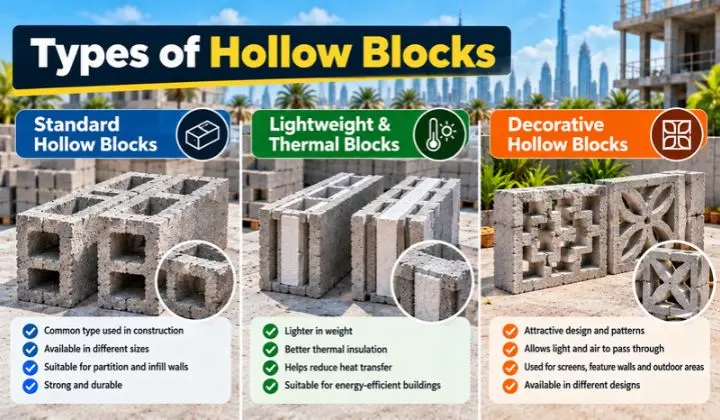
Standard hollow concrete blocks have hollow cores and are available in different thicknesses. They are commonly used for partition walls, infill walls, and other masonry work where the selected product meets the design requirements.
Their regular shape helps workers build walls in courses and control alignment. However, the quality of the finished wall also depends on proper mortar joints, workmanship, and suitable finishing.
Lightweight and Thermal Blocks
Lightweight blocks are designed to reduce unit weight, while thermal blocks aim to improve resistance to heat transfer. These are related but different product features.
Some thermal blocks include insulating materials as part of their design. The block material, thickness, and complete wall construction affect the final result.
If thermal performance is important for a UAE project, check the product’s published U-value or other relevant test data. Do not assume that all hollow blocks provide the same level of heat or sound insulation.
Decorative Hollow Blocks
Decorative hollow blocks are used when a wall needs a particular visual style as well as a practical purpose. Their patterns and openings can allow light and air to pass through, depending on the design.
They may be suitable for screens, feature walls, and selected outdoor areas. Their use depends on strength, fixing methods, exposure, and the intended application. Do not replace structural blocks with decorative units unless the design allows it.
Benefits and Disadvantages of Hollow Blocks
Hollow blocks offer practical benefits, but their performance depends on the product, design, and installation.
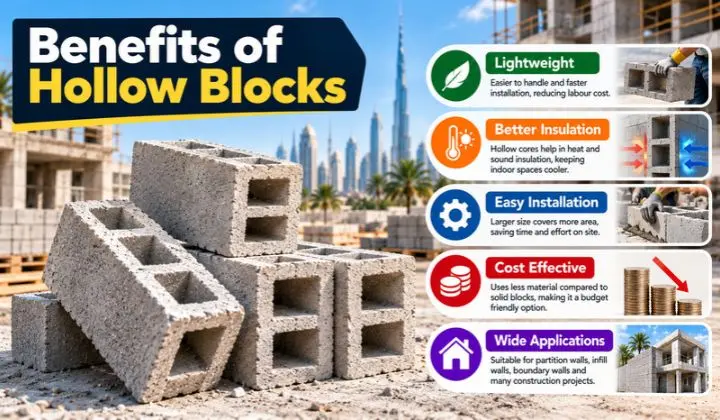
Key Benefits for Construction
1. Lower unit weight than comparable solid blocks
Hollow cores reduce the amount of solid material in a block. As a result, some hollow blocks weigh less than solid blocks with similar outside dimensions. Actual weight depends on the product.
2. Practical wall construction
Regular dimensions help workers lay blocks in courses. Good dimensional accuracy can make alignment and mortar-joint control easier.
3. Potential insulation benefits
Hollow spaces can affect heat and sound transfer, but the level of performance varies. Check test data for the specific block and complete wall system instead of relying on general claims.
4. Space for services or reinforcement
Some block designs allow reinforcement, grout, or services to be incorporated where the construction design permits. The cores should not be changed or filled without considering the wall’s requirements.
5. A range of applications
Different sizes allow hollow blocks to be considered for internal walls, external infill walls, and other suitable masonry applications.
Limitations and Factors to Consider
Hollow blocks are not suitable for every situation.
- Strength varies: Not every block is suitable for load-bearing construction.
- Water absorption matters: Moisture behaviour depends on the block and its exposure. External walls may need suitable protection and finishing.
- Cutting creates waste: Blocks can break during cutting or handling, so quantity estimates should include a reasonable allowance.
- Workmanship affects results: Poor alignment, weak mortar joints, or incorrect installation can reduce wall quality.
- Performance must be checked: Thermal, acoustic, and fire performance should be based on relevant product or wall-system evidence.
The best approach is to match the block to the wall’s purpose and confirm its specifications before purchase.
Hollow Blocks vs Solid Concrete Blocks and Bricks
Choosing between hollow blocks, solid concrete blocks, and bricks depends on your project requirements, budget, and the type of wall you need. No single material is always the cheapest or strongest option.
| Factor | Hollow concrete blocks | Solid concrete blocks | Bricks |
| Structure | Contains hollow cores | Mostly solid concrete | Usually smaller masonry units |
| Weight | Often lighter than comparable solid blocks | Often heavier than comparable hollow blocks | Varies by material and size |
| Installation | Larger units can cover more wall area per piece | Larger units can also cover more wall area | Usually requires more individual units |
| Common applications | Suitable partition and infill walls, subject to specifications | Various masonry applications, depending on strength and design | Different types of masonry walls |
| Cost | Depends on product, labour, and delivery | Depends on product, labour, and delivery | Depends on brick type, labour, mortar, and finishing |
A brick vs hollow block comparison should include the complete wall cost, not just the price of one unit. Bricks and blocks have different dimensions, so the number required to cover the same wall area can vary significantly.
The same applies when comparing solid and hollow blocks. A heavier product is not automatically stronger for every application, and a hollow block is not automatically cheaper after installation and finishing costs are included.
Before choosing a material, consider the required strength, wall thickness, thermal performance, labour, mortar, plaster, and delivery charges. For structural work, follow the approved project design.
How Many Hollow Blocks Do You Need?
Estimating the number of blocks before ordering can help reduce shortages, excess stock, and unnecessary delivery costs.
The calculation depends on the wall area and the face dimensions of the block. The face is the length multiplied by the height, not the thickness.
Hollow Blocks per Square Metre
For a basic estimate, divide one square metre by the face area of a block.
Formula:
Blocks per square metre = 1 ÷ block face area in square metres
For a block with a face size of 400 × 200 mm:
- Length: 0.4 metres
- Height: 0.2 metres
- Face area: 0.4 × 0.2 = 0.08 m²
- Blocks per square metre: 1 ÷ 0.08 = 12.5 blocks
This gives an estimate of 12.5 blocks per square metre before considering mortar-joint allowances and wastage. The actual quantity may vary according to nominal dimensions and the specified joint thickness.
This calculation is useful for early budgeting, but the final order should be based on the actual block system and construction drawings.
How to Calculate Blocks for a Wall
Follow these steps to estimate the quantity for a wall:
- Multiply the wall length by its height to calculate the total area.
- Calculate the area of doors, windows, and other openings.
- Subtract the opening areas from the total wall area.
- Divide the remaining area by the face area of one block.
- Add an allowance for cutting, breakage, and wastage.
Example calculation
Suppose your wall is 5 metres long and 3 metres high.
- Total wall area: 5 × 3 = 15 m²
- Door opening: 0.9 × 2.1 = 1.89 m²
- Net wall area: 15 − 1.89 = 13.11 m²
- Estimated blocks: 13.11 ÷ 0.08 = 163.875
You would need approximately 164 blocks before allowances, using the example block face dimensions.
The final quantity may change because of mortar joints, cutting, damage, and the actual layout. Ask your contractor or supplier to confirm the estimate before placing a bulk order.
Hollow Block Prices in UAE: What Affects the Cost?
The hollow block price in UAE varies according to the block’s size, type, required strength, supplier, and delivery arrangements. There is no single price that applies to every product.
Consider these factors when comparing quotations:
- Block size: Larger or thicker units may cost more per block, but the cost per square metre may give a better comparison.
- Product type: Standard, lightweight, and thermal blocks can have different prices.
- Required strength: Products made to meet specific performance requirements may differ in cost.
- Order quantity: Suppliers may offer different rates for bulk orders.
- Delivery and unloading: Transport distance, site access, and unloading arrangements can affect the final amount.
- Installation costs: Mortar, labour, cutting, finishing, and wastage contribute to the overall wall cost.
If you are comparing a hollow block price in Dubai with a quotation from another emirate, check whether both prices include VAT, delivery, and unloading. Also confirm that both quotations cover blocks of the same dimensions and specifications.
A price displayed online may not reflect the current rate for your order. Ask the supplier for a written quotation that states the product size, quantity, unit price, delivery charges, and any other applicable costs.
How to Choose Quality Hollow Blocks for Your Project
A good buying decision starts with checking the product rather than relying only on its appearance or price.
1. Confirm the dimensions
Ask for the full length, thickness, and height. Check that the supplied blocks match the dimensions stated in the quotation and project specifications.
2. Review the required strength
Check the required compressive strength of concrete hollow blocks against the manufacturer’s technical data and relevant test reports. Do not assume that all blocks of the same size have the same strength.
3. Check the product’s condition
Look for serious cracks, broken corners, and visible damage. If a large part of the batch is damaged, raise the issue with the supplier before installation.
4. Ask for technical specifications
Where relevant, request information about density, water absorption, fire performance, or thermal transmittance. The required properties depend on the intended use of the wall.
5. Confirm delivery arrangements
Check the number of blocks per bundle or truck, site access, unloading arrangements, and how the blocks will be protected during transport.
6. Match the product to the project
The block must meet the requirements of the intended wall. For structural applications, follow the approved drawings and the responsible engineer’s specifications.
If you are comparing concrete products for a fencing or construction project, Vertex Fence provides information about its RCC blocks, which are a separate product category from ordinary hollow masonry blocks. You can review the product details on the Vertex Fence RCC Blocks page. Confirm that the product suits your application before requesting a quotation.
Frequently Asked Questions
Do hollow block dimensions include mortar joints?
The dimensions listed by a manufacturer usually describe the block itself, while nominal masonry dimensions may allow for mortar joints. Confirm the supplier’s measurement convention before estimating the number of blocks required for your wall.
How should hollow blocks be stored on a construction site?
Keep hollow blocks on a stable, level surface and protect them from damage during handling and storage. Follow the manufacturer’s instructions for stacking, moisture protection, and safe movement, especially when handling heavy bundles.
Can hollow blocks be cut to fit around doors, windows, and service openings?
Yes, some hollow blocks can be cut using suitable tools, but cutting can create waste and affect the remaining block. Openings, lintels, reinforcement, and structural areas must follow the approved drawings and the responsible designer’s instructions.
What details should you provide when requesting a hollow block quote in the UAE?
Provide the required block dimensions, type, strength requirements, quantity, project location, and delivery date. Also confirm whether the quotation includes VAT, transport, and unloading so you can compare suppliers fairly.
Can lightweight hollow blocks replace normal-weight blocks in the same wall?
Not automatically. Lightweight blocks may have different strength and thermal properties, so any replacement must meet the wall’s design requirements. Confirm the change with the responsible engineer or designer before ordering or installation.
Conclusion
Choosing the right hollow blocks in UAE starts with understanding the wall’s purpose, required thickness, block dimensions, weight, and strength. Comparing these details before purchase can help you avoid unsuitable products, incorrect quantity estimates, and unexpected costs.
Check the manufacturer’s specifications, calculate the wall area carefully, and compare quotations that cover the same product and delivery conditions. For structural applications, always follow the approved project design rather than choosing a block based on size or price alone.