
 Fences
 Gates
Gates Signage & Boards
 Car Parking Shades
 Block and Foundation
 Spare Parts
Concrete Block for Porta Cabin in UAE | Types & Installation

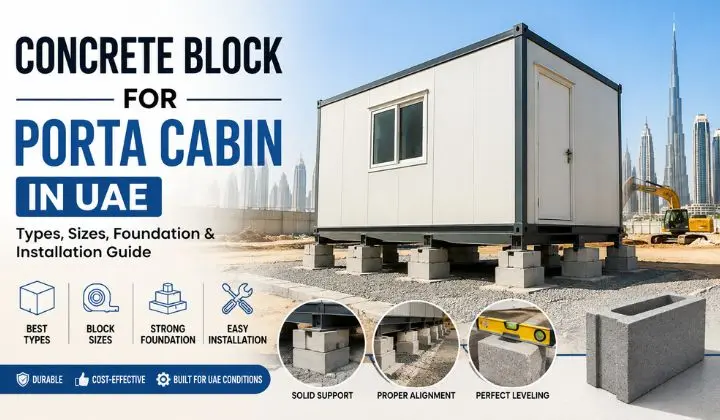
A Concrete Block for Porta Cabin is one of the most reliable and cost-effective foundation solutions for temporary and semi-permanent buildings in the UAE. It is widely used for Construction Site Offices, Security Cabins, Portable Offices, Labour Accommodation, and Storage Cabins because it is faster to install than a Concrete Slab and easier to relocate. However, choosing the wrong block type or poor Ground Preparation can lead to uneven floors, structural movement, and costly repairs. This guide explains how to choose the right foundation, compare block types, select the correct block size, and install a porta cabin properly for long-term stability.
Can a Porta Cabin Be Installed on Concrete Blocks?
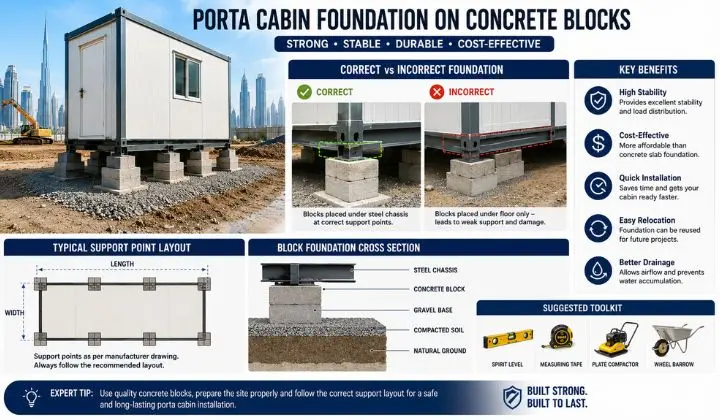
Yes. Most Porta Cabins can safely be installed on Solid Concrete Blocks or RCC Blocks, provided they are placed under the Steel Chassis at the correct Support Points. A properly prepared Concrete Block Foundation with Compacted Soil, balanced Load Distribution, and effective Drainage provides a stable base for most temporary and semi-permanent cabins in the UAE.
At a Glance
| Question | Answer |
| Can a porta cabin sit on concrete blocks? | ✅ Yes |
| Is it better than a concrete slab? | ✅ For most temporary projects |
| Is it suitable for UAE weather? | ✅ Yes, with proper installation |
| Can the cabin be relocated later? | ✅ Yes |
What Is a Concrete Block Foundation for a Porta Cabin?
A Concrete Block Foundation is a support system that uses Foundation Blocks to carry the weight of a Porta Cabin instead of placing the cabin directly on the ground or pouring a full Concrete Slab.
The blocks are positioned under the main Structural Steel frame (Steel Chassis) so the cabin remains level, stable, and properly supported.
This foundation method is popular because it:
- Installs quickly
- Costs less than a slab
- Allows future relocation
- Makes maintenance easier
- Improves Airflow beneath the cabin
For these reasons, it is commonly used across Dubai, Sharjah, Abu Dhabi, and other parts of the UAE.
How Does It Work?
Every Porta Cabin is built on a Steel Chassis.
Instead of allowing the floor to carry the load, the cabin weight is transferred through the steel frame onto strategically placed Foundation Blocks.
When every support block is positioned correctly, the weight spreads evenly across the foundation. This balanced Weight Distribution improves Foundation Stability, reduces stress on the frame, and helps prevent uneven Settlement.
A professional Portable Cabin Foundation normally includes:
- Proper Site Preparation
- Stable Compacted Soil
- A Gravel Base (if required)
- Quality Solid Concrete Blocks or RCC Blocks
- Correct Support Points
- Accurate Leveling
- Good Drainage
Each element plays an important role in creating a durable foundation.
Why Does the Foundation Matter?
Many people believe that any flat surface is enough for a porta cabin. In reality, the foundation directly affects the building’s safety, performance, and lifespan.
A poorly installed foundation may cause:
- Uneven floors
- Doors and windows that don’t close properly
- Water collecting under the cabin
- Frame movement caused by uneven Settlement
- Higher maintenance costs
Investing in the right Concrete Base for Porta Cabin from the beginning helps avoid these problems and reduces future repair expenses.
Where Are Concrete Block Foundations Used?
A Concrete Block Foundation is suitable for many types of Portable Buildings and Modular Construction projects.
Common applications include:
- Construction Site Offices
- Portable Site Offices
- Security Cabins
- Guard Cabins
- Portable Offices
- Labour Accommodation
- Storage Cabins
- Temporary Buildings
- Industrial Cabins
Because these structures are often moved after a project is completed, concrete blocks provide a practical and flexible foundation solution.
Why Choose Concrete Blocks Instead of a Concrete Slab?
Both Concrete Blocks and Concrete Slabs provide structural support, but they are designed for different purposes.
If your cabin is temporary, semi-permanent, or may be relocated in the future, a Concrete Block Foundation is usually the smarter choice. A Concrete Slab is generally better suited for permanent buildings.
The table below shows the key differences.
| Feature | Concrete Block Foundation | Concrete Slab |
| Installation Time | Fast | Slow |
| Initial Cost | Lower | Higher |
| Future Relocation | Easy | Difficult |
| Maintenance | Easy | Moderate |
| Airflow | Excellent | Limited |
| Drainage | Better | Depends on design |
| Best Use | Temporary & Semi-Permanent Projects | Permanent Buildings |
Faster Installation
One of the biggest advantages of using Concrete Blocks UAE is speed.
Unlike a Concrete Slab, there is no need to wait for concrete to cure. Once the site is prepared and the blocks are levelled, the cabin can usually be installed the same day.
This helps construction companies keep projects on schedule.
Lower Overall Cost
A Concrete Block Foundation usually costs less because it requires:
- Less material
- Less labour
- Less equipment
- Less installation time
For many temporary projects, this provides significant savings without sacrificing stability.
Easy Relocation
Many Portable Structures are designed to move between project sites.
A block foundation allows the cabin to be lifted and relocated without breaking a permanent concrete base.
This makes it the preferred choice for contractors managing multiple projects across the UAE.
Better Airflow and Moisture Control
Unlike a slab, a block foundation leaves space beneath the cabin.
This improves Airflow, helps reduce trapped moisture, and supports better Drainage.
As a result, the floor structure stays drier and is easier to inspect during maintenance.
Easier Maintenance
If minor Settlement occurs over time, individual support blocks can often be adjusted without replacing the entire foundation.
This makes long-term maintenance faster and more affordable than repairing a damaged concrete slab.
Expert Recommendation
For most Construction Site Offices, Security Cabins, Portable Offices, and Storage Cabins, a Concrete Block Foundation offers the best combination of flexibility, cost, and Structural Support. If your project involves a heavy multi-unit building or a permanent installation, consult a structural engineer before deciding between concrete blocks and a reinforced slab.
Best Types of Concrete Blocks for Porta Cabins
Not every Concrete Block is suitable for every Porta Cabin. The right choice depends on the cabin’s weight, project duration, ground condition, and budget.
Using the wrong block may cause uneven Load Distribution, foundation movement, or expensive repairs. That’s why it’s important to understand the difference between the main block types before starting your project.
Solid Concrete Blocks – Best for Most Porta Cabin Projects
Solid Concrete Blocks are the most commonly used foundation blocks for Porta Cabins in the UAE. Their dense structure provides excellent Load Bearing, better Foundation Stability, and long-term durability.
Best For
- Construction Site Offices
- Portable Site Offices
- Security Cabins
- Guard Cabins
- Portable Offices
- Storage Cabins
- Small to medium Labour Accommodation
Advantages
- Excellent Compressive Strength
- Strong Structural Support
- Better resistance to cracking
- Suitable for harsh UAE weather
- Low maintenance
- Easy availability across the UAE
Pro Tip: If you’re unsure which block to choose, Solid Concrete Blocks are usually the safest option because they offer the best balance of strength, durability, and cost.
RCC Blocks – Best for Heavy-Duty Projects
RCC Blocks are designed for projects that require extra strength and long-term performance.
These blocks are ideal when the cabin is larger, carries heavy equipment, or will remain in one location for many years.
Best For
- Large Labour Accommodation
- Industrial buildings
- Heavy Portable Structures
- Connected Modular Buildings
- Permanent modular facilities
Advantages
- Higher Load Bearing capacity
- Better structural performance
- Longer service life
- Suitable for demanding environments
When Should You Choose RCC Blocks?
Choose RCC Blocks if your cabin is large, supports multiple rooms, or is expected to remain on-site for several years.
Hollow Concrete Blocks – Are They a Good Choice?
Hollow Concrete Blocks are widely used in construction walls because they are lightweight and easy to handle.
However, they are not usually recommended for supporting heavy Porta Cabins unless approved by the project engineer.
Advantages
- Lightweight
- Easy to transport
- Lower purchase cost
Limitations
- Lower Compressive Strength
- Reduced Bearing Capacity
- Less suitable for concentrated structural loads
For most porta cabin foundations, Solid Concrete Blocks remain the better choice.
Quick Comparison
| Feature | Solid Concrete Blocks | RCC Blocks | Hollow Concrete Blocks |
| Strength | ⭐⭐⭐⭐⭐ | ⭐⭐⭐⭐⭐ | ⭐⭐⭐ |
| Load Bearing | High | Very High | Medium |
| Durability | Excellent | Excellent | Good |
| Best Use | Most Porta Cabins | Heavy Projects | Light Structures |
| Cost | Medium | Higher | Lower |
| Recommendation | ⭐⭐⭐⭐⭐ | ⭐⭐⭐⭐⭐ | ⭐⭐ |
How to Choose the Right Foundation for Your Porta Cabin
The best Concrete Block Foundation is not always the strongest one.
It is the one that matches your building’s size, weight, location, and future use.
Before making your decision, ask yourself these important questions.
What Will the Cabin Be Used For?
Different cabins require different levels of support.
| Cabin Type | Foundation Requirement |
| Security Cabin | Standard Concrete Block Foundation |
| Portable Office | Standard Concrete Block Foundation |
| Construction Site Office | Strong Solid Concrete Blocks |
| Storage Cabin | Standard block foundation |
| Labour Accommodation | Heavy-duty RCC Blocks |
Choosing the foundation based on actual use prevents overspending while maintaining safety.
How Heavy Is the Cabin?
The weight of the cabin determines:
- Number of Support Points
- Type of Foundation Blocks
- Load Distribution
- Required Bearing Capacity
A larger cabin always requires a stronger support system than a single-room office.
What Is the Ground Condition?
Before installation, inspect the site carefully.
Questions to ask:
- Is the soil firm?
- Is it sandy?
- Does water collect after rain?
- Has the land been recently filled?
Proper Ground Preparation is one of the biggest factors affecting foundation performance.
Will the Cabin Be Relocated Later?
This is one question many buyers forget.
If the cabin may move to another project, a Concrete Block Foundation offers a major advantage because it can be dismantled much more easily than a permanent Concrete Slab.
This reduces relocation costs and saves installation time on future projects.
Is Drainage Good Enough?
Water is one of the biggest enemies of any foundation.
Poor Drainage can soften the soil, increase Settlement, and reduce Foundation Stability.
If the site has poor drainage, consider adding a Gravel Base before installation.
Foundation Decision Matrix
| Project Requirement | Recommended Solution |
| Lowest cost | Solid Concrete Blocks |
| Easy relocation | Concrete Block Foundation |
| Heavy building | RCC Blocks |
| Permanent installation | Reinforced Concrete Slab |
| Best all-round option | Solid Concrete Blocks |
Best Block Size and Support Layout
Choosing the correct block size is only half of the job.
Correct Support Point placement is equally important.
Even premium Concrete Blocks UAE cannot provide proper support if they are installed in the wrong position.
Recommended Block Sizes
The correct size depends on:
- Cabin dimensions
- Building weight
- Foundation Design
- Manufacturer recommendations
Commonly used sizes include:
| Block Size | Suitable For |
| 400 × 200 × 200 mm | Small & Medium Porta Cabins |
| 400 × 200 × 150 mm | Light Structures |
| Heavy-duty RCC Blocks | Large Commercial Projects |
Always confirm the required dimensions with the cabin supplier or structural engineer.
Why Support Point Placement Is Critical
The Steel Chassis carries the entire weight of the building.
Every concrete block should support this structural frame, not the floor panels.
Correct Support Point placement provides:
- Better Weight Distribution
- Higher Foundation Stability
- Reduced structural stress
- Longer foundation life
- Lower maintenance costs
Common Mistake: Many installers place extra blocks under the floor instead of beneath the Steel Chassis. More blocks do not always mean a stronger foundation. Correct placement is far more important than quantity.
Expert Recommendation
For more than 90% of standard porta cabin projects in the UAE, a properly levelled Concrete Block Foundation using high-quality Solid Concrete Blocks is the most practical solution. If your project involves large accommodation units, connected modular cabins, or heavy industrial equipment, consult a structural engineer before selecting the block type and Foundation Design.
Step-by-Step Installation Guide for a Concrete Block Foundation
Installing a Concrete Block for Porta Cabin correctly is just as important as choosing the right block. Even high-quality Solid Concrete Blocks or RCC Blocks cannot perform well if the foundation is installed incorrectly.
Follow these professional steps to build a safe and durable Portable Cabin Foundation.
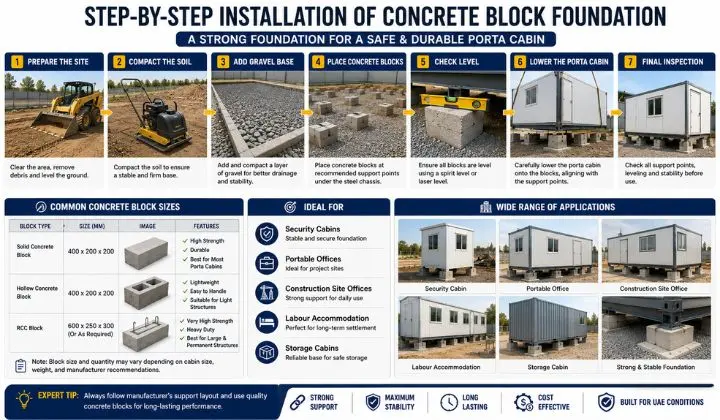
Step 1 – Prepare the Site
Start by clearing the installation area.
Remove:
- Grass and vegetation
- Loose soil
- Rocks and debris
- Standing water
A clean surface makes Ground Preparation easier and improves foundation stability.
Step 2 – Compact the Soil
Loose ground can settle after installation, causing the cabin to become uneven.
Use a plate compactor or roller to create Compacted Soil before placing any blocks.
If the site has sandy soil, extra compaction is recommended because sand shifts more easily under heavy loads.
Step 3 – Install a Gravel Base
A Gravel Base improves both drainage and stability.
It helps:
- Reduce water buildup
- Improve Drainage
- Increase Bearing Capacity
- Minimise future Settlement
For most porta cabin projects, a compacted gravel layer creates a stronger base than placing blocks directly on soil.
Step 4 – Position the Concrete Blocks
Place the Foundation Blocks according to the cabin manufacturer’s support drawing.
Every block should sit directly under the Steel Chassis.
Never support only the floor panels because they are not designed to carry the building’s full weight.
Step 5 – Check the Level
Use a laser level or spirit level to ensure every block is at the same height.
Correct Leveling helps prevent:
- Uneven floors
- Door alignment issues
- Window problems
- Structural movement
Step 6 – Lower the Porta Cabin
Lower the cabin slowly onto the prepared foundation.
Check every Support Point to make sure it carries the load evenly.
There should be no gaps between the Steel Chassis and the supporting blocks.
Step 7 – Final Inspection
Before using the cabin, complete a final inspection.
Confirm:
- All blocks are level.
- The Steel Chassis is fully supported.
- Water can drain away from the foundation.
- The cabin sits evenly without movement.
A final inspection reduces the chance of future repairs.
Installation Checklist
| Checklist | Status |
| Site cleaned | ✅ |
| Ground Preparation completed | ✅ |
| Soil compacted | ✅ |
| Gravel Base installed | ✅ |
| Concrete blocks positioned correctly | ✅ |
| Steel Chassis supported | ✅ |
| Leveling completed | ✅ |
| Final inspection completed | ✅ |
Common Mistakes to Avoid
Avoiding these mistakes can save both time and money.
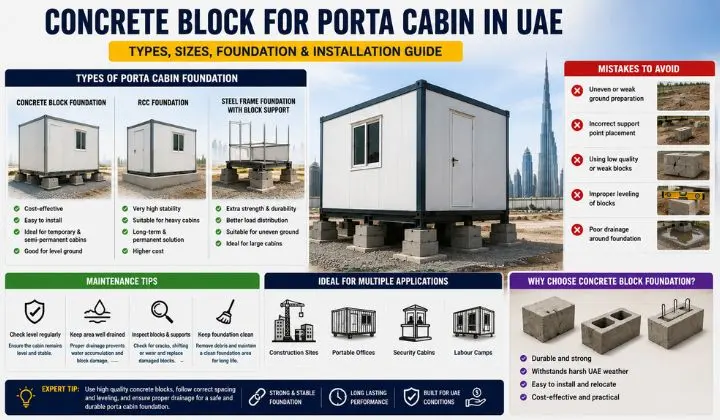
Using Low-Quality Concrete Blocks
Poor-quality blocks may crack under heavy loads.
Always choose blocks with good Compressive Strength from a trusted supplier.
Ignoring Ground Preparation
Even the strongest block cannot perform well on weak ground.
Proper Ground Preparation is essential for long-term stability.
Poor Drainage
Standing water softens the soil and increases settlement.
Always ensure water flows away from the foundation.
Incorrect Support Point Placement
Concrete blocks must support the Steel Chassis, not the cabin floor.
Incorrect placement creates uneven Load Distribution and unnecessary stress on the structure.
Skipping Level Checks
A difference of only a few millimetres can create alignment problems after installation.
Always check the foundation level before lowering the cabin.
What Affects the Cost of a Concrete Block Foundation in UAE?
The cost of a Concrete Block Foundation depends on several factors, not just the price of the blocks.
| Factor | Impact on Cost |
| Cabin size | High |
| Block type | Medium |
| Site condition | High |
| Labour | Medium |
| Equipment | Medium |
| Delivery location | Medium |
Generally, a small Security Cabin costs less to install than a large Labour Accommodation unit because it requires fewer support blocks and less preparation.
Buying Tip: Don’t choose the cheapest option. Spending slightly more on quality Concrete Blocks can reduce maintenance costs over the life of the cabin.
Buying Checklist Before Ordering Concrete Blocks
Before purchasing Concrete Blocks UAE, use this checklist.
✅ Choose the correct block type (Solid Concrete Blocks or RCC Blocks)
✅ Check the Compressive Strength
✅ Inspect block dimensions
✅ Reject cracked or damaged blocks
✅ Confirm the block matches your cabin’s weight
✅ Ask about delivery across the UAE
✅ Buy from a trusted supplier with consistent quality
Why Choose Vertex Fence for Concrete Blocks in UAE?
A strong foundation starts with quality materials.
At Vertex Fence, we supply durable concrete block solutions designed for construction and modular building projects across the UAE. Whether you need blocks for a Security Cabin, Portable Office, Construction Site Office, or Labour Accommodation, our team focuses on quality, consistency, and dependable service.
Why customers choose us:
- High-quality concrete products
- Reliable strength and consistent dimensions
- Suitable for different Porta Cabin applications
- Competitive pricing
- Fast delivery across the UAE
- Professional customer support
Choosing the right supplier helps ensure your foundation performs well from day one.
Frequently Asked Questions
How many concrete blocks are needed for a porta cabin?
The number of blocks depends on the cabin size, total weight, and Foundation Design. Always follow the manufacturer’s support layout instead of estimating block positions.
Can I place a porta cabin directly on the ground?
It is not recommended. Installing a cabin directly on the ground can lead to uneven Settlement, poor drainage, and reduced structural life.
Are RCC blocks better than solid concrete blocks?
For heavy or permanent modular projects, RCC Blocks provide greater strength. For most standard porta cabins, Solid Concrete Blocks offer an excellent balance of cost and performance.
Do I need a gravel base under concrete blocks?
In many cases, yes. A Gravel Base improves drainage, helps distribute the load evenly, and reduces soil movement.
Can a concrete block foundation be reused?
Yes. One of the biggest advantages of a Concrete Block Foundation is that it can often be reused when the porta cabin is relocated, provided the blocks remain in good condition.
How often should I inspect a porta cabin foundation?
Inspect the foundation after installation, after heavy rainfall, and as part of regular site maintenance. Early inspections help identify settlement or drainage issues before they become costly repairs.
Conclusion
A well-built Concrete Block for Porta Cabin foundation is more than just a support system, it protects your investment, improves safety, and extends the life of your portable building.
For most projects in the UAE, Solid Concrete Blocks provide the best combination of strength, cost, and flexibility. Larger or heavier modular buildings may require RCC Blocks or a reinforced foundation designed by a structural engineer.
Before starting your project, focus on four essentials:
- Quality concrete blocks
- Proper Ground Preparation
- Correct Support Point placement
- Good Drainage
Following these best practices will help you build a stable, durable, and long-lasting foundation for your porta cabin.