
 Fences
 Gates
Gates Signage & Boards
 Car Parking Shades
 Block and Foundation
 Spare Parts
Chain Link Fence Specifications in UAE: Mesh, Gauge & Height

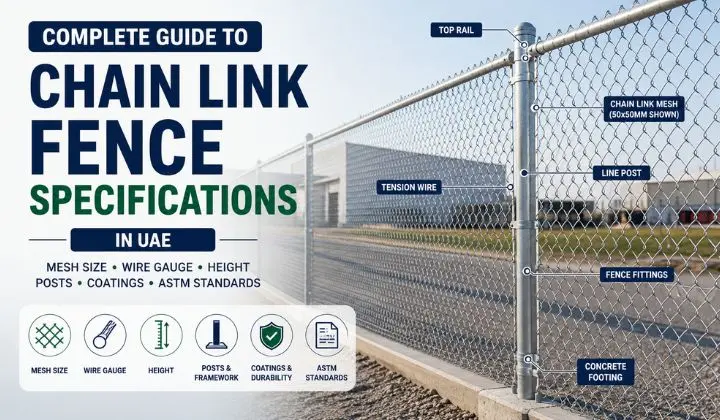
When choosing a chain link fence, mesh size and height are only two parts of the specification. The wire gauge, wire diameter, coating, posts, framework, fittings, and installation method also affect the fence’s strength and service life.
For UAE projects, these details matter even more. Heat, humidity, coastal exposure, wind, security needs, and the type of site can all affect which chain link fence specifications are suitable.
This guide explains the main specifications in simple terms so buyers, contractors, and project teams can compare fencing options with more confidence.
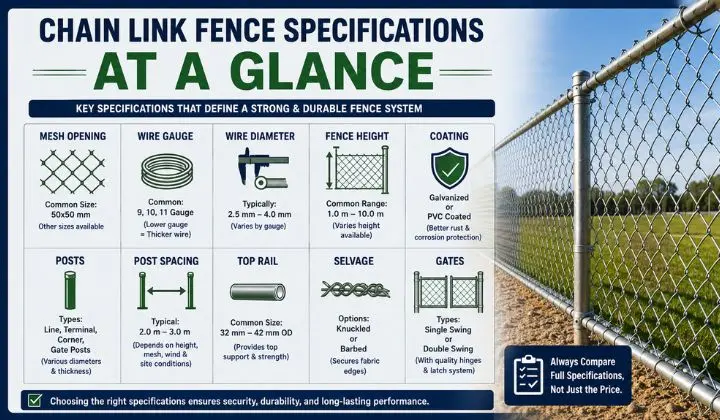
Chain Link Fence Specifications at a Glance
A complete specification should clearly state the following:
| Specification | What to Check | Why It Matters |
| Mesh opening | Diamond opening size | Affects containment and visibility |
| Wire gauge | Wire thickness | Affects fabric strength |
| Wire diameter | Actual wire size | Helps compare products |
| Fence height | Finished height | Depends on the application |
| Coating | Galvanized or PVC coated | Helps protect steel from corrosion |
| Posts | Type, diameter and wall thickness | Supports the fence |
| Post spacing | Distance between posts | Affects stability |
| Framework | Rails, braces and fittings | Supports the fabric |
| Selvage | Knuckle or barbed | Affects the fence edge |
| Gates | Frame, posts and hardware | Provides controlled access |
This is why two suppliers can quote the same 50 × 50 mm mesh but still offer different fencing systems. The wire, posts, coating, framework, and installation can all be different.
Standard Chain Link Fence Measurements & Sizes
When someone searches for standard chain link fence size or chain link fence dimensions, they may be asking about more than the height of the fence.
The main measurements include:
- Mesh opening
- Wire gauge
- Wire diameter
- Fence height
- Post diameter
- Post spacing
- Framework dimensions
- Coating details
There is no single specification that works for every project. A residential boundary may need a different system from a warehouse, construction site, sports facility, or industrial perimeter.
Mesh Size and Diamond Opening
Chain link fabric is made by weaving steel wire into a diamond pattern. The opening between the wires is known as the mesh opening or diamond opening.
A common option is 50 × 50 mm mesh, but other mesh sizes can be selected based on the project.
A smaller opening can provide tighter containment and make it harder for objects to pass through the fence. It can also be useful where climbing is a concern.
A larger opening can provide better visibility and may be suitable for general boundary fencing.
However, mesh size should not be considered by itself.
The final performance of the chain link fabric also depends on the wire gauge, wire diameter, fence height, coating, and supporting framework.
Example
A 50 × 50 mm fence made with heavier wire can have very different performance from a 50 × 50 mm fence made with lighter wire.
So when comparing products, always ask for the mesh size and wire specification together.
Wire Gauge vs. Wire Diameter
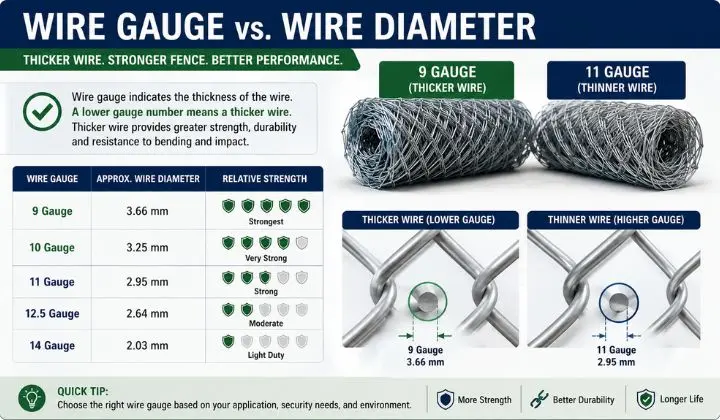
Wire gauge is a way of describing wire thickness. The wire diameter gives the actual physical diameter of the wire.
One important rule is:
A lower gauge number generally means a thicker wire.
For example, a 9-gauge chain link fence uses thicker wire than an 11-gauge fence when the same gauge system is being used.
Thicker wire can provide a stronger and more robust fabric. This is why heavier wire is often considered for commercial, industrial, and higher-security applications.
But wire gauge is only one part of the specification.
You should also compare:
- Mesh opening
- Fence height
- Post diameter
- Framework
- Coating
- Post spacing
- Installation
This gives you a better picture of the complete fencing system.
Is a 9-Gauge Chain Link Fence Thicker Than an 11-Gauge?
Yes. A 9-gauge wire is thicker than an 11-gauge wire in the applicable gauge system.
A thicker wire can provide greater resistance to bending and physical damage. However, it can also require more material and increase the overall cost.
For a proper quotation, ask the supplier to provide both the gauge and the actual wire diameter where applicable. This makes it easier to compare two products accurately.
Chain Link Fence Height
Chain link fence height should be selected according to the purpose of the fence.
A lower fence may be suitable for a residential boundary, while a warehouse, sports facility, industrial site, or security perimeter may require a taller system.
Common project considerations include:
- Residential boundaries
- Commercial properties
- Warehouses
- Construction sites
- Sports facilities
- Industrial properties
- Perimeter security
Fence height also affects the supporting structure.
As the fence becomes taller, greater attention may be needed for:
- Line post size
- Terminal post strength
- Post spacing
- Framework
- Bracing
- Wind exposure
- Foundation design
A taller fence should therefore be designed as a complete system rather than simply using taller fabric with the same supporting components.
Chain Link Fence Posts, Spacing & Framework
The woven fabric is only one part of a chain link fence.
A complete system can include line posts, terminal posts, corner posts, gate posts, top rails, tension wire, tie wire, braces, and fence fittings.
These components support the fabric and help maintain the fence’s shape and tension.
Line, Terminal, Corner & Gate Posts
Different posts perform different structural jobs.
Line Posts
Line posts support the fence along straight sections. They are installed between terminal and corner posts and help maintain the fence’s alignment.
Terminal Posts
Terminal posts are used at the ends of a fence run, corners, and other points where the fabric changes direction. They generally carry more tension than ordinary line posts.
Corner Posts
Corner posts are used where two fence lines meet. Their size and strength should match the requirements of the fence system.
Gate Posts
Gate posts support the gate and carry additional loads from the gate frame, hinges, locks, and movement.
The required post diameter and wall thickness should be selected according to the fence height, fabric, wind exposure, and application.
Post Spacing & Embedment
Chain link fence post spacing should not be treated as one fixed measurement for every project.
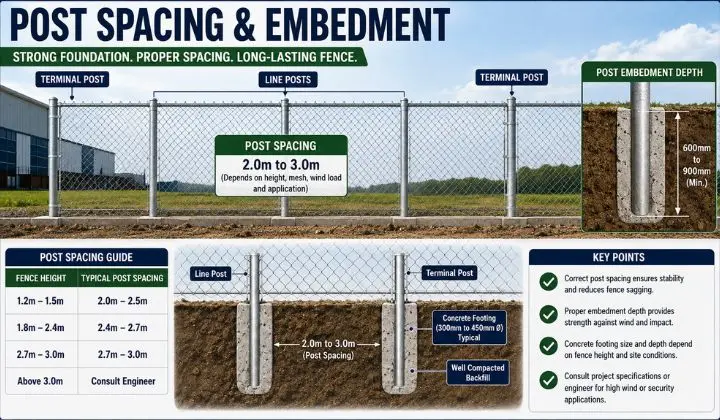
The correct spacing can depend on:
- Fence height
- Mesh opening
- Wire gauge
- Framework strength
- Wind load
- Soil conditions
- Screening or privacy material
- Project requirements
The same applies to chain link fence post depth.
Posts need suitable post embedment and a stable foundation. Concrete footing is commonly used, but its required size and depth depend on the fence design and site conditions.
For example, the correct depth for a 5-foot fence can vary depending on soil, wind exposure, post size, foundation design, and project requirements.
This is particularly important for commercial and industrial fencing where wind and structural loads may be higher.
Top Rail, Tension Wire & Tie Wire
A chain link fence is not held together by the fabric alone.
The top rail runs along the upper edge of the fence and provides additional support.
Tension wire can help keep the fabric tight, depending on the fence design and installation method.
Tie wire is used to secure the fabric to the supporting framework.
Fence fittings connect different parts of the system, including posts, rails, braces, and fabric.
Although these components are smaller than the main posts and fabric, using the right components helps create a more stable and properly finished fence.
Galvanized vs. PVC-Coated Chain Link Fence
The protective coating is another important part of chain link fencing specifications.
Two common options are galvanized steel and PVC-coated chain link fencing.
Galvanized Chain Link Fence
A galvanized chain link fence has a zinc coating that helps protect the steel wire from corrosion.
The coating type and amount can vary according to the product specification and applicable standard.
Galvanized fencing can be suitable for:
- Residential boundaries
- Construction sites
- Warehouses
- Commercial properties
- Industrial areas
- General perimeter fencing
For outdoor UAE applications, the expected exposure should be considered when selecting the zinc coating and other materials.
PVC-Coated Chain Link Fence
A PVC coated chain link fence has a polymer coating over the steel wire. The coating provides an additional protective layer and gives the fence a finished color.
When checking PVC coated chain link fence specifications, look at more than the color.
Important details include:
- Core wire
- Wire diameter
- Mesh opening
- PVC coating
- Coating thickness
- Fence height
- Posts
- Framework
- Fittings
The steel core remains an important part of the fence’s strength. PVC coating should therefore not be treated as a replacement for a suitable wire and framework specification.
Which Chain Link Fence Finish Is Suitable for UAE Conditions?
There is no single finish that is best for every UAE project.
For many general applications, galvanized steel can provide practical corrosion protection.
PVC coating may be a better choice when the project requires a colored finish, additional surface protection, or a specific appearance.
For coastal or high-exposure locations, consider the complete corrosion resistance strategy, including the fabric, posts, fittings, and framework.
For Dubai projects, a PVC coated chain link fence specification in Dubai should also be selected according to the site’s exposure, application, required durability, and project requirements.
Commercial-Grade Chain Link Fence Specifications
A commercial chain link fence should be specified as a complete system rather than by choosing one wire gauge or mesh size.
For commercial properties, the right specification can depend on the required security level, fence height, site conditions, wind exposure, and expected use.
A commercial-grade system may include:
- Suitable mesh opening
- Heavier wire gauge
- Appropriate fence height
- Stronger line posts and terminal posts
- Suitable fence framework
- Durable coating
- Proper fence fittings
- Strong gates and gate posts
- Correct post spacing
- Suitable foundation and installation
For industrial sites, warehouses, and perimeter security, the framework may need to be stronger than a standard residential system.
Commercial grade does not always mean one fixed gauge
For example, choosing a 9-gauge fabric does not automatically make a fence suitable for every commercial project. The complete system should be reviewed, including the fabric, posts, rails, fittings, coating, and installation.
This approach gives buyers a better way to compare commercial chain link fence specifications instead of choosing a product based only on one number.
ASTM Standards for Chain Link Fence
ASTM standards provide technical requirements or practices for different chain link fence materials, components, and installation methods.
They can be useful when preparing project specifications, reviewing technical submittals, or comparing products from different suppliers.
However, the applicable standard should always be confirmed against the project’s drawings, specifications, and required product class.
ASTM A392 — Zinc-Coated Chain Link Fabric
ASTM A392 covers zinc-coated steel chain link fence fabric.
It is relevant when checking galvanized fabric and its protective zinc coating.
When reviewing a galvanized fence specification, don’t look only for the word “galvanized.” Check the applicable coating requirements and product specification.
ASTM F567 — Chain Link Fence Installation
ASTM F567 covers practices for the installation of chain link fences.
Installation can include areas such as:
- Site preparation
- Fence layout
- Post installation
- Fabric installation
- Framework
- Tensioning
- Finishing
This is important because even good-quality materials can perform poorly if they are not installed correctly.
ASTM F668 — PVC-Coated Chain Link Fabric
ASTM F668 relates to polyvinyl chloride, or PVC-coated, steel chain link fabric.
It is relevant when reviewing PVC coating, the steel core wire, and the coating system.
For a PVC-coated product, the specification should clearly identify the fabric and coating requirements rather than simply stating that the fence is “PVC coated.”
ASTM F626 — Fence Fittings
ASTM F626 covers requirements related to fence fittings.
Fittings connect different components of the fencing system and can include hardware used with posts, rails, fabric, and other framework components.
Good fittings are important because the fence is only as strong as its supporting connections.
ASTM F669 — Industrial Posts and Rails
ASTM F669 relates to strength requirements for metal posts and rails used with industrial chain link fences.
This becomes particularly relevant when specifying a commercial or industrial fence where the framework must handle greater structural demands.
ASTM F761 — Residential Posts and Rails
ASTM F761 relates to strength requirements for steel posts and rails used with residential chain link fences.
The important point for buyers is that the post and rail specification should match the intended fence application and height.
ASTM F1043 — Industrial Fence Framework
ASTM F1043 is particularly relevant to industrial steel fence framework.
Framework selection can be affected by:
- Fence height
- Post spacing
- Fabric characteristics
- Wind load
- Screening
- Signs or other materials attached to the fence
For example, privacy screening can increase the wind load on a fence. This may require a stronger framework, different post spacing, or additional structural support.
This is why ASTM F1043 is an important technical reference when reviewing industrial fence framework specifications.
ASTM F1083 — Galvanized Steel Pipe
ASTM F1083 relates to hot-dipped zinc-coated galvanized steel pipe used for fence structures.
It can be relevant when reviewing the steel pipe used for posts, rails, and other structural parts of a fencing system.
Chain Link Fence Specifications by Application
The best specification depends on where the fence will be installed.
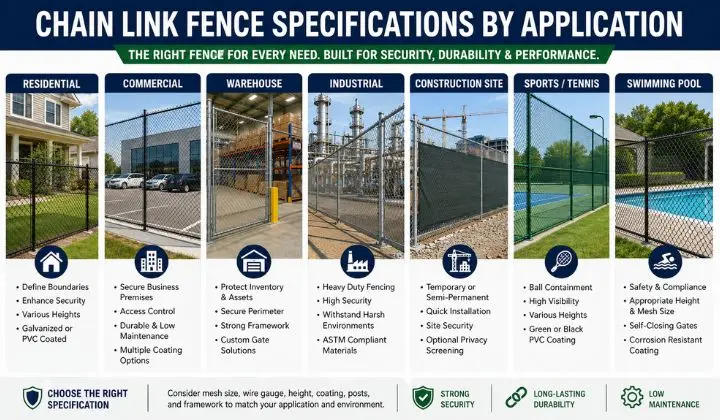
A specification suitable for a home may not be suitable for a warehouse or industrial site.
| Application | Main Specification Considerations |
| Residential fencing | Mesh, height, appearance and durability |
| Commercial fencing | Wire, framework, height and security |
| Warehouse fencing | Perimeter protection and access control |
| Construction site fencing | Practicality, security and installation |
| Sports fencing | Height, containment and visibility |
| Industrial fencing | Heavy-duty fabric and framework |
| Swimming pool fencing | Mesh opening, height and safety requirements |
Residential
Residential fencing usually focuses on boundary definition, appearance, durability, and basic security.
The required mesh, wire, height, coating, and post system should match the property and local project requirements.
Commercial
Commercial fencing generally needs greater attention to durability, access, framework, and security.
Warehouses, parking areas, offices, and commercial compounds may require different specifications depending on their risk level.
Industrial
Industrial fencing often needs stronger fabric and supporting framework.
For industrial chain link fence specifications, consider the fence height, wire, mesh, posts, rails, wind exposure, gates, and security requirements as one system.
Construction Sites
Construction site fencing may be temporary or semi-permanent.
The specification should consider how quickly the fence needs to be installed, site movement, access points, stability, and the required level of security.
Sports Facilities
Sports applications may need taller fencing to keep balls inside the playing area.
For tennis courts and athletic areas, visibility, height, mesh opening, posts, and framework all need to be considered.
Swimming Pools
Pool fencing requires special attention to the mesh opening, fence height, gate design, and applicable safety requirements.
A smaller opening can help reduce climbing opportunities, but the final specification should always follow the applicable project and safety requirements.
Chain Link Fence Specifications for UAE Projects
UAE conditions can affect the selection of fencing materials and coatings.
A specification that works well in one location may not be the best choice for another site.
Heat and Sun Exposure
Outdoor fencing is exposed to high temperatures and strong sunlight for long periods.
The fabric, coating, posts, and other components should therefore be selected for the expected outdoor environment.
Humidity and Coastal Exposure
Coastal locations can expose steel to moisture and salt-laden air.
In these areas, corrosion resistance becomes an important part of the specification.
The coating should be considered for the complete system, including:
- Fence fabric
- Posts
- Rails
- Fittings
- Gates
Wind Exposure
Wind is another important consideration, especially for taller fences.
Fence height, post spacing, framework strength, and any privacy material attached to the fence can affect the wind load.
This means that chain link fence specifications UAE projects should be selected according to the actual site rather than using one standard specification everywhere.
Site Conditions
Ground conditions also affect installation.
The contractor may need to consider:
- Soil type
- Slopes
- Existing concrete
- Drainage
- Foundation requirements
- Access for installation
- Existing structures
For a large commercial or industrial project, these conditions should be reviewed before finalizing the fence specification.
How to Compare Chain Link Fence Quotations
A low price does not always mean a better deal.
Two suppliers may both quote a 50 × 50 mm mesh, but the two fences can still have different specifications.
Before comparing prices, ask each supplier to clearly state the following:
| Item | What to Compare |
| Mesh | Opening size |
| Wire | Gauge and diameter |
| Height | Finished fence height |
| Coating | Galvanized/PVC and coating details |
| Posts | Type, diameter and wall thickness |
| Spacing | Distance between posts |
| Framework | Rails, braces and supports |
| Fittings | Material and coating |
| Gates | Frame, posts and hardware |
| Installation | What is included |
| Foundation | Concrete and related work |
| Quantity | Total fence length and gates |
Example
Supplier A:
50 × 50 mm mesh, 11 gauge, galvanized
Supplier B:
50 × 50 mm mesh, 9 gauge, galvanized
These are not the same specification.
The 9-gauge wire is thicker, so the material and expected performance can differ.
Likewise, two suppliers quoting the same 9-gauge wire can still offer different systems if their posts, framework, coatings, fittings, and installation methods are different.
The best quotation is the one you can clearly understand and compare.
Ask suppliers to provide the full chain link fence specifications rather than only a price per meter.
Chain Link Fence Specification Checklist
Before requesting a quote, prepare this checklist.
Fabric
- Fence height
- Mesh opening
- Wire gauge
- Wire diameter
- Selvage
Coating
- Galvanized or PVC coated
- Zinc coating
- PVC coating details
- Color
Framework
- Line post
- Terminal post
- Corner post
- Gate post
- Top rail
- Tension wire
- Tie wire
- Braces
- Fence fittings
Installation
- Post spacing
- Post embedment
- Concrete footing
- Ground conditions
- Site access
- Fence layout
Project Requirements
- Residential/commercial/industrial use
- Security level
- Gates
- Security topping
- Required standards
- Required finish
- Total fence length
Having these details ready makes it easier to request accurate quotations and compare different suppliers.
Why Choose Vertex Fence for Chain Link Fencing in UAE?
For a UAE project, the fence should be selected according to the required application, site conditions, and project specification.
Vertex Fence provides chain link fencing options for UAE projects, including 50 × 50 mm/custom mesh, different height options, galvanized and PVC-coated finishes, colors, and supporting steel posts.
For commercial and industrial projects, the required mesh, wire, height, coating, posts, framework, gates, and installation requirements can be reviewed before the final specification is selected.
Frequently Asked Questions
Does a smaller chain link mesh make a fence more secure?
A smaller mesh opening can make it harder to pass objects through the fence and can provide better containment. However, overall security also depends on wire thickness, fence height, posts, framework, gates, and installation.
Can chain link fence mesh and posts be customized for a project?
Yes. Chain link fencing can be specified according to the required mesh, height, wire, post type, coating, and framework. Custom requirements should be confirmed with the supplier before fabrication.
What information should I provide when requesting a chain link fence quotation?
Provide the fence height, mesh size, wire gauge or diameter, coating, color, post requirements, gates, and approximate fence length. Site conditions and security requirements should also be shared when relevant.
Does PVC coating change the size of chain link fence wire?
Yes, the PVC layer adds material around the steel core, so the coated wire can have a different overall diameter from the core wire. A specification should identify the core wire and coating details where applicable.
Can chain link fencing be used for high-security perimeter protection?
Yes. Chain link fencing can be part of a perimeter security system. Higher-security projects may use stronger fabric and framework, controlled-access gates, and suitable security toppings based on the project’s design and risk requirements.
How does fence height affect the required chain link fence framework?
A taller fence can create greater structural demands on posts and framework, particularly in windy locations. Height should therefore be considered together with mesh, wire gauge, post spacing, framework strength, and site conditions.
Conclusion
A proper chain link fence specification should cover much more than mesh size.
The key details include mesh opening, wire gauge, wire diameter, fence height, posts, post spacing, framework, coating, fittings, gates, and installation requirements. Relevant ASTM standards can also help define material and component requirements.
For UAE projects, site conditions are equally important. Heat, humidity, coastal exposure, wind, security needs, and the intended application should all be considered before selecting the final system.
When comparing suppliers, do not compare only the price or mesh size. Review the complete chain link fence specifications so you know exactly what is included and can make a fair comparison between quotations.