
 Fences
 Gates
 Signage & Boards
 Car Parking Shades
 Block and Foundation
 Spare Parts
Crowd Control Barriers: Types, Sizes and Uses in the UAE

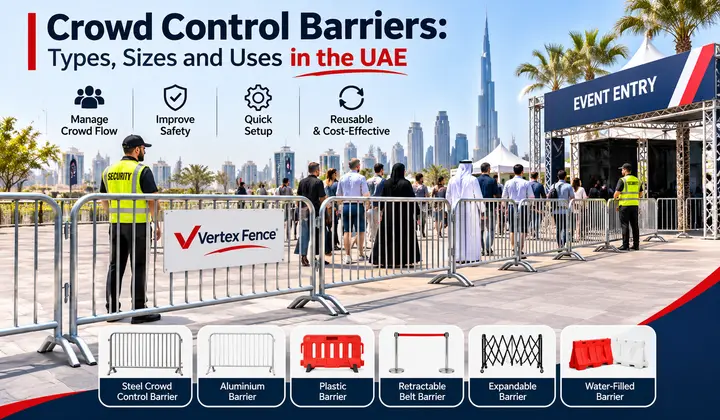
Crowd Control Barriers are used to separate pedestrian areas, control queues and prevent people from entering restricted spaces. For example, at a concert, metal barriers can create a boundary between the audience and the stage, while interlocking barriers can keep entry lines organised outside an exhibition or stadium. At construction sites, temporary barriers help keep visitors away from active work areas.
At concerts and exhibitions, long queues can block entrances, while visitors may move into staff-only or equipment areas. Barriers help prevent these situations by separating public access from restricted areas, keeping queues in designated spaces and leaving clear routes for entry and exit.
What Are Crowd Control Barriers?
Crowd control barriers are temporary or movable structures used to guide pedestrians, separate public areas and restrict access to selected locations. They create visible boundaries that help people follow organised routes without needing permanent walls or fencing.
These barriers are also called pedestrian barriers, crowd barricades, event barriers or crowd management barriers. Their design depends on where they will be installed and the level of separation required.
For example, an outdoor concert may need interlocking steel barriers to separate the audience from the stage. An airport may use retractable belt barriers to organise passenger queues, while a construction site may need temporary fencing to keep pedestrians away from dangerous work areas.
Most temporary barriers are designed for quick installation, removal and reuse. Some models also include connecting hooks, removable feet, reflective strips and access gates.
Types of Crowd Control Barriers
Different locations need different barrier designs. The following types are commonly used for pedestrian management, events and temporary site separation.
1. Steel Crowd Control Barriers
Steel crowd control barriers are a popular choice for outdoor events, public gatherings and construction projects. Their metal frames provide a strong physical boundary and can be connected to form longer barrier lines.
Most models use steel tubes with welded vertical bars. A galvanized steel finish helps protect the metal against corrosion, making it suitable for repeated outdoor use.
Common features include:
- Strong tubular steel frames
- Interlocking hooks for connecting multiple panels
- Removable or fixed support feet
- Galvanized or powder-coated finishes
- Stackable designs for easier storage
Steel barriers are suitable for concerts, sports events, public festivals and pedestrian diversion routes. They are also useful for rental companies because their reusable construction supports repeated installation.
2. Aluminium Crowd Control Barriers
Aluminium crowd control barriers provide a lighter alternative to traditional steel models. Their reduced weight makes them easier for workers to carry, transport and reposition.
They are often used at exhibitions, indoor venues, temporary walkways and events where barriers need frequent movement.
Aluminium also offers natural corrosion resistance. However, the strength and stability of each model depend on its frame design, thickness, connections and support system.
These barriers are worth considering when easy handling and lower transportation weight are important.
Plastic Crowd Control Barriers
Plastic crowd control barriers are lightweight, easy to handle and available in bright colours. They are commonly used for temporary pedestrian separation, maintenance work and public events.
Many models use high-density polyethylene (HDPE), a durable plastic material that resists moisture and does not rust like ordinary steel.
Their main features include:
- Lightweight construction
- Bright and visible colours
- Easy installation and removal
- Weather-resistant material
- Interlocking or removable feet on selected models
Plastic barriers are useful where workers need to move and reposition units regularly. However, they should not automatically be treated as a replacement for heavy-duty steel barriers where stronger physical separation is required.
4. Retractable Belt Barriers
Retractable belt barriers use upright posts with a built-in belt that extends from one post to another. They are mainly designed to organise queues and guide people through controlled waiting areas.
You will commonly find them in airports, hotels, banks, shopping centres, hospitals and exhibition halls.
Their main advantages include quick setup, adjustable queue layouts and compact storage. Some models also allow businesses to print their logos or instructions on the belts.
These barriers are best for guiding people rather than stopping strong crowd pressure.
5. Interlocking Pedestrian Barriers
Interlocking pedestrian barriers have connecting hooks or joints that allow individual panels to join together. This creates a continuous boundary with fewer gaps between units.
They are useful at concerts, sporting events, construction areas and public gatherings where organisers need to create temporary walking routes.
Their modular design makes it easier to extend, shorten or change a barrier line when the layout changes.
6. Heavy-Duty Crowd Control Barriers
Heavy-duty crowd control barriers are design for applications that require stronger frames, more stable feet or specialised crowd-facing structures.
Depending on the model, they may include reinforced steel sections, wider support bases and stronger connecting systems.
They can be used at large public events, busy outdoor venues and locations that need more robust pedestrian separation.
It is important to check the manufacturer’s specifications before using any barrier in a high-pressure crowd environment. A standard pedestrian barrier should not be assumed to provide protection against vehicle impacts or extreme crowd forces.
Crowd Control Barrier Sizes and Specifications
Barrier size affects how much space each unit covers, how easily people can pass through nearby routes and how much storage space is required.
Most metal crowd control barriers are rectangular panels. Their dimensions vary by manufacturer, model and intended application.
A common steel pedestrian barrier specification is approximately:
| Specification | Example measurement |
| Width | 2,500 mm |
| Height | 1,200 mm |
| Outer frame | 32 mm × 1.5 mm |
| Inner tubes | 16 mm × 1 mm |
| Tube spacing | 150 mm |
| Surface finish | Hot-dip galvanized |
These measurements are an example of a commercially available barrier design, not a universal standard. Always check the actual product specification before ordering.
What Do These Barrier Specifications Mean?
Understanding the measurements helps buyers compare different barrier models and select equipment that suits their project.
Width: A 2,500 mm-wide panel covers 2.5 metres of a straight barrier line. This helps estimate how many panels may be needed for a particular area.
Height: A height of 1,200 mm creates a visible physical boundary to guide pedestrian movement.
Outer frame: The example uses a 32 mm frame with a 1.5 mm wall thickness. Frame dimensions and material thickness are important when comparing construction quality.
Inner tubes: The 16 mm × 1 mm tubes form the vertical sections within the frame and contribute to the panel’s overall construction.
Tube spacing: A spacing of 150 mm describes the distance between the inner tubes. Check how the manufacturer measures this distance, as it may refer to centre-to-centre spacing or the clear gap.
Surface finish: Hot-dip galvanizing applies a protective zinc coating to steel, helping reduce corrosion and making the barrier more suitable for outdoor exposure.
Common Uses of Crowd Control Barriers in the UAE
The UAE hosts international exhibitions, sporting competitions, concerts, construction projects and large public gatherings throughout the year. Each setting has different pedestrian management requirements.
Crowd control barriers help organisers create clear routes, separate restricted areas and manage public movement.
1. Concerts, Festivals and Public Events
Concerts and festivals attract large numbers of visitors, especially around entrances, stages and food areas. Organisers use steel crowd barriers to separate audience sections, protect performance areas and guide visitors towards designated entrances.
Interlocking barriers are useful because they can form long connected lines. Organisers can also add controlled access points for staff and emergency teams.
2. Construction Sites and Roadworks
Construction sites contain machinery, tools, open trenches and other hazards. Temporary barriers help separate workers from pedestrians and keep visitors away from restricted work areas.
Metal pedestrian barriers and temporary fencing can define safe walking routes around active projects. For road maintenance, plastic barriers and suitable warning equipment can help guide pedestrians away from work zones.
The barrier system should match the actual site risks and applicable local safety requirements.
3. Airports and Transportation Hubs
Airports, bus stations and transport facilities need organised passenger movement. Retractable belt barriers help create separate queues at check-in counters, security checkpoints and customer service desks.
For outdoor transport areas, stronger pedestrian barriers may be more suitable where a physical boundary is required.
4. Shopping Malls and Commercial Buildings
Shopping malls regularly use barriers during promotional events, seasonal sales and maintenance work.
Retractable posts can organise customer queues, while portable barriers help restrict access to cleaning areas, repair work and temporary closures.
5. Sports Stadiums and Sporting Events
Sports venues use crowd management barriers to separate spectators, players and operational areas.
Steel barriers can define spectator routes, organise entrance queues and create boundaries around restricted sections. For large competitions, organisers should also plan suitable emergency exits and pedestrian routes.
6. Hotels, Exhibitions and Business Events
Hotels and exhibition centres often require temporary crowd management without changing the permanent layout.
Decorative post-and-rope systems can organise VIP areas, while retractable belts help manage registration desks and visitor queues. Portable metal barriers are useful when organisers need stronger separation.
Crowd Control Barriers for Sale vs Rental in the UAE
Businesses and event organisers can either purchase barriers or arrange temporary rentals. The right option depends on how often the equipment will be needed, the project duration and the available budget.
Crowd Control Barriers for Sale
Companies that organise regular events or manage construction sites often need a reliable supply of crowd control barriers. Purchasing their own equipment allows them to reuse the barriers across multiple projects.
Before purchasing, consider:
- Material and construction quality
- Barrier dimensions and weight
- Galvanized or powder-coated finish
- Connecting hooks and support feet
- Storage and transportation requirements
- Quantity and future project demand
Buying can provide better long-term value when the barriers are used regularly across multiple projects.
Crowd Control Barriers Rental
Crowd control barriers rental is suitable for short-term requirements, such as a weekend event, exhibition or temporary construction project.
Renting allows organisers to arrange the required number of barriers without purchasing and storing them permanently.
Before confirming a rental, check the following:
- Total number of available units
- Rental period and delivery arrangements
- Installation and collection services
- Condition of the barriers
- Included feet, connectors and gates
- Replacement or damage conditions
For one-time events, rental can reduce upfront costs. However, businesses with regular requirements should compare rental expenses against the cost of purchasing their own equipment.
Crowd Control Barriers Dubai: What Should Buyers Consider?
Dubai has a wide range of commercial, construction and event environments. Choosing the right barrier requires more than comparing prices.
When searching for crowd control barriers Dubai, buyers should consider the installation location, expected use and required barrier specifications.
For example, an outdoor festival may need galvanized steel barriers, while an indoor exhibition may benefit from lightweight aluminium panels or retractable belt systems.
Buyers should also consider:
Outdoor conditions: Check the surface finish and corrosion protection, especially for barriers that will remain outside for long periods.
Ground conditions: Select suitable support feet for the installation surface. Uneven ground may require a different support arrangement.
Visibility: Bright colours and suitable reflective features can help people identify temporary boundaries.
Delivery: Confirm that the supplier can deliver the required quantity to your project location.
Local requirements: Check applicable site, event and safety requirements before installation.
These considerations also apply to projects in Abu Dhabi, Sharjah and other UAE locations.
How to Choose the Right Crowd Control Barrier Supplier
Selecting a reliable crowd control barrier supplier is important because product quality affects handling, durability and overall performance.
Instead of selecting a supplier based on price alone, compare the following factors.
1. Check Product Specifications
Ask for clear product information, including dimensions, frame thickness, material, finish and weight. This helps you compare different barrier models before placing an order.
2. Review Material and Surface Finish
For repeated outdoor use, check whether steel barriers have a suitable galvanized finish. For lightweight handling, compare aluminium and plastic options.
3. Confirm Connecting Systems
If you need a long barrier line, check the hooks, connectors and feet. Compatible components make installation easier and help create a more organised layout.
4. Compare Prices and Quantities
Request quotations based on the required quantity. Also check whether accessories, transportation and installation are include in the quoted price.
5. Ask About Delivery and Support
For large projects, delivery arrangements matter. Confirm the expected delivery time, available stock and after-sales support before making a decision.
At Vertex Fence customers can discuss their crowd barrier requirements and compare suitable options based on their project needs.
Safety and Installation Tips for Crowd Control Barriers
Even good-quality barriers need proper placement. Incorrect installation can create gaps, block walking routes or reduce the stability of the system.
Follow these basic practices:
- Inspect each panel before installation and check for damaged joints or loose parts.
- Place barriers on suitable, stable ground.
- Connect adjoining panels properly.
- Keep emergency exits and access routes clear.
- Avoid placing barriers where they create unnecessary pedestrian bottlenecks.
- Use suitable warning signs around restricted or hazardous areas.
- Inspect the barrier line regularly during busy events.
Remember that barriers are only one part of a crowd safety plan. Event organisers should also consider crowd capacity, trained security staff, emergency access and suitable evacuation arrangements.
Conclusion
Crowd control barriers serve different purposes across the UAE, from separating concert audiences and protecting construction zones to organising passenger queues at airports. Steel panels provide a solid physical boundary for outdoor events, while aluminium barriers are easier to transport between indoor venues. Plastic barriers work well for temporary maintenance areas, and retractable belt systems help businesses manage customer queues without installing permanent fixtures.
Before ordering, measure the required barrier length and check the panel dimensions, frame thickness, connecting hooks and support feet. For outdoor projects in the UAE, pay particular attention to galvanised finishes that help protect steel against corrosion. Also confirm the available stock, delivery arrangements and whether the supplier can provide the required quantity for your project.
Frequently Asked Questions
How many crowd control barriers are needed for a 100-metre area?
For a straight 100-metre boundary, you need 40 barriers if each panel is 2.5 metres wide. Order extra panels for corners, entrances and access gaps.
Can crowd control barriers be connect to create a continuous boundary?
Yes, interlocking hooks join individual panels to form a connected barrier line. Check connector compatibility before purchasing panels from different manufacturers.
Which crowd control barriers are suitable for outdoor use in the UAE?
Hot-dip galvanised steel barriers are a suitable option for outdoor events because their zinc coating helps protect against corrosion. Check the finish and construction before buying.
Can retractable crowd control barriers be use outdoors?
Yes, but only models design for outdoor conditions should be used. Check the post material, base stability and belt resistance to weather before installation.
What accessories are needed with crowd control barriers?
Removable feet and connecting hooks are essential for many interlocking systems, while access gates, reflective strips and storage racks may be needed depending on your site layout.