
 Fences
 Gates
Gates Signage & Boards
 Car Parking Shades
 Block and Foundation
 Spare Parts
Chain Link vs Welded Mesh Fence: Which Is Better in UAE

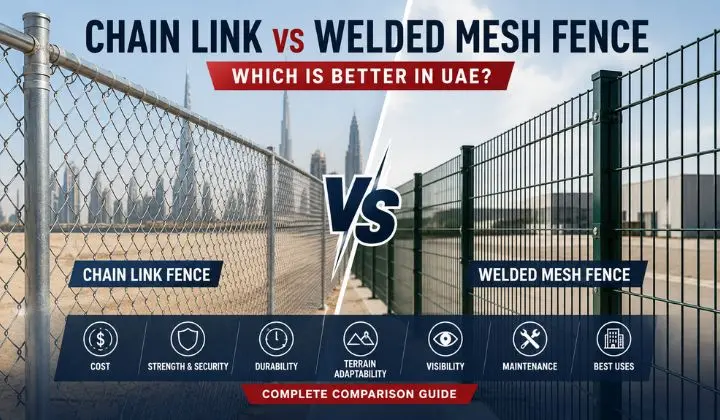
Choosing between a chain link fence and a welded mesh fence is not only about price or appearance. The better option depends on your site’s security needs, ground conditions, fence specification, and expected use.
Both are widely used for perimeter fencing, but they have different structures. A chain link fence is made by weaving steel wire into a flexible diamond pattern, while a welded mesh fence uses wires joined at their intersections to create a more rigid structure.
For long boundaries where flexibility and budget matter, chain link fencing can be a practical choice. For commercial or industrial sites where rigidity, appearance, and stronger perimeter control are more important, welded mesh fencing may be the better fit.
In the UAE, you should also consider heat, humidity, coastal exposure, and corrosion resistance when selecting a fencing system. The right wire diameter, mesh aperture, coating, posts, and installation method can all affect performance.
Chain Link vs Welded Mesh Fence
Chain link fence is generally better for economical, long-distance boundary fencing where flexibility and visibility are important. Its woven structure can also adapt more easily to uneven or sloping ground.
Welded mesh fence is generally better when you need a rigid structure, clean appearance, and stronger perimeter control. Its welded intersections keep the wires in a fixed grid, helping the fence resist bending and deformation.
However, there is no universal winner. The actual performance of either system depends on the mesh aperture, wire diameter, fence height, post spacing, fixing system, coating, and site conditions.
For a UAE project, the right choice should therefore be based on the complete fencing system rather than the mesh type alone.
Chain Link vs Welded Mesh: Key Differences
The main difference between these two fencing systems is their construction.
A chain link fence uses woven wire mesh. Steel wire is formed into interconnected links that create the familiar diamond pattern. Because the wires are woven rather than welded together, the mesh remains flexible.
A welded wire fence, on the other hand, uses horizontal and vertical wires joined at their intersections. These welded intersections create a fixed grid and give the fence greater structural rigidity.
This basic difference affects flexibility, security, installation, appearance, maintenance, and suitability for different types of ground.
Structure and Construction
A chain link fence is normally supplied as a roll of flexible mesh. Its diamond mesh pattern allows the fence to move and adjust when installed over changing ground levels.
This flexibility makes chain link useful for long boundaries, construction sites, farms, sports areas, and other applications where the ground may not be perfectly flat.
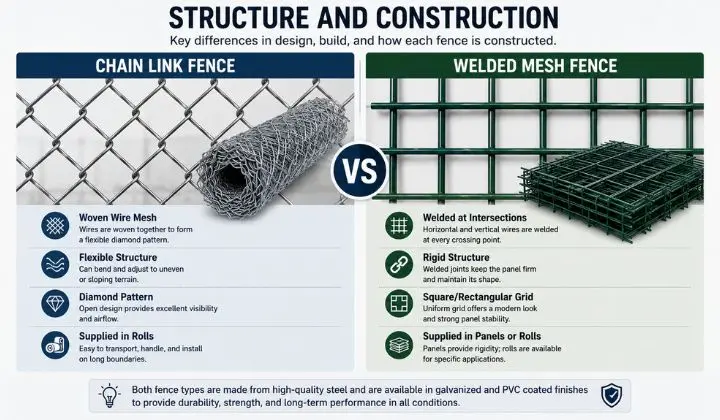
A welded system has a more fixed structure. Welded wire mesh is formed by joining horizontal and vertical wires at every crossing. Many products are supplied as rigid mesh panels, although welded mesh is also available in roll forms depending on the product.
The rigid structure helps the panel maintain its shape after installation. It can also provide a more uniform appearance around commercial and industrial properties.
When comparing products, do not look only at the words “chain link” or “welded mesh.” Check the actual mesh opening, wire gauge, wire diameter, panel dimensions, coating, posts, and fixing system.
These specifications can make a major difference in the final performance of the fence.
Strength and Security
Strength is one of the biggest reasons buyers compare chain link and welded mesh.
Welded mesh is generally more rigid because its wires are fixed together at the intersections. This fixed structure can make it more resistant to bending, sagging, and deformation than a standard woven chain link system.
Chain link can still provide effective perimeter security when it is correctly specified and installed. Its performance depends on factors such as wire diameter, mesh opening, fence height, tensioning, posts, and fittings.
Security is also affected by the size of the openings. Smaller openings can reduce available handholds and footholds, while heavier wire can make cutting more difficult.
For projects with higher security requirements, anti-climb fencing or specialized high-security fencing may be more suitable than standard chain link or basic welded mesh.
For example, 358-style security mesh uses very small openings designed to make climbing and cutting more difficult. It should be considered a specialized security product rather than treated as the same thing as ordinary welded mesh.
So, is welded mesh always stronger?
Not necessarily. The strength of a fence depends on the complete system, including the wire diameter, mesh aperture, fence height, posts, fixings, foundations, and overall design.
Flexibility, Terrain and Fence Span
Ground conditions are an important part of the decision.
Chain link has a natural advantage on uneven terrain because its woven construction allows it to flex and follow changes in ground level.
This can make it easier to install on sloping terrain, irregular ground, and large sites where creating a perfectly level foundation would be difficult or expensive.
Welded mesh panels are more rigid. They work particularly well on flat terrain, prepared ground, concrete surfaces, and sites where accurate panel alignment is possible.
Welded mesh can still be installed on uneven ground, but the installation may require more planning. Depending on the site, installers may need stepped sections, adjusted panels, different post arrangements, or suitable foundations.
What About Fence Span?
Fence span refers to the distance supported between fence posts or structural points. It is important because the distance between posts affects how well the fence handles its own weight, wind pressure, and external forces.
There is no single post-spacing number that works for every project.
The correct post spacing depends on:
- Fence height
- Mesh type
- Wire diameter
- Panel dimensions
- Wind exposure
- Ground conditions
- Post strength
- Foundation design
- Fixing method
For this reason, span and post spacing should be decided as part of the complete fencing system rather than using a generic measurement.
Durability and Maintenance
Both chain link and welded mesh can provide good durability when manufactured from suitable steel and protected correctly.
Galvanized steel is commonly used for outdoor fencing because its zinc coating helps protect the underlying steel from corrosion.
PVC-coated products may also be used where additional protection, color, or a particular finish is required.
However, no fencing material should be described as completely rust-proof. Real-world corrosion resistance depends on the coating, steel quality, environment, installation, physical damage, and maintenance.
This is especially important in the UAE.
A fence installed in a coastal area can face greater exposure to salt and moisture than one installed inland. High humidity and environmental exposure can also affect the long-term condition of metal fencing.
Chain link may require occasional tension adjustment if the mesh becomes loose or damaged. Local sections can often be repaired without replacing the entire fence.
Welded mesh generally maintains its rigid shape well. However, if a panel suffers major physical damage, replacing the affected section may be more practical than trying to restore its original shape.
The expected service life should therefore be based on the actual product specification and site conditions rather than one fixed number for every fence.
Visibility, Appearance and Privacy
Visibility is another important difference.
The open structure of chain link provides clear sightlines through the fence. This can be useful for construction sites, warehouses, sports facilities, parking areas, and properties where monitoring the perimeter is important.
Welded mesh can also provide good visibility, depending on its mesh aperture and design. Its straight horizontal and vertical lines often create a cleaner and more modern appearance.
Neither standard chain link nor standard welded mesh should automatically be considered a privacy fence.
If privacy is required, a suitable screening material or privacy system can be added depending on the fence design.
This makes the decision more about the purpose of the fence:
- Need maximum visibility? Chain link can be a strong choice.
- Need a cleaner structured appearance? Welded mesh may be preferable.
- Need privacy? Consider an appropriate screening solution with either system.
Chain Link vs Welded Mesh Fence Cost in UAE
Cost is one of the strongest factors behind this comparison.
In general, chain link fence cost is often lower at the initial material stage than a rigid welded mesh system. Chain link is supplied in rolls and can be economical for large perimeter projects.
A welded mesh fence cost can be higher because rigid panels, supporting posts, fittings, and installation requirements may increase the initial investment.
However, comparing only the purchase price does not give the complete picture.
A better comparison looks at:
Initial cost + installation + maintenance + repairs + replacement = total project cost
This is why total cost of ownership is useful when comparing fencing systems.
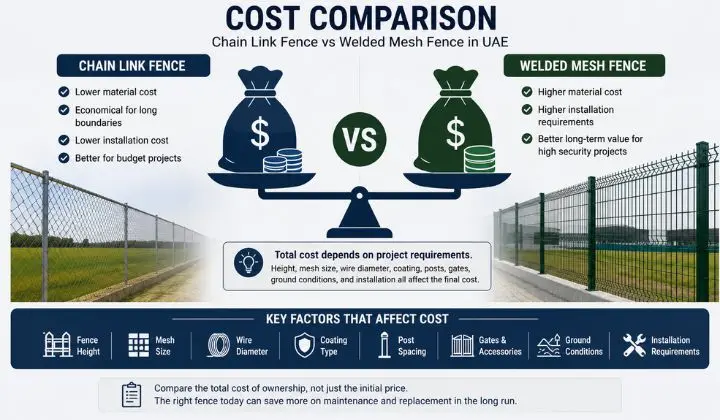
What Affects Fence Cost?
The final chain link fence price or welded mesh fence price can vary significantly from one project to another.
Important factors include:
- Total fence length
- Fence height
- Mesh aperture
- Wire diameter
- Wire gauge
- Steel and coating specification
- Number of posts
- Post spacing
- Gates and access points
- Ground preparation
- Foundations
- Installation requirements
- Site access
- Project location
For example, a tall security fence with a small mesh opening and heavy-gauge wire will naturally have different requirements from a basic boundary fence.
This is why there is no single fencing cost in UAE that applies to every project.
A proper quotation should be based on the actual site and required specification.
Initial Price vs Total Cost of Ownership
A lower initial price does not always mean lower long-term cost.
Chain link can provide excellent value where the main requirements are economical coverage, flexibility, visibility, and general perimeter protection.
Welded mesh may justify a higher initial investment where the project needs greater rigidity, stronger perimeter control, a uniform appearance, or reduced risk of deformation.
The right question is therefore not simply:
Which fence is cheaper?
A better question is:
Which fence provides the required performance at the best overall project cost?
This approach helps buyers avoid selecting a cheaper system that may not meet the site’s security or durability requirements.
Chain Link vs Welded Mesh Fence: Pros and Cons
Both fencing systems can work well, but they solve different problems. The right choice depends on what you need from the fence rather than which material is generally considered “better.”
| Factor | Chain Link Fence | Welded Mesh Fence |
| Initial cost | Generally lower | Generally higher |
| Structure | Flexible woven mesh | Rigid welded grid/panel |
| Flexibility | High | Lower |
| Rigidity | Moderate | High |
| Uneven terrain | Easier to adapt | Requires more planning |
| Security | Good for general boundaries | Better for stronger perimeter control |
| Visibility | Excellent | Good, depending on aperture |
| Appearance | Traditional | Cleaner and more modern |
| Maintenance | Generally low | Generally low |
| Large boundaries | Very practical | Suitable with proper planning |
Chain Link Fence: Main Advantages
- Cost-effective for many large boundary projects
- Flexible and easier to adapt to uneven terrain
- Provides high visibility
- Relatively quick to install
- Suitable for long perimeter runs
- Available with galvanized and coated finishes
- Easy to repair or adjust in many applications
Chain Link Fence: Main Limitations
- Less rigid than welded mesh
- Can sag or deform if not properly tensioned or supported
- Provides limited privacy
- Standard designs may offer less resistance to climbing or cutting than specialized security mesh
- Its traditional appearance may not suit every modern commercial property
Welded Mesh Fence: Main Advantages
- High structural rigidity
- Welded intersections help maintain panel shape
- Can provide stronger perimeter control
- Small mesh openings can make climbing and access more difficult
- Clean and uniform appearance
- Suitable for many commercial and industrial applications
- Available in different mesh sizes, wire diameters, heights, and coatings
Welded Mesh Fence: Main Limitations
- Usually has a higher initial cost
- Less flexible than chain link
- Uneven or sloping ground can require more installation planning
- Damaged rigid panels may need replacement rather than simple retensioning
The important point is that both options have a place in professional fencing. The choice should be based on security, terrain, budget, durability, appearance, and project requirements.
Which Fence Is Better for Different UAE Projects?
The right fencing system can change depending on the type of property.
A construction site, warehouse, residential compound, and high-security facility do not have the same requirements. Understanding the application makes the comparison much easier.
Construction Sites and Temporary Boundaries
Chain link is often a practical solution for construction sites where a large area needs to be enclosed at a controlled cost.
Its flexible structure works well for temporary or changing site boundaries. It also provides visibility, allowing workers and security staff to monitor activity around the perimeter.
For construction projects where the ground changes during development, the flexibility of chain link can also be useful.
Welded mesh can be used where a more rigid temporary or semi-permanent barrier is preferred, but the choice should consider how often the fence needs to be moved or modified.
Warehouses and Industrial Facilities
Warehouses and industrial facilities often need more than simple boundary marking.
Chain link can be suitable for general perimeter protection, storage yards, parking areas, and lower-risk zones where visibility and economical coverage are important.
Welded mesh can be a better option where the site needs greater rigidity, stronger intrusion resistance, or a more controlled perimeter.
For higher-risk areas, the fence should be designed as part of a wider security system that may include controlled gates, lighting, security cameras, and other appropriate measures.
Commercial Properties and Compounds
Commercial properties often need to balance security with appearance.
Welded mesh can provide a clean and uniform look because the panels have straight horizontal and vertical lines. This can work well around offices, commercial compounds, warehouses, and modern developments.
Chain link can still be a good option when budget, visibility, and practical boundary protection are more important than appearance.
If privacy is required, either system may be combined with an appropriate screening solution.
Large Perimeter Projects
For large sites, the total length of the fence becomes an important factor.
Chain link is commonly suitable for long perimeter runs because the mesh is supplied in rolls and can cover large distances efficiently.
Its flexibility can also make installation easier when the ground is not perfectly level.
Welded mesh can also be used for large boundaries, especially when a rigid panel system is required. However, the project should account for panel dimensions, transportation, post spacing, foundations, alignment, and installation time.
For large commercial and industrial projects, comparing the complete installed system is more useful than comparing mesh prices alone.
Uneven or Sloping Sites
If the site has significant changes in ground level, chain link usually has a practical advantage.
Its woven construction allows it to follow the shape of the ground more easily. Proper tensioning and post installation are still important to maintain a secure and neat boundary.
Welded mesh can be installed on slopes, but rigid panels require more planning. Depending on the site, installers may use stepped sections or adjusted panel arrangements.
For very uneven ground, the installation method should be decided before the fencing material is ordered.
Higher-Security Facilities
Higher-security projects need a different approach from ordinary boundary fencing.
Welded mesh can offer a stronger starting point because its rigid structure and welded intersections make it more difficult to deform than standard chain link.
The security level can be increased through suitable:
- Mesh aperture
- Wire diameter
- Fence height
- Strong posts
- Secure fixings
- Security gates
- Appropriate security toppings
For critical infrastructure and sites with serious intrusion risks, specialized high-security fencing or anti-climb fencing may be more suitable than standard welded mesh.
The fence should always be selected according to the actual threat and site requirements.
How UAE Climate Affects Your Fence Choice
The UAE’s environment is an important consideration when choosing outdoor fencing.
High temperatures, strong sunlight, humidity, and coastal salt exposure can all affect outdoor steel products and their protective coatings over time.
This does not mean that one fence type is automatically better for the UAE. Instead, the material and coating specification should match the site’s environment.
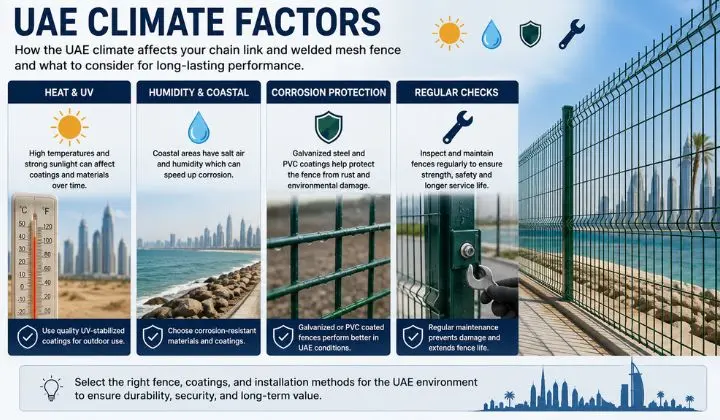
Heat and UV Exposure
UAE summers expose outdoor fencing to high temperatures and strong sunlight.
Steel itself is well suited to outdoor fencing, but coatings, finishes, and other components should be selected for exterior use.
If a PVC-coated product is being considered, check that the coating is suitable for the intended outdoor environment.
The fence should also be installed with suitable posts and fittings because the complete system must withstand the local conditions.
Humidity and Coastal Conditions
Coastal locations can expose fencing to moisture and salt, which can increase the risk of corrosion.
This makes corrosion resistance particularly important for projects near the sea.
Galvanized steel provides a protective zinc layer over the steel. Additional coatings may also be used depending on the product and required finish.
For coastal and saline environments, the correct coating specification should be selected based on actual exposure rather than choosing a product simply because it is described as “galvanized.”
Corrosion Protection and Coating
Both chain link and welded mesh can be manufactured with protective finishes.
Common options include galvanized steel and PVC-coated wire or mesh, depending on the product.
The quality and thickness of the protective coating, the steel specification, physical damage, installation conditions, and maintenance can all affect the fence’s long-term performance.
For this reason, buyers should ask about the actual coating and material specification before comparing quotations.
Which Fence Should You Choose?
There is no single fence that is best for every UAE project.
Your decision should be based on the site’s budget, security level, terrain, appearance, durability requirements, and environmental exposure.
Choose Chain Link If:
- You need an economical boundary.
- You are fencing a large area.
- Flexibility is important.
- The site has uneven or sloping ground.
- You need clear visibility.
- The security requirement is general rather than highly specialized.
- You want a practical solution for construction or temporary boundaries.
For projects where you need help comparing mesh sizes, wire specifications, posts, coatings, and installation requirements, experienced Fence Suppliers in UAE can help you match the system to the site.
Choose Welded Mesh If:
- You need a rigid fence structure.
- Stronger perimeter control is important.
- A clean and modern appearance is preferred.
- Smaller mesh openings are required.
- The project is permanent.
- The site is mainly flat or prepared.
- The fence will be used around commercial or industrial property.
A Fence Manufacturer in UAE can also help you select the right combination of panel height, mesh aperture, wire diameter, coating, posts, and fixing system.
The most important point is to compare the complete fencing system, not only the mesh.
Frequently Asked Questions
Can chain link fencing be upgraded for better security?
Yes. A chain link system can be upgraded with suitable fence height, heavier wire, smaller mesh openings, stronger posts, proper tensioning, and appropriate security toppings. The right combination depends on the site’s security risk and required level of protection.
Can welded mesh fencing be installed on uneven ground?
Yes, but rigid welded panels need more planning on uneven ground. Depending on the site, installation may use stepped sections, adjusted panels, different post arrangements, or suitable foundation solutions to maintain proper alignment and stability.
Does a smaller mesh opening always make a fence more secure?
No. A smaller mesh aperture can reduce handholds and make access through the fence more difficult, but security also depends on wire diameter, fence height, rigidity, post strength, and fixing quality. The complete system should be assessed rather than mesh size alone.
What factors should I check before requesting a fencing quote in the UAE?
Provide the required fence length and height, mesh opening, wire diameter, coating, gate requirements, ground conditions, and installation location. You should also explain whether the project is temporary or permanent and what level of security the site requires.
Is galvanized or PVC-coated fencing better for UAE conditions?
Both can be suitable, but the better option depends on the site’s environment and product specification. Coastal and humid areas require particular attention to corrosion resistance, while PVC coating can provide additional protection and a different appearance depending on the product.
Can chain link and welded mesh fencing be combined on the same project?
Yes. Different fencing systems can be used for different areas of one property. For example, chain link may be practical for a long general boundary, while welded mesh can be installed around areas that need greater rigidity or stronger perimeter control.
Conclusion
Chain link fence is generally the practical option when you need economical coverage, flexibility, visibility, and easier adaptation to uneven ground. It can work well for construction sites, large boundaries, sports areas, farms, and general perimeter protection.
Welded mesh fence is generally a better choice when rigidity, a uniform appearance, smaller mesh openings, and stronger perimeter control are important. It can be suitable for warehouses, factories, commercial compounds, and other permanent applications.
UAE conditions should also be part of the decision. Heat, humidity, coastal exposure, and corrosion risk can affect the choice of steel and protective coating.
Most importantly, do not compare fences only by their initial price. Consider the mesh aperture, wire diameter, fence height, posts, fixing system, coating, installation, maintenance, and expected service requirements together.
When these factors match the actual site, you can choose a fencing system that provides the right balance of security, durability, flexibility, appearance, and cost.
Vertex Fence can help you evaluate the fencing requirements for your UAE project and select a suitable system based on the site conditions and required level of protection.