
 Fences
 Gates
Gates Signage & Boards
 Car Parking Shades
 Block and Foundation
 Spare Parts
Anti Climb Fence vs Chain Link Fence: Best for UAE Security

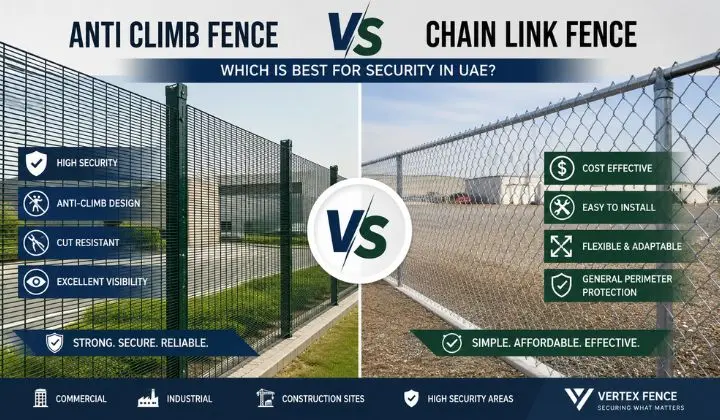
Choosing between an Anti Climb Fence and a Chain Link Fence depends on more than the upfront price. The main differences are security level, mesh design, climbing resistance, cutting resistance, durability, installation, and project requirements.
For high-security sites, an Anti Climb Fence is generally the stronger choice because its narrow mesh openings, welded structure, and rigid panels make climbing and cutting more difficult. Chain Link Fence, however, remains a practical and cost-effective fencing option for large areas where general perimeter protection is required.
For projects in the UAE, the choice should also consider corrosion resistance, outdoor exposure, site conditions, and the level of security needed.
Anti Climb Fence vs Chain Link Fence at a Glance
The easiest way to understand the difference is to compare the two systems across the factors that matter most to a project buyer.
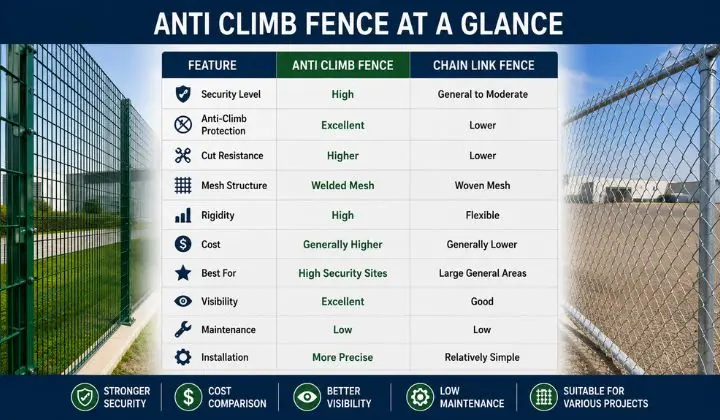
| Factor | Anti Climb Fence | Chain Link Fence |
| Security Level | High | General to moderate |
| Structure | Welded mesh | Woven mesh |
| Mesh Pattern | Small rectangular openings | Diamond-shaped openings |
| Anti-Climb Performance | Excellent | Lower |
| Cut Resistance | Higher | Lower |
| Rigidity | High | Flexible |
| Visibility | Excellent | Good |
| Initial Cost | Generally higher | Generally lower |
| Installation | Requires accurate panel fitting | Relatively simple |
| Maintenance | Low with suitable coating | Low with suitable coating |
| Best For | High-security and restricted sites | Large general-purpose perimeters |
The key point is simple: Anti Climb Fence prioritizes security performance, while Chain Link Fence prioritizes economical coverage, flexibility, and simple installation. The better option depends on what you need the fence to achieve.
What Is an Anti Climb Fence?
An Anti Climb Fence is a high-security welded mesh fence designed to make unauthorized access more difficult. Unlike woven fencing, the horizontal and vertical wires are welded together, creating a strong and rigid panel.
Its small mesh aperture gives an intruder very few places to put their hands or feet. This makes the fence difficult to scale and also limits access for common cutting tools.
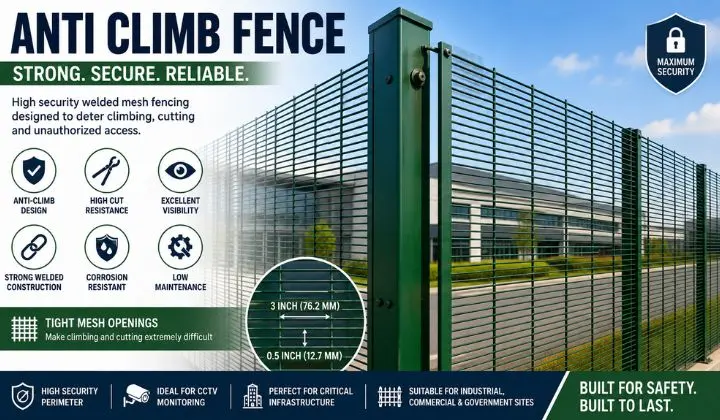
A typical system can include:
- Welded wire mesh
- Steel fence panels
- Security posts
- Tamper-resistant fixing systems
- Security bolts
- Gates
- Optional razor wire or other security toppings
The exact specification can vary by project. Important factors include wire diameter, mesh opening, panel height, post size, coating, and fixing method.
Vertex Fence’s current UAE product information lists a 76.2 mm × 12.7 mm mesh, 4.0 mm wire diameter, heavy-duty galvanized steel, powder coating, and tamper-proof clamps and bolts for its Anti Climb Fence system.
What Does 358 Anti Climb Fence Mean?
The term 358 Security Fence refers to a specific high-security mesh configuration.
The “358” name comes from:
- 3 inches horizontal opening
- 0.5 inches vertical opening
- 8-gauge wire
This is approximately 76.2 mm × 12.7 mm. The narrow openings are one of the main reasons 358 mesh is difficult to climb because they provide limited hand and foothold opportunities.
The welded construction also creates a rigid structure, which helps the panel maintain its shape after installation. This combination of narrow openings and welded wires makes 358 fencing a common choice for high-security perimeter applications such as airports, prisons, military facilities, data centers, and critical infrastructure.
However, “358” should be treated as a specific specification, not as a name for every Anti Climb Fence. Always check the actual mesh aperture and wire diameter before comparing products.
What Is a Chain Link Fence?
A Chain Link Fence is a woven wire fencing system made by interlocking steel wire into a familiar diamond-shaped mesh pattern.
The woven construction gives Chain Link its main advantage: flexibility. It can cover large areas efficiently and is often easier to install than rigid welded panels.
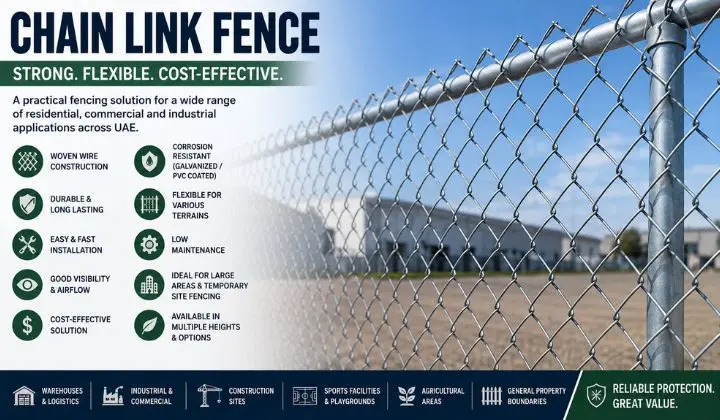
Modern Chain Link systems may use galvanized steel or PVC-coated wire to improve corrosion resistance and outdoor performance. Vertex Fence describes its Chain Link Fence as a strong, affordable and low-maintenance option for residential, commercial and industrial applications across the UAE.
Common uses include:
- Warehouses
- Construction sites
- Sports facilities
- Commercial properties
- Industrial boundaries
- Agricultural areas
- General property fencing
Chain Link is especially useful when a project needs large-area fencing, good visibility, reasonable cost, and straightforward installation.
Anti Climb Fence vs Chain Link Fence: Security Comparison
Security is the most important difference between these two fencing systems.
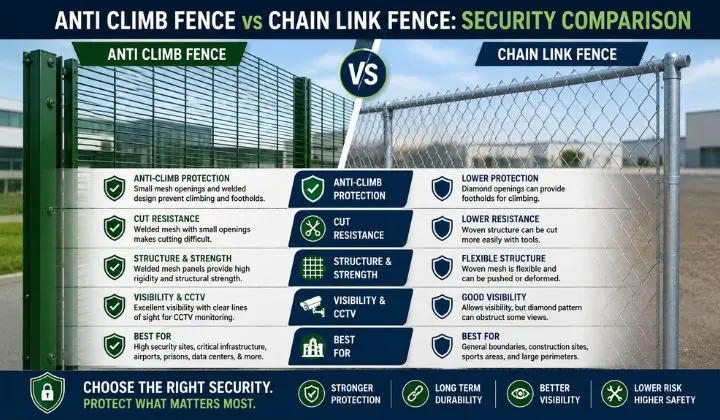
A fence is not secure simply because it is made from steel. Its actual performance depends on several factors, including mesh design, wire diameter, fence height, rigidity, posts, gates, fixing systems, and additional security measures.
For high-risk sites, these details matter because the goal is not only to mark a boundary. The fence may need to delay or deter unauthorized access, climbing, cutting, and tampering.
Which Fence Provides Better Anti-Climb Protection?
Anti Climb Fence generally provides better anti-climb protection than standard Chain Link Fence.
The main reason is the size and shape of the mesh.
A traditional Chain Link Fence uses a diamond pattern. The openings can provide points where a person may place their hands or feet while attempting to climb.
An Anti Climb Fence uses much smaller mesh openings. In a 358 configuration, the 12.7 mm vertical opening leaves very little space for a useful hand or foothold.
The welded panel also stays more rigid than flexible woven mesh.
This creates a simple security advantage:
Smaller mesh + rigid welded structure = fewer opportunities to climb.
That is why Anti Climb systems are commonly considered for high-security perimeter applications.
Which Fence Is More Resistant to Cutting?
Anti Climb Fence also has an advantage when cut resistance is an important requirement.
Its closely spaced wires make it harder to position cutting tools inside the mesh. The welded intersections also help the panel retain its structure when individual wires are attacked.
Chain Link Fence is not automatically weak. A heavy-duty Chain Link system with suitable wire diameter and security additions can provide useful perimeter protection. However, its woven structure is generally more flexible and offers more accessible areas between the wires.
This means the two systems should not be judged only by material thickness.
Mesh aperture, wire diameter, construction method, and the complete fence system all affect cutting resistance.
Does Fence Height Affect Security?
Yes, fence height affects security, but height is only one part of the overall design.
A taller fence can make jumping or climbing over the perimeter more difficult. However, simply increasing height does not automatically turn a standard fence into a high-security system.
Security also depends on:
- Mesh aperture
- Wire diameter
- Panel rigidity
- Post strength
- Foundation
- Gate design
- Fixing system
- Security toppings
- Site layout
For example, a tall fence with large climbable openings may still provide less anti-climb protection than a properly specified fence with a smaller mesh aperture.
So when deciding how tall an Anti Climb Fence should be, the correct height should be based on the site’s risk level, project specifications, local requirements, and the complete perimeter security design.
Visibility and CCTV Surveillance
Visibility is another important reason Anti Climb Fence is used in security-sensitive locations.
Both Anti Climb and Chain Link Fence allow people and cameras to see through the perimeter. This can support CCTV monitoring, security patrols, and visual inspection.
Anti Climb Fence has a dense mesh pattern, but its open welded structure still allows clear observation through the fence. This can help security teams monitor areas on both sides of the perimeter without using a solid wall.
For sites that depend heavily on perimeter monitoring, the fence should work with the wider security system rather than block it.
The best setup may combine:
Security fencing + CCTV surveillance + lighting + controlled gates + suitable security toppings.
This creates a more complete perimeter security approach than relying on the fence alone.
Anti Climb Fence vs Chain Link Fence: Price and Cost
Price is often the first factor buyers compare, but the lowest material price does not always mean the lowest total project cost.
A proper comparison should consider the complete fencing system, including panels or mesh, posts, foundations, gates, fixings, coatings, transportation, and installation.
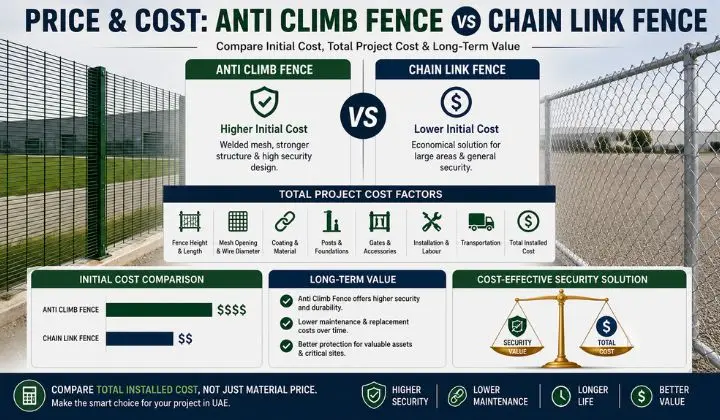
In general, Chain Link Fence has a lower initial material cost than a high-security welded Anti Climb Fence. However, Anti Climb Fence can provide greater security value when the cost of unauthorized access, damage, or future upgrades is considered.
Which Fence Has the Lower Initial Price?
For many large-area projects, Chain Link Fence is the more cost-effective fencing option.
Its woven construction uses a relatively simple manufacturing process, and the mesh can be supplied in rolls. This can make transportation, handling, and installation easier, especially for long boundaries.
Anti Climb Fence normally has a higher initial price because it uses welded panels, stronger specifications, closer mesh openings, and more rigid supporting components.
However, price should be compared using the same specifications. A quote for a 1.8 m Chain Link Fence should not be compared directly with a taller, heavier Anti Climb system.
Always compare:
- Fence height
- Mesh opening
- Wire diameter
- Wire gauge
- Coating
- Posts
- Fixings
- Gates
- Foundation requirements
- Installation
This gives a more useful Anti Climb Fence vs Chain Link Fence price comparison.
What Determines the Total Fencing Cost?
The final fence cost depends on much more than the mesh itself.
Fence Length and Height
A longer boundary needs more material, while a taller fence normally requires more mesh, stronger posts, and additional structural support.
Mesh and Wire Specification
The mesh aperture, wire diameter, and steel specification affect both material quantity and security performance.
Coating
Galvanized steel and other protective finishes can increase the initial cost but may improve corrosion resistance and long-term outdoor performance.
Posts and Foundations
Post size, spacing, foundation depth, and ground conditions can have a major effect on the total project cost.
Gates and Accessories
Pedestrian gates, vehicle gates, locks, hinges, security bolts, and other security fence accessories need to be included when comparing quotations.
Installation
Installation cost depends on site access, ground conditions, fence length, height, labour requirements, and the installation method.
This is why two projects with the same fence length can have very different final costs.
Material Price vs Installed Project Cost
A useful way to compare fencing quotations is to separate material cost from the installed cost.
For example, one supplier may quote only for the fence mesh and posts, while another may include:
- Transportation
- Site preparation
- Foundations
- Installation
- Gates
- Fixings
- Security accessories
The second quotation may appear more expensive, even though it provides a more complete service.
For large projects, buyers can also compare the approximate cost per linear metre:
Total fencing project cost ÷ total fence length = approximate installed cost per metre
This is only a comparison tool. Gates, corners, foundations, difficult terrain, and special security requirements can change the actual cost.
For an accurate Anti Climb Fence vs Chain Link Fence cost comparison in the UAE, the supplier should receive the project length, required height, specifications, location, and installation requirements.
Durability, Lifespan and Maintenance in UAE Conditions
A fence installed outdoors in the UAE must handle more than normal wear.
High temperatures, humidity, dust, and coastal conditions can affect exposed steel over time. For this reason, corrosion resistance, coating quality, installation, and maintenance should be considered when choosing between Anti Climb and Chain Link Fence.
There is also no single lifespan that applies to every Chain Link or Anti Climb Fence. The actual service life depends on the material, coating, environment, installation quality, and maintenance.
Corrosion Protection and Coating
Galvanized steel is widely used for outdoor fencing because the zinc coating helps protect steel from corrosion.
Some systems can also use PVC-coated wire or additional protective finishes. The right option depends on the project environment and required level of protection.
For UAE projects, coating should be selected with the site conditions in mind, particularly where fencing is exposed to humidity or a coastal environment.
The important question is not simply:
“Which fence lasts longer?”
Instead, ask:
“Which fence specification and coating are suitable for the environment where it will be installed?”
How UAE Conditions Affect Fence Performance
UAE fencing projects can face:
- High temperatures
- Strong sunlight
- Dust and sand
- Humidity
- Coastal salt exposure
- Corrosive outdoor environments
Coastal locations can be more demanding because salt and moisture can increase the risk of corrosion on exposed metal components.
That makes corrosion protection, coating quality, proper installation, and regular inspection especially important.
The fence should also be selected as a complete system. A well-protected mesh will not provide the expected performance if posts, fixings, gates, or other components are poorly protected.
Maintenance and Long-Term Value
Both Anti Climb and Chain Link Fence can be low maintenance when properly specified and installed.
Routine inspections should check:
- Damaged mesh or panels
- Loose fixings
- Post movement
- Gate hardware
- Signs of corrosion
- Coating damage
- Security accessories
Chain Link may require checking tension and connections, while welded panels generally maintain their shape because of their rigid construction.
The lifespan of a Chain Link Fence or Anti Climb Fence should therefore be judged by the complete system rather than the mesh alone.
A slightly higher initial investment can make sense if it provides better protection, lower repair requirements, and longer useful service for the specific project.
Which Fence Is Best for Different UAE Projects?
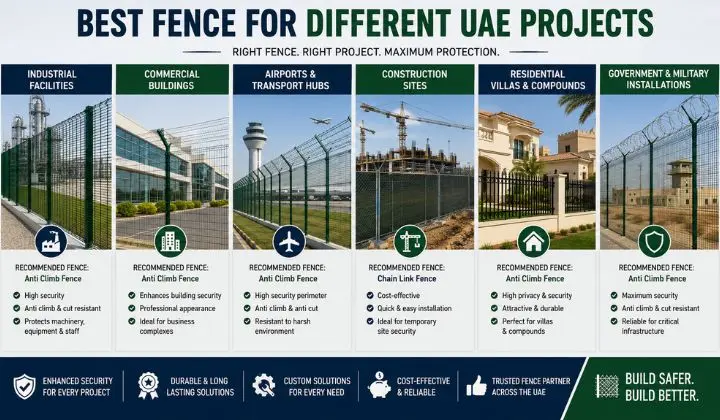
The right fence depends heavily on what the site needs to protect.
A small commercial boundary and a restricted infrastructure facility should not necessarily use the same security specification.
Warehouses and Logistics Facilities
Warehouses and logistics sites often have large perimeters, vehicle access points, valuable equipment, and areas that may need controlled access.
Chain Link Fence can be suitable where the main requirement is economical perimeter coverage with good visibility.
Anti Climb Fence becomes more suitable when the site contains high-value assets, restricted storage areas, or a higher risk of unauthorized entry.
For a large site, the best answer may also be a combination of different security levels.
Industrial and Commercial Properties
Industrial facilities may need protection around buildings, equipment, storage yards, utility areas, and employee access points.
For general boundary control, Chain Link provides a flexible and economical solution.
Where the security risk is higher, Anti Climb Fence can provide a stronger physical barrier because its rigid welded mesh and smaller openings make climbing and cutting more difficult.
The fence specification should match the value of the assets and the level of access control required.
Airports, Government Facilities and Critical Infrastructure
Airports, government facilities, power facilities, data centers, and other critical infrastructure normally require stronger perimeter security than a basic property boundary.
In these situations, Anti Climb Fence is generally more appropriate because security teams may need:
- Strong anti-climb performance
- Better resistance to tampering
- High visibility
- Rigid panels
- Compatibility with surveillance
- Additional security toppings
The complete perimeter should still be designed as a system. Gates, access control, lighting, CCTV, foundations, and other security measures can be just as important as the fence itself.
Construction Sites
Construction sites often need fencing that can be installed quickly and moved or adjusted as the project changes.
Chain Link Fence can be a practical option for many temporary or general construction boundaries because of its flexible structure and relatively simple installation.
If a construction site contains expensive machinery, restricted areas, or a higher security risk, a stronger Anti Climb solution may be considered for specific sections.
Sports Facilities and General Boundaries
Sports courts, fields, parks, and general property boundaries often need good visibility and reliable perimeter control.
Chain Link Fence is widely used for these applications because it provides an open boundary without creating a solid visual barrier.
Anti Climb Fence can be considered where preventing unauthorized entry or climbing is a higher priority.
The choice should therefore be based on the site’s actual use rather than simply selecting the most expensive fence.
Can Chain Link Fence Be Upgraded for Higher Security?
Yes. A Chain Link Fence does not have to remain a basic boundary system.
Depending on the project, its security can be improved with:
- Barbed wire
- Razor wire
- Increased fence height
- Stronger posts
- Improved gates and locks
- Additional security fittings
- Privacy or security screens where appropriate
These upgrades can make Chain Link more suitable for sites that need additional protection.
However, there is a practical limit.
If a project requires strong anti-climb protection, high cut resistance, rigid panels, and a dedicated high-security perimeter, starting with an Anti Climb Fence may be more suitable than repeatedly upgrading a standard Chain Link system.
When Is Upgrading Chain Link Enough?
An upgraded Chain Link system may be suitable when:
- The security risk is moderate
- Large perimeter coverage is needed
- Budget is important
- The site needs flexible fencing
- Additional deterrents provide enough protection
- Full high-security fencing is not required
This approach can provide a good balance between security, cost, and coverage.
When Should You Choose Anti Climb Fence Instead?
Anti Climb Fence is generally the better starting point when the site has a high security requirement.
Consider it when:
- Climbing resistance is a priority
- Cutting resistance is important
- The property contains valuable assets
- The perimeter protects a restricted area
- CCTV visibility is important
- Unauthorized access could create serious risk
In these situations, choosing a high-security fence from the start can be more practical than trying to make a general-purpose fence perform beyond its original design.
Anti Climb Fence vs Chain Link Fence: Which One Should You Choose?
There is no single winner for every project.
Choose Anti Climb Fence if:
- High-security perimeter protection is required
- Anti-climb performance is a priority
- Better cutting resistance is needed
- The site contains valuable or critical assets
- The perimeter includes restricted areas
- A rigid welded fence is preferred
- Strong compatibility with security systems is required
Choose Chain Link Fence if:
- Large-area coverage is the main requirement
- A more economical solution is preferred
- General perimeter security is sufficient
- Fast and flexible installation is important
- The project may need future security upgrades
- The site is a warehouse, construction area, sports facility, or general commercial boundary
Consider a Combination If:
A large site does not always need the same security level everywhere.
For example, a project could use Chain Link around a lower-risk outer boundary and Anti Climb Fence around a restricted internal zone.
This layered perimeter security approach can help balance the project’s security requirements and budget.
Frequently Asked Questions
Does Anti Climb Fence block visibility?
No. Anti Climb Fence is an open welded mesh system that allows visibility through the fence while making climbing and cutting more difficult. This makes it suitable for sites that need both physical protection and CCTV surveillance.
Is Anti Climb Fence suitable for uneven or sloped ground?
It can be used on many different site conditions, but the installation method must be planned around the ground profile. Post positioning, panel configuration, foundations, and site preparation should be checked before installation.
What should I check before comparing fencing quotations?
Compare the same specifications, including fence height, mesh opening, wire diameter, coating, posts, foundations, gates, fixings, transportation, and installation. A lower material price may not represent a lower total project cost.
Can the same fence specification be used around an entire site?
Not always. Large properties can have different security zones, so one area may need economical Chain Link while a restricted or high-risk area may require Anti Climb Fence. A zone-based approach can provide better value.
Does fence height matter more than mesh design for security?
No. Height is important, but overall security also depends on mesh aperture, wire diameter, rigidity, posts, foundations, gates, and security toppings. A properly designed fence should consider all of these factors together.
What information does a fencing supplier need to prepare an accurate quote?
A supplier normally needs the total fence length, required height, location, ground conditions, preferred mesh and wire specification, coating, gates, security requirements, and whether installation is required. These details help produce a more accurate project-specific quotation.
Conclusion
The choice between Anti Climb Fence vs Chain Link Fence comes down to the level of protection your project actually needs.
Anti Climb Fence is generally the stronger option when anti-climb performance, cut resistance, rigid construction, and high-security perimeter protection are priorities. It is well suited to restricted sites, critical infrastructure, and other locations where unauthorized access presents a serious risk.
Chain Link Fence is a practical and cost-effective fencing solution for large boundaries, warehouses, construction sites, sports facilities, and other applications where general perimeter protection is enough.
For UAE projects, also consider corrosion resistance, coating, humidity, coastal exposure, maintenance, installation requirements, and total project cost before making a final decision.
The best fence is not always the cheapest or the strongest. It is the one that matches the site risk, security requirements, budget, environment, and intended use.
For a project-specific recommendation, Vertex Fence can help you compare the suitable fencing specification based on your site requirements rather than choosing only by price.