
 Fences
 Gates
 Signage & Boards
 Car Parking Shades
 Block and Foundation
 Spare Parts
Noise Barrier Fence: How Acoustic Fencing Reduces Road Noise

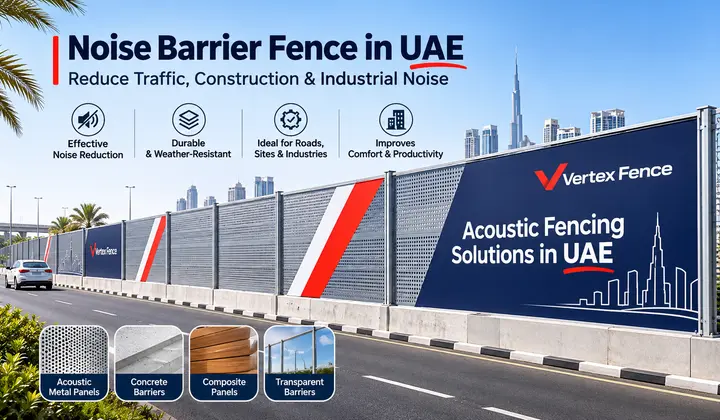
Traffic noise can make homes, offices and outdoor spaces uncomfortable, especially when a busy road runs nearby. Construction work, generators and industrial machines can also create constant noise that affects daily life. A noise barrier fence helps reduce sound travelling from a noisy area towards a place that needs protection. However, its performance depends on the barrier’s height, length, material, position and construction. Not every solid fence provides acoustic protection.
A standard boundary fence may offer privacy and security, but it does not automatically have tested acoustic performance. This guide explains acoustic fencing types, ratings, UAE applications, installation requirements and cost factors to help you choose a suitable system.
What Is a Noise Barrier Fence?
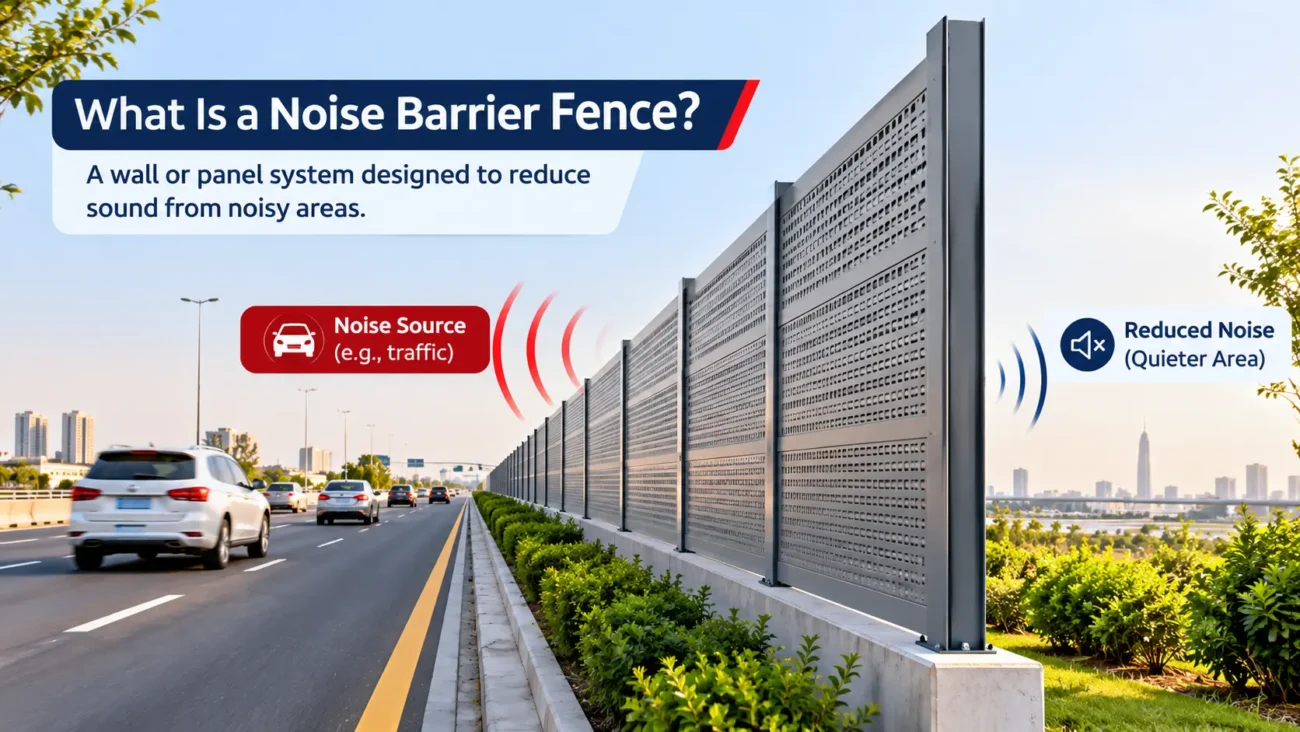
A noise barrier fence is a wall or panel system that reduces sound travelling from one area to another. Contractors install it between a noise source and the location that needs protection, such as a home beside a busy road or offices near industrial machinery.
You may also see terms such as sound barrier fence, noise reduction fence and outdoor acoustic barriers. These systems use suitable materials, construction and positioning to control sound.
A properly designed system may include:
- Dense panels that limit sound transmission.
- Secure joints that reduce gaps.
- Materials with tested sound insulation properties.
- Sound-absorbing surfaces to control reflected noise.
- Strong posts, frames and foundations.
The main aim is to reduce noise reaching a specific area. However, a barrier cannot remove sound at its source or make an outdoor space completely silent.
How Does Acoustic Fencing Reduce Road Noise?
Sound travels through the air from vehicles, machinery and other sources. When a suitable barrier stands between the source and the receiver, it changes the path sound waves can follow.
Four main factors explain how acoustic fencing helps control noise.
1. It Blocks the Direct Sound Path
Without a barrier, traffic noise can travel directly from a busy road towards nearby properties.
A suitable wall or panel system interrupts this path, reducing the direct sound that reaches the protected area. However, the barrier needs enough height and length to prevent sound from travelling over or around it.
2. It Limits Sound Passing Through the Panels
Panel material, thickness and construction affect how much sound passes through a barrier.
Dense materials and properly designed layers can improve sound insulation. Secure connections also prevent sound from travelling through gaps.
Therefore, check test results for the complete panel assembly instead of judging performance by thickness or weight alone.
3. It Absorbs Some Sound Energy
Some acoustic fence panels use sound-absorbing materials to reduce reflections from their surfaces.
For example, certain acoustic metal panels have a perforated facing with an internal layer of mineral wool. The material absorbs some sound energy as it enters the panel.
Sound absorption and sound blocking are different functions. Depending on the project, a barrier may need both properties.
4. It Reduces Sound Travelling Over and Around the Barrier
Sound can bend over the top and around the sides of a barrier. Engineers call this process sound diffraction.
A barrier creates a quieter area behind it, known as a sound shadow. Its effectiveness depends on the barrier’s dimensions, position and the distance between the noise source and receiver.
Therefore, a taller wall does not always solve the problem. The complete site layout matters too.
Types of Noise Barrier Fences Used in the UAE
Different projects need different acoustic barrier materials. The right option depends on the noise source, required performance, site conditions and appearance.
1. Acoustic Metal Panel Barriers
Acoustic metal panels suit some road, industrial and commercial projects that need a designed sound barrier.
These systems may use steel or aluminium panels with a perforated facing and an internal sound-absorbing layer, such as mineral wool.
Some designs combine sound blocking and absorption. Before choosing one, check its acoustic ratings, corrosion protection, joint design and support structure.
2. Construction-Site Acoustic Hoarding
Drilling, cutting, excavation and concrete work can disturb nearby residents and businesses. Specialist construction noise barriers and acoustic hoarding can help reduce sound reaching surrounding areas.
However, standard construction hoarding mainly provides site security, privacy and separation. It does not automatically offer tested acoustic performance.
A standard PPGI temporary fence can serve as a temporary site boundary. However, do not treat it as an acoustic barrier unless the complete system has suitable acoustic test data.
3. Concrete Noise Barrier Walls
Concrete walls appear in some highway, infrastructure and industrial projects. Their high mass can help limit sound transmission when engineers design them for this purpose.
However, concrete alone does not guarantee effective noise control. The wall still needs suitable height, length, position, connections and foundations.
For a better understanding of concrete construction materials, see this guide to precast concrete in the UAE. It explains common precast applications but does not provide acoustic performance specifications.
4. Timber and Composite Acoustic Fencing
Timber and composite materials may suit residential gardens and outdoor spaces where appearance matters.
Some specialist systems combine dense boards with additional acoustic layers. However, ordinary decorative timber fencing does not automatically qualify as an acoustic barrier.
Check the product’s test results, weather resistance and maintenance requirements before choosing it.
5. Transparent Acoustic Barriers
Acoustic glass or acrylic panels can reduce sound while allowing natural light and visibility.
They may suit roadside locations, pedestrian areas and properties where a solid wall would block important views.
Check the panel thickness, supporting frame and connections. Also consider cleaning, scratches, sunlight and outdoor exposure.
Acoustic Ratings Explained: STC, NRC and Noise Reduction
When comparing acoustic products, you may come across two common ratings: STC and NRC. They measure different acoustic properties.
What Is STC?
STC (Sound Transmission Class) measures how well a tested building element resists sound passing through it under specified laboratory conditions.
A higher STC value generally indicates greater resistance to sound transmission. Check whether the rating applies to the complete panel assembly or only one material.
What Is NRC?
NRC (Noise Reduction Coefficient) measures how much sound a material absorbs across a specified range of frequencies.
A higher NRC value generally indicates greater sound absorption. This rating helps compare materials used inside some acoustic panels.
STC vs NRC: What Is the Difference?
| Rating | What it measures | What it tells you |
| STC | Resistance to sound transmission | How well a tested element blocks sound |
| NRC | Sound absorption | How much sound a material absorbs |
A high NRC does not automatically mean a panel blocks more sound. Likewise, a high STC does not show how much sound the panel absorbs.
Therefore, check which property your project needs before comparing products.
Why Laboratory Ratings Do Not Guarantee Site Performance
Laboratory tests help compare products under controlled conditions. However, real sites have additional challenges.
Sound may pass through panel joints, openings at the base or spaces around gates. It can also travel over the top or around the ends.
Nearby buildings, ground conditions and the distance between the source and receiver can affect the result. Therefore, use product ratings as a guide rather than a guarantee of actual noise reduction.
Where Are Noise Barrier Fences Used in the UAE?
Busy highways, construction developments, residential communities and industrial facilities can all create noise problems. Each setting needs a suitable solution.
1. Highways and Busy Roads
Highway noise barriers help reduce traffic sound reaching nearby homes, schools, offices and public areas.
They usually stand between the road and the location that needs protection. Their height and position depend on the road layout, traffic conditions and nearby buildings.
A suitable barrier can create a quieter area behind it, although the level of improvement varies by location.
2. Construction Sites and Urban Developments
Drilling machines, cutting equipment, trucks and other construction activities can disturb nearby areas.
Specialist construction noise barriers can help control sound around active work zones. The system should match the site layout and the type of work taking place.
3. Villas, Gardens and Residential Communities
Traffic, nearby businesses and outdoor equipment can affect the comfort of residential properties.
A suitable noise reduction fence may reduce sound reaching a garden, patio or boundary area. First, identify the noise source and the part of the property that needs protection.
Also check community rules, boundary restrictions and local approval requirements.
4. Rooftop HVAC and Chiller Equipment
Air-conditioning units, chillers and ventilation systems can produce continuous mechanical noise.
A suitable barrier can interrupt the direct sound path towards nearby areas. However, the design must allow enough airflow and provide access for maintenance.
Blocking air intakes or exhaust outlets can affect equipment performance. Therefore, a simple solid wall may not suit every installation.
5. Generators and Industrial Facilities
Generators, compressors, pumps and factory machines can create noise that affects workers and nearby properties.
Industrial noise barriers can reduce sound reaching surrounding areas when their design suits the equipment and site layout.
If machinery produces noise in several directions, an acoustic enclosure may provide better coverage. The choice depends on the source, ventilation and maintenance needs.
How to Choose the Right Acoustic Fencing for Your Project
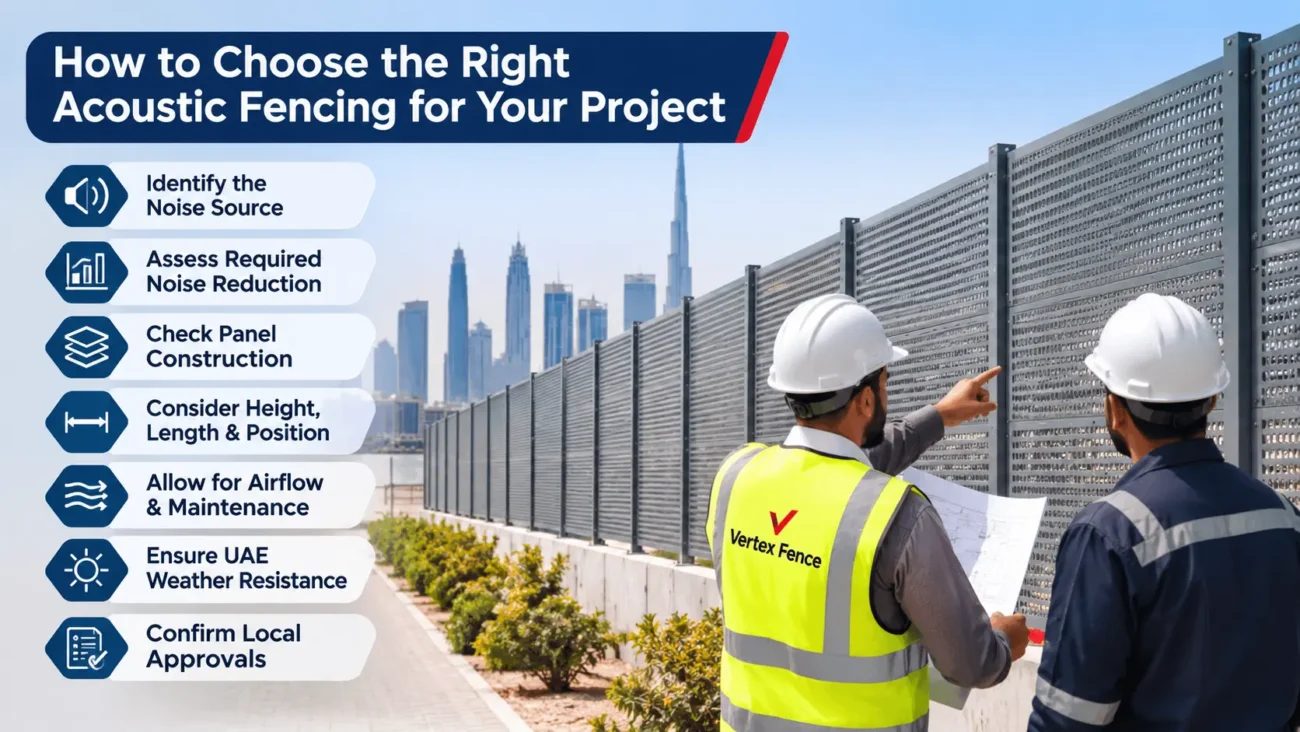
Choosing a suitable system starts with understanding the noise problem. Comparing products before identifying the source can lead to unnecessary costs.
1. Identify the Noise Source
First, identify what creates the noise. It could be traffic, construction equipment, a generator, an air-conditioning unit or industrial machinery.
Different sources produce different sound levels and frequencies. Therefore, a system that suits a roadside project may not work as well around a generator.
2. Assess the Required Noise Reduction
Identify the area that needs protection and the noise level the project aims to achieve.
An acoustic professional can assess existing noise levels, source and receiver positions, and suitable barrier options. This helps the project team set realistic performance targets.
3. Check the Panel Construction
Compare acoustic metal panels, concrete systems, composite materials and other specialist options.
Check the complete panel design, including outer layers, internal materials, joints and fixing methods. Also ask for test reports that relate to the actual product.
4. Consider Height, Length and Position
A barrier needs to interrupt the sound path between the source and the protected area.
Its height, length and position affect how much sound travels over or around it. The correct dimensions depend on the site layout and acoustic assessment.
A taller wall is not always the best solution. Correct positioning also makes an important difference.
5. Allow for Airflow and Equipment Access
If the barrier stands near an HVAC unit, generator or industrial machine, make sure it does not restrict essential airflow.
The design should also provide enough space for inspection, repairs and regular maintenance. This helps control noise without creating equipment problems.
6. Consider UAE Weather Conditions
Outdoor installations in the UAE face strong sunlight, high temperatures, dust and humidity. Coastal projects may also experience salt exposure, which increases corrosion risk for metal components.
Before choosing a system, check:
- UV-resistant materials and suitable outdoor finishes.
- Corrosion protection for metal panels, posts and fasteners.
- Secure connections and suitable fixings.
- Structural design for local wind conditions.
- Cleaning and long-term maintenance requirements.
Solid panels can catch more wind than open mesh fencing. Therefore, the frame, foundations and connections must suit the site’s exposure. For more detail, read this guide to fence wind load calculation. It explains how wind pressure affects fencing structures and why the support system matters.
7. Confirm Local Approvals and Site Requirements
Before installation, check the requirements of the relevant municipality, development authority, property management team and project owner.
Rules can differ by emirate, location and type of work. Roadside barriers may also need additional checks because of their position near public roads or infrastructure.
Always confirm the requirements for your specific project.
Noise Barrier Fence Installation: What Does the Process Involve?
A successful installation needs proper planning. The structure must meet the project’s acoustic needs while remaining stable outdoors.
1. Site Inspection and Noise Assessment
Start by identifying the main noise source and inspecting the location.
Consider nearby buildings, ground levels, road layout, equipment position and the area that needs protection. Where required, an acoustic professional can measure existing noise levels and recommend performance targets.
2. Acoustic and Structural Design
The design team selects the material, panel construction, height, length and support system.
They should also consider wind loads, foundations, access points and ventilation. The acoustic and structural requirements must work together to create a safe, stable barrier.
3. Site Measurement and Foundation Preparation
Workers prepare the ground and install the required foundations, posts, frames or support structures.
The foundation design depends on the barrier’s weight, height, wind exposure and ground conditions.
4. Panel Installation and Joint Sealing
Install the panels according to the approved design and manufacturer’s instructions.
Check the connections, edges and base details. Small openings can allow sound to pass through, so installers should inspect the complete structure.
5. Final Inspection and Performance Testing
After installation, inspect the panels, supports, joints, foundations and access points.
If the project has a defined noise reduction target, arrange suitable acoustic measurements to check the result. Finally, compare the findings with the agreed project requirements.
How Much Does Acoustic Fencing Cost in Dubai?
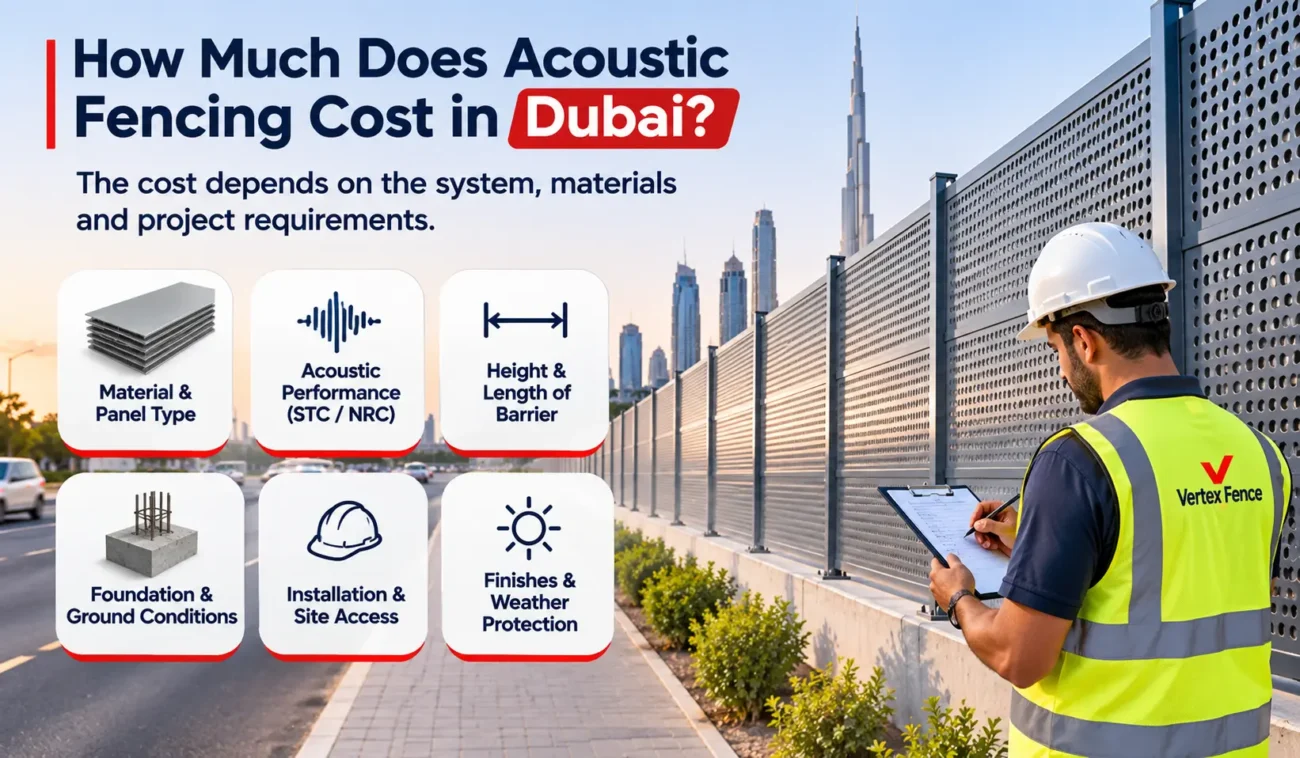
The cost of acoustic fencing in Dubai depends on the system and the performance the project needs. A standard solid fence and a tested acoustic panel system are not directly comparable.
There is no single price for every project. Online supplier listings may show indicative prices, but only a project-specific quotation can confirm the cost for your site.
Main Factors That Affect the Cost
1. Material and Panel Construction
Steel, aluminium, concrete, composite and transparent systems have different material and manufacturing costs. Multi-layer acoustic panels may cost more than basic solid panels.
2. Acoustic Performance Requirements
Projects that need tested sound-blocking and sound-absorbing properties may require specialist panels and additional components.
3. Barrier Height and Length
Larger structures need more panels, supports, foundations and installation work. Their dimensions may also affect structural requirements.
4. Foundation and Ground Conditions
Uneven, rocky or weak ground may require extra preparation or a different support arrangement.
5. Site Access and Installation
Busy roads, rooftops and restricted industrial areas may need special equipment, traffic management or additional labour.
6. Finishes and Weather Protection
Protective coatings, corrosion-resistant materials and suitable outdoor finishes can affect the initial cost and long-term maintenance.
What Should You Check Before Accepting a Quotation?
Compare quotations with the same project scope. Ask suppliers for:
- Panel material and complete construction.
- Acoustic ratings and supporting test reports.
- Panel height, length and thickness.
- Posts, frames, foundations and connections.
- Installation, transport and access requirements.
- Warranty and maintenance details.
A lower quotation may not include the same acoustic performance or structural support. Therefore, compare the full specification instead of looking only at the price per square metre.
Noise Barrier Fence vs Acoustic Enclosure: Which Solution Do You Need?
A noise barrier fence and an acoustic enclosure both help control noise, but they work in different ways.
| Feature | Noise barrier fence | Acoustic enclosure |
| Main purpose | Interrupts the direct sound path | Surrounds a noise source |
| Typical design | Wall or panel barrier | Enclosed or partly enclosed structure |
| Common uses | Roads, boundaries and construction areas | Generators, compressors and machinery |
| Airflow | Usually allows open airflow around the source | Needs planned ventilation |
| Maintenance access | Depends on barrier position | Needs suitable access panels or doors |
Choose a noise barrier fence when you need to reduce sound travelling between a source and a protected area. However, consider an acoustic enclosure when machinery produces noise in several directions and needs more complete coverage. Some projects may need both systems.
Final Thoughts
A noise barrier fence can make outdoor and working areas more comfortable by reducing sound from roads, construction sites and industrial equipment. However, its performance depends on the material, dimensions, position and construction.
For UAE projects, consider heat, UV exposure, dust, coastal corrosion and wind loading. Most importantly, do not assume that every solid metal or PVC fence provides tested acoustic protection.
When planning your project Vertex Fence helps you explore suitable fencing options based on your site requirements. Identify the noise source, assess the area that needs protection and compare available systems using their technical specifications and test reports. This approach helps you choose a practical solution based on your project’s actual needs.
Frequently Asked Questions
How effective is a noise barrier fence at reducing traffic noise?
A noise barrier fence can reduce traffic noise by interrupting the direct sound path between a road and a nearby property. Its performance depends on its height, length, material, position and gaps.
What is the difference between STC and NRC in acoustic fencing?
STC measures resistance to sound transmission, while NRC measures sound absorption. They describe different properties and are not interchangeable.
What is the best material for an outdoor noise barrier fence in the UAE?
Acoustic metal panels, concrete and specialist composite systems may suit different projects. Consider acoustic test results, UV exposure, heat, corrosion protection, wind loading and maintenance before choosing.
How much does acoustic fencing cost per square metre in Dubai?
The cost depends on the material, acoustic rating, dimensions, foundations and installation requirements. Ask suppliers for a project-specific quotation rather than relying on a general price.
Can acoustic fencing reduce noise from air-conditioning units and generators?
Yes, a suitably designed barrier can reduce noise travelling from HVAC units, chillers and generators. However, it must allow proper airflow and maintenance access.
Does a noise barrier fence need to be completely sealed?
The barrier needs continuous construction wherever the acoustic design requires it, because gaps can allow sound to pass through. However, the design must also consider drainage, ventilation, structural safety and access.