
 Fences
 Gates
 Signage & Boards
 Car Parking Shades
 Block and Foundation
 Spare Parts
U Channel Guide: Steel, Aluminum & Glass Applications

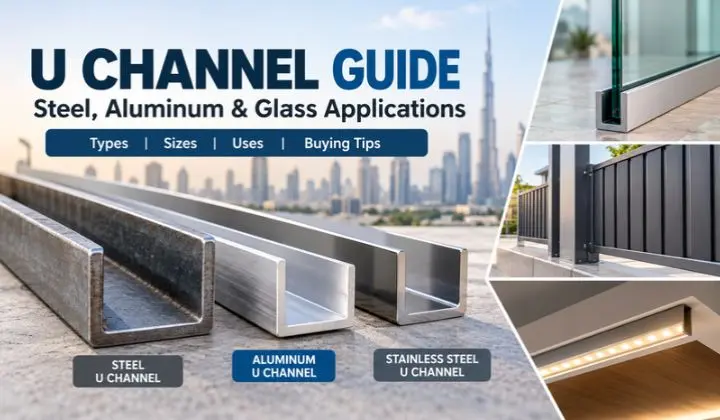
A U channel is a metal profile with a U-shaped cross-section. It has a flat base, called the web, and two sides, called flanges. Depending on its design, it can hold, guide, cover or support other components.
U channels are used in metal framing, construction, fencing, furniture, panel edges and glass systems. However, not every U channel is suitable for every job. A thin aluminum trim channel, for example, is different from a heavy steel channel designed for structural use.
The right choice depends on the material, dimensions, thickness, expected load and installation method. Before ordering, check that the profile matches your project requirements.
Main Parts of a U Channel
A U channel has several important dimensions:
- Web: The flat base of the channel.
- Flanges: The two sides that rise from the base.
- Internal width: The space between the inner faces of the flanges.
- Channel height: The height of the sides.
- Wall thickness: The thickness of the metal.
These measurements help you determine whether the channel will fit your panel, frame or other component. They are also useful when requesting a supplier quotation.
Types of U Channels by Material
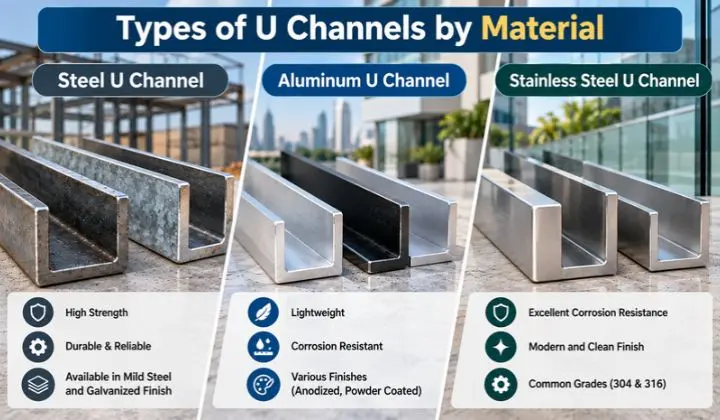
U channels are available in different materials. Each material has its own benefits, limits and suitable applications.
Steel U Channel
A steel U channel is often chosen when strength and rigidity are important. Steel profiles are used in construction, equipment frames, supports and metal fabrication. The correct size and thickness depend on the load and how the channel will be installed.
A mild steel U channel can be useful for general fabrication and framing. However, untreated steel can rust when exposed to moisture, so outdoor applications may need a suitable protective coating.
A galvanized U channel has a zinc coating that helps protect the steel from corrosion. It can be suitable for certain outdoor applications, including compatible fencing systems. Its performance depends on coating quality, exposure, installation and maintenance.
When comparing U channel steel sizes, do not look at height alone. Check the width, thickness, material grade and intended use. Heavy structural channels and thin formed channels may have similar U-shaped profiles but very different load capacities.
Aluminum U Channel
An aluminum U channel is often selected when low weight and corrosion resistance are important. Aluminum profiles are generally easier to handle than steel profiles of similar size. They are commonly used for trim, edging, display frames and selected panel or glazing applications.
An alum U channel may be available in different dimensions, lengths and finishes. Common finishes include natural aluminum, anodized surfaces and powder coating. A black aluminum U channel can suit projects that need a dark finish, while an aluminum U channel with flange may be useful where a particular mounting or edge-covering shape is required.
Aluminium U channel sizes can range from small decorative profiles to larger extruded sections. Always check the actual product drawing instead of assuming that channels with similar names have the same dimensions. Some profiles can be cut to a required length, while custom sizes or finishes may need a special order.
Aluminum can work well in many outdoor settings, but the correct alloy, finish and fixing method still matter. Contact between different metals can also cause corrosion under certain conditions, so compatible fasteners and suitable separation methods may be needed.
Stainless Steel U Channel
A stainless steel U channel, also called an SS U channel or stainless steel U-shaped channel, is used where corrosion resistance, appearance or specific hygiene requirements matter.
Common stainless steel grades include 304 and 316. Grade 316 is often considered for environments with greater exposure to salts or chlorides, but the right grade depends on the site conditions. No stainless steel grade is completely immune to corrosion in every environment.
Stainless steel U channel sizes and thicknesses vary by supplier and product type. Some profiles are made for general fabrication, while others are designed for specific uses, such as glass partitions or panel frames. Check the product specifications before selecting a profile for a particular application.
U Channel Sizes, Dimensions and Specifications
Choosing the correct size is just as important as choosing the right material. A channel that is too narrow may not fit the part it needs to hold. One that is too loose may not provide the intended fit or support.
When checking U channel dimensions, focus on four main measurements:
- Height: The distance from the base to the top of a flange.
- Width: The overall width across the channel, according to the supplier’s measurement method.
- Thickness: The thickness of the metal.
- Length: The total length of the profile.
Always confirm how a supplier defines width and height. Different product types may use different measurement conventions.
How to Read a U Channel Size Chart
A U channel size chart may list the height, width, thickness and length of each profile. Structural steel tables may also include web thickness, flange thickness and weight per metre. These details help buyers compare products and estimate material requirements.
For example, a supplier may list a channel using three dimensions in millimetres. Before ordering, confirm the order of those dimensions and whether they refer to internal or external measurements.
There is no single size that works for every project. U channel sizes in mm range from small trim profiles to larger structural sections. Available sizes also vary by material and manufacturing method. Use the supplier’s current technical drawing or product data sheet rather than relying only on a general online chart.
If you need U channel steel standard sizes or an MS U channel sizes chart, make sure it matches the type of channel you intend to buy. Structural channels, cold-formed profiles and custom-fabricated sections may have different dimensions and performance.
A U channel weight chart can help estimate the weight of a steel section, but the chart must match the exact profile and material specification. Do not use an estimated weight as proof that a channel can safely support a particular load.
What Should You Confirm Before Ordering?
Before requesting a quotation, prepare the material type, dimensions, thickness, required length, finish and quantity. If the channel will hold a panel or carry a load, explain how it will be installed and what it needs to support.
A technical drawing or sample can reduce confusion, especially for custom profiles. Ask the supplier to confirm material grade, dimensional tolerances and relevant technical documents before approving the order.
U Channel for Glass: Types and Applications
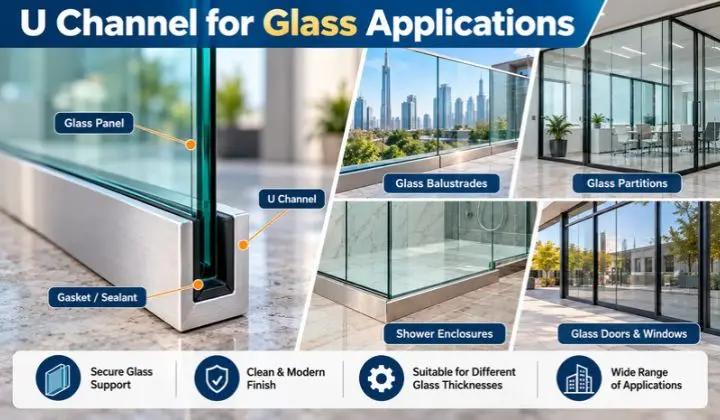
A U channel for glass is a profile used in certain glazing systems to hold or retain the edge of a glass panel. Depending on its design, it may be used in glass partitions, screens and other suitable installations.
A U channel for a glass panel is not automatically suitable for every glass panel. The right choice depends on the glass type, thickness, panel size, support conditions, fixing method and manufacturer’s requirements. Glass thickness alone is not enough to confirm compatibility or safety.
Aluminum or Stainless Steel for Glass?
An aluminum profile may be suitable when low weight and a particular finish are priorities. A stainless steel profile may be chosen for its appearance or specific corrosion-resistance needs. Neither material is automatically the best choice for every glass installation.
A glass partition U channel should be part of a system designed for that application. A U channel for glass partition may require compatible gaskets, setting blocks, sealants, anchors or other fittings, depending on the manufacturer’s design.
Searches such as stainless steel U channel for 10mm glass and stainless steel U channel for 12mm glass refer to specific glass-thickness requirements. However, the thickness alone does not prove that a channel will fit or safely support the panel. The channel’s internal dimensions, tolerances and installation details must also be checked.
Similarly, an aluminium U channel for 8mm glass should be selected using the manufacturer’s approved specifications. A general-purpose trim profile should not be used as a glass-support system unless it is suitable and approved for that purpose.
Glass Channel Installation and Safety
Before installation, confirm the channel model, glass specification, fixing points and supporting surface. The wall, floor or supporting frame must be suitable for the loads involved.
For glass barriers or installations where failure could cause injury, use a properly designed system that meets the applicable building and safety requirements. The complete assembly, including the glass, channel, anchors, seals and supporting structure, must be suitable for its intended use.
A channel’s appearance or material alone does not prove that it is safe for a particular glass installation. Follow the manufacturer’s instructions and obtain professional advice where the application requires structural or safety assessment.
Steel U Channel vs Aluminum U Channel
Steel and aluminum U channels may look similar, but their properties and uses can differ. The right option depends on the job, installation conditions and required performance.
Strength and Weight
Steel is often preferred for applications that need strength and rigidity. However, not every steel profile is designed for heavy loads. Its performance depends on the material grade, dimensions, thickness and support conditions.
An aluminum U channel is lighter and can be easier to handle during installation. It is commonly used for trim, edging and selected framing systems. Its strength depends on the alloy, profile design and thickness.
Do not compare two channels by material alone. Check their technical specifications and intended use before selecting one for a project.
Corrosion Resistance and Maintenance
Aluminum naturally forms a thin oxide layer that helps protect its surface. Anodizing and powder coating can provide additional surface protection and change the appearance of the profile.
Steel may need galvanizing, painting or another suitable coating to reduce corrosion. Stainless steel also needs the correct grade and care for its environment.
For outdoor projects in the UAE, consider moisture, coastal air, cleaning products and exposure to different weather conditions. These factors can affect the service life of the channel and its finish.
Cost and Application
The total cost includes more than the price per metre. Material, dimensions, finish, cutting, fittings, transport and installation can all affect the final amount.
Steel may be suitable where its strength and rigidity meet the project requirements. Aluminum may be a better fit when lower weight and a particular finish are priorities. The best option is the one that meets the required specifications without adding unnecessary cost.
Common Applications of U Channels
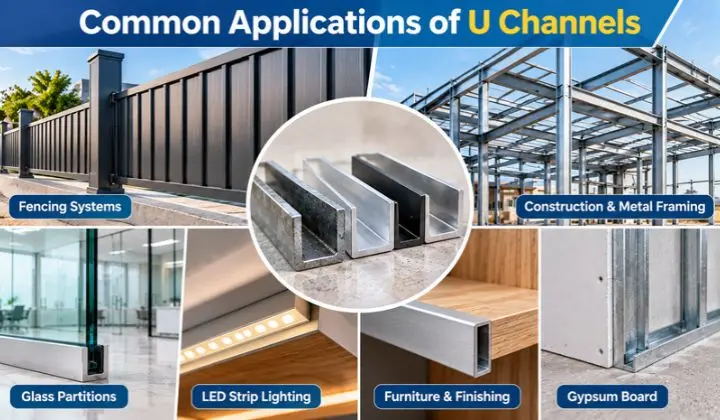
U channels are used across construction, fencing, glazing and finishing work. Their exact role depends on the profile design and the system in which they are installed.
Fencing Supports and Metal Fence Systems
In suitable fencing systems, a galvanized U channel can help support or connect components. Its role depends on the fence design, dimensions and fixing method.
For example, Vertex Fence lists GI U channels and clamps in its spare parts category. These types of components can form part of a compatible fencing system, but the correct specification must be checked before installation.
A general-purpose U channel should not automatically replace a fence support or connector. Confirm the profile dimensions, compatibility and installation requirements for the actual fence system.
Construction and Metal Framing
Steel and aluminum profiles can be used in selected frames, brackets, supports and fabrication projects. Some profiles are designed for structural work, while others are intended for light framing or finishing.
A U channel for gypsum board belongs to a different application from a heavy structural steel channel. Drywall systems use profiles designed to work with the relevant boards, studs and tracks. Follow the system manufacturer’s specifications rather than selecting a channel based only on its shape.
Glass Partitions and Panels
Glass channels can form part of suitable glazing systems. Their dimensions, material and fixing method must match the glass and the intended installation.
Use the correct channel, compatible fittings and suitable anchors. For installations involving barriers or potential fall risks, the complete system must meet applicable safety requirements.
Lighting, Furniture and Finishing
Smaller U-shaped profiles are also used for furniture edges, display frames and decorative finishing. A U channel for LED strip light may hold a lighting strip or diffuser when the profile is designed for that purpose.
Other products include brass U channel, chrome U channel, PVC U channel, plastic U channel, acrylic U channel and rubber U channel. These profiles may serve decorative, protective or edging purposes. They are not direct replacements for steel or aluminum channels in every application.
A slotted U channel has openings that can help with adjustment or fastening in compatible systems. Before using one to support equipment, confirm that its design and specifications suit the intended load.
How to Choose the Right U Channel in the UAE
The right choice depends on the application and the conditions at the installation site. Use the following checks before placing an order.
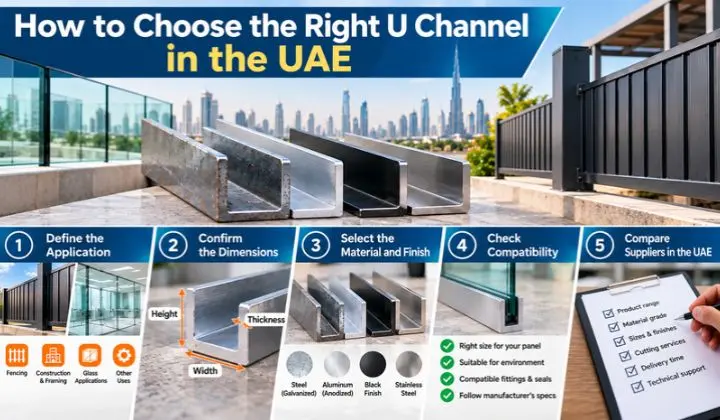
1. Define the Application
Decide whether the channel is for fencing, glass, framing, edging or another purpose. This helps narrow down the suitable profile types. A decorative channel should not be treated as a structural support.
2. Confirm the Dimensions
Record the required height, width, internal opening, thickness and length. If the channel must fit around a panel, measure the panel and check the required clearance. Do not rely on the product name alone.
3. Select the Material and Finish
Consider strength, weight, corrosion resistance and appearance. For outdoor installations, check whether the material and protective finish suit the environment. For glass applications, choose a profile designed for the intended glazing system.
4. Check Compatibility and Documentation
Ask the supplier for a technical drawing, material grade and available product specifications. If the channel is part of a fence, glass system or load-bearing assembly, confirm that it works with the other components.
5. Compare Suppliers
If you are looking for aluminium U channel suppliers in UAE, compare actual specifications rather than product names alone. Check available sizes, finishes, cutting services, minimum order quantities and delivery terms.
The lowest price may not offer the best value if the profile does not fit your project or requires extra modification.
What Affects U Channel Prices in the UAE?
There is no single price for every U channel. The final cost depends on the material, dimensions and order requirements.
- Material and grade: Steel, aluminum and stainless steel have different costs.
- Dimensions and thickness: Larger or thicker profiles usually require more material.
- Surface finish: Galvanizing, anodizing and powder coating can affect the price.
- Length and quantity: Standard stock lengths and bulk orders may be priced differently from small custom orders.
- Fabrication: Cutting, drilling, punching and other modifications may add costs.
- Delivery: Transport costs can vary according to the supplier and delivery location.
For an accurate quotation, provide the material, dimensions, thickness, finish, required quantity and delivery location. If you have a drawing, share it with the supplier. Also confirm whether cutting, accessories, finishing and delivery are included in the quoted price.
Frequently Asked Questions
Can a standard aluminum U channel safely hold a glass panel?
Not necessarily. The channel must be suitable for the glass system and match the panel dimensions, load, fixing method and supporting surface. Use the manufacturer’s specifications, especially for barriers or installations where failure could cause injury.
Is galvanized U channel suitable for outdoor fencing in the UAE?
It can be suitable for some outdoor fencing systems because its zinc coating helps protect steel from corrosion. Its suitability depends on coating quality, exposure, dimensions and the fence design. Confirm the required specifications before installation.
What information should I provide to get an accurate U channel quotation?
Provide the material, dimensions, thickness, length, finish and quantity. Explain the intended use and installation conditions as well. A technical drawing or sample can help the supplier identify the correct profile.
Can U channels be cut or fabricated to custom dimensions?
Many suppliers offer cutting, while some can provide custom profiles, holes or other modifications. Availability depends on the material, profile and manufacturing method. Confirm the tolerances, finish and lead time before ordering.
What is the difference between a U channel and a slotted strut channel?
A standard U channel is a U-shaped profile used for applications such as framing, edging or support. A slotted strut channel is a purpose-designed framing component with slots or holes for compatible connectors and adjustable fixing. They should not be treated as interchangeable unless the product specifications allow it.
Final Thoughts
Choosing the right U channel starts with understanding the job it needs to do. Steel may suit projects where strength and rigidity matter, aluminum may be useful when lower weight is important, and stainless steel may suit applications that need particular corrosion resistance or a specific finish.
Before ordering, check the dimensions, material grade, finish and fixing requirements. For glass systems and load-bearing applications, rely on the relevant technical specifications rather than appearance alone.
A suitable channel should fit the project, work with the other components and meet the requirements of its intended use.