
 Fences
 Gates
Gates Signage & Boards
 Car Parking Shades
 Block and Foundation
 Spare Parts
Sliding Gate Design Ideas for Modern Homes: Styles, Types & Motors

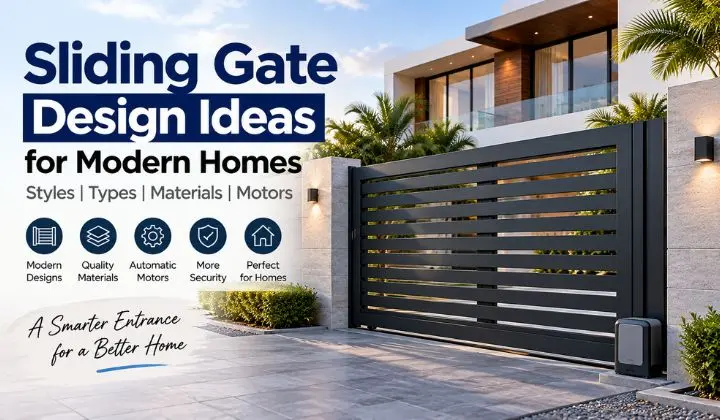
A well-chosen sliding gate can change the look and function of a home’s entrance. Unlike a swing gate, it moves sideways, which can make better use of the driveway and leave more room for vehicles to enter and park.
Today, homeowners can choose from many sliding gate designs, materials, and opening systems. A simple modern sliding gate design can suit a clean villa exterior, while a decorative or solid design may offer more privacy and security.
The right choice depends on more than appearance. You also need to think about driveway space, gate weight, opening width, material, maintenance, and whether you want manual or automatic operation.
This guide explains the main house sliding gate design options, gate types, materials, driveway requirements, and automation choices so you can make a practical decision for your property.
What Is a Sliding Gate and How Does It Work?
A sliding gate is an entrance gate that opens by moving horizontally to one side instead of swinging inward or outward. This makes it useful for homes where driveway space is limited or where a swing gate would interfere with parking.
A typical system includes a gate panel, rollers, guide system, and either a ground track or a cantilever mechanism. An automatic system can also include a sliding gate motor, gear rack, controller, remote, and safety sensors.
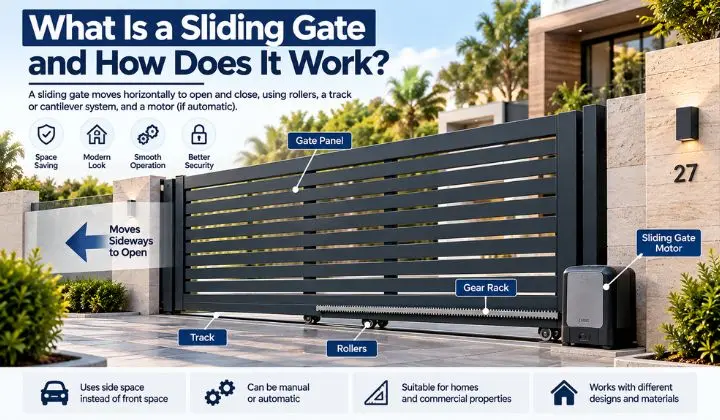
For a residential sliding gate, the opening system should match the gate’s size, weight, and expected daily use. A small home gate does not always need the same setup as a large commercial entrance.
The main advantage is simple: the gate uses the space beside the entrance rather than the space directly in front of it.
Modern Sliding Gate Design Ideas for Homes
The design should match your home’s front elevation, boundary wall, and overall architectural style. A good gate should look like part of the property rather than an unrelated feature.
Horizontal Slat Sliding Gate
A horizontal slat design uses evenly spaced bars running across the gate. It is one of the most popular choices for a modern sliding gate design because the clean lines work well with contemporary homes.
The spacing between slats can also affect privacy and airflow. Wider gaps provide more visibility, while closer slats create a more private entrance.
Vertical Slat Sliding Gate
Vertical slats give the entrance a taller and more structured appearance. This style can work well with villas that have vertical architectural features, columns, or tall boundary walls.
The slat spacing can be adjusted according to the required level of privacy, visibility, and airflow.
Minimalist Sliding Gate
A minimalist gate focuses on simple shapes, clean lines, and limited decoration. It is a good option when the house already has a modern exterior and you do not want the entrance to look too busy.
A simple sliding gate for home use can still provide a strong visual entrance when the material, proportions, and finish are selected carefully.
Solid Panel Sliding Gate
A solid panel gate provides a more closed appearance and can offer a higher level of visual privacy.
It can be useful for homes facing busy roads or properties where homeowners do not want a clear view into the driveway. However, a solid panel can be heavier than an open slat design, so its weight should be considered when choosing the supporting hardware and motor.
Laser-Cut or Geometric Sliding Gate
Laser-cut designs allow homeowners to add patterns, shapes, logos, or custom details to the gate.
This option works well when appearance is a major part of the entrance design. The pattern can also be selected to balance privacy, light, and visibility instead of creating a completely closed panel.
Aluminium Sliding Gate
An aluminium sliding gate is a popular option for modern homes because aluminium can provide a clean appearance without the weight associated with some steel constructions.
It can also be finished in different colours and surface treatments. For UAE homes, the selected protective finish is important because gates are exposed to heat, dust, humidity, and, in coastal areas, salty air.
How to Choose a Sliding Gate Design for Your House
Choosing a gate only because it looks attractive in a photograph can lead to problems later. The design should work with the actual property.
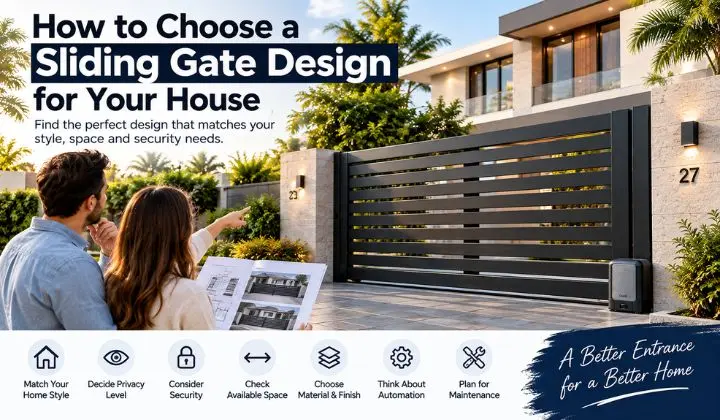
1. Match the House Architecture
Look at the home’s doors, windows, boundary walls, and exterior finishes. A gate with clean lines usually suits contemporary architecture, while a more decorative design may work better with traditional or detailed elevations.
2. Decide How Much Privacy You Need
Think about what you want people outside the property to see.
An open slat design gives more visibility and airflow. A solid or closely spaced design provides more visual screening.
3. Consider Security
The gate should be difficult to force open and should work properly with the selected locking mechanism, hinges or rollers, and access system.
For an automatic gate, photocell sensors and other safety devices can also help detect obstacles during operation.
4. Check Available Space
Measure the driveway opening and the space beside it before selecting a design. The gate needs enough room to move fully out of the entrance.
This is especially important for a sliding driveway gate, because a beautiful design is not useful if the property does not have enough side clearance.
5. Think About Gate Weight
Different designs can have very different weights. A large solid metal gate may require a stronger structure and more suitable hardware than a lightweight slatted aluminium gate.
This also affects the sliding gate motor if you choose automatic operation.
6. Choose the Material and Finish Carefully
Consider weight, maintenance, appearance, and outdoor exposure. In the UAE, the finish should also be suitable for the local environment.
Is a Sliding Gate Suitable for Your Driveway?
A sliding gate can be a practical choice when a property has enough space beside the entrance for the gate to move.
Before installation, check these points:
- Driveway opening width
- Side/runback space
- Available parking area
- Vehicle turning space
- Ground level and drainage
- Position of boundary walls
- Gate weight and length
- Electrical access if automation is planned
The required side space depends on the gate design and opening width. A professional site measurement is therefore important before fabrication.
For example, if your entrance is wide but there is very little wall space beside it, a standard sliding system may not be suitable. A telescopic sliding gate or another layout may be worth considering.
Ground conditions also matter. A tracked gate needs a properly installed ground track that stays clear and aligned. If a ground track across the entrance is undesirable, a cantilever sliding gate can be considered.
Types of Sliding Gates: Tracked, Cantilever & More
Not every sliding gate works in the same way. The right system depends on the entrance layout, available space, ground conditions, and gate size.
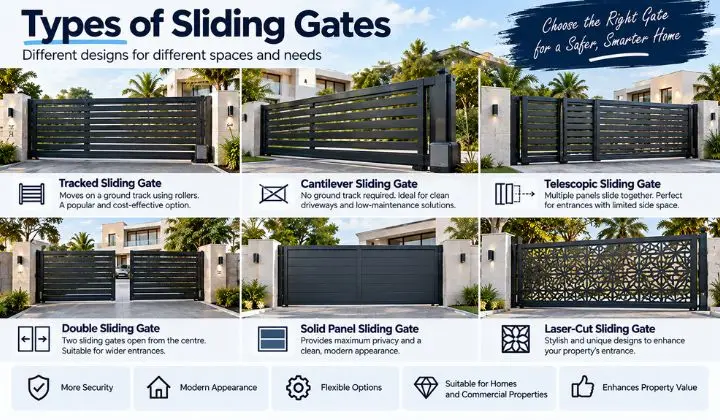
Tracked Sliding Gate
A tracked gate moves along a fixed ground track installed across the entrance.
The system is straightforward and can work well when the driveway has a suitable level surface. However, the track needs to remain reasonably clean and free from stones, sand, and other debris.
Regular cleaning is especially useful in dusty environments.
Cantilever Sliding Gate
A cantilever gate moves without a ground track running across the driveway. The gate is supported by a system of rollers and a counterbalance arrangement positioned to the side.
This can be useful where a ground track would be difficult to maintain or where the driveway surface makes a conventional track unsuitable.
However, cantilever gates require suitable side space and a properly designed supporting structure.
Telescopic Sliding Gate
A telescopic system uses two or more gate panels that move together and overlap when opening.
Its main benefit is saving runback space. It can be useful for properties where a normal single sliding panel cannot move far enough to clear the entrance.
The additional moving parts mean the system should be properly designed and installed.
Double Sliding Gate
A double sliding gate uses two panels that move in opposite directions. This can be useful for wider entrances where moving one very large panel would not be practical.
The design can also create a balanced appearance across a wide driveway.
Which Material Is Best for a Sliding Gate?
There is no single material that is right for every property. The choice should depend on the gate’s size, required strength, appearance, maintenance needs, and outdoor conditions.
Aluminium Sliding Gates
Aluminium is useful when a homeowner wants a lightweight gate with a modern appearance.
Its lower weight can also reduce the load placed on the moving system compared with a heavier design of similar size. Powder coating and other suitable finishes can provide colour and surface protection.
Steel Sliding Gates
Steel is commonly considered when strength and a robust appearance are important.
A steel gate can be made in many styles, including slatted, solid, decorative, and geometric designs. Because steel construction can be heavy, the gate weight, rollers, track, and motor capacity should all be considered together.
Galvanized Steel Sliding Gates
Galvanized steel has a protective zinc coating designed to help protect the steel from corrosion.
It can be useful for outdoor applications, but the complete gate system still needs an appropriate finish and maintenance plan. Damage to coatings, joints, or exposed areas should not be ignored.
Choosing a Material for UAE Conditions
UAE gates can be exposed to strong sunlight, heat, dust, sand, humidity, and coastal conditions.
For this reason, do not look at material alone. Consider the protective coating, construction quality, drainage, hardware, cleaning routine, and the property’s location.
Manual vs Automatic Sliding Gates
A manual sliding gate can be a suitable choice when the gate is used only occasionally and someone can open and close it by hand.
For homes with regular vehicle movement, an automatic sliding gate can provide more convenience. The gate can be operated using a remote control or integrated with other gate automation and access-control equipment.
An automatic system usually includes a motor/operator, controller, gear rack, remote receiver, and safety sensors.
The important point is to select the automation system after considering the actual gate rather than choosing a motor simply because it has a high advertised capacity.
How to Choose the Right Sliding Gate Motor
Choosing the right sliding gate motor is not simply about buying the motor with the highest capacity. The motor should match the actual gate and how often it will be used.
A motor that is suitable for a small residential gate may not be suitable for a large, heavy entrance. The wrong choice can lead to slow movement, excessive strain, noise, or frequent maintenance.
Consider these factors before selecting an automatic sliding gate motor:
Gate Weight and Length
The gate weight is one of the first things to check. Gate length also matters because a long gate places different demands on the operator than a short one.
A solid steel gate, for example, can be much heavier than a similar-sized aluminium or slatted gate.
Daily Operating Frequency
Think about how many times the gate will open and close each day.
A private home with a few vehicle movements has different requirements from a busy entrance serving many vehicles. The operating frequency should be considered when selecting the motor and automation system.
Opening Speed
Some homeowners want faster opening for convenience, but speed should not come at the expense of safe and controlled movement.
The required opening speed depends on the property, gate size, motor system, and safety setup.
Gate Design and Wind Exposure
A solid gate can catch more wind than an open slat design. This can increase the load on the moving system, particularly with larger gates.
This is another reason why the sliding gate design and motor should be considered together.
Track and Roller Condition
Even a correctly sized motor can struggle if the gate does not move smoothly.
The guide rollers, bearing wheels, track, and other moving components should be properly aligned. A gate that requires excessive force to move manually may put unnecessary strain on the motor.
Safety and Manual Release
An automatic gate should include suitable safety sensors, such as photocells, where required by the system design.
A manual release mechanism is also useful because it allows the gate to be operated manually if power or automation becomes unavailable.
What Is Included in a Sliding Gate Automation Kit?
A typical sliding gate automation system contains several components that work together rather than just a motor.
Common components include:
- Sliding gate operator/motor
- Gear rack
- Control board
- Remote control
- Receiver
- Photocell sensors
- Safety devices
- Manual release mechanism
Additional sliding gate accessories may include keypads, intercoms, access-control devices, warning lights, and additional remote controls.
The exact components depend on the automation setup and the level of access control required. For a home, a basic remote-controlled system may be enough, while a larger property may need a more complete access system.
What Are the Advantages and Disadvantages of Sliding Gates?
A sliding gate can be an excellent fit for one property and less suitable for another. Understanding both sides helps you make a practical choice.
Advantages of Sliding Gates
Space-efficient movement:
The gate moves sideways instead of swinging across the driveway, leaving more usable space in front of the entrance.
Good for modern homes:
There are many contemporary sliding gate styles, from simple slats to decorative and laser-cut designs.
Privacy options:
Solid panels and closely spaced slats can provide more visual screening.
Automation:
A sliding gate can be fitted with an automatic operator for convenient daily access.
Flexible design:
Homeowners can choose different materials, patterns, colours, and finishes to match the property.
Disadvantages of Sliding Gates
Side space is required:
The gate needs enough room beside the entrance to move completely open.
Tracks need attention:
Tracked systems can collect dust, sand, stones, and other debris that may affect movement.
More components:
An automatic system includes motors, rollers, controls, sensors, and other parts that need proper installation and occasional inspection.
Installation can be more involved:
Ground preparation, alignment, supporting structures, and electrical work may be required depending on the system.
Sliding Gate vs Swing Gate: Which Suits Your Property?
Both systems can work well, but the property layout should guide the decision.
| Factor | Sliding Gate | Swing Gate |
| Opening movement | Moves sideways | Swings inward or outward |
| Front driveway space | Does not need swing clearance | Needs swing area |
| Side space | Requires runback space | Usually less side runback |
| Wide entrances | Can suit wide openings | May require multiple leaves |
| Automation | Available | Available |
| Best suited to | Properties with suitable side space | Properties with suitable swing clearance |
If your driveway has limited space directly in front of the gate but enough room along one side, a sliding system may fit the layout well.
If there is not enough side space for the gate to move back, a swing design or another gate arrangement may need to be considered.
The decision should therefore be based on property layout, available space, entrance width, vehicle movement, and installation conditions, rather than simply choosing one gate type for every home.
How Much Does a Sliding Gate Cost in the UAE?
There is no single sliding gate price that applies to every project. The final cost depends on the gate’s size, material, design, construction, automation, and installation requirements.
Important cost factors include:
- Gate width and height
- Material selection
- Gate weight
- Custom design and decorative work
- Tracked or cantilever construction
- Rollers and other hardware
- Sliding gate motor
- Automation and access-control components
- Electrical work
- Foundation or site preparation
- Installation requirements
For example, a simple manual aluminium gate will have different requirements from a large custom steel gate with a sliding gate automation system.
If you are comparing quotes, look beyond the total price. Check what is included in the quotation, such as fabrication, hardware, motor, safety sensors, installation, and electrical work.
For an accurate project price, the entrance should be measured and the required gate specifications confirmed first.
How to Maintain a Sliding Gate in the UAE
Regular maintenance can help keep a sliding gate moving smoothly and can make it easier to identify problems before they become expensive repairs.
Clean the Track and Moving Area
For tracked gates, remove dust, sand, stones, leaves, and other debris from the track.
This is particularly important in the UAE, where outdoor gates can collect dust and sand quickly.
Check Rollers and Wheels
Watch for unusual noise, jerky movement, or increased resistance. These can indicate an issue with the guide rollers, bearing wheels, alignment, or other hardware.
Inspect the Motor and Gear Rack
For an automatic gate, check the motor and gear rack for unusual sounds or movement.
If the gate becomes noticeably slower or struggles to open, avoid repeatedly forcing the system to operate. The cause should be checked instead.
Keep Safety Sensors Clean
Dust can affect photocells and other sensors. Keep them clean and make sure they remain correctly positioned.
Check the Protective Finish
Inspect the gate surface for scratches, coating damage, rust, or other signs of deterioration.
This is particularly useful for gates exposed to humidity or coastal air.
Which Sliding Gate Is Right for Your Home?
The right choice depends on what matters most to you.
| Your Requirement | Option to Consider |
| Clean modern appearance | Horizontal or vertical slat design |
| More privacy | Solid panel sliding gate |
| Decorative entrance | Laser-cut/geometric design |
| Lightweight construction | Aluminium sliding gate |
| Strong, robust construction | Steel sliding gate |
| No ground track across driveway | Cantilever sliding gate |
| Limited runback space | Telescopic sliding gate |
| Frequent vehicle access | Automatic sliding gate |
| Wide entrance | Double sliding gate |
For a modern villa, the gate should also work with the existing perimeter fence, boundary wall, driveway, and front elevation.
At Vertex Fence, the gate design can be considered as part of the wider entrance and fencing appearance rather than as a separate element.
FAQs
How much side space does a sliding gate need?
A sliding gate needs enough runback space beside the entrance for the gate to move completely open. The required space depends on the gate width, design, and whether you use a standard, telescopic, or cantilever system.
Can a sliding gate work on a sloped driveway?
It can depend on the slope, ground condition, drainage, and gate system. A site assessment is important because the slope can affect the gate’s movement, track installation, and supporting structure.
How long does it take to install a sliding gate?
Installation time varies according to the gate size, system type, site preparation, foundation work, automation, and electrical requirements. A new installation may take longer when substantial groundwork or supporting structures are needed.
Can a sliding gate be designed to match an existing fence?
Yes. The gate can be designed to coordinate with an existing fence through the same or complementary material, colour, finish, pattern, and slat style. This can create a more consistent entrance appearance.
What should I check before ordering a sliding gate?
Check the entrance width, available side space, gate dimensions, expected weight, material, track or cantilever system, automation requirements, driveway condition, privacy needs, and finish. These details help ensure the gate is practical as well as attractive.
Why Choose Vertex Fence for Sliding Gate Solutions in the UAE?
A sliding gate should be designed around the property rather than selected only from a standard picture or catalogue.
A professional solution should consider the gate design, material, dimensions, driveway layout, hardware, automation requirements, security, privacy, and UAE outdoor conditions together.
Vertex Fence can help homeowners consider these factors when planning a sliding gate and matching it with the property’s existing fencing and entrance design.
The goal is simple: choose a gate that looks right, fits the available space, operates smoothly, and suits the way the property is actually used.