
 Fences
 Gates
Gates Signage & Boards
 Car Parking Shades
 Block and Foundation
 Spare Parts
Cement Bricks: Uses, Types & Brickwork Cement Ratio Guide

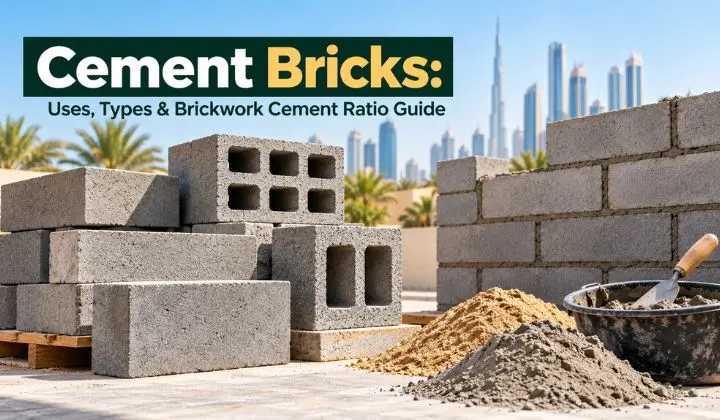
Cement bricks are masonry units made from materials such as cement, sand, aggregates, and water. The mixture is moulded, compacted, and cured to form strong and uniform building units.
They are used for wall construction, boundary walls, partition walls, and many residential and commercial projects. Unlike traditional red bricks, which are made from clay and fired, cement bricks are produced from a cement-based mixture.
Choosing the right brick is not only about price. You should also consider compressive strength, density, water absorption, dimensional accuracy, wall thickness, durability, and the intended use.
This guide explains the main types of cement bricks, how they are made, where they are used, and how the brick work cement ratio works when building a brick wall.
What Are Cement Bricks?
A cement brick is a manufactured masonry unit made by combining cement with sand, fine aggregates, aggregates, and water. The mixture is placed into a mould and compacted before going through a curing process.
The quality of the finished brick depends on the materials used, the mix, moulding, compaction, curing, and quality control during manufacturing.
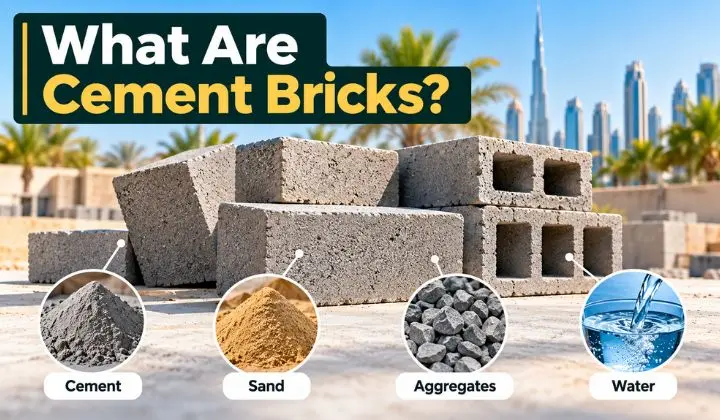
The term concrete bricks is also used for cement-based masonry products. However, product composition and specifications can vary between manufacturers. Larger masonry units are commonly known as concrete blocks or cement blocks.
One important point is that the material used to make a cement brick is different from the material used to join bricks during construction.
Cement Brick Mix vs Brickwork Mortar Mix
The brick cement mix is the mixture used to manufacture the actual brick. It may contain cement, sand, aggregates, water, and other approved materials.
Brickwork mortar, in contrast, is used to join bricks together. It is generally made from cement, sand, and water.
This means the manufacturing mix and mortar mix should not be treated as the same thing.
For example, a cement-to-sand ratio used for brickwork describes the mortar between the bricks. It does not automatically describe the manufacturing formula of the cement brick itself.
Types of Cement Bricks
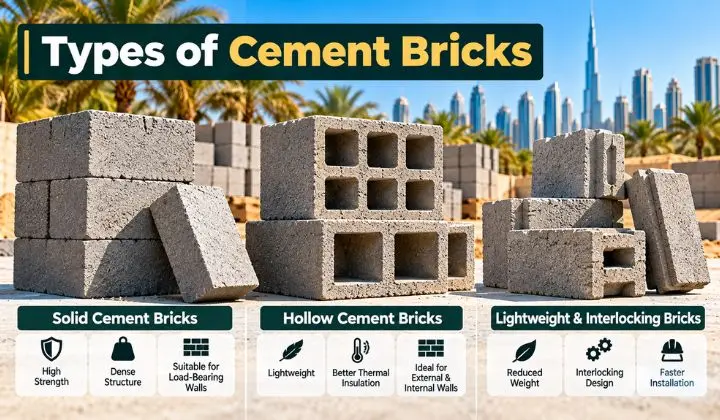
Different types of cement bricks are available for different construction needs. The right choice depends on the wall design, required strength, weight, and application.
Solid Cement Bricks
Solid cement bricks have a dense body with little or no internal hollow space.
Their dense structure can provide good strength and durability when the units are properly manufactured and used for a suitable application. They can be considered for walls where a solid masonry unit is required.
The main trade-off is weight. Solid units can be heavier to handle and transport than hollow or lightweight alternatives.
Hollow Cement Bricks
Hollow cement bricks contain internal cavities that reduce the amount of material in the unit.
Because of their lighter weight, they can be easier to handle during construction. Hollow designs may also reduce the overall weight of a wall.
However, not every hollow brick has the same strength. The number and shape of cavities, wall thickness, manufacturing method, and product specification all matter.
Before using hollow units in a project, check their stated compressive strength and intended application.
Lightweight and Interlocking Bricks
Lightweight bricks are designed to reduce the weight of masonry while providing the performance required for a particular application.
Interlocking bricks have specially shaped edges that fit together during installation. Their design can help with alignment and may reduce the need for conventional mortar in some systems.
These products should be installed according to the manufacturer’s instructions. The construction method can differ from traditional brick masonry.
Key Properties of Cement Bricks
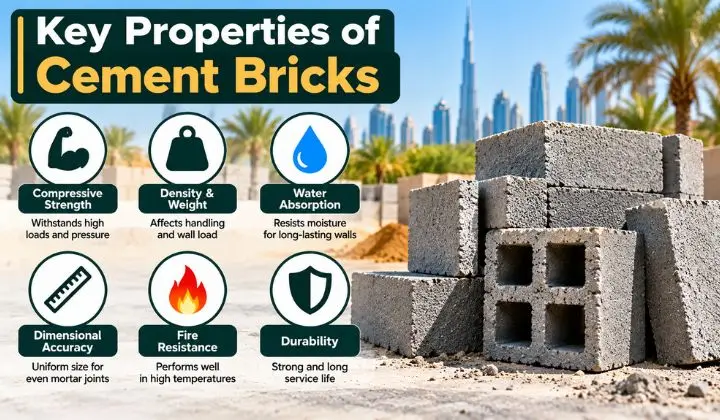
When comparing cement bricks, look beyond their appearance. Their physical properties can affect wall strength, installation, durability, and maintenance.
Compressive Strength
Compressive strength measures how much compressive load a masonry unit can withstand under a specified test method.
The required strength depends on the application. A brick suitable for a simple partition wall should not automatically be assumed to be suitable for a load-bearing wall.
Always check the product specification and structural requirements before selecting a unit for structural work.
Density and Weight
Density affects the weight of an individual brick and the overall weight of the wall.
Solid cement bricks are generally heavier than hollow or lightweight units. This can affect transportation, handling, installation, and the loads placed on the supporting structure.
For larger projects, unit weight should be considered before ordering materials.
Water Absorption
Water absorption indicates how much water a masonry unit can absorb under a defined test.
This property matters because masonry can be exposed to rain, humidity, cleaning water, or ground moisture.
For external walls and perimeter walls, it is especially important to consider moisture exposure, drainage, wall design, and the manufacturer’s product specifications.
Dimensional Accuracy
Good dimensional accuracy helps builders create more even mortar joints.
When bricks have consistent dimensions, they are easier to align and can produce a cleaner wall surface. Poorly sized or inconsistent units may require more adjustment during installation.
This is one reason quality checks are important when buying masonry materials.
Fire and Weather Resistance
Cement-based masonry can provide useful fire resistance and weather resistance, depending on the product, wall thickness, construction method, and tested performance.
For outdoor construction in the UAE, the wall may face strong sunlight, heat, dust, moisture, and other environmental conditions.
The brick should therefore be selected according to the actual conditions where it will be installed.
Durability and Structural Integrity
Good durability depends on more than the brick itself.
Material quality, manufacturing, curing, mortar, wall design, drainage, workmanship, and environmental exposure all affect the service performance of a masonry wall.
A strong brick does not automatically create a strong wall. The complete structural integrity of the wall depends on how all these parts work together.
How Are Cement Bricks Made?
The manufacturing process can vary between manufacturers and brick types, but the basic stages usually include material preparation, mixing, moulding, compaction, curing, and quality checks.
Raw Materials
The main raw materials can include:
- Cement
- Sand
- Fine aggregates
- Other aggregates
- Water
- Approved additives, where required
The quality and proportion of these materials have a direct effect on the finished product.
Clean materials and controlled proportions help manufacturers produce more consistent units.
Mixing and Moulding
The raw materials are measured and mixed to create a consistent mixture.
The mixture is then placed into moulds that determine the brick’s size and shape.
Proper moulding is important because consistent dimensions make the bricks easier to use during brick masonry.
Compaction
After the mixture is placed in the mould, it is compacted.
Proper compaction helps reduce unwanted air spaces and creates a more consistent unit.
The exact method depends on the production system and the type of cement brick being manufactured.
Curing and Drying
After moulding, cement bricks need proper curing so the cement can develop its required properties.
Curing is an important part of producing durable masonry units. Poor curing can affect the strength and quality of the finished bricks.
Once the required curing process is complete, the bricks can be prepared for storage, handling, and delivery.
Quality Checks
Manufacturers can perform different quality testing checks depending on the product and applicable requirements.
Common checks may include:
- Dimensions
- Compressive strength
- Water absorption
- Weight or density
- Surface condition
- General consistency
These checks help determine whether the bricks meet their intended product specification.
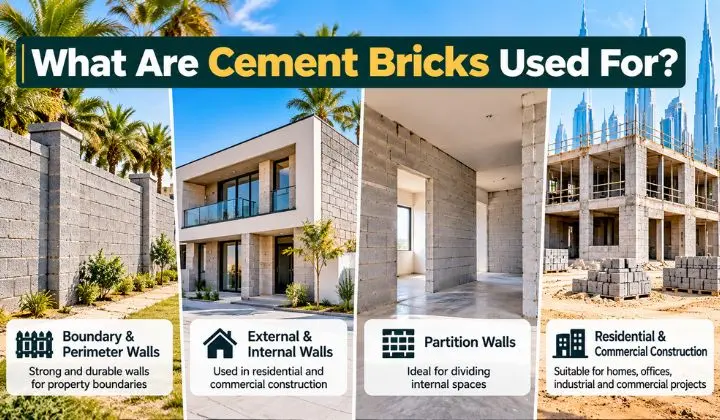
What Are Cement Bricks Used For?
Cement bricks can be used for different types of masonry work when the selected product is suitable for the application.
Boundary and Perimeter Walls
One common use is a cement brick wall for a property boundary or perimeter wall.
Masonry can provide a solid base that can also be combined with fencing, gates, and other perimeter solutions.
For a complete boundary system, the wall, fence, gate, foundation, drainage, and finish should be considered together rather than as separate elements.
External and Internal Walls
Cement bricks can be used for both external and internal walls, depending on their specifications.
External walls normally face greater exposure to weather and moisture, so water absorption, weather resistance, wall thickness, and surface protection should be considered.
Internal walls may have different requirements, particularly where weight, space, sound control, or partition design is important.
Partition Walls
Some cement masonry units are suitable for partition walls where the purpose is to divide internal spaces.
For a non-load-bearing partition, factors such as unit weight, wall thickness, installation method, and finish can be important.
The brick should still match the requirements of the building and project specification.
Residential and Commercial Construction
Cement bricks may be used in residential and commercial construction for suitable wall applications.
The correct choice depends on the required strength grade, dimensions, wall design, exposure, and intended use.
For structural work, the product should be selected according to the project’s engineering requirements rather than simply choosing the strongest-looking or lowest-cost brick.
What Is the Brickwork Cement Ratio?
The brick work cement ratio refers to the proportion of cement and sand used to make mortar for laying bricks.
For example, a 1:4 cement-to-sand ratio means:
1 part cement : 4 parts sand
This is a mortar proportion. It does not mean that the cement brick itself is manufactured using a 1:4 mix.
The required mortar proportion can vary depending on the masonry unit, wall type, exposure, required performance, and project specification.
What Does a 1:4 Cement-to-Sand Ratio Mean?
In a 1:4 mortar mix, one measured part is cement and four measured parts are sand.
For example, if a bucket is used as the measuring unit:
- 1 bucket cement
- 4 buckets sand
The same measuring method should be used consistently.
Water is then added as needed to achieve workable mortar. Too much water can affect the quality of the mortar, so it should not simply be added without control.
What Do 1:5 and 1:6 Ratios Mean?
A 1:5 mortar ratio means:
1 part cement + 5 parts sand
A 1:6 mortar ratio means:
1 part cement + 6 parts sand
These ratios describe the relative quantities of cement and sand.
They should not be treated as universal formulas for every wall. The correct mortar depends on the type of masonry, required performance, exposure, wall construction, and project specification.
How Do You Choose the Right Mortar Ratio?
There is no single mortar ratio that should automatically be used for every project.
When choosing a cement mortar mix, consider:
- Type of brick or block
- Wall type
- Required strength
- Mortar joint thickness
- Exposure to moisture and weather
- Whether the wall is load-bearing or non-load-bearing
- Project specifications
It is also important to remember that using more cement is not automatically the correct solution. The mortar should be suitable for the masonry unit and the intended application.
How to Calculate Cement and Sand for Brickwork
A proper cement mortar calculation in brick masonry starts with the actual wall dimensions and brick size.
The main information needed includes:
- Wall length
- Wall height
- Wall thickness
- Brick dimensions
- Mortar joint thickness
- Door and window openings
- Mortar ratio
- Expected wastage
Cement Mortar Calculation in Brick Masonry
To estimate mortar, first determine the total volume of the wall.
Then estimate the volume occupied by the bricks. The remaining volume represents the approximate mortar space before accounting for practical factors such as joints and wastage.
This is why a cement and sand and bricks calculator can only provide a useful estimate when accurate project dimensions and assumptions are entered.
For real construction work, the actual brick dimensions and project specification should be used instead of relying on one generic number.
How Much Cement Is Required for 1,000 Bricks?
There is no single cement quantity that applies to every 1,000 bricks.
The amount of cement required for brickwork depends on:
- Brick size
- Wall thickness
- Number of bricks
- Mortar joint thickness
- Cement-to-sand ratio
- Openings
- Wastage
- Actual mortar requirement
For example, 1,000 smaller bricks can require a different mortar volume from 1,000 larger bricks. The same applies when comparing different wall thicknesses or joint sizes.
So, if you search for how much cement is required for 1000 bricks, make sure the answer states its assumptions. A number without those assumptions can be misleading.
How to Calculate Cement and Sand for Brickwork
The actual quantity of cement and sand depends on the wall size, brick dimensions, mortar joints, and selected cement-to-sand ratio.
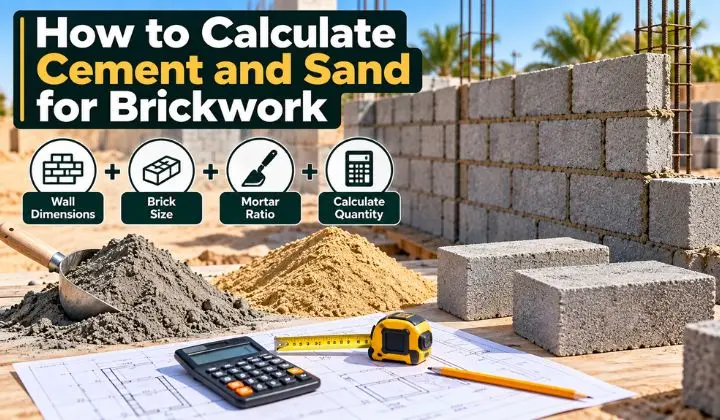
A simple calculation starts by finding the wall volume:
Wall volume = Length × Height × Wall thickness
Next, estimate the volume occupied by the bricks. The difference gives an approximate mortar requirement.
For practical work, you should also allow for small losses and site wastage. Openings such as doors and windows should be removed from the wall volume when calculating a larger project.
Practical Example
Suppose a wall is:
- 10 m long
- 2 m high
- 0.20 m thick
The wall volume is:
10 × 2 × 0.20 = 4 m³
This is the total wall volume before deducting bricks and openings.
The final mortar quantity cannot be calculated accurately from wall volume alone. You also need the actual brick dimensions and mortar joint thickness.
This is why a professional brickwork calculation should use the actual project measurements instead of a fixed estimate for every wall.
Factors That Change Cement Quantity
The amount of cement required for brickwork can change because of:
- Brick size
- Wall thickness
- Mortar joint thickness
- Brick arrangement
- Number of openings
- Selected mortar ratio
- Site wastage
- Workmanship
For a large project, calculating the material requirement before ordering can help reduce both shortages and unnecessary leftover materials.
Cement Bricks vs Red Bricks: What’s the Difference?
Both cement bricks and red or clay bricks can be used for masonry, but they are made differently and can have different properties.
| Factor | Cement Bricks | Red/Clay Bricks |
| Main material | Cement-based mixture | Clay |
| Manufacturing | Moulded and cured | Shaped and fired |
| Weight | Depends on solid/hollow design | Depends on size and density |
| Strength | Depends on product specification | Depends on clay, firing and product quality |
| Water absorption | Varies by product | Varies by product |
| Appearance | Usually uniform | Natural clay appearance |
| Size accuracy | Can be highly consistent | Depends on manufacturing |
| Thermal performance | Depends on density and design | Can provide useful thermal performance |
| Common uses | Walls, partitions, boundaries and other masonry | Walls and traditional masonry |
Which One Should You Use?
There is no single choice that fits every construction project.
Consider the wall type, strength requirement, appearance, local availability, thermal needs, moisture exposure, cost, and project specification before selecting the material.
For example, a property owner focused on a uniform modern finish may have different requirements from someone restoring a traditional brick structure.
Cement Bricks vs Concrete Blocks
Cement bricks and concrete blocks are both cement-based masonry products, but their size and design can be quite different.
Concrete blocks are generally larger units, which can cover more wall area with fewer pieces. They are available in different forms, including solid blocks and hollow blocks.
| Factor | Cement Bricks | Concrete Blocks |
| Unit size | Usually smaller | Usually larger |
| Handling | Smaller units can be easier to position | Larger units cover more area |
| Wall construction | More individual units | Fewer units for the same wall area |
| Options | Solid, hollow and other designs | Solid, hollow and lightweight options |
| Mortar | Used between units where required | Used between blocks where required |
| Applications | Walls, partitions, boundaries | Walls, partitions and larger masonry work |
When comparing products, don’t look only at the individual unit price. Consider block size, mortar consumption, labour, wall thickness, handling, transportation, and installation time.
This gives a more realistic picture of the total construction cost.
Advantages and Disadvantages of Cement Bricks
Advantages of Cement Bricks
Cement bricks can offer several practical benefits when the correct product is selected.
Consistent Dimensions
Manufactured units can provide good dimensional accuracy, which helps create more uniform courses and mortar joints.
Strength
Suitable products can provide good compressive strength for their intended applications.
Durability
Properly manufactured, cured, and installed masonry can provide long-term durability under suitable conditions.
Different Designs and Sizes
Cement-based masonry is available in solid, hollow, lightweight, and interlocking forms, giving builders different options for different applications.
Suitable for Different Wall Applications
Depending on the product specification, cement bricks can be used for internal walls, external walls, partition walls, boundary walls, and other masonry applications.
Disadvantages of Cement Bricks
Cement bricks also have some limitations that should be considered.
Solid Units Can Be Heavy
Solid masonry units can be heavier than hollow or lightweight alternatives. This can affect handling and transportation.
Moisture Needs Attention
Water absorption varies between products. Outdoor walls should be designed with suitable drainage and moisture protection.
Insulation Depends on the Product
A dense cement brick does not automatically provide the same thermal performance as a specially designed lightweight or insulated masonry product.
Quality Can Vary
Not every supplier produces units with the same strength, dimensions, or water absorption. Product specifications and testing information are important.
Installation Still Matters
Even high-quality bricks can produce poor results if the wall has uneven joints, poor alignment, unsuitable mortar, or inadequate curing and workmanship.
Cement Brick Sizes and Price in UAE
Size and price are important when planning a masonry project in the UAE.
However, there is no single cement bricks price that applies to every product.
Common Cement Brick and Block Sizes
Cement-based masonry products can be available in different dimensions depending on the manufacturer.
Common wall-thickness categories can include:
- 4-inch units
- 6-inch units
- 8-inch units
You may also find different solid block size in UAE and hollow block dimensions depending on the supplier and application.
For example, a 6 inch hollow block and an 8 inch cement block are not simply interchangeable. Their dimensions, weight, strength, and intended wall application can differ.
Always check the actual product dimensions before calculating the number of units required.
How Much Do Cement Bricks Cost in UAE?
The price of cement bricks in the UAE can change based on several factors.
These include:
- Brick type
- Size
- Strength
- Solid or hollow design
- Order quantity
- Supplier
- Delivery distance
- Project location
- Current material and transport costs
If you are looking for a cement bricks price list, check whether the quoted price includes delivery, loading, VAT, and other applicable charges.
For bulk construction, asking for a project-specific quotation can give a more useful figure than relying on a general online price.
When searching for cement bricks for sale, also check the supplier’s product specifications rather than comparing price alone.
How to Choose the Right Cement Bricks for Your Project
Choosing cement bricks becomes easier when you work through a simple checklist.

1. Identify the Application
First decide whether the bricks are needed for an internal wall, external wall, partition, boundary wall, or another application.
2. Check Required Strength
Look at the product’s stated compressive strength and confirm that it matches the project’s requirements.
3. Select the Right Size
Brick or block size affects wall thickness, weight, mortar quantity, and the number of units required.
4. Compare Solid and Hollow Options
Solid units may be suitable where a dense masonry unit is required, while hollow or lightweight products can reduce weight in suitable applications.
5. Check Water Absorption
For outdoor applications, water absorption and moisture exposure should be considered carefully.
6. Check Dimensions
Good dimensional accuracy can make installation easier and improve the final wall finish.
7. Ask About Quality Testing
Where available, request relevant product information for strength, dimensions, absorption, and other required properties.
8. Consider Delivery
For a large order, transportation can become an important part of the total cost.
If you’re sourcing materials for a wider perimeter project, companies such as Vertex Fence can also help you plan masonry alongside fencing and gate requirements, where those services are part of the project scope.
Cement Bricks for Boundary Walls in UAE
Cement bricks for boundary wall construction can be useful when a property needs a solid masonry perimeter.
A boundary wall is exposed to outdoor conditions, so selection should consider more than appearance.
Strength and Wall Design
The masonry unit should have suitable compressive strength for the intended wall design.
The foundation, wall thickness, reinforcement where required, and overall structural design should also be considered.
Moisture and Drainage
Outdoor masonry can be exposed to rain, ground moisture, cleaning water, and humidity.
Good drainage and appropriate construction details can help reduce moisture-related problems.
Combining Masonry With Fencing
A masonry wall does not always have to be the complete perimeter solution.
It can be combined with:
- Metal fencing
- Security fencing
- Gates
- Decorative fencing
- Perimeter fencing systems
This can allow the property owner to separate the solid lower section from the upper security or decorative section.
For UAE properties, the final design should also consider the property’s use, surrounding environment, required privacy, security needs, and local project requirements.
Common Cement Brick and Brickwork Mistakes
Small mistakes during material selection or installation can create bigger problems later.
Choosing Only by Price
The cheapest unit is not automatically the most suitable. Compare strength, dimensions, absorption, quality, delivery, and intended application.
Using the Wrong Mortar Ratio
Don’t choose a mortar ratio simply because it was used on another project. The mix should match the masonry and project requirements.
Adding Too Much Water
Excess water can change the behaviour and performance of mortar. Water should be controlled rather than added randomly.
Ignoring Brick Dimensions
Small differences in dimensions can affect quantity calculations, mortar joints, wall alignment, and the final finish.
Poor Alignment
Uneven courses can make the wall look poor and may affect its construction quality.
Ignoring Curing
Proper curing is important for cement-based products. Both manufactured units and cement-based construction work need appropriate curing practices.
Ordering Without Calculating
Ordering materials without estimating the wall area, openings, brick size, and wastage can lead to shortages or excess stock.
Ignoring Project Specifications
For structural or commercial construction, product selection should follow the relevant drawings, engineering requirements, and project specifications.
Frequently Asked Questions
Can Cement Bricks Be Used for Both Internal and External Walls?
Yes, suitable cement bricks can be used for both internal and external wall applications. The correct product depends on the wall design, strength requirements, moisture exposure, thickness, and manufacturer’s specifications.
External walls normally need more attention to weather resistance, water absorption, drainage, and surface protection than many internal applications.
Do Cement Bricks Need Curing After They Are Manufactured?
Yes, curing is an important part of cement-brick production because it allows the cement-based material to develop its required properties. The exact curing method and duration depend on the manufacturing process and product requirements.
Proper curing can have a direct effect on the final strength and durability of the masonry unit.
Can You Use the Same Mortar Ratio for Every Type of Cement Brick?
No. A single mortar ratio should not automatically be used for every cement brick or masonry project. The suitable mix can depend on the brick type, wall type, required performance, exposure, and project specification.
For this reason, a 1:4, 1:5, or 1:6 mortar ratio should be treated as a specified mix rather than a universal rule for every wall.
What Should You Check Before Buying Cement Bricks in UAE?
Check the brick dimensions, type, compressive strength, water absorption, density, quality testing, quantity, and intended application. Also confirm whether the quoted price includes delivery and other applicable charges.
For large projects, comparing product specifications along with the price gives you a much clearer basis for choosing a supplier.
Can Cement Bricks Be Used With Fencing and Boundary Wall Systems?
Yes, cement-brick masonry can be combined with suitable fencing and gate systems as part of a complete property perimeter. The final design depends on the required height, foundation, structural details, security needs, and appearance.
For a boundary project, it is useful to plan the masonry wall, fencing, gates, and perimeter system together so that the finished installation works as one design.
Final Thoughts
Cement bricks are practical masonry units that can be used for many wall and construction applications. But choosing the right product requires more than checking the price.
Look at compressive strength, density, water absorption, dimensions, durability, wall thickness, and intended use before buying. The same approach applies to mortar: the brick work cement ratio should be selected according to the masonry and project requirements rather than treated as one fixed formula.
For brickwork calculations, use the actual wall dimensions, brick size, joint thickness, openings, and mortar ratio. This gives a much more useful estimate of cement and sand requirements than a generic figure for 1,000 bricks.
For UAE boundary projects, cement masonry can also be combined with fencing and gates to create a complete perimeter wall system. Planning these elements together can help achieve the required balance of structure, security, appearance, and long-term performance.