
 Fences
 Gates
Gates Signage & Boards
 Car Parking Shades
 Block and Foundation
 Spare Parts
RCC Blocks for Temporary Fencing: Benefits, Uses & Installation Guide

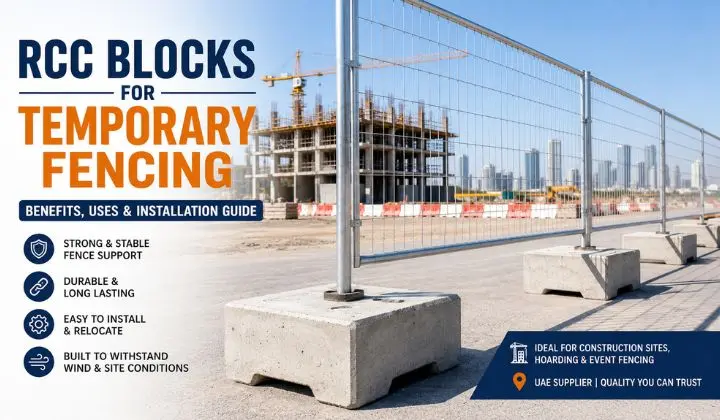
Temporary fencing needs a strong and stable base to stay upright, especially on busy construction sites and exposed outdoor areas. RCC Blocks for Temporary Fencing provide the weight needed to support temporary fence posts and panels without creating a permanent foundation.
These blocks are commonly used with temporary fence panels, site hoarding, construction fencing, and other temporary perimeter systems. They are especially useful on concrete, asphalt, and paved surfaces where digging into the ground may not be practical.
The right block, however, is not simply the heaviest one available. Fence height, panel type, wind exposure, surface condition, post size, gates, corners, and the overall fence layout all affect the stability of a temporary fence.
This guide explains what RCC blocks do, what specifications to check, and how to choose a suitable base for your project.
What Are RCC Blocks for Temporary Fencing?
RCC stands for Reinforced Cement Concrete. RCC blocks are concrete units made using cement, aggregates, sand, water, and reinforcement where required. For temporary fencing, the block works mainly as a heavy concrete fence base or ballast.
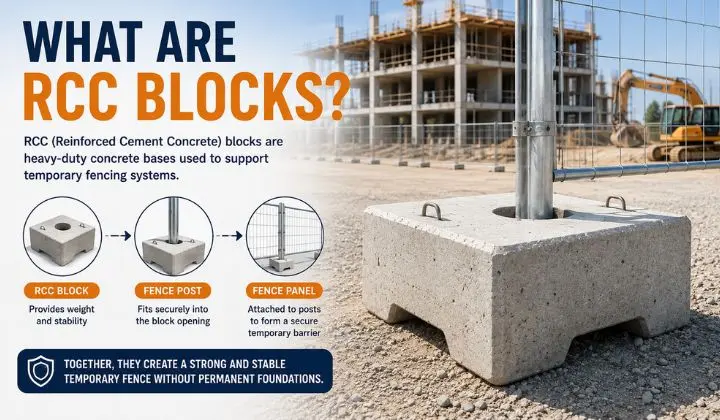
A typical setup has three main parts:
- RCC block — provides the weight and base.
- Temporary fence post — fits into the opening in the block.
- Temporary fence panel — attaches to the posts to form the fence line.
Together, these parts create a temporary perimeter without requiring a traditional buried foundation.
The main job of the block is to add mass at the bottom of the fence. This helps improve fence stability and reduces unwanted movement when the fence is exposed to wind or normal site activity.
The terms used in the market can vary. You may see these products described as concrete ballast blocks, concrete fence blocks, precast concrete ballast blocks, concrete hoarding blocks, or hoarding blocks.
For heavier temporary systems, the term concrete kentledge blocks may also be used to describe concrete units used as ballast or counterweight.
RCC Blocks vs Ordinary Concrete Bases
Not every concrete block is suitable for temporary fencing.
A fencing block needs to work with the fence post and panel system. Its block dimensions, weight, concrete quality, opening size, and handling method all matter.
For this reason, buying a random concrete block simply because it is heavy can create installation problems. The block should be selected as part of the complete fencing system.
Why Use RCC Blocks for Temporary Fencing?
RCC blocks offer several practical benefits when a temporary fence needs a stable base.
Provides Stability and Ballast
The biggest benefit is simple: ballast adds weight to the bottom of the fence.
Wind can push against a temporary fence panel. The taller or more enclosed the panel is, the more important wind load and wind exposure become.
A properly selected concrete block increases the resistance of the fence system to movement and overturning. This is particularly important for temporary hoarding because solid panels can catch more wind than open mesh panels.
The block does not work alone. Stability depends on the complete system, including the panel, post, connections, block weight, fence height, surface and site conditions.
This is why overturning resistance should be considered when planning temporary fencing rather than looking at block weight alone.
Works on Hard Surfaces
One of the main reasons contractors use concrete ballast is that temporary fencing often needs to be installed where digging is difficult or undesirable.
Examples include:
- Concrete slabs
- Asphalt areas
- Paved surfaces
- Car parks
- Finished construction areas
- Industrial yards
- Event spaces
A ballast-based system can provide a practical alternative where traditional ground anchoring is not suitable.
For a hard-surface installation, the surface still needs to be reasonably stable and suitable for the fencing system. A heavy block cannot solve every problem caused by an uneven, damaged, or unstable surface.
Durable and Reusable
Concrete is well suited to demanding construction environments because it can handle regular outdoor use when properly manufactured and handled.
Precast concrete blocks can also provide consistent dimensions from one unit to another. This makes planning and positioning easier when many blocks are needed around a site.
For temporary projects, reusability can also be useful. A block can potentially be moved and used at another location when the project layout changes, provided it remains in good condition and is suitable for the new fencing system.
This makes RCC blocks useful for projects where a temporary boundary may need to be installed, removed, or changed during different construction phases.
Supports Site Security and Access Control
Temporary fencing is not only about creating a visible boundary.
A stable fence can help define restricted areas, control access, separate work zones, and protect people from active construction areas.
For example, construction site fencing can be used around:
- Building projects
- Excavation areas
- Material storage zones
- Equipment areas
- Temporary work zones
When combined with suitable gates and access points, RCC-based fencing can form part of a wider site security and perimeter protection system.
What Size RCC Block Is Used for Temporary Fencing?
There is no single universal RCC block size for every temporary fence.
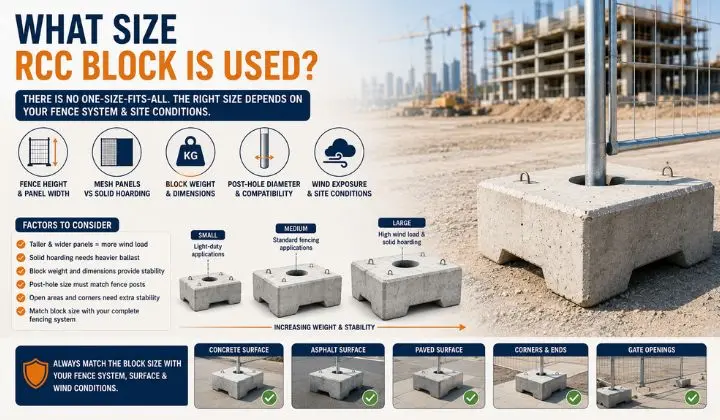
The right block size and block weight depend on the complete fencing setup and site conditions. A small open mesh fence in a sheltered area may have different requirements from tall solid hoarding in an exposed location.
Before choosing a block, consider these factors:
Fence Height and Panel Width
A taller fence can present more surface area to the wind. A wider panel can also affect the forces acting on the base and posts.
This means the fence panel dimensions should be considered when selecting the base.
Do not choose a block based only on the fence length. The height and individual panel size also matter.
Mesh Panels vs Solid Hoarding
The type of panel is another important factor.
Temporary fence panels made from open mesh allow some air to pass through. Solid site hoarding, on the other hand, has a much more enclosed surface.
Because of this difference, solid hoarding can place greater demands on the fence stability system when exposed to wind.
If you are using solid panels, the ballast requirement should be assessed for the actual fence configuration rather than copied from an open mesh fencing setup.
Block Weight and Dimensions
Two blocks can have different dimensions and weights, so both measurements should be checked.
A heavier block may provide more ballast, but the block also needs to fit the site and fencing system.
Consider:
- Overall block weight
- Length and width
- Height
- Footprint
- Storage space
- Transport requirements
- Handling equipment
The available space along the fence line can also affect which block configuration is practical.
Post-Hole Diameter and Compatibility
One of the easiest details to overlook is the opening for the fence post.
The post-hole diameter should match the fencing system. The fence post compatibility should be confirmed before ordering a large quantity of blocks.
If the opening is too small, the post may not fit. If it is too large for the intended system, additional compatibility issues may arise.
For this reason, always confirm the post dimensions and block opening together.
Wind Exposure and Site Conditions
A temporary fence in a sheltered location does not experience the same conditions as one in an open area.
Consider whether the site is:
- Open and exposed
- Near tall buildings
- Along a road
- Near the coast
- Surrounded by open land
- Subject to frequent strong winds
The fence layout also matters. Corners, fence ends, and gates can behave differently from a long straight fence run.
For larger projects, the required stabilization should be assessed based on the actual fencing system and site conditions rather than using a general block size as a rule.
RCC Block Specifications to Check Before Ordering
Before buying RCC blocks for sale, check more than just the price.
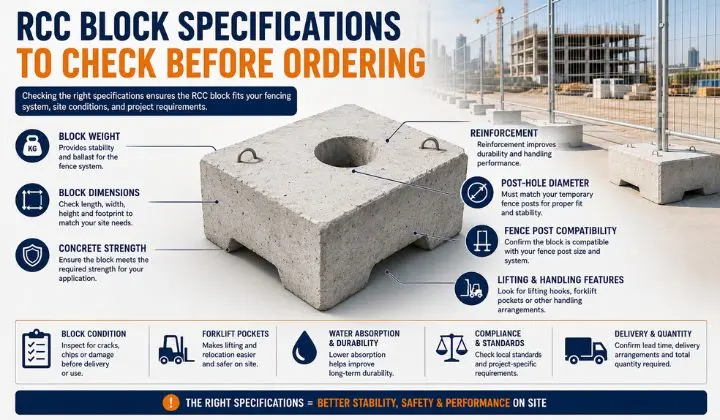
The following specifications can help you choose a block that works with your fencing system.
| Specification | Why It Matters |
| Block weight | Determines how much ballast the base provides and affects handling. |
| Block dimensions | Determines the footprint and available space around the fence. |
| Concrete strength | Helps assess whether the block is suitable for the intended application. |
| Reinforcement | Can improve the block’s ability to handle handling and service loads when properly designed. |
| Post-hole diameter | Must suit the temporary fence post. |
| Fence-post compatibility | Prevents problems during installation. |
| Lifting points | Can make moving heavy blocks easier where provided. |
| Forklift pockets | Useful for handling and relocation where included in the design. |
| Block condition | Cracks or serious damage can affect suitability and safe handling. |
Check the Complete Fence System
A common mistake is ordering the blocks first and trying to make the fence fit afterward.
A better approach is to confirm:
Fence panel → fence post → block opening → block weight → site conditions
This simple check can prevent many installation problems.
For larger projects, it is also useful to confirm how the blocks will be transported, unloaded, positioned, and moved around the site.
Where Are RCC Blocks Used for Temporary Fencing?
RCC blocks can be used in many situations where a temporary fence needs a strong heavy-duty base.
Construction Sites & Building Projects
Construction sites are one of the most common applications.
Temporary fencing can create a boundary around active work areas while allowing the layout to change as construction progresses.
Typical uses include:
- Construction site fencing
- Site perimeter protection
- Restricted work areas
- Material storage areas
- Equipment zones
- Temporary pedestrian separation
- Construction entrances
RCC blocks are particularly useful when the fence needs to stand on an existing hard surface without creating a permanent foundation.
Roadwork & Infrastructure Projects
Road and infrastructure work often requires temporary boundaries around changing work zones.
Depending on the project, temporary fencing can help separate workers, equipment, materials, pedestrians, and traffic areas.
RCC blocks may be used with temporary fencing around:
- Road construction
- Utility work
- Infrastructure projects
- Drainage work
- Public-area construction
- Temporary work compounds
The exact fencing and stabilization method should always match the project layout and safety requirements.
Industrial & Commercial Sites
Industrial and commercial projects may require temporary boundaries during construction, maintenance, expansion, or site changes.
Applications can include:
- Warehouses
- Industrial facilities
- Commercial developments
- Storage areas
- Renovation projects
- Restricted operational zones
Here, a stable concrete fence base can help create a clear temporary boundary while keeping the system removable.
Events & Temporary Venues
Temporary fencing is also used outside construction.
Events and temporary venues may need fencing to control access, separate service areas, or define restricted zones.
RCC blocks can be considered where a heavier base is suitable for the fence system and the surface allows practical placement.
For events, transport and handling should also be considered because heavy concrete units require suitable equipment for safe movement.
RCC Blocks vs Other Temporary Fencing Base Options
RCC blocks are not the only way to support temporary fencing. The best option depends on the fence type, surface, project duration, wind exposure, and how much stability the system needs.
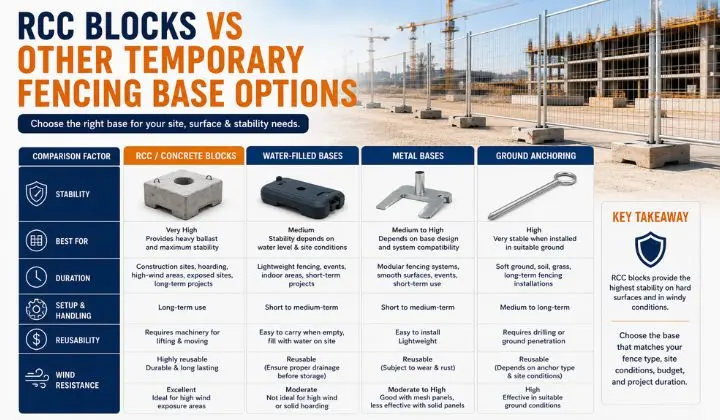
| Base Option | Suitable For | Main Consideration |
| RCC / concrete blocks | Heavy-duty temporary fencing and hoarding | Weight, handling and compatibility |
| Water-filled bases | Lightweight or modular temporary fencing | Filling, drainage and stability |
| Metal bases | Compatible modular fencing systems | System compatibility |
| Ground anchoring | Suitable ground conditions | Requires suitable ground penetration |
RCC or Concrete Blocks
Precast concrete ballast blocks provide substantial mass at the bottom of a fence. They can be a practical choice for construction sites, hoarding, industrial areas, and hard-surface installations.
Their main advantages are strength, durability, and the ability to provide ballast without creating a permanent foundation.
The trade-off is handling. Heavy blocks need suitable equipment for loading, unloading, positioning, and relocation.
Water-Filled Bases
Water-filled plastic bases are lighter before filling and can be easier to move by hand in some temporary fencing systems.
However, they are only suitable when their design and capacity match the fence system and site conditions. They should not automatically be treated as an equivalent replacement for a heavy RCC base.
Metal Bases
Metal feet are used with some modular temporary fence systems. They can be convenient for lightweight panels and frequent movement.
Their suitability depends heavily on the specific panel and post system. A metal base is not automatically suitable for every type of temporary fencing.
Ground Anchoring
Ground anchoring can provide strong support where the ground and project conditions allow suitable penetration.
It may not be practical on concrete slabs, asphalt, finished paving, or areas where the surface cannot be damaged. In such cases, a ballast-based system can be more practical.
How to Install Temporary Fencing with RCC Blocks
Correct installation is just as important as selecting the right block. Even a heavy concrete fence block can perform poorly if the surface, posts, panels, or connections are not installed correctly.
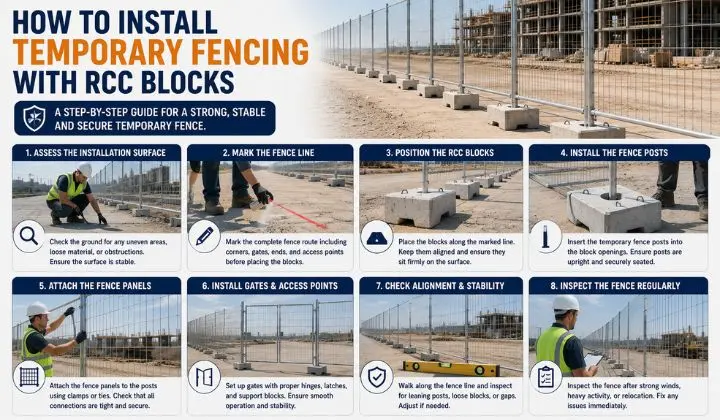
Use this basic process as a practical guide.
1. Assess the Installation Surface
Start by checking the ground or surface where the fence will stand.
Look for:
- Uneven areas
- Loose material
- Damaged concrete
- Potholes
- Slopes
- Standing water
- Obstructions
The surface should be stable enough to support the blocks and fencing system.
If the surface is uneven, placing a heavy block on an unstable area can affect the fence’s overall structural stability.
2. Mark the Fence Line
Mark the complete fence route before positioning the blocks.
Check:
- Overall fence length
- Panel positions
- Gate locations
- Corners
- Fence ends
- Access points
- Required clearances
Planning the layout first makes the installation faster and reduces the need to move heavy blocks later.
3. Position the RCC Blocks
Place the blocks along the planned fence line according to the requirements of the fencing system.
Keep the blocks properly aligned and make sure they sit firmly on the surface.
Do not assume that placing blocks closer together or farther apart will automatically improve stability. The correct spacing should match the fence system and project requirements.
4. Install the Temporary Fence Posts
Once the blocks are positioned, install the temporary fence posts into their openings.
Before doing this, confirm that the post diameter matches the block opening.
The post should sit correctly in the base without relying on improvised materials to make an incompatible opening work.
5. Attach the Temporary Fence Panels
Install the temporary fence panels between the posts and secure them using the appropriate connections for the system.
Check that:
- Panels are properly connected
- Posts remain upright
- Connections are secure
- Panels are aligned
- There are no unnecessary gaps
A strong base cannot make up for poorly connected panels.
6. Install Gates and Access Points
Gates deserve extra attention because they are moving parts of the fence system.
Make sure the gate posts, hinges, latches, and supporting blocks are suitable for the gate configuration.
The same applies to corners and fence ends. These areas should be considered separately when checking perimeter stability.
7. Check Alignment and Stability
Walk along the completed fence and inspect the entire line.
Check for:
- Leaning posts
- Moving blocks
- Loose connections
- Uneven panels
- Unstable gates
- Gaps at the base
- Problems at corners and ends
If anything looks unstable, correct it before the fence is put into normal use.
8. Inspect the Fence Regularly
Temporary fencing is exposed to changing site conditions.
Inspect it after:
- Strong winds
- Heavy site activity
- Fence relocation
- Changes to the site layout
- Accidental impact
- Repairs or panel replacement
Regular inspection helps identify problems before they become bigger issues.
How Much Do RCC Blocks for Temporary Fencing Cost in the UAE?
The RCC block price in the UAE can vary from one project to another. There is no single price that applies to every block because size, weight, specifications, quantity, and delivery can all affect the final cost.
When comparing RCC blocks for temporary fencing price, consider the complete supply rather than looking only at the unit price.
Block Size and Weight
Larger and heavier blocks generally require more concrete and can have higher manufacturing and handling costs.
The required size should be based on the fencing system and site conditions, not simply on the lowest available price.
Quantity
Buying a small number of blocks and ordering a large bulk quantity are different supply requirements.
If you need bulk RCC blocks, ask the supplier for a project-based quotation that includes the required quantity and specifications.
Concrete Specification
Concrete strength, reinforcement, finish, and manufacturing requirements can affect the cost.
If your project requires a specific concrete specification, provide those details when requesting a quotation.
Custom Sizes
Standard blocks may not always fit every fencing system.
A project may require different dimensions, post openings, lifting arrangements, or other specifications. Custom RCC blocks can therefore affect the final price.
Delivery and Handling
Transportation is another important part of the total cost.
Heavy blocks may require suitable trucks, loading equipment, offloading arrangements, and equipment for positioning them at the site.
For this reason, ask whether the quotation includes delivery and what handling arrangements are expected at the project location.
RCC Blocks for Temporary Fencing in the UAE
Temporary fencing is widely used for construction, infrastructure, industrial, and commercial projects across the UAE.
Projects in Dubai, Abu Dhabi, Sharjah, Ajman, and other Emirates can have very different site conditions. The right base therefore depends on the actual project rather than the location name alone.
Temporary Fencing for UAE Construction Sites
Construction projects may need temporary boundaries for months or even through several stages of work.
A ballast-based fence can help create a removable temporary site boundary around:
- Building projects
- Excavation zones
- Storage areas
- Work compounds
- Industrial developments
- Commercial construction sites
The system can then be changed as the project develops.
Choosing Blocks for UAE Outdoor Conditions
Outdoor fencing can face heat, wind, dust, vehicle movement, and frequent site activity.
The selection process should therefore consider:
Fence height + panel type + wind exposure + surface + fence layout + block specifications
This approach is more reliable than choosing a block based only on its weight.
For projects with large solid hoarding, unusual fence heights, exposed locations, or complex layouts, the stabilization requirements should be checked for the actual system before installation.
Common Mistakes to Avoid When Using RCC Blocks for Temporary Fencing
Even a good-quality block can cause problems when the wrong system or installation method is used.
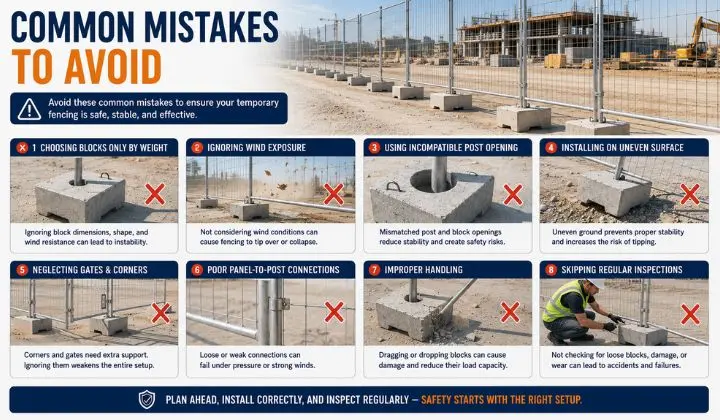
Choosing Blocks Only by Weight
A heavier block is not automatically the correct block.
The opening, dimensions, fence type, post compatibility, surface, and site conditions all matter.
Ignoring Fence Height and Wind Exposure
Wind is one of the most important factors in temporary fencing.
A tall solid fence can experience very different forces from a shorter open mesh fence. Always consider the complete system when assessing wind resistance and stability.
Using an Incompatible Post Opening
Always check the post dimensions before ordering.
A mismatch between the post and block opening can create unnecessary installation problems and may prevent the fencing system from being installed as intended.
Installing on an Uneven or Unstable Surface
Do not assume that the weight of the block will fix an unsuitable surface.
The base needs to sit properly on a stable surface. Uneven or damaged areas should be assessed before installation.
Neglecting Gates, Corners and Fence Ends
A straight fence run is not the only part that matters.
Gates, corners, changes in direction, and fence ends should all be included when reviewing the overall stabilization of the fence.
Poor Panel-to-Post Connections
The fence panel must be properly connected to the post.
Loose or damaged connections can reduce the stability of the whole fence even when the concrete base is correctly positioned.
Improper Handling
Heavy RCC blocks should be moved using suitable handling equipment and safe lifting practices.
Do not try to move heavy concrete units manually when their weight requires mechanical handling.
Frequently Asked Questions
Can temporary fencing with RCC blocks be moved to another location?
Yes, one of the practical benefits of a ballast-based temporary fence is that the system can be dismantled and relocated when the project layout changes. The blocks should be checked for damage and handled with suitable equipment during relocation.
Do RCC blocks work with both mesh fencing and solid hoarding panels?
They can be used with different temporary fencing systems when the block, post and panel are properly matched. However, solid hoarding creates greater wind exposure than open mesh, so the required stabilization should be assessed for the actual fence design.
How should RCC blocks be selected for gates, corners, and fence ends?
Start by considering the complete fence layout, including gate size, panel type, fence height, surface and wind exposure. Gates, corners and ends may need different stabilization considerations from a normal straight fence run.
What should I check before ordering RCC blocks for a temporary fence?
Check the block weight, dimensions, post-hole size, concrete specification, reinforcement, lifting features, and compatibility with your fence posts. You should also provide the supplier with your fence height, panel type, quantity and project location.
Can RCC blocks be customized for a temporary fencing project?
Yes, custom concrete blocks can be considered when standard dimensions or post openings do not match a project’s fencing system. Discuss the required dimensions, opening size, weight, handling method and intended application with the supplier before production.
Get RCC Blocks for Temporary Fencing in the UAE
Choosing the right base is an important part of building a stable temporary fence. The block should match the temporary fence posts, panels, surface, fence height, wind exposure, and overall site layout.
Vertex Fence supplies RCC blocks for construction and fencing applications, with standard and custom options available for different project requirements.
When requesting a quotation, provide:
- Required fence length
- Fence height
- Mesh or solid panel type
- Number of blocks required
- Post dimensions
- Project location
- Delivery requirements
- Any custom block requirements
This gives the supplier enough information to recommend a suitable concrete ballast solution and prepare a more accurate quotation.
If you are planning temporary fencing for a construction, industrial, commercial, infrastructure, or event project in the UAE, selecting the right RCC blocks for temporary fencing at the planning stage can make installation, handling, and future relocation much easier.