
 Fences
 Gates
Gates Signage & Boards
 Car Parking Shades
 Block and Foundation
 Spare Parts
Aluminum Fence Installation in UAE: Cost, Process & Benefits

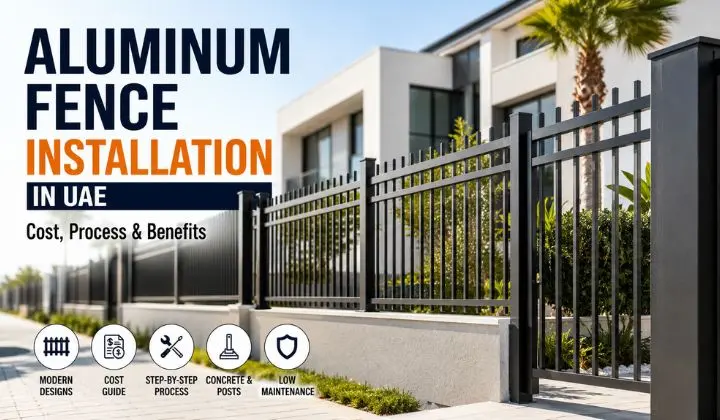
If you want a fence that looks clean, needs little upkeep, and can handle outdoor conditions, aluminum fence installation can be a practical choice for properties in the UAE. Aluminum fencing is used around villas, gardens, pools, offices, warehouses, and other outdoor areas.
The installation is more than simply joining aluminum fence panels together. A good result depends on accurate measurements, proper fence posts, a suitable concrete foundation or anchoring method, correct panel alignment, and well-fitted gates.
This guide explains the aluminum fence installation process, common designs, cost factors, post installation, and options for installing a fence on concrete. It also explains where professional installation can save time and prevent common problems.
Why Choose an Aluminum Fence for Your UAE Property?
One of the main reasons people choose aluminum fencing is its resistance to rust. Unlike ferrous metals, aluminum does not develop the same type of red rust when exposed to moisture.
This can be useful in the UAE, where outdoor fencing may face heat, strong sunlight, humidity, dust, and, in coastal locations, salt exposure.
Corrosion and Rust Resistance
A properly finished aluminum fence can provide good resistance to outdoor exposure. A quality powder-coated aluminum fence adds another protective layer and gives the fence its final appearance.
However, no fence should be treated as completely maintenance-free. Scratches, damaged coating, poor-quality hardware, or unsuitable installation can still create problems over time.
Low Maintenance
Aluminum fence maintenance is generally simple. Regular cleaning can remove dust, sand, and other buildup from the surface.
For most properties, you do not need the same level of painting and rust treatment associated with some traditional metal fences. You should still check the fasteners, hinges, latches, and coating from time to time.
Lightweight and Easy to Handle
Aluminum is lighter than many steel and iron fencing systems. This can make transportation and handling easier during fence installation.
Its lower weight does not mean every aluminum fence is suitable for every application. The fence profile, design, post system, foundation, and intended use all matter.
Suitable for Different Property Types
Aluminum fencing can work with many UAE property styles, including:
- Residential villas
- Gardens and outdoor areas
- Swimming pools
- Commercial buildings
- Offices
- Warehouses
- Property boundaries
- Walkways and entrances
The right design depends on whether your main goal is appearance, privacy, boundary definition, or access control.
Aluminum Fence Designs: Which Style Is Right for Your Property?
Today’s aluminum fence designs range from simple open fences to more decorative and private options. The best choice depends on the style of your property and how much privacy or visibility you need.
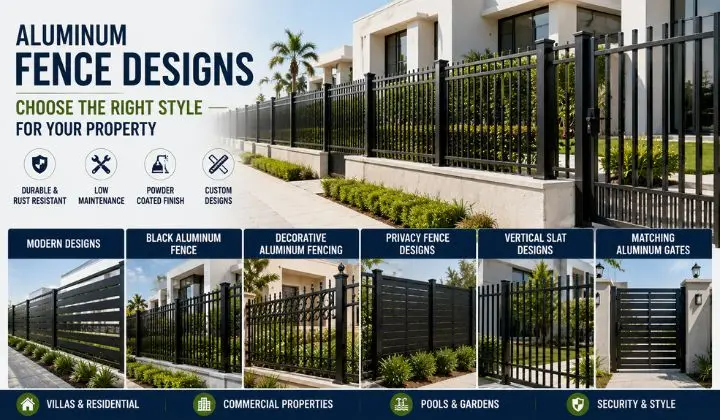
Black Aluminum Fence
A black aluminum fence is a popular choice when you want a clean and modern look. Black works well with many villa exteriors, gardens, walls, and landscaping styles.
It can also give an aluminum fence a more traditional iron-fence appearance without using actual wrought iron.
Modern Aluminum Fence
For modern properties, simple lines and clean profiles can create a neat appearance. Modern aluminum fence designs can include horizontal rails, vertical slats, or other custom layouts.
The design should also consider the location of the fence. A front boundary may need a different appearance from a garden or pool enclosure.
Decorative Aluminum Fence
If appearance is the main priority, decorative aluminum fencing can add more detail to a property entrance or boundary.
Decorative tops, rails, posts, and matching gates can be combined to create a more traditional appearance.
Privacy Aluminum Fence
Open aluminum fences allow air and visibility through the fence. If you need more privacy, you can consider privacy aluminum fence designs with closer or wider solid-style sections.
Keep in mind that more material and a more complex design can affect the overall aluminum fencing cost.
How Much Does Aluminum Fence Installation Cost in UAE?
The aluminum fence installation cost depends on the project rather than one fixed rate. Two properties with the same fence length can have very different installation prices because their designs, ground conditions, gates, and foundations may not be the same.
For this reason, a proper installation quote should be based on the actual site and selected fence system.
What Affects Aluminum Fence Installation Price?
Several factors can change the final aluminum fence installation price:
| Cost factor | Why it matters |
| Fence length | More panels and posts increase material and labor |
| Fence height | Taller systems can require different profiles and support |
| Design | Decorative or custom designs can cost more |
| Gates | Gate size, hardware, and support affect the project |
| Ground conditions | Hard, rocky, or uneven ground can make installation harder |
| Foundation | Different sites may need different foundation methods |
| Slope | Sloped ground requires additional layout and installation planning |
| Custom fabrication | Special sizes, colors, or profiles can increase the price |
| Labor | Installation difficulty affects labor requirements |
What Should Be Included in an Installation Quote?
Before accepting a quote, check whether it clearly covers:
- Aluminum fence materials
- Aluminum fence posts
- Aluminum fence panels
- Gates and gate hardware
- Foundation or anchoring work
- Installation labor
- Finishing requirements
- Removal of old fencing, if needed
- Final inspection and cleanup
A very low quote may not always be the cheapest option if important installation work or materials are left out.
For a reliable aluminum fence installation UAE project, a site inspection is usually more useful than relying on a general online price.
How Does Aluminum Fence Installation Work?
A professional installation normally starts before any post is placed in the ground. The installer first needs to understand the property, measure the fence line, plan the posts, and select the right installation method.
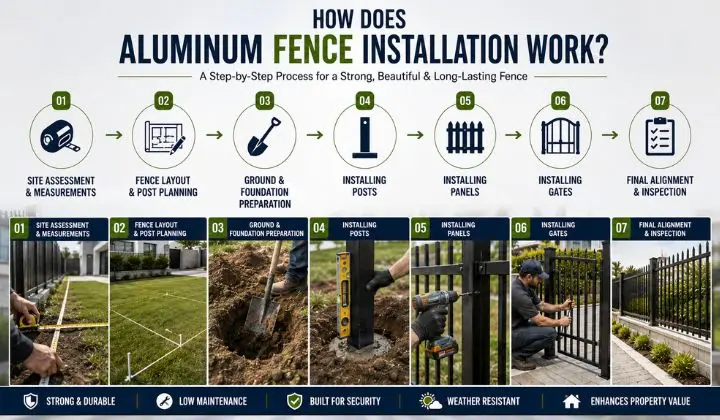
1. Site Assessment and Measurements
The first step is to inspect the installation area and take accurate measurements.
The installer should look for:
- Property boundaries
- Corners and changes in direction
- Existing walls and columns
- Gates and access points
- Landscaping
- Sloped or uneven ground
- Existing concrete
- Potential underground services
Accurate measurements help determine how many fence panels, posts, gates, and other components are needed.
A small measurement error can become a bigger problem when the installer reaches the final section of the fence.
2. Fence Layout and Post Planning
After measuring the area, the fence line is marked and the locations of the line posts, corner posts, end posts, and gate posts are planned.
The layout should allow the panels to follow the property’s actual shape.
This is also the stage where the installer can identify difficult areas. For example, a property may have a sudden slope, a narrow passage, a wall, or an existing concrete surface.
Good planning reduces unnecessary cutting and helps maintain consistent spacing and alignment.
3. Ground and Foundation Preparation
The foundation supports the fence, so this step should not be rushed.
Depending on the property, the installer may need to prepare post holes and use a concrete footing, or use a suitable surface-mounting system where the fence is being installed on existing concrete.
The correct method depends on the fence system, fence height, soil conditions, wind exposure, gate loads, and site requirements.
There is no single foundation method that is suitable for every aluminum fence.
4. Installing Aluminum Fence Posts
Once the locations are prepared, the aluminum fence posts are positioned and secured.
Posts need to be correctly aligned and kept plumb. The installer should repeatedly check the level while setting the posts because a small alignment problem can become obvious when several panels are connected.
Different posts can also have different jobs. Line posts support panels in straight sections, while corner and end posts are used where the fence changes direction or finishes.
Gate posts deserve particular attention because they carry the weight and movement of the gate.
5. Installing Aluminum Fence Panels
After the posts are properly positioned, the aluminum fence panels are connected between them.
Depending on the system, this may involve brackets, screws, fasteners, or other joining components.
The installer checks:
- Panel alignment
- Rail level
- Picket spacing
- Connection points
- Fence height
- Overall appearance
Panels should not simply be installed as quickly as possible. The fence line needs to look consistent from one end to the other.
For properties with changes in elevation, the installer may need rackable panels or a stepped layout. This is discussed in more detail in Part 2.
6. Installing Gates and Hardware
A fence gate needs more than just a panel placed inside an opening.
The installation may include:
- Gate posts
- Hinges
- Latches
- Screws and fasteners
- Gate frame
- Stops or other hardware
The gate should open and close smoothly without rubbing against the ground or fence.
Its final position should also provide enough clearance for normal use.
7. Final Alignment and Inspection
The final step is checking the completed installation.
The installer should inspect:
- Post alignment
- Panel level
- Fence-line consistency
- Gate operation
- Hinges and latches
- Fasteners
- Coating and finish
- Visible installation damage
The work area should also be cleaned once the installation is complete.
A final inspection is important because it gives the property owner a chance to identify small issues before the project is considered finished.
How Are Aluminum Fence Posts Installed?
The aluminum fence post installation method depends on the fence system and the property.
In a typical ground installation, the post locations are marked, suitable holes are prepared, posts are positioned, alignment is checked, and the posts are secured using the specified foundation method.
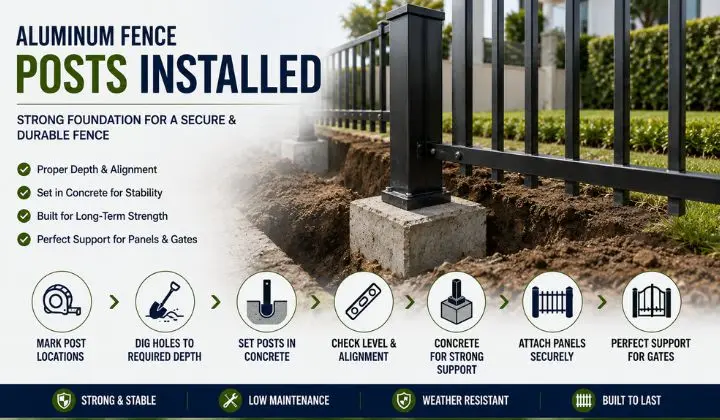
What Types of Aluminum Fence Posts Are Used?
Most fence layouts can include several post types:
- Line posts — used along straight sections
- Corner posts — used where the fence changes direction
- End posts — used where a fence section ends
- Gate posts — support gates and their hardware
Correct post selection is important because each position can have different structural requirements.
How Deep Should an Aluminum Fence Post Be?
There is no single aluminum fence post depth that should be applied to every project.
The required depth and foundation can depend on fence height, post design, soil conditions, wind exposure, gate loads, manufacturer instructions, and local requirements.
For that reason, the installer should follow the specifications for the selected fence system rather than using a random depth found online.
Why Is Post Alignment So Important?
Even good-quality aluminum fencing can look poor if the posts are not aligned correctly.
Posts should be checked for vertical alignment and consistent positioning before the panels are permanently connected. Correct alignment also helps the aluminum fence panels and gates operate as intended.
Should Aluminum Fence Posts Be Set in Concrete?
For many traditional ground-mounted fence installations, aluminum fence posts in concrete are used to create a stable foundation.
However, whether concrete is required depends on the fence system and site conditions.
A proper concrete foundation may be suitable when posts are installed into soil, but the footing design should take into account factors such as fence height, soil, wind exposure, and the loads placed on gate posts.
When Is Concrete Commonly Used?
Concrete can be used to secure buried posts in prepared ground.
The basic process is:
- Mark the post location.
- Prepare the required post hole.
- Position and align the post.
- Check its level.
- Add the specified concrete or foundation material.
- Keep the post correctly positioned while the foundation sets.
The exact installation method should follow the requirements of the selected fence system.
What About Gate Posts?
Gate posts can require extra attention because the gate moves every time it is opened or closed.
A wide or heavy gate can place more load on its posts than a normal fence panel. This is why the gate posts, foundation, hinges, and other gate hardware should be planned together rather than treated as a normal fence section.
Key Things to Check Before Installing an Aluminum Fence
Before the installation starts, a property owner should confirm a few basic points:
- Is the fence line correctly measured?
- Are property boundaries clear?
- Where will the gates be located?
- Is the ground level or sloped?
- Is there existing concrete?
- Are there underground utilities or other obstacles?
- Which aluminum fence design has been selected?
- What foundation method will be used?
- Does the quotation include installation and hardware?
- Are the finish and color clearly specified?
Taking care of these details before installation can prevent expensive changes later.
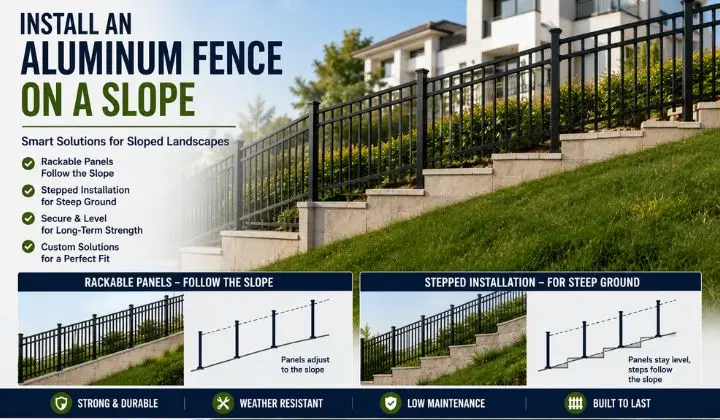
How Do You Install an Aluminum Fence on a Slope?
Installing an aluminum fence on sloped ground needs more planning than installing one on a flat surface. The main challenge is keeping the fence secure while making the panels follow the property’s elevation.
There are two common approaches: rackable aluminum fence panels and stepped fence installation. The right option depends on the fence system, slope, panel design, and the look you want.
Rackable Aluminum Fence Panels
With rackable panels, the panel can follow the angle of the ground instead of staying completely level.
This can create a smoother appearance on a gradual slope because the fence follows the terrain more closely. However, not every aluminum fence system is designed to rack, so the manufacturer’s specifications should be checked first.
Stepped Fence Installation
With a stepped installation, each panel section stays at its own level, creating a series of steps as the ground changes height.
This approach can work well when the slope is more noticeable or when the selected fence panels cannot be racked. The installer needs to plan the changes carefully so the fence does not look uneven or leave unwanted gaps underneath.
Which Method Is Better?
Neither method is automatically better for every property.
The decision should consider:
- Slope angle
- Fence design
- Panel construction
- Required privacy
- Property appearance
- Ground conditions
- Drainage
- Manufacturer requirements
For a complex aluminum fence on a slope, measuring the elevation before ordering materials can prevent expensive changes during installation.
Can You Install an Aluminum Fence Yourself?
Yes, DIY aluminum fence installation is possible for some property owners, especially when the fence line is short, accessible, and mostly level.
Aluminum components are relatively easy to handle because they are lighter than many steel or iron systems. But the physical work should not be underestimated. Digging post holes, moving concrete, keeping posts aligned, and installing gates can become difficult on a large project.
When DIY Installation May Be Practical
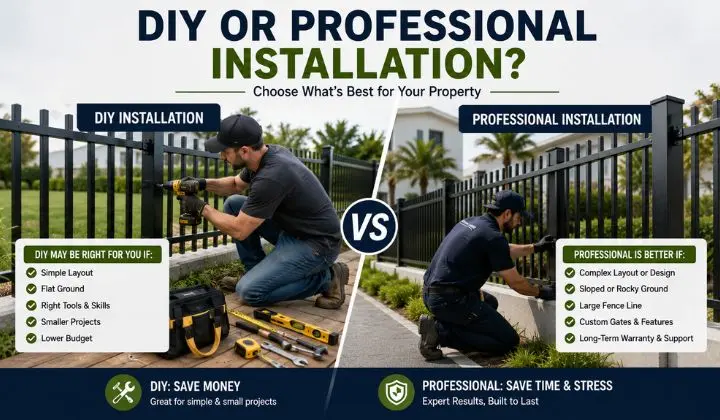
A DIY project may be suitable when:
- The fence layout is simple.
- The ground is easy to dig.
- There are few corners.
- The fence is relatively short.
- There are no major slopes.
- You have basic construction tools.
- You understand how to measure and level posts.
You should also check any applicable property, community, pool, or local requirements before starting.
When Professional Installation Is a Better Choice
Professional fence installation can make more sense when the property has:
- A long fence line
- Steep or uneven terrain
- Hard or rocky soil
- Existing concrete
- Multiple gates
- Complex corners
- Custom fence designs
- Difficult access
A project that looks simple on paper can become much harder once digging and alignment begin.
For example, if a post location contains hard material or roots, changing the layout may affect the position of several panels. An experienced aluminum fence contractor can identify these problems before installation begins.
What Tools Are Needed for DIY Aluminum Fence Installation?
Common aluminum fence installation tools can include:
- Tape measure
- String line and stakes
- Spirit or laser level
- Shovel
- Post-hole digging equipment
- Drill or power driver
- Appropriate cutting tool
- Wrench or socket set
- Concrete-mixing equipment
- Rubber mallet
- Safety gloves and eye protection
The exact tools depend on the fence system and installation method.
What Are the Downsides of Aluminum Fencing?
Aluminum fencing has many advantages, but it is not the perfect material for every situation.
Understanding the disadvantages before buying can help you choose the right fence instead of choosing a material based only on appearance.
Aluminum Is Lighter Than Steel and Iron
The lighter weight makes aluminum easier to handle, but it can also mean that some aluminum systems are less suitable for applications where the fence may face strong physical impact.
For heavy-duty security requirements, steel fencing may be worth considering.
Open Designs Do Not Provide Full Privacy
Traditional aluminum fences often use open rails and pickets. This gives good visibility but does not block people from seeing through the fence.
If privacy is important, consider a privacy aluminum fence or another design with closer or more solid sections.
Custom Designs Can Increase the Price
Basic aluminum fencing can be straightforward, but custom heights, colors, profiles, decorative details, gates, and unusual layouts can increase the overall aluminum fence cost.
This is why it is better to compare complete quotations rather than comparing only the price per panel.
Damage Can Still Happen
Aluminum is resistant to corrosion, but it is not immune to physical damage.
A strong impact can bend or damage a component, and a deep scratch can affect the protective finish. Damaged areas should be inspected and repaired where necessary.
Aluminum vs Steel vs Wrought Iron Fencing
The best fence material depends on what matters most to you: maintenance, appearance, strength, weight, or corrosion resistance.
| Feature | Aluminum | Steel | Wrought Iron |
| Weight | Lightweight | Heavier | Heavy |
| Corrosion resistance | High with suitable finish | Requires suitable protection | Requires regular protection |
| Maintenance | Low | Moderate | Higher |
| Appearance | Modern and decorative | Modern/industrial | Traditional/decorative |
| Handling | Easier | More demanding | More demanding |
| Privacy | Depends on design | Depends on design | Usually open |
| Common use | Villas, gardens, commercial areas | Heavy-duty applications | Decorative/traditional properties |
Aluminum vs Steel Fence
Aluminum vs steel fence comes down to the needs of the property.
Aluminum is attractive when low maintenance, lighter weight, and corrosion resistance are priorities. Steel may be preferred where greater strength and impact resistance are more important.
Aluminum vs Wrought Iron Fence
An aluminum fence vs iron fence comparison often comes down to appearance and maintenance.
Wrought iron fencing can provide a classic, heavy appearance, while aluminum can create a similar decorative look with less weight and generally less maintenance.
For many UAE properties, aluminum is attractive because outdoor exposure can make corrosion protection an important consideration.
How to Maintain an Aluminum Fence in the UAE
An aluminum fence is relatively easy to maintain, but UAE conditions still make regular cleaning worthwhile.
Dust, sand, moisture, strong sunlight, and coastal air can all affect the appearance of an outdoor fence.
Clean Dust and Sand Regularly
Use clean water to remove loose dust and sand from the fence.
For heavier dirt, a mild cleaning solution and a soft cloth or sponge can usually be used. Avoid abrasive tools that could scratch the protective coating.
Inspect the Finish
Check the fence occasionally for:
- Scratches
- Chips
- Impact damage
- Peeling or damaged coating
- Discoloration
- Dirt buildup
A damaged finish should not simply be ignored, especially in locations exposed to moisture or salt.
Check Hardware and Gates
The fence itself may need little attention, but moving components can need more.
Inspect:
- Hinges
- Latches
- Screws
- Brackets
- Gate alignment
- Other gate hardware
A gate that starts rubbing or does not close properly should be adjusted rather than left until the problem becomes worse.
Consider Coastal Exposure
Properties close to the sea may experience higher levels of salt and humidity.
This does not mean aluminum fencing cannot be used in coastal areas. It means the finish, hardware quality, cleaning routine, and overall installation should be selected with the environment in mind.
For more detail about protective finishes and UAE conditions, you can also connect this section to your existing article about powder-coated aluminum fence.
How to Choose an Aluminum Fence Installer in UAE
Choosing the right aluminum fence installer is just as important as choosing the fence itself.
A good fence can still perform poorly if the posts are badly aligned, the foundation is unsuitable, or the gates are incorrectly installed.
Check Previous Installation Work
Ask to see examples of completed projects.
Look for projects similar to yours, especially if you need:
- Villa fencing
- Large boundaries
- Custom gates
- Sloped installations
- Pool fencing
- Decorative designs
- Commercial fencing
Ask About the Installation Method
A professional installer should be able to explain how the fence will be installed on your property.
Ask about:
- Post foundations
- Post spacing
- Concrete or surface mounting
- Panel installation
- Gate support
- Slope solutions
- Finishing
You do not need to be a construction expert. The installer should explain the important decisions in simple terms.
Get a Detailed Quotation
A written fence quotation should make it clear what you are paying for.
Ideally, it should identify the fence design, dimensions, gates, materials, installation work, finish, and any additional site work.
This makes it easier to compare different contractors fairly.
Ask About Warranty and After-Sales Support
Before accepting an installation, ask what is covered by the warranty and who handles problems after completion.
Also ask whether the warranty covers only materials or includes installation-related issues.
Why Choose Vertex Fence for Aluminum Fence Installation?
Vertex Fence provides aluminum fencing solutions for residential and commercial properties in the UAE, including villas, gardens, offices, warehouses, and other outdoor spaces.
The service can include site assessment, custom fabrication, finishing, professional installation, and final inspection, helping property owners manage the project from measurement through completion.
If you are planning a new fence, the best starting point is to have the property assessed so the fence length, design, gates, foundation requirements, and installation method can be properly evaluated.
Frequently Asked Questions
Can an aluminum fence be cut to fit around corners and obstacles?
Yes. Aluminum fence systems can often be adjusted or custom-made to suit corners, walls, pillars, landscaping, and other obstacles. The exact cutting and connection method depends on the fence system, so measurements should be taken before panels are fabricated or installed.
What happens if the ground is too hard to dig for aluminum fence posts?
Hard or rocky ground can make normal post-hole digging difficult. The installer may need suitable digging equipment or a different foundation approach after checking the actual site conditions and the fence system requirements.
Can an aluminum fence be installed between existing walls or columns?
Yes, aluminum panels can sometimes be fitted between existing masonry, concrete columns, or other structures. The installer needs to check the structure first and choose suitable brackets, anchors, posts, and panel dimensions.
What type of aluminum fence is best for a front yard or villa entrance?
The best style depends on the property’s architecture and whether you want visibility, privacy, security, or decoration. Black aluminum fence designs, modern vertical profiles, and decorative fencing can all work well for villa entrances when matched with the right gate.
Do aluminum fence gates need different posts from regular fence panels?
Often, yes. Gate posts carry the weight and movement of the gate, so their foundation and support may need more attention than standard line posts. Gate size, weight, hinges, and opening frequency should all be considered during planning.
What should I check before accepting an aluminum fence installation?
Check that the posts are aligned, panels are level, fasteners are secure, and gates open and close smoothly. Also inspect the coating for visible damage and make sure the finished fence matches the agreed design, dimensions, and quotation.
Conclusion
Aluminum fence installation is not just about choosing attractive panels. The quality of the finished fence depends on the complete system: accurate measurements, suitable posts, a stable foundation, correct panel installation, properly supported gates, and a layout that matches the property’s terrain.
For UAE properties, aluminum can be a strong option when you want a low-maintenance fence, corrosion resistance, and a wide choice of modern or decorative designs. But the right system still depends on your property’s ground conditions, privacy needs, security requirements, and budget.
For a simple project, DIY installation may be possible. For large boundaries, difficult ground, slopes, existing concrete, custom designs, or multiple gates, professional aluminum fence installation UAE can help avoid costly installation mistakes.