
 Fences
 Gates
Gates Signage & Boards
 Car Parking Shades
 Block and Foundation
 Spare Parts
PVC Barrier: Types, Uses & Benefits for Construction in the UAE

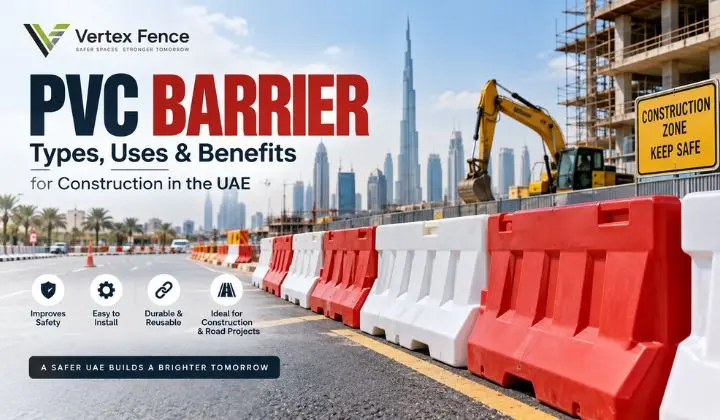
Construction sites and road projects need clear ways to separate workers, vehicles, pedestrians, and dangerous areas. A PVC Barrier is one option used for temporary separation, traffic control, and site safety.
In the UAE, barriers can be found around construction sites, road maintenance areas, excavation zones, parking areas, events, and temporary traffic routes. The right barrier depends on the type of work, traffic conditions, required visibility, and level of protection.
This guide explains the different types of PVC and plastic barriers, their common uses, and what you should check before selecting one for a project.
What Is a PVC Barrier?
A PVC barrier is a safety product made from PVC (Polyvinyl Chloride) or a PVC-based material and designed to create a visible boundary between people, vehicles, equipment, or restricted areas.
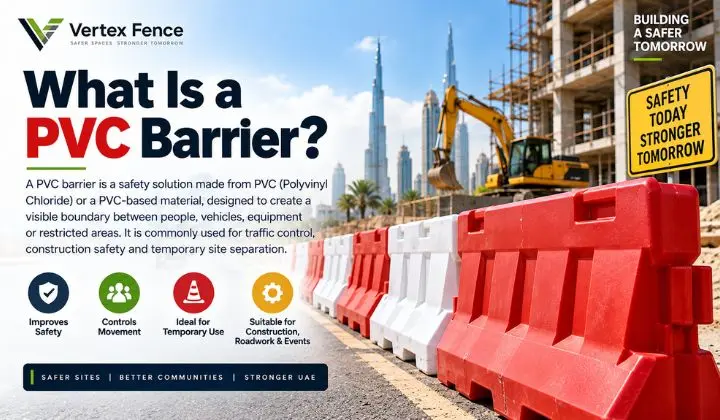
In simple terms, its job is to separate an area and help control movement.
A Plastic Barrier may be used for traffic management, pedestrian safety, construction safety, or temporary access control. Depending on the design, some barriers can be connected together, filled with water, or fitted with reflective features.
One important point is that not every plastic road barrier is made from PVC. HDPE Barrier systems are also common, particularly in temporary traffic applications. Therefore, always check the actual material and technical specification before ordering.
A temporary plastic barrier should also not automatically be treated as a crash barrier. A Crash Barrier is designed and tested for specific vehicle-impact conditions. If a project requires vehicle restraint, the contractor should follow the project specification and use a system tested for that purpose.
What Are the Different Types of PVC Barriers?
PVC and plastic barriers are available in different forms because a road project does not have the same requirements as a construction site, event, or pedestrian area.
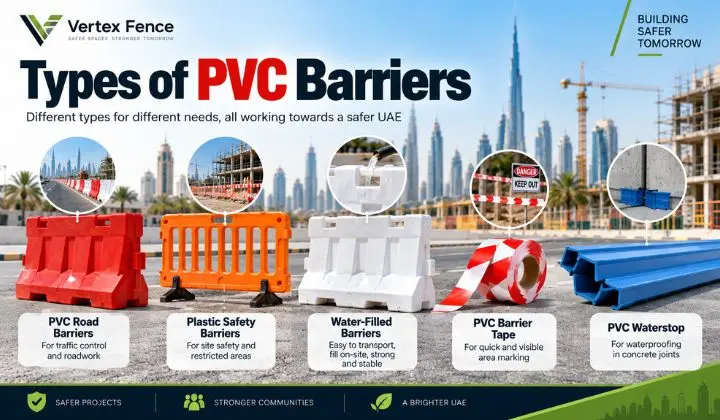
PVC Road Barriers
PVC Road Barriers are used to create a visible boundary around roadwork, maintenance areas, temporary traffic routes, and construction zones.
A PVC Road Barrier can help separate workers from traffic and guide vehicles around a Work Zone.
Many temporary systems are designed to be moved or connected together as the work area changes. This can be useful when road layouts need to change during different stages of a project.
However, the barrier must match the actual risk. A lightweight channelizing barrier should not be used where the project requires a tested vehicle restraint system.
Plastic Safety Barriers
Plastic Safety Barriers are mainly used to mark and separate areas where people or vehicles should not enter.
They can be useful around:
- Construction Zones
- Equipment and machinery
- Maintenance areas
- Restricted sections
- Pedestrian routes
- Temporary access points
- Hazardous work areas
Visibility is important. Bright colours, clear shapes, and Reflective Markings can make a barrier easier to see, especially around roads and outdoor work areas.
A Safety Barrier is most effective when it forms part of a wider site-safety plan that can include signs, lighting, cones, markings, and controlled access.
Water-Filled Road Barriers
Water-filled barriers are hollow units that can be filled with water after they are positioned at the worksite.
The main reason for this design is practical: the empty unit is easier to transport and handle, while water adds ballast after installation.
A Water-Filled Barrier can be used for temporary roadwork, traffic separation, construction areas, and other work-zone applications.
But there is an important distinction:
A water-filled barrier is not automatically a crash barrier.
Some products are designed for channelizing and separation, while specific systems may be engineered and tested for vehicle impact. The required level of protection should always be checked against the product’s testing and project requirements.
PVC Barrier Tape
PVC Barrier Tape is mainly used to warn people and mark a restricted or potentially dangerous area.
For example, it may be placed around a maintenance area, temporary hazard, construction section, or restricted access point.
However, barrier tape provides a visual warning, not strong physical protection.
It cannot stop a vehicle and should not be used as a replacement for a physical barrier where the site requires proper separation from vehicles, machinery, or serious hazards.
PVC Water Barrier / PVC Waterstop
The term PVC Water Barrier can be confusing because it may refer to a completely different construction product.
A PVC Waterstop is used in concrete construction to help control water movement through joints.
It can be installed around Construction Joints and Expansion Joints in structures such as basements, tanks, tunnels, swimming pools, and other areas where preventing water ingress is important.
This is completely different from a water-filled road barrier.
Water-filled road barrier = traffic/site separation.
PVC waterstop = concrete joint waterproofing.
Understanding this difference is important when searching for products or requesting a quotation.
Where Are PVC Barriers Used in the UAE?
PVC and plastic barriers have several practical uses across construction, roadwork, maintenance, and temporary public areas.
Construction Sites
At a Construction Site, barriers can separate workers from vehicles, machinery, stored materials, and active work areas.
For example, a contractor may place temporary barriers around an active work section while keeping a safe route open for workers or visitors.
The purpose is to make the boundary easy to understand and reduce unnecessary access into the work area.
Road Construction and Maintenance
A Road Barrier can help define temporary traffic routes during road construction, repair, or maintenance.
Barriers may be used together with traffic signs, cones, road markings, warning lights, and other Traffic Control measures.
This creates a clearer route for drivers while helping workers maintain a defined working area.
The exact barrier required depends on factors such as vehicle speed, traffic volume, road design, and the level of protection required.
Excavation and Work Zones
Excavation creates an obvious need for controlled access.
A barrier can help identify an Excavation Area and keep pedestrians and vehicles away from the edge.
However, a temporary barrier is only one part of excavation safety. Depending on the site, additional measures such as proper access, warning signs, edge protection, lighting, and excavation controls may be required.
Pedestrian Routes
Construction projects often affect existing footpaths and access routes.
A Pedestrian Barrier can help separate people from machinery, vehicles, or active construction work.
For example, a contractor may create a temporary walking route around a building project while keeping pedestrians away from the main construction area.
The barrier should be positioned so that the route remains clear and does not create unnecessary trip or access problems.
Traffic Management
Temporary barriers are also used as part of Traffic Management plans.
They can help separate traffic lanes, guide vehicles, close off sections of a road, or define a temporary work area.
For larger road projects, barriers should be selected according to the complete traffic-control plan rather than being placed based only on appearance or price.
Events and Crowd Control
Plastic barriers can also be useful for Crowd Control at events, exhibitions, festivals, sporting activities, and temporary venues.
They can define entrances, walking routes, restricted areas, service sections, or temporary queues.
In these situations, the main goal is usually controlling pedestrian movement, rather than providing vehicle-impact protection.
Parking and Access Areas
Barriers can also be placed around parking areas, loading zones, service entrances, and temporary restricted-access locations.
They provide a clear physical boundary without requiring a permanent structure.
This makes temporary barriers useful when the layout of an area may change later.
What Are the Benefits of PVC Barriers?
The main practical benefit of many PVC and plastic barriers is flexibility. They can be used where a temporary boundary is needed without installing a permanent structure.
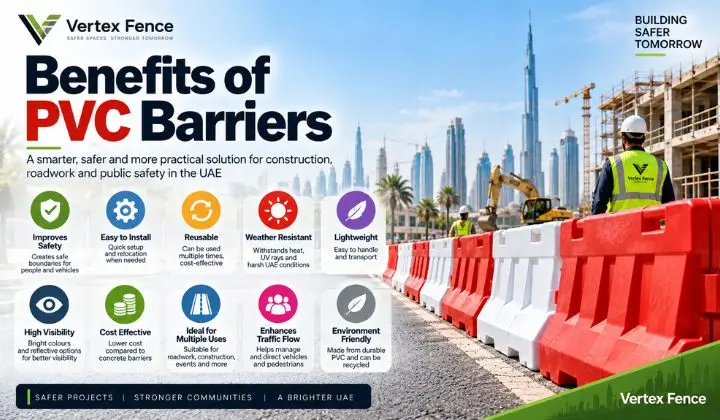
High Visibility
A barrier needs to be noticed before it can provide useful separation.
Bright colours, clear designs, and Reflective Markings can make barriers easier for drivers, workers, and pedestrians to identify.
This is particularly useful around roadwork and construction areas.
Lightweight Handling
Many plastic barriers are easier to transport and reposition than heavy concrete barriers.
This can be useful when a work area changes regularly.
For contractors handling multiple Construction Projects in UAE, easier handling can also simplify temporary site arrangements.
Easy Repositioning
Construction and roadwork layouts are not always fixed.
A temporary barrier can be moved when the working area, pedestrian route, or traffic arrangement changes.
This makes portable systems useful for maintenance projects, temporary roadwork, events, and changing construction zones.
Resistance to Outdoor Conditions
Outdoor barriers may be exposed to sunlight, moisture, dust, heat, and changing weather conditions.
The actual performance depends on the material and product design. Therefore, buyers should check the manufacturer’s specifications for UV resistance, temperature range, and intended outdoor use rather than assuming every plastic barrier has identical performance.
Reusable
Some temporary barriers can be reused at different locations or during different stages of a project.
This can be useful for contractors who regularly manage Roadwork, construction areas, traffic control, or temporary access routes.
Easy Temporary Deployment
Water-filled designs can be transported while empty and filled after being positioned.
This can reduce the handling difficulty associated with moving very heavy solid barriers before installation.
The exact handling requirements still depend on the product’s design and manufacturer instructions.
Flexible Applications
A plastic barrier can support several types of site control, including Vehicle Separation, pedestrian routing, restricted access, and temporary traffic guidance.
The important point is to select a barrier designed for the specific job rather than assuming one barrier type can handle every safety requirement.
Reflective and Custom Options
Depending on the product, barriers may be available with different colours, reflective strips, connection systems, or other project-specific features.
When ordering in bulk, ask the supplier about available Product Specifications, sizes, colours, connection methods, and customization options.
PVC Barrier vs Other Safety Barriers
PVC and plastic barriers are only one option. Other barrier systems serve different purposes.
PVC or Plastic Barrier vs HDPE Barrier
An HDPE Barrier is another type of plastic barrier commonly used for temporary traffic and work-zone applications.
The choice should be based on the actual product specifications, including dimensions, weight, ballast system, connections, durability, and intended application.
Simply choosing a product because it is called “plastic” does not tell you how it will perform.
PVC Barrier vs Concrete Road Barrier
A Concrete Road Barrier is much heavier and provides a different type of physical separation.
Its weight can make it difficult to move, but that same mass can be useful in applications where substantial physical separation is required.
A lightweight plastic barrier should not be treated as a direct replacement when a project specification calls for a concrete barrier.
PVC Barrier vs Jersey Barrier
A traditional Jersey Barrier is commonly associated with concrete or other rigid systems used for vehicle separation.
The term PVC Jersey Barrier may be used for plastic products with a similar shape, but the name alone does not mean that the product provides the same impact performance as a concrete Jersey barrier.
Always check the manufacturer’s specifications and testing information.
PVC Barrier vs Metal or Crash Barrier
A Metal Barrier or Crash Barrier is generally used when vehicle restraint or impact performance is required.
These systems are designed around specific performance requirements.
Therefore, if your project requires a crashworthy system, do not select a basic plastic barrier simply because it looks similar. Check the required testing, installation method, and project specification first.
PVC Barrier vs Bollard
A Bollard and a barrier serve different purposes.
A bollard usually provides protection at a specific point, such as a building entrance, doorway, pedestrian area, or vehicle-access point.
A barrier creates a longer line of separation.
Bollard = point protection
Barrier = line or area separation
The correct choice depends on what you need to protect and how people or vehicles move around the site.
What Sizes and Specifications Should You Consider?
There is no single Plastic Barrier Size that suits every project. The right dimensions depend on the application, available space, traffic conditions, stability requirements, and how the barrier will be installed.
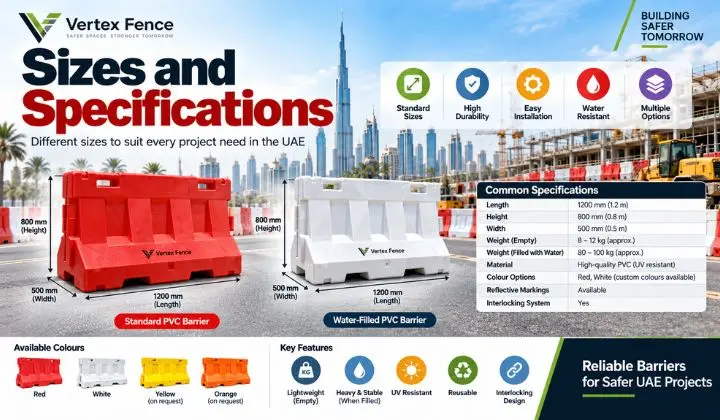
Before ordering, check these specifications carefully.
Length, Width and Height
Start with the basic Barrier Dimensions.
The length tells you how much area one unit can cover. The width of the base affects how much space the barrier takes up, while Barrier Height affects visibility and separation.
For road projects, also consider the available road width. A barrier should provide the required separation without unnecessarily reducing the usable route.
Weight and Water Capacity
If you are choosing a water-filled system, check both the empty and filled Barrier Weight.
You should also check its Water Capacity because this determines how much ballast can be added.
Two barriers can have similar external dimensions but very different weights and stability once filled. This is why product specifications matter more than appearance.
Stability
Barrier Stability depends on more than weight.
The base design, surface condition, ballast, connections, wind, traffic movement, and installation method can all affect performance.
For a normal pedestrian or site-separation application, stability requirements may be different from those for a road project. If the barrier is expected to withstand vehicle impact, use a system that has been tested for the required application.
Interlocking System
An Interlocking Barrier can connect individual units to create a continuous line.
This can be useful for long construction sites and roadwork because connected units can provide a more organized boundary.
Before ordering, check how the units connect and whether the connection system is suitable for the intended application.
Reflective Markings
Reflective Markings can make a barrier easier to see in low-light conditions.
For roadwork and areas close to traffic, visibility should be considered alongside warning signs, lighting, cones, and other traffic-control measures.
Ask the supplier whether reflective strips or other visibility features are included as standard or available as an option.
How Much Does a PVC Barrier Cost in the UAE?
The PVC Barrier Cost depends on the product design and project requirements.
There is no single price that applies to every PVC or plastic barrier in the UAE. A small lightweight barrier and a heavy-duty water-filled road barrier can have very different prices.
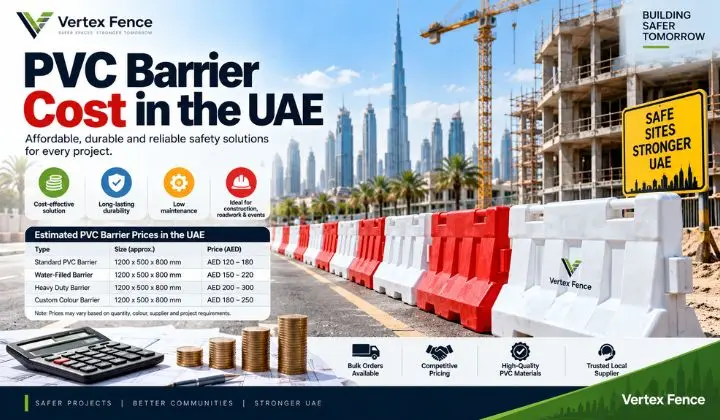
When comparing the Plastic Road Barrier Price in UAE, consider the following:
- Material
- Length and dimensions
- Height and base size
- Empty weight
- Water capacity
- Interlocking system
- Reflective features
- Quantity required
- Customization
- Accessories
- Delivery location
- Installation requirements
For example, a barrier designed for simple pedestrian separation may have very different specifications from a system intended for temporary traffic management.
If you are requesting a PVC Barrier Price, give the supplier your project details instead of asking only for a unit price. This allows you to compare products based on the same requirements.
For large construction or infrastructure projects, bulk quantities may also affect the quotation.
PVC Water Barrier vs Water-Filled Barrier: What’s the Difference?
These two terms are sometimes mixed together, but they can describe different products.
Understanding the difference can prevent you from ordering the wrong item.
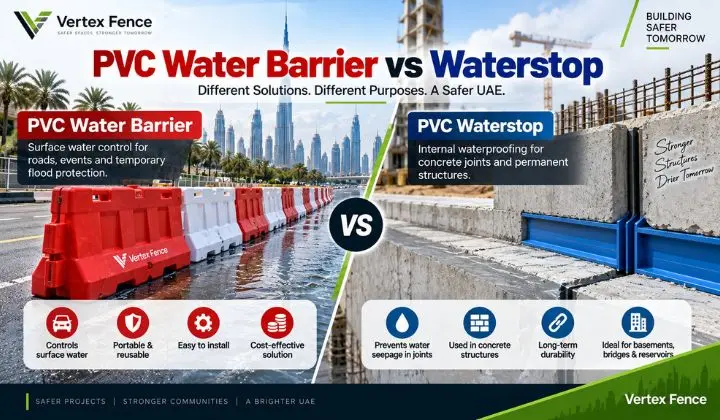
Water-Filled Road Barrier
A water-filled road barrier is a hollow plastic unit designed to be filled with water after it is positioned.
Its main uses can include:
- Temporary traffic separation
- Road maintenance
- Construction work zones
- Pedestrian separation
- Temporary access control
The water adds ballast and makes the unit heavier after installation.
However, not every water-filled barrier is designed to withstand vehicle impact. If a project requires crash protection, check whether the Water-Filled Barrier has the required testing and approval.
PVC Waterstop
A PVC Waterstop serves a completely different purpose.
It is installed in concrete structures to help prevent water from passing through joints.
It may be used in:
- Basements
- Water tanks
- Tunnels
- Swimming pools
- Reservoirs
- Concrete foundations
- Other waterproofing applications
The product works around a Construction Joint or Expansion Joint to control water movement through the concrete joint.
So the difference is simple:
| Product | Main purpose |
| Water-filled road barrier | Traffic and site separation |
| PVC waterstop | Concrete joint waterproofing |
If you are looking for a barrier for roadwork, you need a road-safety product. If your project needs protection against water ingress through concrete joints, you need an appropriate waterstop system.
How to Choose the Right PVC Barrier for Your Project
The best way to choose a barrier is to start with the job it needs to perform.
Use this checklist before ordering.
1. Identify the Main Purpose
First ask why you need the barrier.
Is it for Traffic Control, pedestrian separation, construction safety, crowd control, restricted access, or road maintenance?
A clear answer makes it easier to select the correct product.
2. Check Traffic Conditions
If vehicles will operate near the barrier, look at:
- Vehicle speed
- Traffic direction
- Vehicle types
- Traffic volume
- Road width
- Distance between vehicles and workers
If vehicle impact protection is required, make sure the selected system is actually designed and tested for that purpose.
3. Consider Pedestrian Movement
If pedestrians will pass near the barrier, provide a clear and practical route.
The barrier should not create unnecessary obstacles, narrow passages, or trip hazards.
For busy public areas, think about how people will enter, exit, turn, and move around the work zone.
4. Check the Required Size
Review the Barrier Dimensions before ordering.
Check:
- Length
- Width
- Height
- Base size
- Empty weight
- Filled weight
- Water capacity
For a long boundary, calculate the number of units required based on the actual effective length of each connected barrier.
5. Check Stability
Consider the surface where the barrier will be installed.
A barrier placed on a flat, stable surface may behave differently from one placed on uneven ground or an exposed outdoor area.
Wind and vehicle movement should also be considered where relevant.
6. Consider Visibility
A barrier should be easy to identify.
Look for suitable colours, clear design, and Reflective Markings where needed.
On roads and busy construction sites, visibility should be part of the overall Traffic Management plan.
7. Check Outdoor Conditions
UAE projects can expose products to strong sunlight, heat, dust, and moisture.
Ask the supplier about the material’s suitability for the intended outdoor environment.
Instead of accepting a general claim such as “weather resistant,” ask for actual product information covering UV exposure, temperature, and outdoor use.
8. Check Installation and Connections
Find out whether the units need:
- Water filling
- Sand or another approved ballast
- Special connectors
- Anchoring
- Accessories
- Specific positioning
For an Interlocking Barrier, understand how the connection works before ordering a large quantity.
9. Consider Project Duration
For short-term roadwork, a temporary barrier may be enough.
For a long project, think about repeated handling, storage, cleaning, maintenance, and the number of times the barrier may be relocated.
10. Choose the Right Supplier
When searching for a PVC Barrier Supplier, Plastic Barrier Supplier in UAE, or Road Barrier Supplier UAE, do not compare suppliers only by price.
Ask for:
- Material details
- Product dimensions
- Weight
- Water capacity
- Connection method
- Reflective options
- Intended application
- Available quantities
- Delivery information
If you are comparing Road Barriers Suppliers in UAE, request specifications for the same type of product from each supplier. This makes the comparison much more useful.
For larger projects, you may also look for a Road Barrier Manufacturer that can provide the required quantity and technical information.
Common PVC Barrier Selection Mistakes
Choosing the wrong barrier can create safety and project problems. These are some common mistakes to avoid.
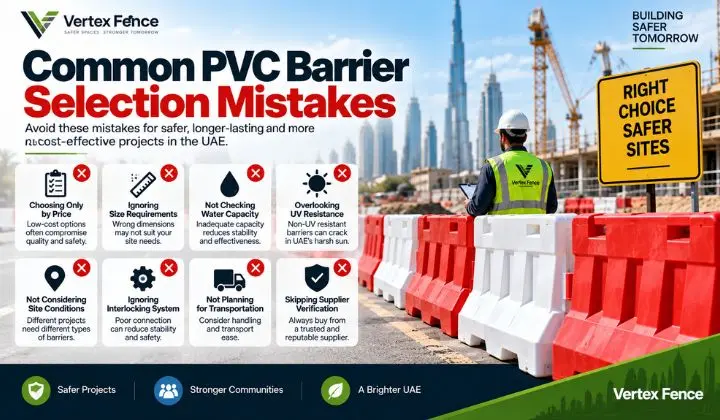
Choosing Only by Price
Price is important, but it should not be the only factor.
A cheaper barrier may have different dimensions, lower weight, fewer visibility features, or a different intended application.
Compare the full specification, not just the quotation.
Confusing a Safety Barrier With a Crash Barrier
A barrier can look strong without being designed for vehicle impact.
If the project requires crash protection, check the relevant testing, installation conditions, and project specification.
Using Barrier Tape for a Serious Hazard
PVC Barrier Tape can warn people that an area is restricted, but it does not provide strong physical separation.
If people or vehicles must be kept away from a dangerous area, a suitable physical barrier may be required.
Ignoring Barrier Connections
If multiple units are being installed together, the connection system matters.
Poorly connected units may not provide the intended continuous boundary.
Always follow the manufacturer’s installation instructions.
Ignoring Site Conditions
A barrier suitable for an indoor event may not be suitable for an exposed road project.
Consider sunlight, heat, wind, surface condition, vehicle movement, and expected project duration.
Buying Without Checking Specifications
Do not select a product only from a photograph.
Before placing an order, confirm Barrier Height, length, width, weight, water capacity, material, connection method, and intended use.
Frequently Asked Questions
Can a PVC barrier be used instead of a concrete barrier?
It depends on the application and required level of protection. A plastic barrier can be suitable for temporary separation and traffic management, but it should not replace a specified concrete or crashworthy barrier unless it meets the project’s required performance criteria.
What is the difference between a PVC barrier and a bollard?
A PVC barrier normally creates a longer line of separation between people, vehicles, or areas. A bollard usually protects a specific point, such as a doorway, building edge, pedestrian area, or vehicle-access point.
Are water-filled plastic barriers suitable for every roadwork project?
No. Their suitability depends on the road layout, traffic conditions, required protection, and product specification. Some water-filled barriers are intended for channelizing, while other systems may have been specifically tested for vehicle-impact performance.
Can PVC barrier tape replace a physical safety barrier?
No. Barrier tape mainly provides a visual warning and marks a restricted area. It does not provide the physical protection or separation offered by a proper barrier, so higher-risk areas may require a suitable physical safety system.
What should I check before ordering plastic barriers for a UAE project?
Check the material, dimensions, height, weight, ballast capacity, connection method, visibility features, outdoor suitability, and intended use. For road projects, also confirm whether the product meets the testing, approval, and installation requirements of the specific project.
Conclusion
A PVC Barrier can be a useful solution for temporary Construction Safety, roadwork, pedestrian separation, traffic management, restricted areas, and other projects where a clear physical boundary is needed.
But choosing the right barrier is more important than simply choosing the cheapest option.
Before buying, consider the application, traffic conditions, barrier dimensions, stability, visibility, material, installation method, outdoor conditions, and required protection level.
Also remember the difference between a water-filled road barrier and a PVC waterstop. One is used for traffic and site separation, while the other is used for concrete waterproofing.
If you are sourcing barriers for a UAE construction or infrastructure project, Vertex Fence can be included in your supplier comparison. Ask for the relevant product specifications, available sizes, quantity-based pricing, and recommended application before placing your order.
The right barrier is not simply the one that looks strong. It is the one that is designed for the job, suitable for the site, correctly installed, and able to provide the level of separation or protection your project requires.