
 Fences
 Gates
Gates Signage & Boards
 Car Parking Shades
 Block and Foundation
 Spare Parts
PPGI Temporary Fence vs Site Hoarding: Best for UAE Sites

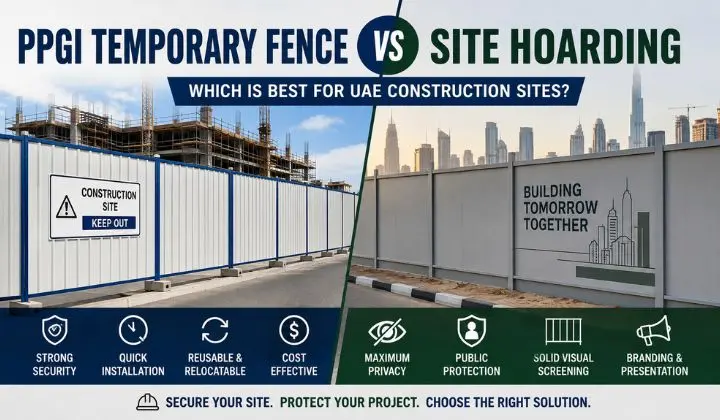
A construction site needs more than a simple boundary. The right construction site fencing helps separate the work area from the public, control access, protect equipment, and improve overall site security. In the UAE, the choice also needs to consider heat, UV exposure, humidity, corrosion, wind, and the layout of the project.
Two common options are PPGI temporary fencing and site hoarding. They may look similar because both can create a solid perimeter, but they are not always used for the same purpose.
A PPGI temporary fence is a modular system made from pre-painted galvanized steel panels, usually supported by a frame, bases, clamps, and gates. It is useful when a contractor needs a strong boundary that can be installed, removed, relocated, and reused.
Site hoarding is generally a solid temporary enclosure designed to provide stronger visual privacy, site screening, and separation from public areas. It is often considered for projects where people can easily see or approach the construction area.
So, which one is better?
There is no single answer for every project. The better option depends on project duration, public exposure, security requirements, privacy, wind conditions, site layout, installation needs, and long-term reuse.
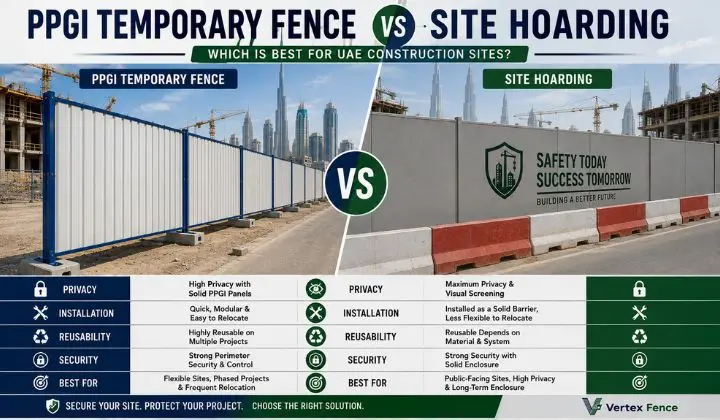
PPGI Temporary Fence vs Site Hoarding
A PPGI temporary fence is usually the better choice when a project needs a modular, reusable, and relocatable perimeter. It can work well when the site layout changes during different construction phases.
Site hoarding is often the better choice when the main priority is a solid visual barrier, stronger privacy, public separation, or a more enclosed appearance around a busy construction site.
| Factor | PPGI Temporary Fence | Site Hoarding |
| Privacy | High with solid PPGI panels | High |
| Security | Strong perimeter control | Strong perimeter control |
| Installation | Generally quick | Depends on system |
| Relocation | Easy with a modular system | Less flexible in fixed systems |
| Reusability | High | Depends on the system |
| Public screening | Good | Excellent |
| Project changes | Very suitable | Better for planned layouts |
| Wind consideration | Important | Very important for solid panels |
| Long-term value | Strong when reused | Strong for long-duration enclosure |
| Best use | Flexible construction sites | Privacy-focused or public-facing sites |
The key point is simple: do not choose a fence only because its initial price looks lower. Look at the complete system and how it will perform during the whole project.
What Is a PPGI Temporary Fence?
A PPGI temporary fence is a portable fencing system made with pre-painted galvanized steel panels. PPGI stands for Pre-Painted Galvanized Iron, although the actual steel specification can vary between manufacturers.
The galvanized layer helps protect the steel from corrosion, while the paint or protective finish provides an additional surface layer. This makes PPGI panels suitable for many outdoor applications when the correct specification is selected.
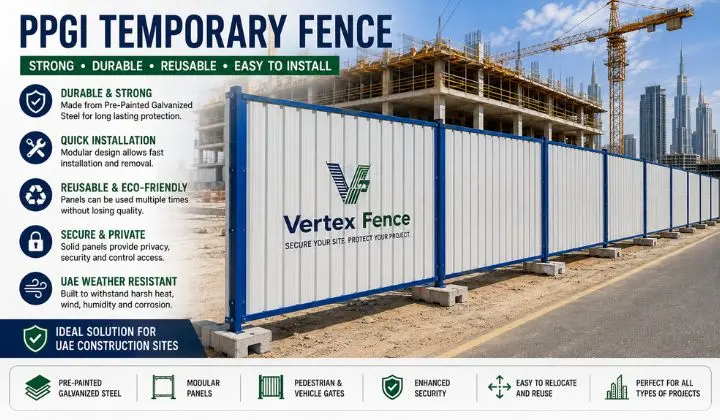
A typical system can include:
- PPGI fence panels
- galvanized steel frame
- support pipes or posts
- concrete or steel bases
- fence clamps or couplers
- pedestrian gates
- vehicle gates
- bracing or stabilizers where needed
This makes the fence more than just a sheet of steel. It is a complete temporary site enclosure.
Why Is PPGI Used for Temporary Construction Fencing?
Construction projects often change as work moves from excavation to structure, external works, services, and finishing. A fixed perimeter may not be practical for every stage.
A modular PPGI system can be relocated, extended, or reconfigured as the site changes. This can be useful for contractors who manage several construction phases or want to use the same panels on future projects.
The solid surface can also provide visual privacy. People outside the site cannot see through the panels in the same way they can see through open mesh fencing.
For UAE projects, the finish and material specification also matter. A suitable protective coating, galvanized steel construction, and proper maintenance can help the panels handle outdoor exposure.
What Is Site Hoarding?
Site hoarding is a solid temporary barrier used around construction, demolition, renovation, and development sites. Its main purpose is to create a controlled perimeter while limiting visibility into the work area.
Unlike open mesh fencing, solid hoarding can act as a visual barrier between the construction site and surrounding roads, properties, workers, and pedestrians.
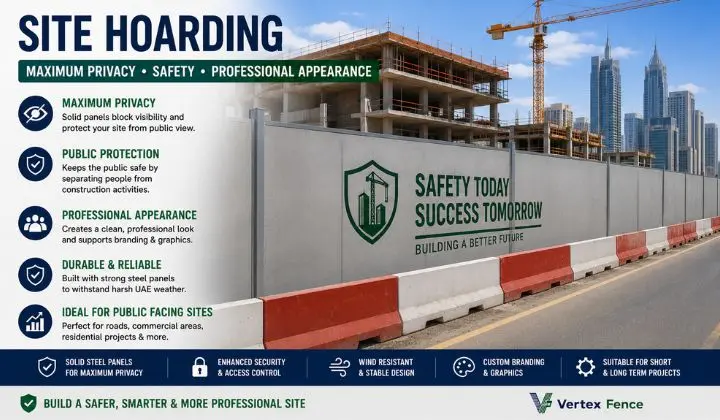
A hoarding system may use steel panels, timber, composite materials, or other suitable boards depending on the project.
For this article, the focus is on steel-based hoarding because it is closely related to PPGI temporary fencing.
A typical steel hoarding system may include:
- steel hoarding panels
- vertical supports or frames
- bases or foundations
- bracing
- clamps or connecting components
- pedestrian gates
- vehicle gates
- stabilizers
- ground skirts or infills
The exact system should be selected according to the site conditions rather than assuming that every hoarding system has the same strength or installation method.
PPGI Temporary Fence vs Site Hoarding: Key Differences
The biggest mistake is to compare these systems only by their panel material.
The real comparison is about how the complete perimeter system works on the construction site.
Privacy and Visual Screening
Privacy is one of the clearest differences between open fencing and solid enclosure systems.
A solid PPGI panel blocks direct views into the construction area. This can help hide unfinished structures, stored materials, equipment, and other work activities from people outside the site.
This makes solid panels useful when construction site privacy, appearance, and visual screening are important.
Site hoarding also provides a solid barrier. In many projects, its purpose is not only to keep people out but also to prevent the public from seeing what is happening inside.
This can be useful for:
- busy urban projects
- residential developments
- commercial developments
- public-facing construction sites
- sites beside pedestrian routes
- projects where branding or project information is displayed
If the project only needs a basic boundary and visibility through the fence is useful for security or site supervision, open mesh fencing can sometimes be considered instead. But when privacy is a priority, a solid system has a clear advantage.
Security and Access Control
Both PPGI temporary fencing and site hoarding can provide perimeter security, but the final security level depends on the complete installation.
A strong perimeter should control:
- who can enter
- where people can enter
- where vehicles can enter
- how gates are locked
- whether panels can be moved or lifted
- how the system is supported
A temporary fence can be fitted with security gates, pedestrian gates, and vehicle gates to create controlled entry points.
The same applies to site hoarding. Properly planned gates can help separate pedestrian and vehicle movement and reduce uncontrolled access.
Solid panels can also reduce the visibility of valuable equipment and materials from outside the site. This does not make theft impossible, but reducing visibility can remove an easy view of what is available inside.
For better access control, the gate system, locks, panel connections, and base arrangement should be considered together rather than judging security from the panel alone.
Installation, Removal and Relocation
One of the main advantages of a modular temporary fence is flexibility.
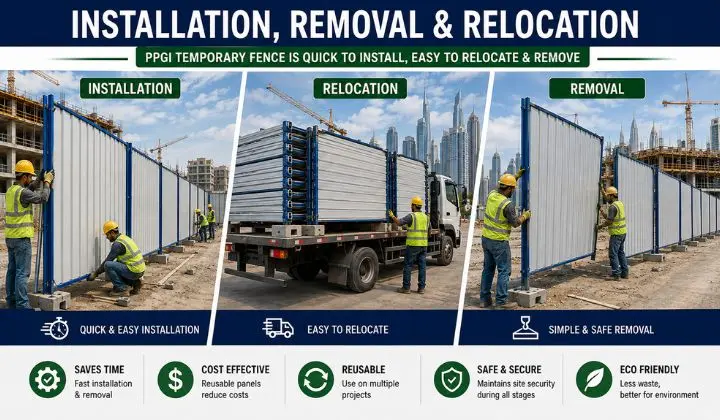
Panels can normally be connected using fence clamps, couplers, bases, and other supporting components. This allows the perimeter to be installed without treating every section as a permanent wall.
That matters when a construction site changes shape.
For example, a contractor may need to:
- open a new vehicle entrance
- close an old access point
- move the fence after excavation
- expand the working area
- reduce the perimeter during later phases
A modular system can make these changes easier.
Site hoarding can also be temporary and modular, but the installation method varies. Some systems use freestanding or ballasted supports, while others require more fixed supports or foundations.
Therefore, when comparing installation time, ask:
Is the hoarding freestanding, ballasted, or fixed into the ground?
The answer can make a major difference to installation, removal, and relocation.
Durability and UAE Weather
UAE construction sites can face intense sunlight, high temperatures, humidity, dust, and strong winds. These conditions make material selection and installation quality important.
Galvanized steel provides corrosion protection, while a suitable coating can add another layer of protection. However, no coating removes the need for proper inspection and maintenance.
Wind is especially important when using solid panels.
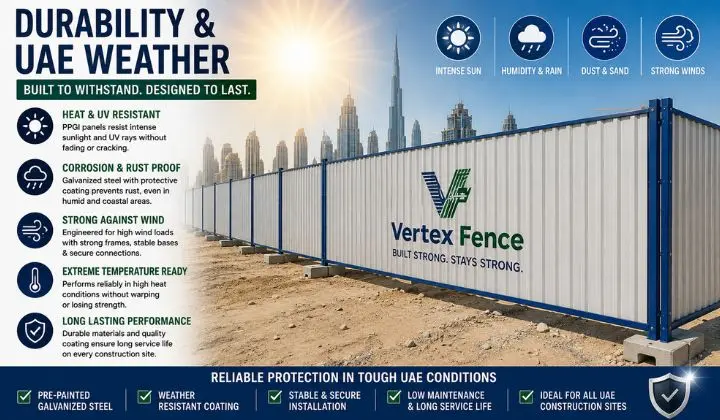
A solid fence catches more wind than an open mesh panel because there are fewer openings for air to pass through. This creates additional pressure on:
- panels
- frames
- bases
- clamps
- supports
- bracing
- stabilizers
For exposed sites, the fencing system should be designed and installed with the expected wind load and site conditions in mind.
This is particularly important for large solid enclosures, corner sections, gates, and areas where the ground does not provide a strong foundation.
A strong panel alone is not enough. The support system is part of the fence’s performance.
Reusability and Long-Term Value
A major reason contractors choose temporary fencing is the ability to use the system again.
A modular PPGI fence can potentially be:
installed → dismantled → stored → transported → reinstalled
This makes reusable temporary fencing useful for contractors handling multiple projects.
For example, a company working on several residential developments may move the same fencing panels from one completed site to another.
However, reuse depends on proper handling. Panels should be inspected after removal for:
- bent frames
- damaged sheets
- loose connections
- corrosion
- damaged bases
- damaged clamps
- coating damage
Good storage also matters. Panels should be protected from unnecessary damage and stacked safely.
This is where lifecycle cost becomes more useful than simply looking at the original purchase price.
A fence that costs slightly more initially may provide better value if it can be reused across several projects with limited replacement and maintenance costs.
What Matters More Than the Panel?
When comparing PPGI temporary fencing with site hoarding, it is easy to focus on the visible panel.
But the panel is only one part of the system.
A reliable temporary perimeter also depends on:
Panel + frame + base + connection + gate + support + installation
For example, a strong steel panel installed with weak supports may still become unstable during strong winds.
Likewise, a good panel with poorly connected sections can create gaps in the perimeter.
Before selecting a system, contractors should therefore look at the complete construction fence panels and support arrangement, not just the sheet material.
This approach gives a more realistic view of safety, performance, and value.
Which Is Better for Your UAE Construction Project: PPGI Temporary Fence or Site Hoarding?
There is no single option that is best for every construction site. The right choice depends on what the perimeter needs to do throughout the project.
Before ordering, consider five things: project duration, public exposure, privacy, site changes, and wind conditions.
Choose PPGI Temporary Fence When
A PPGI temporary fence can be a good fit when the site needs a flexible and reusable perimeter.
It is especially useful when:
- The site layout will change during construction.
- Fence panels may need regular relocation.
- The contractor wants to reuse panels on future projects.
- Quick installation and removal are important.
- Different access points may be needed as work progresses.
- The project needs a solid panel but does not require a more fixed hoarding arrangement.
For example, a large residential development may have different working zones during excavation, structural work, and external works. A modular fencing system can be moved as these areas change.
The key benefit is flexibility. Instead of treating the perimeter as a permanent structure, the contractor can adjust it as the project develops.
Choose Site Hoarding When
Site hoarding may be more suitable when the main requirement is a strong, continuous visual barrier.
It can be a better choice when:
- The site is beside a busy road or pedestrian route.
- The public should not be able to see the construction activity.
- Strong visual privacy is required.
- The project needs a more enclosed appearance.
- Branding, notices, or project information will be displayed.
- The perimeter is expected to remain in a planned configuration for a longer period.
Solid hoarding can also help separate the public from construction activities, materials, equipment, and other hazards.
However, solid panels should not be selected without considering wind. A continuous barrier can experience significant wind pressure, so the support system, ballast, bracing, and site conditions need proper attention.
Consider a Hybrid Solution When
You do not always have to use one fencing type around the entire project.
A hybrid temporary fencing approach can make sense when different areas have different requirements.
For example:
- Solid PPGI hoarding can be used along a public-facing road.
- More flexible temporary fencing can be used around an internal work area.
- A stronger enclosure can be installed around valuable equipment.
- Temporary panels can be used around areas that will change frequently.
This approach can reduce unnecessary costs while still providing the required security, privacy, and access control in higher-priority areas.
The important point is to design the perimeter around the site’s actual risks rather than applying the same solution everywhere.
PPGI Temporary Fence vs Site Hoarding Price and Cost in UAE
One of the most common questions is:
Which option costs less?
The answer is not as simple as comparing two panel prices.
The price of a panel is only one part of the total project cost. A proper comparison should include the complete system and all services required to install, operate, move, and remove it.
A basic cost calculation can include:
Panels + supports + bases + gates + delivery + installation + maintenance + relocation + removal
The final amount depends on the project specification.
What Affects PPGI Temporary Fence Cost?
Several factors can change the cost of PPGI temporary fencing.
Panel Size and Thickness
Larger or heavier panels can require more material and stronger supporting components.
The required panel thickness, height, width, and frame specification should therefore be confirmed before comparing supplier quotations.
Perimeter Length
A 100-metre perimeter will obviously require fewer panels and supports than a 1,000-metre perimeter.
The number of corners, gates, changes in direction, and access points can also affect the total quantity.
Bases and Support System
The quotation should clearly state whether bases, concrete blocks, steel supports, clamps, stabilizers, or other components are included.
A low panel price may not represent a low installed cost if important support components are charged separately.
Gates and Access Points
A construction project normally needs controlled access for both people and vehicles.
Pedestrian gates and vehicle gates add to the overall system cost, particularly when heavy-duty or security-focused access is required.
Installation and Removal
Some suppliers quote for supply only, while others include installation.
These should not be compared as equal offers.
Ask whether the quotation includes:
- Delivery
- Installation
- Gate installation
- Relocation
- Dismantling
- Final removal
Rental vs Purchase
For a short project, temporary fence rental may make more sense than purchasing the complete system.
For contractors working across several projects, purchasing reusable panels can provide better long-term value.
The right decision depends on project duration, storage availability, future use, and the expected number of deployments.
What Affects Site Hoarding Cost?
Site hoarding cost depends on similar factors but can also involve additional requirements based on the installation method.
Consider:
- Hoarding panel material
- Height
- Thickness
- Support structure
- Ground fixing or ballast
- Bracing
- Gates
- Installation
- Delivery
- Removal
- Surface preparation
- Branding or custom finishes
A solid hoarding system may also need additional wind protection depending on its height, location, exposure, and support arrangement.
This is why two projects using apparently similar hoarding panels can have very different final costs.
Price vs Total Project Cost vs Lifecycle Cost
These three terms should not be confused.
Price is what you pay for the product.
Total project cost includes the product plus services and supporting components.
Lifecycle cost considers what the system costs over its useful period, including maintenance, relocation, reuse, and removal.
For example, a reusable PPGI system may have a higher purchase price than a basic one-time solution but provide better value if the same panels are reused on several projects.
That is why contractors should compare cost per project or cost over the expected life of the system, not only the initial panel price.
What to Check Before Ordering Temporary Fencing or Site Hoarding
Before accepting a quotation from a temporary fencing supplier, make sure you know exactly what you are buying.
Panel Material and Thickness
Confirm whether the panels are made from PPGI, galvanized steel, or another material.
Ask for the relevant material and thickness information instead of relying only on descriptions such as “heavy duty” or “premium quality.”
Panel Dimensions and Height
Check:
- Panel height
- Panel width
- Sheet thickness
- Frame dimensions
The required height can affect privacy, stability, material quantity, and cost.
Frame, Base and Support System
Ask how the panels will be supported.
Depending on the system, this may include:
- galvanized steel frame
- concrete or steel bases
- support pipes
- clamps
- couplers
- ballast
- bracing
- stabilizers
The support system is particularly important for solid panels exposed to wind.
Gates and Access Points
Confirm the number and type of gates required.
A site may need separate:
- Pedestrian access
- Vehicle access
- Emergency access
- Security-controlled entrances
Planning these points before installation avoids unnecessary modifications later.
Installation, Delivery and Removal
Ask whether the quotation covers the complete service or only the panels.
A proper quotation should make clear whether it includes:
Supply → delivery → installation → relocation → dismantling → removal
This makes supplier comparisons much easier.
Rental or Purchase Terms
If you are renting, confirm:
- Rental period
- Extension charges
- Damage responsibility
- Replacement costs
- Relocation charges
- Removal charges
If purchasing, consider:
- Storage
- Future reuse
- Maintenance
- Transportation between projects
UAE Construction-Site Considerations
A fencing system that works well in one location may not be suitable for another.
For UAE construction sites, the selection should consider the project’s environment as well as the fencing product.
Public and Pedestrian Exposure
A site beside a busy road, footpath, school, commercial area, or residential community has different perimeter needs from an isolated construction compound.
Where people are close to the boundary, privacy, controlled access, and public protection become more important.
The fencing should also prevent easy access to construction hazards and maintain safe entry and exit points.
Heat, UV and Humidity
Outdoor fencing in the UAE is exposed to strong sunlight and high temperatures for long periods.
Humidity and coastal conditions can also increase corrosion risk.
A suitable galvanized steel construction and protective coating can help, but the condition of the fence should still be inspected during the project.
Pay attention to:
- Scratched coating
- Exposed steel
- Rust
- Loose connections
- Damaged panels
- Damaged bases
Small defects are easier to repair before they become larger problems.
Wind Exposure and Solid Panels
Wind deserves special attention when using solid PPGI panels or site hoarding.
An open mesh fence allows some air to pass through. A solid panel blocks much more airflow and can therefore place greater pressure on the support system.
The required wind resistance depends on factors such as:
- Panel height
- Panel surface
- Site location
- Exposure
- Ground conditions
- Support spacing
- Ballast
- Bracing
Do not assume that a heavier panel automatically means a safer fence.
The complete system must be stable for the conditions where it will be installed.
Local Requirements and Project Conditions
Construction projects in the UAE can have different requirements depending on their location, road exposure, project type, and authority or developer requirements.
Before installation, the contractor should confirm the applicable requirements for the specific project, especially where the perimeter affects public access, roads, pedestrian movement, or other shared areas.
This is one reason a professional temporary fence supplier UAE should ask about the actual site instead of quoting only from a panel quantity.
Which One Should You Choose?
The best choice depends on what your construction project needs most.
Choose PPGI Temporary Fence If:
- You need a modular perimeter.
- The site layout will change.
- Panels need to be relocated.
- Reuse is important.
- You want solid panels with flexible installation.
- You expect to use the system on future projects.
Choose Site Hoarding If:
- Maximum visual screening is important.
- The site is highly visible to the public.
- Strong privacy is required.
- A continuous solid enclosure is preferred.
- Branding or project graphics are important.
- The perimeter will remain in a planned configuration.
Choose a Hybrid System If:
- Different areas have different risks.
- Public-facing sections need solid screening.
- Internal areas need more flexibility.
- You want to balance security, privacy, flexibility, and cost.
The right decision is therefore not simply “PPGI is cheaper” or “hoarding is stronger.” The correct choice depends on the complete system, site conditions, project duration, access requirements, and expected use.
For UAE contractors, developers, and site managers, a good fencing decision should protect people, control access, withstand the local environment, and provide value throughout the project.
A supplier such as Vertex Fence can also help assess the required panel configuration, supports, gates, and installation scope based on the actual site rather than quoting a one-size-fits-all system.
Frequently Asked Questions
Can PPGI temporary fencing and site hoarding be used together on the same construction site?
Yes. A project can use solid PPGI hoarding along public-facing areas and more flexible temporary fencing in sections where the layout changes frequently. This can help match the perimeter to different security, privacy, and access needs.
What should I include when requesting a quote for PPGI temporary fencing?
Give the supplier the perimeter length, required height, number of gates, site location, expected project duration, and whether you need purchase or rental. Also ask whether bases, supports, delivery, installation, relocation, and removal are included.
How does fence height affect the stability and cost of a temporary site enclosure?
A taller solid fence generally has more surface area exposed to wind and may require a stronger support arrangement. Height can also increase material quantities, so it can affect both the stability and total project cost.
Does a solid PPGI fence require different wind protection from mesh temporary fencing?
It can. Solid panels allow less air to pass through than mesh, so wind pressure on the enclosure can be higher. The required ballast, bracing, stabilizers, and support arrangement should be selected according to the site and expected wind conditions.
How often should temporary fencing or site hoarding be inspected during construction?
The perimeter should be checked regularly and after events that could affect its stability, such as strong winds, vehicle impact, or site changes. Inspections should look for damaged panels, loose connections, unstable bases, gaps, corrosion, and damaged gates.
When should a construction project replace or upgrade temporary fencing with solid hoarding?
Consider upgrading when public exposure increases, privacy becomes more important, demolition or higher-risk work begins, or the existing perimeter no longer provides suitable screening or access control. The decision should be based on the current project risk and site conditions, not simply the original fencing choice.