
 Fences
 Gates
Gates Signage & Boards
 Car Parking Shades
 Block and Foundation
 Spare Parts
Police Barrier Size & Dimensions: Standard Sizes, Specifications and Uses

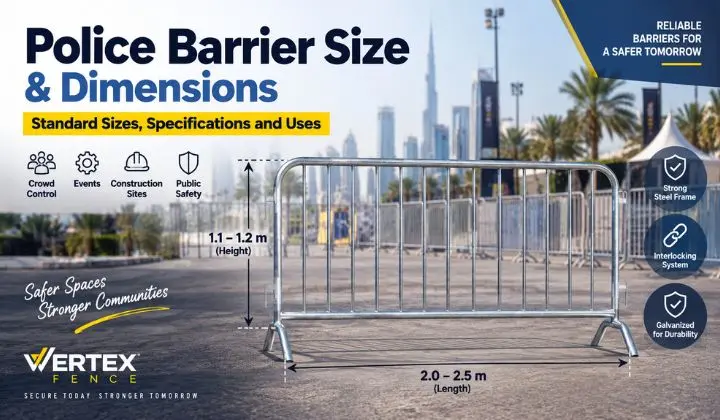
If you are buying or renting a police barrier, size is one of the first things you need to check. But police barrier size is not limited to length and height. The base, weight, frame and connection system can also affect how the barrier works on site.
There is no single size used by every manufacturer. Common products are around 2 to 2.5 metres long and about 1.1 to 1.2 metres high, while smaller configurations are also available. The right option depends on where the barrier will be used, how much area you need to control, and how often the barriers will be moved.
This guide explains police barrier dimensions, common sizes, technical specifications, stability, and practical uses so you can compare products before making a decision.
What Is a Police Barrier?
A police barrier is a temporary metal barricade used to control the movement of people and create a clear boundary. It is commonly used for crowd control, pedestrian management, queues, restricted areas, events, construction sites and public gatherings.
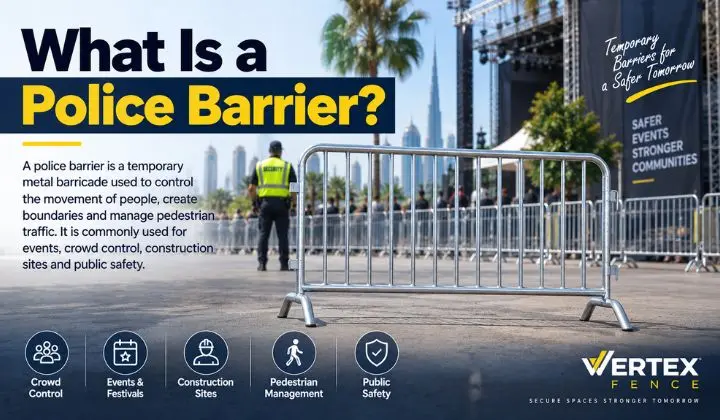
Most models have a steel frame, vertical tubes or mesh infill, supporting feet and an interlocking system. Several individual barriers can be connected together to create a longer controlled line.
The name can sometimes be confusing because suppliers may use terms such as police barricade, crowd control barrier, pedestrian barrier or metal barrier for similar products.
Unlike a permanent fence, a police barrier is designed to be installed, moved and removed when required. This makes it useful when the layout of an area changes regularly.
What Is the Standard Police Barrier Size?
There is no one universal standard police barrier size. Different manufacturers offer different dimensions depending on the design, material, weight and intended application.
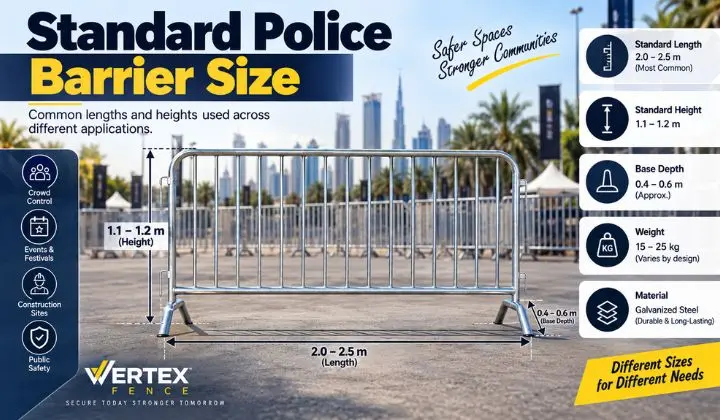
Common police barrier length options include approximately:
- 1.5 metres
- 2.0 metres
- 2.3 metres
- 2.5 metres
The height of many models is around 1.1 to 1.2 metres.
For example, one manufacturer may supply a 2m × 1.1m barrier, while another may offer a 2.5m × 1.2m model. Both can be used for crowd control, but they will not provide exactly the same coverage or handling.
This is why you should not assume that every product called a police barrier has identical police barriers dimensions.
Police Barrier Size Comparison
| Barrier Length | Typical Height | Suitable For |
| 1.5m | Around 1.1m | Small areas and tight spaces |
| 2.0m | Around 1.1–1.2m | General crowd control barriers |
| 2.3m | Around 1.1–1.2m | Medium and large events |
| 2.5m | Around 1.1–1.2m | Long runs and larger areas |
These figures are common working ranges rather than fixed industry rules. Always confirm the manufacturer’s exact specification before ordering.
A longer barrier can cover more ground with fewer units, but that does not mean it is always the better choice. Shorter barriers can be easier to arrange around corners, entrances and narrow spaces.
Police Barrier Dimensions Explained
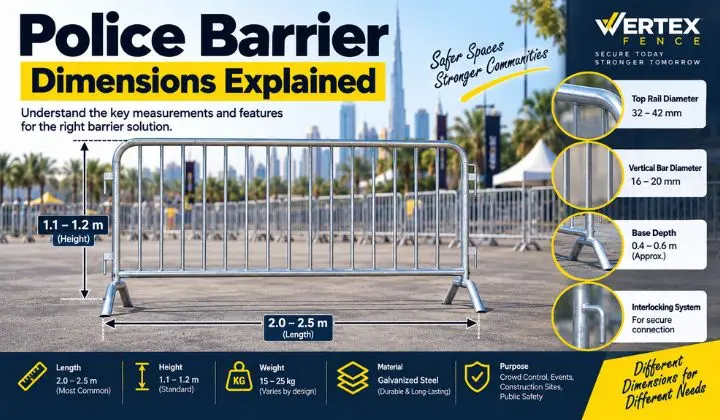
When comparing products, it is easy to focus only on the advertised length. However, the complete police barrier dimensions can include several measurements that affect installation and performance.
Police Barrier Length
The length is the horizontal distance covered by one barrier.
For example, a barrier with a listed length of 2.5m can cover more straight-line space than a 2m barrier. This can reduce the number of individual units needed for a long perimeter.
However, the actual layout matters. If you need several corners, entrances or gaps, you may not use every barrier at its full straight-line capacity.
When calculating your order, use the effective barrier length and then consider the site layout.
Police Barrier Height
Height is measured from the ground to the top of the barrier.
A height of around 1.1–1.2m is common because it provides a visible physical boundary while still allowing people and event staff to see across the barrier.
The purpose is usually to guide pedestrian traffic and control access rather than create a tall security wall.
A taller barrier is not automatically a better option. The required height depends on the application, layout and level of control needed.
Police Barrier Base and Depth
The base is one of the most important parts of a barrier because it helps keep the frame upright.
Different designs use different types of feet, including flat feet, bridge-style feet and other shapes designed for stability or easier handling.
The base can also affect how much space the barrier occupies on the ground. This is why you should ask for the base depth when comparing products.
Two barriers can have the same length and height but take up different amounts of floor space because their feet are designed differently.
Police Barrier Weight
Weight varies according to the steel frame, tube thickness, feet, infill and overall construction.
A lightweight barrier can be easier for workers to carry and reposition. A heavier metal police barrier may be useful where stability is more important.
However, weight should not be considered on its own. The barrier base, connection system and ground conditions can also have a major effect on stability.
What Does 2500 × 1200 mm Mean?
A specification such as 2500 × 1200 mm can look technical, but the basic meaning is simple:
- 2500 mm = 2.5 metres
- 1200 mm = 1.2 metres
For a typical police barrier, these measurements may represent the overall length and height.
However, always confirm the measurement order with the supplier. Product listings do not always use exactly the same format, and the base or feet may extend beyond the main frame.
For example, imagine you need to create a 25m straight barrier line using a barrier with an effective length of 2.5m:
25 ÷ 2.5 = 10 barriers
That gives you a starting quantity of 10 units.
If the layout includes a gate, entrance, corner or access gap, the final quantity may be different. This simple example shows why understanding the actual barrier dimensions is important before ordering.
Police Barrier Specifications Beyond Size
Size tells you how much space a barrier can cover, but it does not tell you everything about its quality or suitability.
Two barriers with similar dimensions can have different performance because their materials and construction are different.
Before buying or renting, check these specifications.
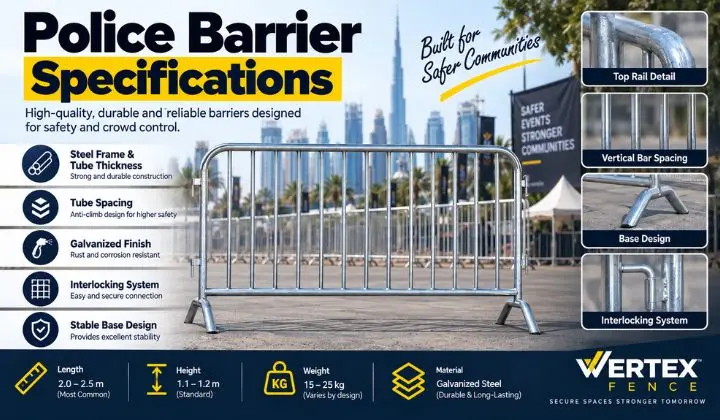
Steel Frame and Tube Thickness
The frame forms the main structure of the barrier. Manufacturers may use different tube diameters and wall thicknesses.
A properly designed steel frame provides the structure needed for repeated handling and normal crowd-control use. Tube thickness can also affect the overall weight of the product.
Do not judge a barrier only by the largest tube size listed in a specification. Look at the complete construction, including the feet and connection points.
Tube Spacing or Tube Pitch
Tube pitch describes the spacing between structural tubes or vertical elements.
This matters because the spacing affects visibility and how easily a person can pass through the barrier.
Closer spacing can create a more controlled boundary, while wider spacing may give a more open appearance.
If a supplier provides a tube-pitch measurement, ask how it was measured. This helps you make a fair comparison between different steel barriers.
Galvanized Steel and Corrosion Resistance
Outdoor barriers are exposed to weather, moisture, dust and repeated handling. A galvanized steel finish can help protect the steel against corrosion.
Hot-dip galvanizing is one common method used to provide a protective zinc coating.
For outdoor projects in the UAE, finish quality is worth checking because barriers may be used, transported and stored repeatedly. A suitable finish can help extend the useful life of the product.
Mesh or Anti-Climb Infill
Some police barriers use vertical bars, while others use anti-climb mesh or similar infill.
Mesh can create a more enclosed boundary and may make it harder for people to climb through the barrier.
This can be useful for certain events, restricted areas and construction applications. However, not every project needs mesh, so the design should match the actual purpose of the barrier.
Feet and Interlocking Hooks
The feet provide the support at ground level, while interlocking hooks or other connection fittings allow multiple barriers to be joined.
This connection is important when several units are being used together for crowd management.
A properly connected barrier line is easier to keep in position than a group of completely separate units. It also allows workers to create longer runs and change the layout when necessary.
How Do Size, Weight and Base Design Affect Stability?
A common mistake is to think that the largest or heaviest barrier is always the most stable. In reality, stability depends on several factors working together.
The barrier base determines the footprint on the ground. Weight can help resist movement, while the interlocking system can connect several units and help maintain a continuous line.
The surface underneath the barrier is also important. A barrier placed on a flat, firm surface will behave differently from one placed on uneven or sloping ground.
For areas where strong crowd pressure is expected, compare the complete product rather than focusing only on size. Look at:
- Barrier weight
- Base/feet design
- Frame construction
- Interlocking connections
- Ground conditions
- Intended application
This approach helps you choose a barrier based on how it will actually be used rather than choosing a product simply because it has larger dimensions.
What Is the Purpose of a Police Barrier?
The main purpose of a police barrier is to control pedestrian movement and create temporary restricted areas.
Common uses include:
- Crowd control
- Pedestrian management
- Queue management
- Access control
- Perimeter security
- Event security
- Temporary separation around work areas
- Controlled entrances and exits
For example, an event organiser can use barriers to keep spectators behind a defined line while leaving a separate route for staff.
On a construction site, they can help separate pedestrians from an active work area.
The key benefit is flexibility. A temporary barrier can be installed when needed and removed or rearranged after the activity is finished.
Where Are Police Barriers Used?
Police barriers can be used in many situations where temporary pedestrian control is needed.
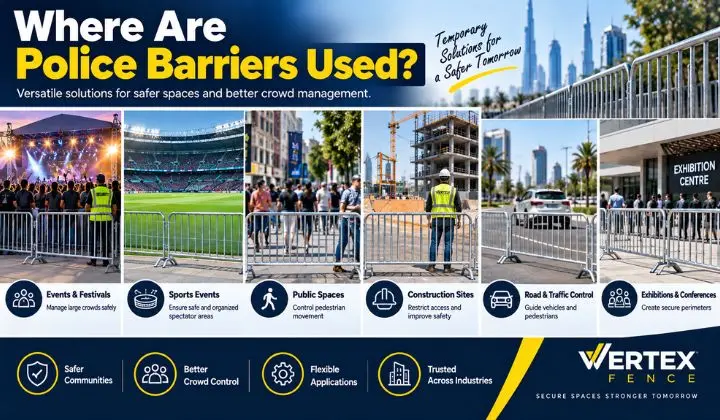
Events and Festivals
Concerts and festivals often require controlled entrances, queues, restricted areas and clear pedestrian routes.
Barriers can be connected into long lines and rearranged when the event layout changes.
Sports Events and Stadiums
At sports venues, barriers can guide spectators, organise queues and separate public areas from controlled zones.
The barrier layout can also help keep walkways clear around busy entrances and exits.
Concerts and Public Gatherings
Large gatherings need clear boundaries so that people know where they can and cannot go.
Police barricades can create temporary lines around stages, entrances, VIP areas or other restricted sections.
Construction Sites
Construction projects often have areas where pedestrians should not enter.
A temporary metal barrier can create a visible separation between the public and the work area without installing a permanent fence.
Road and Utility Works
Road repairs and utility work can change pedestrian routes for a limited period.
Barriers can help guide people around temporary work zones and create a clearer separation between pedestrians and workers.
For applications involving vehicles or road traffic, however, the barrier must be suitable for that specific purpose. A normal pedestrian barricade should not automatically be treated as a vehicle safety barrier.
Exhibitions and Conferences
Indoor events can use barriers for registration queues, controlled entrances, VIP areas and organised pedestrian movement.
Because the barriers are temporary, organisers can change the layout as the event progresses.
How Many Police Barriers Do You Need?
The number of barriers you need depends on the total length you want to control and the effective length of each unit.
A simple starting formula is:
Number of barriers = Required barrier-line length ÷ Effective barrier length
For example, if you need to cover a straight 20m area and each barrier is 2m long:
20 ÷ 2 = 10 barriers
If you use 2.5m barriers for the same straight line:
20 ÷ 2.5 = 8 barriers
Here are some quick examples:
| Required Length | Barrier Length | Approx. Quantity |
| 10m | 2m | 5 |
| 20m | 2m | 10 |
| 50m | 2m | 25 |
| 10m | 2.5m | 4 |
| 20m | 2.5m | 8 |
| 50m | 2.5m | 20 |
These calculations assume a straight line with no gaps.
In a real project, you may need extra units for corners, entrances, gates and separate sections. For example, a 20m perimeter with two access points will not be planned in exactly the same way as a simple 20m straight line.
It is also important to check whether the listed barrier length is the actual usable coverage after connection. Ask the supplier for the effective length if you need an accurate quantity.
Which Police Barrier Size Should You Choose?
The right size depends on the space, layout and purpose of the barrier. Choosing the largest available product is not always the best solution.
You should consider police barrier size, weight, base design, construction and how often the units need to be moved.
Choose a Shorter Barrier for Tight Spaces
A 1.5m barrier can be useful when the site has narrow spaces, several corners or a layout that changes frequently.
Shorter units can be easier for workers to position around entrances and bends. They can also give you more control over the exact shape of a temporary boundary.
Choose Around 2m for General Crowd Control
A 2m unit is a practical option for many normal crowd control barriers applications.
It provides a useful balance between coverage and handling. It can work well for queues, events, pedestrian routes and temporary restricted areas.
If the layout contains many changes in direction, a 2m barrier can also provide more flexibility than a very long unit.
Choose Around 2.3–2.5m for Long Runs
Longer barriers can be useful when you need to create a long, mostly straight barrier line.
For example, a 2.5m unit covers more distance per barrier than a 2m unit. This can reduce the number of individual barriers needed for large events, long pedestrian routes and temporary perimeters.
But remember that fewer units does not automatically mean a better setup. You still need to consider transportation, handling, storage, corners and access points.
Consider More Than Size for Outdoor Projects
For construction sites, road work and other outdoor applications, look at the complete specification:
Size + weight + base + frame + finish + connection system
A barrier with suitable galvanized steel, a stable base and reliable connections may be a better choice than another product with similar dimensions but a different construction.
Police Barrier vs Crowd Control Barrier vs Other Temporary Barriers
The names used for temporary barriers can vary between suppliers. A buyer should therefore compare the actual product design and specifications instead of relying only on the product name.
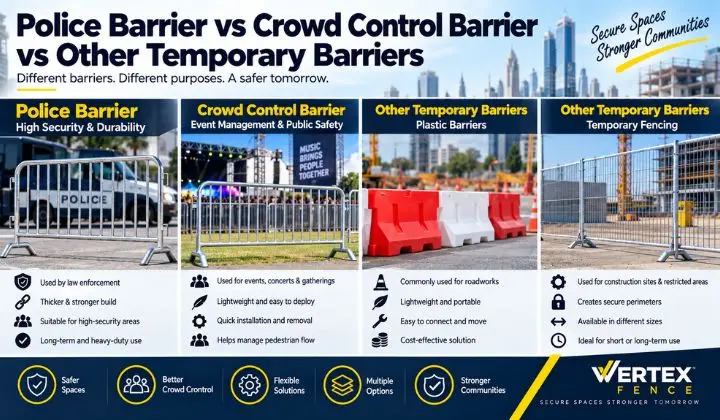
Police Barrier vs Crowd Control Barrier
A police barrier is generally a type of crowd control barrier used to guide people, restrict access and create temporary boundaries.
The two terms are often used for similar metal barricades. However, the frame, feet, tube spacing, weight and connection system can differ from one manufacturer to another.
If you are comparing products, focus on the actual specifications rather than assuming two products are identical because they have similar names.
Police Barrier vs Pedestrian Barrier
A pedestrian barrier is a broader term for a barrier used to guide or separate people.
A police-style barrier can perform the same basic function but may have a particular design, such as tubular steel construction, heavy feet and interlocking hooks.
The right option depends on whether you need simple pedestrian guidance, crowd separation or a more robust temporary boundary.
Police Barrier vs Temporary Fencing
Temporary fencing usually creates a more enclosed perimeter than an open police barrier.
A police barrier allows people to see through the structure and is generally easier to move and rearrange. Temporary fencing may be more suitable when you need a stronger visual separation around a construction area, storage area or restricted site.
Police Barrier vs Traffic Barrier
A police or crowd-control barrier is mainly intended for managing pedestrians.
A traffic barrier has a different purpose and may be designed for vehicle or road applications. You should not assume that a standard pedestrian barricade can provide vehicle protection.
Always select a barrier based on the actual hazard and application.
Should You Buy or Rent Police Barriers?
The decision between buying and renting depends mainly on how often you need the barriers and how long you will use them.
When Renting Makes More Sense
Police barrier rental can be a practical choice for short-term requirements such as:
- Concerts
- Festivals
- Sporting events
- Temporary construction work
- Public gatherings
- Short-term crowd-control needs
Rental can also be useful when you do not have enough storage space for a large number of barriers.
For example, if an event needs 100 barriers for two days but the company has no regular need for them, renting may be more practical than purchasing and storing 100 units after the event.
When comparing rental options in the UAE, look beyond the daily or project rate. Check whether transportation, setup, collection and other handling costs are included.
When Buying Makes More Sense
Buying may be more suitable when barriers are needed regularly.
Event companies, contractors, venues and organisations that use barriers throughout the year may benefit from keeping their own stock.
Ownership also gives you more control over availability. You do not need to depend on rental stock being available every time a project starts.
However, buying means you need suitable storage and must take care of transportation, inspection and maintenance.
What to Look for in a Police Barrier Supplier in the UAE
Choosing the right supplier is just as important as choosing the right size.
Do not order a barrier based on a single statement such as “2.5m police barrier.” Ask for the complete product specification so you know exactly what you are getting.
Check the Exact Dimensions
Ask for:
- Overall length
- Overall height
- Base or foot depth
- Effective coverage after connection
This prevents confusion when comparing different police barriers dimensions.
Check the Steel Construction
Ask about the:
- Steel frame
- Tube diameter
- Tube thickness
- Tube spacing
- Mesh or vertical-bar design
- Overall weight
These details help you understand how the product is built instead of judging quality from appearance alone.
Check the Finish
For outdoor use, ask whether the product is galvanized steel or has another protective finish.
If the barriers will be used repeatedly outdoors, corrosion resistance can be important for maintaining their condition over time.
Check the Base and Connection System
Look at the design of the feet and the interlocking hooks.
A good barrier setup needs more than a strong frame. The units must also stand properly and connect securely when used in a continuous line.
Explain Your Actual Application
Tell the supplier where the barriers will be used.
For example:
“I need 2.5m barriers for a large outdoor event.”
is more useful than simply asking:
“What is your police barrier price?”
The supplier can then understand the required crowd management, layout, environment and quantity.
For businesses looking for police barriers in UAE, a supplier such as Vertex Fence can be approached with the project requirements so the barrier configuration can be matched to the intended application.
Frequently Asked Questions
Can police barriers be joined together to create longer runs?
Yes. Most police-style barriers use an interlocking system with hooks or similar connecting fittings. This allows separate units to form a continuous line while still making it possible to remove or rearrange sections when the site layout changes.
Does a longer police barrier mean fewer barriers are needed?
Generally, yes. A 2.5m barrier covers more straight-line distance than a 2m barrier, so you may need fewer units for the same length. However, corners, entrances, gates and access gaps can change the final number required.
What should you check if the quoted police barrier dimensions don’t match?
Check whether the supplier is giving the frame size or the complete outside measurement. Confirm the length, height, base depth, weight and connection arrangement before comparing two products.
Can police barriers be used on uneven ground?
They may be suitable for some outdoor surfaces, but uneven or sloping ground can affect stability. The barrier base, weight and connection system should be checked against the actual site conditions before installation.
Is the lightest police barrier always the easiest option to use?
Not necessarily. A lighter unit is easier to carry and reposition, but a heavier design may offer better resistance to movement in some situations. The best choice depends on the weight, feet, frame, connections and intended application.
Conclusion
Choosing the right police barrier size is about more than selecting the longest or tallest product available.
Common options are often around 2–2.5 metres in length and 1.1–1.2 metres in height, but exact dimensions vary between manufacturers. The base, weight, frame, tube spacing, finish and interlocking system should also be checked before ordering.
For smaller or complex layouts, shorter barriers can provide more flexibility. For long straight runs, a 2.3–2.5m barrier can reduce the number of units required.
Most importantly, choose the barrier according to the actual job. Consider the crowd control requirement, ground conditions, expected use, transportation, storage and total quantity before making a decision.
A good supplier should be able to provide the complete specification and help you select a configuration that fits your project rather than simply selling you a standard-size barrier.