
 Fences
 Gates
Gates Signage & Boards
 Car Parking Shades
 Block and Foundation
 Spare Parts
How to Choose the Right Fence for Your Property in UAE

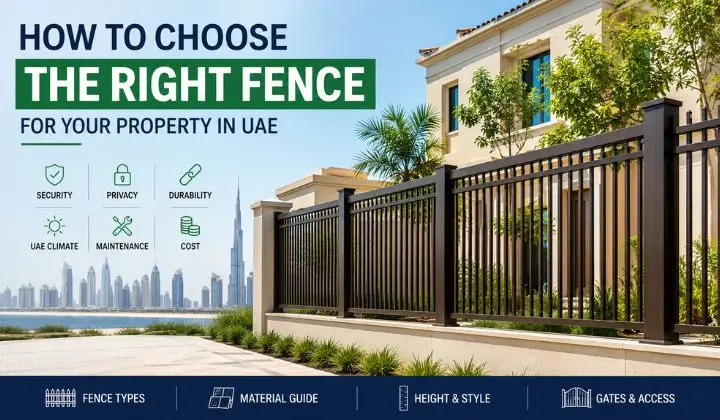
Choosing the right fence starts with one simple question: what do you need the fence to do? A villa may need privacy and a clean appearance, while a warehouse may need strong perimeter security, visibility, and long-term durability.
The right choice also depends on your property type, security requirements, privacy level, fence material, height, maintenance, installation, and budget. In the UAE, you should also consider heat, humidity, dust, UV exposure, and corrosion when selecting an outdoor fencing system.
Instead of choosing a fence only because it looks good or has a low price, compare how well it fits your property and how it will perform over time.
What Should You Consider When Choosing a Fence?
Before comparing fence types, make a short list of what matters most for your project. This makes it easier to narrow down the right option instead of comparing every fencing product available.
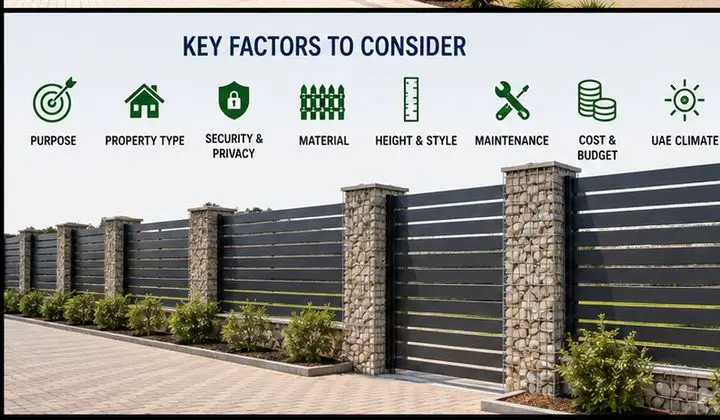
Purpose
First, decide whether you need the fence for security, privacy, property boundaries, safety, appearance, or a combination of these needs.
For example, a high-security site needs a very different solution from a residential villa. A large warehouse may benefit from a visible perimeter system, while a home may place more importance on privacy and appearance.
Property Type
Your property has a direct effect on the type of fencing you need. Residential fencing often focuses on privacy, appearance, and low maintenance. Commercial fencing may need a balance of security, visibility, and professional appearance.
Industrial sites, warehouses, and construction projects usually have different requirements again, especially when the fence needs to protect a large boundary.
Security and Privacy
Security and privacy are related, but they are not the same thing.
A fence with an open design can provide better visibility around a property, while a more enclosed design can provide greater visual privacy. For security applications, factors such as fence height, panel strength, climbing resistance, posts, gates, and installation also matter.
Material and Durability
The right fence material should match the location and expected use of the fence. Consider strength, maintenance, appearance, corrosion resistance, and outdoor durability rather than looking at the material price alone.
Height, Cost and Installation
Fence height affects privacy, security, appearance, and material requirements. Cost also includes more than the panels themselves. You may need to consider fence posts, foundations, gates, installation, and future maintenance.
Start With the Purpose of Your Fence
One of the most common mistakes is choosing a fence before deciding what it needs to achieve. Start with the purpose, then select the fence style and material that support that purpose.
Security and Perimeter Protection
If security is the main reason for installing a fence, focus on the complete perimeter protection system rather than appearance alone.
For a high-security property, look at factors such as fence height, panel or mesh construction, anti-climb features, post strength, gates, and the difficulty of gaining unauthorized access.
An Anti-Climb Fence can be considered where climbing resistance is a key requirement. Its design is intended to make it difficult for a person to find usable footholds or handholds.
For industrial and commercial sites, Welded Mesh Fence can provide a rigid barrier while maintaining visibility across the perimeter. This can be useful where security and visual monitoring are both important.
For larger boundaries where cost and visibility are important, a Chain Link Fence can be a practical option. It creates a clear boundary without completely blocking the view of the site.
The key point is that the strongest type of fencing is not automatically the best choice for every property. The required level of protection depends on the site’s risks, location, access points, and security goals.
Privacy
If privacy is your main concern, pay attention to the fence’s height, panel arrangement, and gaps.
A solid or more enclosed design can reduce sightlines into a property and provide a higher level of privacy. Open fencing, on the other hand, allows people to see through the boundary and may be better when visibility is important.
When deciding how to choose a fence for privacy, also consider where the fence will be installed. A villa may require more privacy around outdoor living areas, while a commercial property may need visibility for security and monitoring.
Privacy should therefore be balanced with airflow, appearance, security, and the property’s overall design.
Property Boundary and Appearance
Not every fence is installed mainly for security or privacy. Sometimes the main purpose is to clearly define a property boundary and improve the appearance of the site.
For these projects, design becomes more important. An Aluminum Fence can suit properties where a clean, modern appearance and low maintenance are priorities. A Cast Iron Fence may be more suitable when a traditional or decorative appearance is wanted.
The best fence style should work with the building, entrance, landscape, and gate rather than looking like a separate element added later.
Choose a Fence Based on Your Property Type
There is no single best fence for a property. The right solution changes according to how the property is used and what the fence needs to protect.
Residential Properties and Villas
For villas and other residential properties, homeowners often balance privacy, appearance, security, and maintenance.
A good residential fence should fit the property’s design while providing the required level of boundary protection. PVC fencing, ECO PVC Fence, and aluminum options can be considered when low maintenance and appearance are important.
Where stronger perimeter security is needed, metal fencing can be more appropriate. The final choice should depend on the location of the fence and whether privacy or visibility is the higher priority.
For a front boundary, an open decorative design may create a more welcoming appearance. Around a private garden or outdoor area, a more enclosed design may provide better privacy.
Commercial and Industrial Properties
Commercial and industrial properties usually have more demanding requirements than a typical home.
The fence may need to provide perimeter security, control access, withstand regular outdoor exposure, and maintain visibility around the site.
For these applications, Welded Mesh Fence, chain link, and higher-security fencing systems can be considered depending on the required protection level.
For example, a warehouse may need a rigid perimeter that allows security staff or cameras to maintain visibility. A site with higher security risks may require an Anti-Climb Fence and stronger access control.
The important thing is to select the fence as part of the property’s overall security system rather than treating it as a simple boundary.
Warehouses, Construction Sites and High-Security Areas
Different sites need different levels of protection.
A warehouse may require a permanent perimeter fence with secure gates and controlled access. A construction site may need a temporary solution that can be installed, moved, or removed as the project changes.
For temporary projects, PPGI Temporary Fence systems can be considered where a practical temporary boundary is required.
High-security locations need more careful planning. Fence height, panel design, posts, foundations, gates, and unauthorized access risks should all be considered together.
The more important the security function is, the less you should rely on appearance or initial price as the main selection factor.
What Type of Fencing Should You Get?
If you are still asking, “what type of fencing should I get?”, start by matching your main requirement to the type of fence.
| Main Requirement | Fence to Consider | Why |
| High security | Anti-Climb Fence | Provides strong climbing resistance |
| Industrial perimeter | Welded Mesh Fence | Rigid structure with good visibility |
| Cost-effective boundary | Chain Link Fence | Practical for large areas |
| Residential appearance | Aluminum / PVC | Clean appearance and low maintenance |
| Decorative boundary | Cast Iron Fence | Traditional and decorative appearance |
| Temporary site protection | PPGI / Temporary Fence | Suitable for temporary project boundaries |
This table should be used as a starting point, not as a fixed rule. Site conditions, required height, installation method, security level, and local requirements can change the final recommendation.
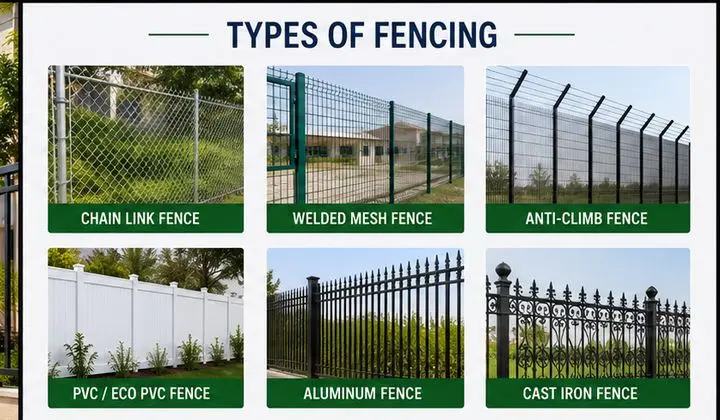
When Chain Link Is a Practical Choice
Chain Link Fence is often considered for large boundaries where visibility, durability, and cost are important. Its open structure allows people to see through the fence, so it is not the first choice when complete privacy is required.
It can work well for warehouses, industrial areas, utility sites, and other properties where the boundary needs to be clear without creating a solid visual barrier.
When Welded Mesh Is a Better Choice
Welded Mesh Fence has a rigid panel structure that can provide a stronger and more defined barrier than basic mesh fencing.
It can be useful for commercial and industrial properties where security, visibility, and a clean appearance all matter. The final specification should be selected according to the required level of perimeter security.
When Anti-Climb Fencing Is Needed
When the main concern is preventing people from climbing over the boundary, an Anti-Climb Fence can be a better fit than standard open fencing.
The fence should still be considered as part of a complete security system. Gates, posts, foundations, access control, and the surrounding site layout can all affect how effective the overall barrier is.
Choose the Right Fence Material
Material affects the fence’s appearance, strength, maintenance, lifespan, and performance in outdoor conditions. There is no single material that is best for every application.
Chain Link and Galvanized Steel
Galvanized steel fence systems are commonly considered for outdoor boundaries because the protective zinc coating helps improve corrosion resistance compared with unprotected steel.
Chain link is particularly useful where visibility and cost-effectiveness matter. It can be a practical choice for large sites where a long boundary needs to be secured without using a fully enclosed design.
However, material selection should also consider the site’s environment. Locations exposed to humidity, coastal air, or other corrosive conditions may require appropriate coatings and specifications.
Welded Mesh and Anti-Climb Fencing
Welded mesh and anti-climb systems are suitable when a more rigid and security-focused barrier is required.
Welded mesh provides a structured panel design, while anti-climb fencing focuses more strongly on reducing opportunities for climbing. Both can maintain visibility, which can be useful for monitoring a commercial or industrial perimeter.
The correct choice depends on the site’s security requirements, required height, panel specification, and installation conditions.
Aluminum, PVC and ECO PVC
Aluminum can be a useful option when appearance, low maintenance, and resistance to outdoor conditions are important. Its clean appearance can work well with modern residential and commercial properties.
PVC fencing can also be considered where low maintenance and a consistent appearance are priorities. ECO PVC Fence may be suitable for projects looking for a practical fencing solution with a clean finish and reduced maintenance needs.
Before choosing any material, consider the fence’s location, expected exposure, required strength, and long-term maintenance rather than choosing based on appearance alone.
Cast Iron
Cast Iron Fence can suit properties where decorative appearance and a strong metal boundary are important.
Its traditional appearance can work well around entrances, villas, and properties where the fence needs to contribute to the overall architectural style.
However, decorative metal fencing is not automatically the best choice for privacy. Its design, spacing, and height should be considered based on the property’s actual needs.
Consider UAE Climate, Durability and Maintenance
Choosing a fence for the UAE is not only about its appearance or initial price. Outdoor fencing is exposed to heat, UV exposure, humidity, dust and sand, and some locations may also face stronger coastal conditions.
These factors can affect the fence material, coating, maintenance needs, and long-term performance. A material that works well in one environment may need a different specification or protective finish in another.
Heat and UV Exposure
Strong sunlight and high temperatures can affect outdoor materials over time. When comparing fencing options, consider their weather resistance and ability to maintain their appearance under regular sun exposure.
For this reason, don’t select a fence only by looking at how it appears when new. Ask how the material and finish are expected to perform after years of outdoor exposure.
Humidity and Coastal Conditions
Properties close to the coast can face higher humidity and salt exposure. These conditions can increase the risk of corrosion for unsuitable metal products.
For metal fencing, corrosion resistance, galvanization, and an appropriate protective coating should be considered when selecting the specification.
A galvanized steel fence can be a practical option for many outdoor applications, but the correct coating, material specification, installation, and maintenance still matter.
Dust, Sand and Maintenance
Dust and sand are common outdoor conditions in the UAE. While they may not damage every fence material in the same way, they can affect appearance and increase cleaning requirements.
If you want low-maintenance fencing, consider how often the fence will need cleaning, repainting, treatment, or repairs. A slightly higher initial investment may make sense if it reduces ongoing maintenance and replacement costs.
Choose the Right Fence Height and Style
Fence height should be based on what you want the fence to achieve. A higher fence can improve privacy and create a stronger physical boundary, but height alone does not determine security or suitability.
When deciding how to choose a fence style, consider the property, surrounding architecture, privacy requirements, visibility, and security level.
How High Should Your Fence Be?
There is no single fence height that works for every UAE property.
A lower fence may be suitable when appearance and visibility are important. A taller fence may be more suitable where privacy or stronger boundary protection is needed.
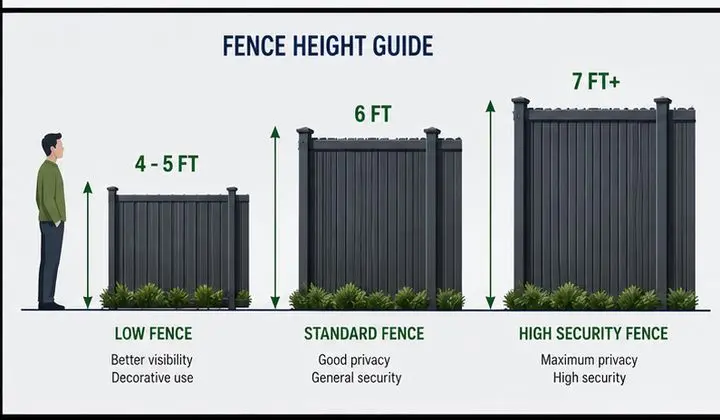
If you are comparing a 5 foot fence with a 6 foot fence, don’t make the decision based only on the extra height. Consider:
- How much privacy you need
- The level of security required
- Visibility around the property
- Property type
- Gate and access requirements
- Applicable local requirements
The final height should be confirmed according to the property’s location and any applicable authority, community, or project requirements.
Choosing Between Open and Enclosed Styles
The fence design also affects how people interact with the property.
Open fencing allows better visibility and can make a boundary feel less enclosed. It may be useful where monitoring and visibility are important.
Solid fence panels provide fewer sightlines and can offer greater privacy. Semi-solid fence panels provide a middle ground where some visibility and airflow are still wanted.
So, the best fence style is not simply the one that looks attractive. It should support the purpose of the property.
Consider Cost, Installation and Long-Term Value
Price is an important part of choosing a fence, but the cheapest option is not always the best value.
Your total fencing budget can include the material, fence height, total length, posts, foundations, gates, labour, site preparation, and future maintenance.
What Affects Fence Cost?
Fence cost can vary significantly between projects because every site has different requirements.
Important cost factors include:
- Fence material
- Total fence length
- Fence height
- Design and finish
- Number of gates
- Posts and foundations
- Site conditions
- Installation requirements
- Future maintenance
This is why comparing only the price per metre may not give you a complete picture.
Is the Cheapest Fence Always the Best Choice?
Not necessarily.
Chain Link Fence can be a cost-effective solution for some large boundaries because it uses an open design and can cover large areas efficiently. But if the property needs high security, privacy, or a more decorative appearance, a different system may provide better overall value.
Think about long-term cost, not only the purchase price. A fence that costs less initially but requires frequent repairs or replacement may become more expensive over time.
The better question is:
Which fence gives the right balance of performance, lifespan, maintenance, and cost for this property?
Don’t Forget Gates and Access Points
A fence and its gate should be planned as one system.
A strong fence can still have a weak access point if the gate, hinges, locking system, posts, or installation are not suitable for the site’s requirements.
Think about whether the property needs:
- Pedestrian access
- Vehicle access
- Driveway access
- Emergency access
- Controlled entry
- Frequent-use gates
For commercial and industrial properties, gate security can be especially important because access points are often more heavily used than the rest of the perimeter.
The gate should also work visually with the fence. Matching the fence gates with the main fence design can create a more complete and professional appearance.
Common Fence Selection Mistakes to Avoid
Choosing a fence becomes easier when you know what mistakes to avoid.
Choosing only by price
A low upfront price does not always mean low overall cost. Consider installation, maintenance, durability, and expected service life.
Ignoring the purpose
A decorative fence may not provide the security required for an industrial site. Likewise, a heavy security fence may be unnecessary for a simple residential boundary.
Choosing the wrong height
Fence height should match privacy, security, visibility, and property requirements. Don’t simply choose the tallest available option.
Ignoring UAE conditions
Heat, UV exposure, humidity, dust, and coastal conditions can affect outdoor fencing. Material and coating should be selected with the installation environment in mind.
Forgetting the gate
The gate is part of the boundary system. Its design, strength, access method, and installation should match the fence and the property’s use.
Compromising on installation
Even a high-quality fence can perform poorly if the posts, foundations, alignment, or fixings are not installed correctly.
Not checking applicable requirements
Before installation, confirm any applicable local, community, project, or authority requirements related to fence height, placement, design, or approvals.
How to Choose a Fence Supplier in UAE
Once you know what type of fence you need, choosing the right supplier is the next step.
Don’t compare suppliers only by quotation. Look at the quality of materials, product range, manufacturing capability, project experience, customization options, installation support, warranty, and after-sales service.
A reliable supplier should be able to understand your property’s requirements and explain why a particular fencing system is suitable.
When comparing Fence Suppliers in UAE, also ask about the material specification, coating or finish, expected maintenance, installation method, and whether the supplier has experience with projects similar to yours.
For projects that require specific dimensions, finishes, security levels, or customized fencing, working with an experienced Fence Manufacturer in UAE can make the selection and specification process easier.
For example, Vertex Fence provides different fencing solutions for residential, commercial, industrial, and project-based requirements.
Which Fence Is Right for Your Property?
If you are still unsure how to choose a fence, use this quick guide as a starting point:
| Your Main Priority | Fence to Consider | Main Reason |
| High security | Anti-Climb Fence | Strong focus on climbing resistance |
| Industrial perimeter | Welded Mesh Fence | Rigid structure and good visibility |
| Large, cost-conscious boundary | Chain Link Fence | Practical and economical for many large areas |
| Residential appearance | Aluminum / PVC | Clean appearance and low maintenance |
| Decorative boundary | Cast Iron Fence | Decorative and traditional appearance |
| Privacy | Solid or enclosed fencing | Reduces direct sightlines |
| Temporary site protection | PPGI / Temporary Fence | Designed for temporary project boundaries |
| Low maintenance | Aluminum / PVC | Generally requires less routine upkeep |
This is a starting point rather than a universal rule. The final choice should take into account your property type, security requirements, privacy needs, climate, fence height, site conditions, budget, and installation requirements.
Frequently Asked Questions
Can I use different types of fencing on the same property?
Yes. Using different fencing systems can make sense when different parts of a property have different requirements. For example, a property may use decorative fencing at the front and a more security-focused system around its main perimeter.
Should fence visibility be prioritized over privacy?
It depends on the property’s purpose. Open fencing can improve visibility and help with perimeter monitoring, while enclosed fencing can provide greater privacy. Choose based on whether visibility, privacy, or a balance of both matters most.
How can I compare two fence options before making a decision?
Compare them using the same factors: security, privacy, material, durability, maintenance, appearance, installation requirements, and total cost. This gives you a better comparison than looking at the purchase price alone.
Is a more expensive fence always better?
No. A higher price may reflect stronger materials, a different finish, more complex design, or higher security, but that does not make it the right choice for every property. The best option is the one that meets your requirements without paying for features you do not need.
Can a fence be upgraded later for better security?
In some cases, yes. Security can sometimes be improved through changes to the fence, gates, access control, or other security features. However, it is better to plan the required security level before installation so the posts, foundations, and overall system can support the intended upgrades.
When should I replace an existing fence instead of repairing it?
Replacement may make more sense when the fence has major structural damage, severe corrosion, unstable posts, repeated failures, or no longer provides the required security. If repairs are becoming frequent or costly, compare the repair cost with the long-term value of a new system.
Conclusion
The best fence is not simply the strongest, cheapest, or most attractive option. It is the one that fits the purpose, property, security level, privacy needs, climate, budget, and long-term maintenance requirements.
For a UAE property, consider the local outdoor environment as carefully as the fence’s design. Compare the material, height, installation, gates, durability, and total cost before making a decision. A clear understanding of these factors will help you choose a fencing system that performs well and remains suitable for your property over time.