
 Fences
 Gates
Gates Signage & Boards
 Car Parking Shades
 Block and Foundation
 Spare Parts
Concrete Cover Blocks in Dubai: Types, Uses, Sizes & PVC Options

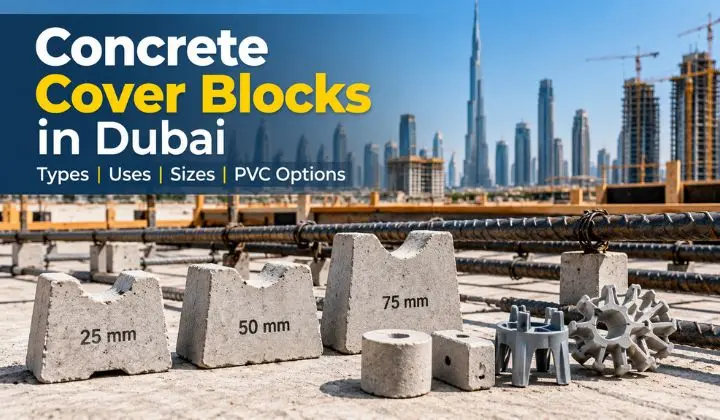
A concrete cover block is a small spacer used in reinforced concrete construction to keep reinforcement bars (rebar) at the correct distance from the concrete surface. This distance is known as concrete cover or clear cover.
The right cover helps protect steel reinforcement from moisture, corrosion and heat while keeping the reinforcement in its designed position. Cover blocks are commonly used in slabs, beams, columns, footings, foundations, walls and raft foundations.
In Dubai and across the UAE, the correct cover block should be selected according to the structural drawings, reinforcement arrangement, required cover and project specifications. Choosing a block only because it is cheap or readily available can lead to the wrong cover or poor reinforcement positioning.
What Is a Concrete Cover Block?
A concrete cover block is a spacer placed between reinforcement and the formwork or concrete surface. Its main purpose is to maintain the specified distance between the steel reinforcement and the finished concrete surface.
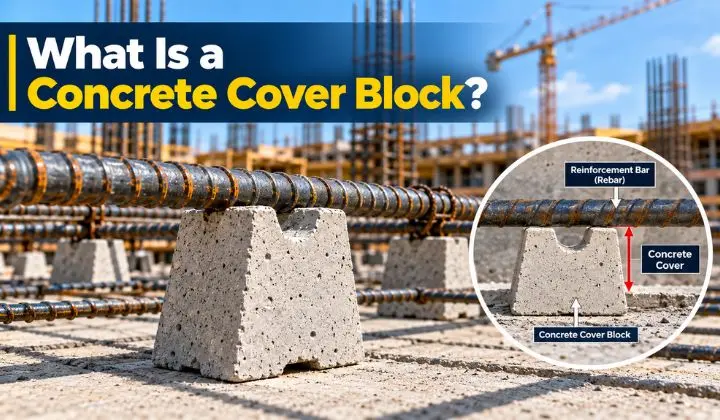
For example, when a project specifies 50 mm of clear cover, a suitable concrete cover block 50mm can help maintain that distance when correctly installed.
Cover blocks are available in different materials, sizes and shapes. Common options include precast concrete cover blocks, fibre-reinforced products and PVC spacers.
The required product depends on the structural element and design. A spacer suitable for a slab may not be the right choice for a footing or raft foundation.
What Is the Purpose of Concrete Cover?
Concrete cover has several important functions in reinforced concrete construction.
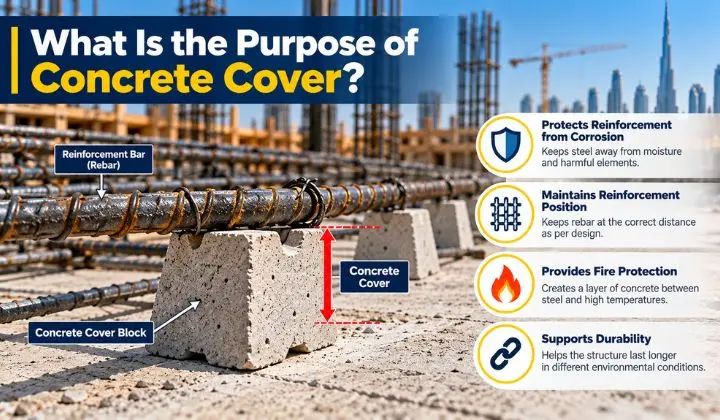
1. Protecting reinforcement:
Adequate cover creates a protective layer around the steel and helps reduce exposure to moisture and other substances that can contribute to reinforcement corrosion.
2. Maintaining reinforcement position:
A suitable spacer helps keep reinforcement bars at the required position while workers fix the steel and place concrete.
3. Supporting durability:
Correct cover is part of the overall design approach for durability. The required amount can vary depending on exposure and project requirements.
4. Fire protection:
Concrete cover provides a layer of concrete between the reinforcement and external heat. The required cover for fire performance depends on the structural design and applicable requirements.
The key point is simple: cover blocks help maintain the specified concrete cover; they do not replace the structural design.
Cover Block vs Spacer Block: Are They the Same?
The terms cover block, spacer block and concrete spacer are often used for products that help maintain reinforcement at a required position.
A cover block usually refers to a spacer that maintains the required distance between reinforcement and the concrete surface. A spacer block can be a broader term for a component used to support or position reinforcement.
For example, a contractor may ask for a concrete spacer, while another supplier may call a similar product a cover block.
The name is less important than the product’s actual specifications. Before ordering, check:
- Required cover dimension
- Rebar diameter
- Reinforcement arrangement
- Product dimensions
- Material
- Stability
- Project specifications
This helps ensure that the selected product performs the intended job.
Types of Concrete Cover Blocks
Different construction applications can require different spacer materials and designs. The most suitable option depends on the structural element, required cover and project requirements.
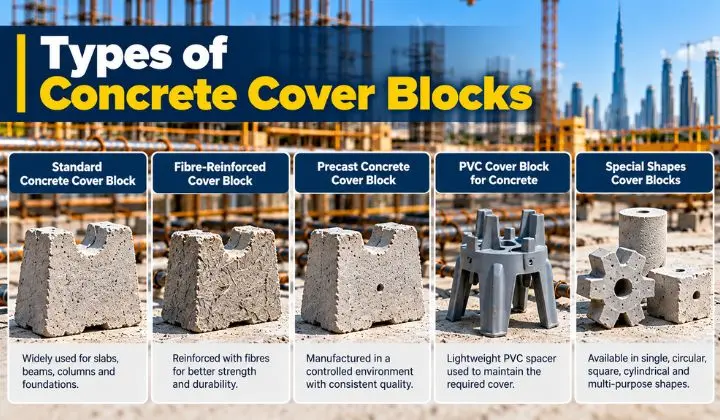
Standard Concrete Cover Blocks
Standard concrete cover blocks are widely used to keep reinforcement away from the formwork and maintain the required clear cover.
They are available in different dimensions and shapes. Their size should be selected according to the cover specified in the structural drawings.
A good spacer should remain stable during reinforcement fixing and concrete pouring. The product should also have consistent dimensions so the required cover can be maintained across the work area.
Fibre-Reinforced Cover Blocks
Fibre-reinforced cover blocks contain fibres within a cement-based material. Fibre reinforcement can improve certain properties of the spacer, depending on the product design and manufacturing process.
These products may also be described as a fiber concrete spacer cover block.
When considering fibre-reinforced products, do not focus on the word “fibre” alone. Check the actual product specifications, including:
- Cover dimension
- Product dimensions
- Strength
- Rebar compatibility
- Intended application
- Manufacturing consistency
This is particularly important when ordering cover blocks for large construction projects.
Precast Concrete Cover Blocks
Precast concrete cover blocks are manufactured before being delivered to the construction site.
Their main advantage is consistent production when suitable manufacturing controls are followed. They can be produced in different sizes and shapes for various reinforced concrete applications.
Precast spacers may be used with reinforcement in:
- Slabs
- Beams
- Columns
- Footings
- Foundations
- Walls
The required size should still be based on the structural design rather than simply choosing the most commonly available product.
PVC Cover Blocks for Concrete
PVC cover blocks for concrete are lightweight spacers made from PVC or another plastic material.
They are available in different shapes and sizes and can be considered for project-specific reinforcement applications. Their suitability depends on the product design, required cover, reinforcement arrangement and project specifications.
PVC should not automatically be considered suitable for every application. Before selecting a PVC cover block, check its intended use and compatibility with the construction requirements.
For projects where material selection is important, compare the product’s specifications rather than choosing based only on weight or price.
Common Cover Block Shapes
Cover blocks can be manufactured in different shapes to suit different reinforcement arrangements.
Common designs include:
- Single cover blocks
- Multi-purpose spacers
- Circular spacers
- Square spacers
- Cylindrical spacers
The shape can affect how the spacer sits against the formwork or reinforcement. The most suitable design depends on the application and the way the reinforcement is arranged.
Concrete Cover Block Sizes and How to Choose the Right One
One of the most important questions when buying a cover block is: What size do I need?
The answer depends on the required concrete cover shown in the structural drawings.
Common cover dimensions may include 25 mm, 30 mm, 40 mm, 50 mm, 75 mm and 100 mm, but these should not be treated as universal application rules.
| Cover Dimension | General Consideration |
| 20–25 mm | Smaller specified cover requirements |
| 30–40 mm | Project-dependent applications |
| 50 mm | Larger specified cover requirements |
| 75 mm | Applications requiring greater specified cover |
| 100 mm | Special or project-specific requirements |
The cover block size should match the required clear cover. It should also be compatible with the reinforcement arrangement and remain stable during construction.
25 mm Concrete Cover Block
A 25 mm concrete cover block is designed to maintain a nominal 25 mm separation between reinforcement and the concrete surface when correctly positioned.
Whether 25 mm is appropriate depends on the structural element, exposure conditions and project requirements.
Do not assume that a 25 mm spacer can be used simply because the reinforcement is in a slab or wall. Always check the specified cover first.
50 mm Concrete Cover Block
A 50mm cover block is intended to maintain a nominal 50 mm cover when properly installed.
A concrete cover block 50mm may be specified for applications where the structural design requires greater separation between reinforcement and the concrete surface.
Before ordering, confirm:
- Required cover
- Reinforcement arrangement
- Spacer dimensions
- Rebar compatibility
- Project specification
The term “50 mm” describes the intended cover dimension; it does not mean that this size is suitable for every foundation, beam or slab.
75 mm Concrete Cover Block
A concrete cover block 75 mm provides a nominal 75 mm separation between reinforcement and the relevant concrete surface when correctly installed.
A 75mm cover block may be required in some foundation or other project-specific applications where greater cover is specified.
Again, the structural drawings should determine whether 75 mm is required. Selecting a larger spacer without checking the design can also create an incorrect reinforcement position.
Which Cover Block Is Used for Slabs, Beams, Columns and Foundations?
There is no single cover block that should automatically be used for every structural element.
The correct spacer block depends on the required cover, reinforcement arrangement and project design.
| Structural Element | Main Selection Consideration |
| Slabs | Required cover and reinforcement position |
| Beams | Bottom, side and top reinforcement arrangement |
| Columns | Reinforcement cage and specified cover |
| Footings | Bottom reinforcement and ground-facing cover |
| Foundations | Required cover and exposure conditions |
| Walls | Distance between reinforcement and formwork |
| Raft foundations | Top/bottom reinforcement and spacer stability |
For slabs, the spacer needs to keep the reinforcement at the specified level during construction. Beams and columns can require different arrangements because reinforcement is positioned around several sides.
Foundations and footings may also require different cover because the reinforcement can be exposed to different environmental conditions.
For this reason, contractors should avoid using one standard concrete spacer throughout a project without checking the drawings.
Concrete Cover Block Specification Checklist
Before ordering a concrete cover block, do not look at price and size alone. The product should match the requirements of the construction project.
A simple specification checklist can help contractors, engineers and purchasing teams avoid unsuitable products.
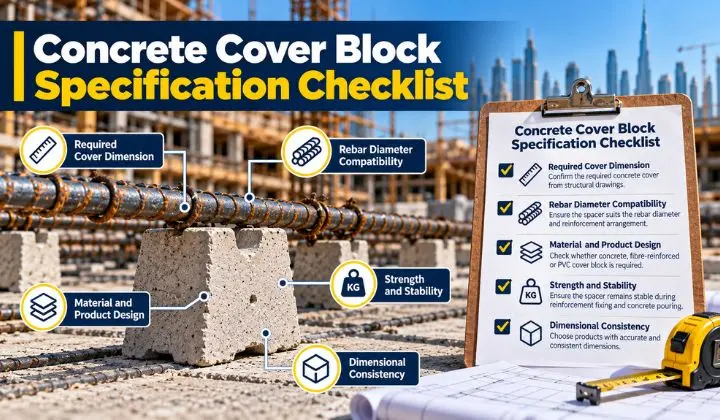
Required Cover Dimension
First, confirm the required concrete cover from the structural drawings.
The cover dimension determines how far the reinforcement should remain from the concrete surface. A 25 mm, 50 mm or 75 mm spacer should only be used when it matches the required project specification.
Rebar Diameter Compatibility
The rebar diameter and reinforcement arrangement should also be considered.
The spacer needs to support the reinforcement properly and remain stable during construction. A product that does not suit the reinforcement arrangement may move during installation or concrete placement.
Material and Product Design
Check whether the project requires a concrete, fibre-reinforced cover block, precast spacer or PVC cover block.
Material selection should be based on the application, project requirements and product specifications rather than choosing a material simply because it is lighter or cheaper.
Strength and Stability
The spacer should be able to remain stable under the conditions it will face during reinforcement fixing and concrete pouring.
For larger or more demanding applications, check the manufacturer’s stated product specifications and intended use.
Dimensional Consistency
Consistent dimensions are important because variations can affect the actual cover maintained across the structure.
This becomes even more important when hundreds or thousands of spacers are required for a large project.
Concrete vs PVC Cover Blocks for Concrete
Both concrete and PVC spacers can be found in the construction market, but they have different characteristics.
| Factor | Concrete Cover Block | PVC Cover Block |
| Material | Cement/concrete-based | PVC/plastic |
| Weight | Generally heavier | Generally lighter |
| Available designs | Different sizes and shapes | Different sizes and shapes |
| Typical application | Many reinforced concrete applications | Project-dependent applications |
| Selection | Based on project requirements | Based on project requirements |
| Main check | Size, stability and suitability | Size, stability and suitability |
A concrete spacer may be selected when a cement-based product is preferred for the application. PVC products may be considered where a lightweight plastic spacer fits the project requirements.
There is no single material that should automatically be selected for every structure. The decision should consider reinforcement positioning, required cover, stability, environmental conditions, construction method and project specifications.
For Dubai and UAE projects, it is also useful to confirm that the supplier can provide the required sizes consistently throughout the project.
Concrete Cover Blocks for Raft Foundations
A raft foundation can contain a large reinforcement arrangement, often with steel placed in more than one layer.
This makes correct reinforcement positioning especially important. A suitable concrete cover block raft foundation application helps maintain the specified distance between the reinforcement and the concrete surface.
Before concrete is poured, the site team should check:
- Bottom reinforcement cover
- Top reinforcement position
- Spacer stability
- Reinforcement alignment
- Required cover
- Missing spacers
- Damaged spacers
- Possible reinforcement movement
The correct cover should always come from the structural drawings.
For example, a contractor should not automatically choose a 75 mm spacer simply because it is being used for a foundation. The required cover depends on the actual structural and project requirements.
How to Estimate the Number of Concrete Cover Blocks Needed
Concrete cover block estimation should be based on the actual reinforcement layout rather than a universal number of blocks per square metre.
A practical method is:
Step 1: Review the Structural Drawings
Identify the slabs, beams, columns, walls, footings and foundations where spacers are required.
Step 2: Confirm the Required Cover
Check the specified clear cover for each structural element.
Step 3: Check the Reinforcement Arrangement
Look at the bar size, spacing, layers and reinforcement cage arrangement.
Step 4: Select the Spacer
Choose a suitable concrete spacer, spacer block or PVC product based on the required cover and reinforcement arrangement.
Step 5: Determine Spacing
Follow the project requirements or approved construction method for spacer placement. Do not rely on an arbitrary spacing rule for every structure.
Step 6: Calculate the Quantity
Calculate the number of spacers based on the actual work area and required placement arrangement.
Step 7: Allow for Wastage
Where appropriate, include a reasonable allowance for damaged or unusable pieces.
This approach gives a more reliable estimate than using one fixed formula for every project.
Concrete Cover Block Price in Dubai
The concrete cover block price in Dubai can vary from one supplier and product to another.
Several factors can affect the final quotation:
- Cover block size
- Material
- Shape
- Product design
- Quantity
- Packaging
- Custom requirements
- Bulk order volume
- Delivery location
- Project specifications
For example, the price of a small standard spacer may differ from a larger or specially designed product ordered in bulk.
Because prices can change with quantity, specifications and delivery requirements, buyers should request a current quotation rather than relying on an old online price.
When comparing suppliers, look at product quality, dimensions, availability and suitability as well as the quoted price.
How to Choose Concrete Cover Block Suppliers in Dubai & UAE
Choosing the right concrete cover block suppliers in Dubai is important when the project needs a regular supply of reinforcement accessories.
Before placing an order, check the following:
Available Sizes
The supplier should offer the cover dimensions required for your project, such as 25 mm, 50 mm or 75 mm where applicable.
Material Options
Check whether the supplier offers the required concrete, fibre-reinforced or PVC options.
Product Specifications
Ask for clear information about dimensions, intended application and other relevant specifications.
Bulk Availability
Large projects may require significant quantities. Confirm that the supplier can maintain supply throughout the project.
Delivery
For Dubai and wider UAE projects, confirm delivery arrangements, lead times and the project location before ordering.
Project Suitability
The most important question is whether the product matches the structural requirement.
The same checklist can be used when searching for a concrete cover block supplier in UAE.
Vertex Fence can be included in the supplier comparison process when contractors need construction products and want to discuss available options, specifications and project quantities.
Common Mistakes to Avoid When Using Cover Blocks
Even a good cover block can fail to provide the intended result if it is selected or installed incorrectly.
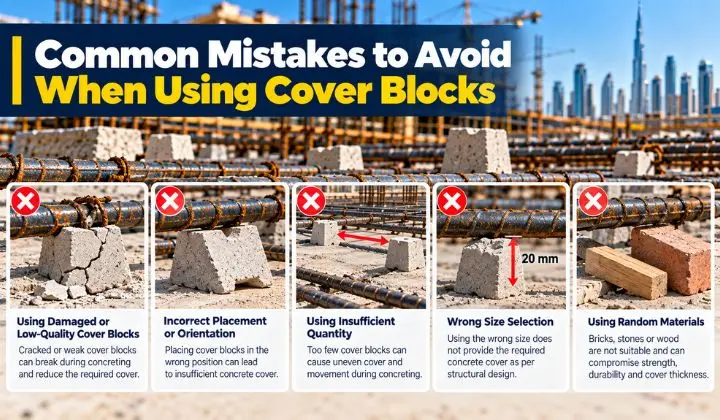
Choosing the Wrong Size
Do not select a spacer simply because it is available in the warehouse. Confirm the required cover first.
Ignoring Rebar Diameter
The reinforcement arrangement and rebar diameter can affect the type and design of spacer required.
Using Damaged Spacers
Cracked, broken or badly damaged spacers should not be used where they cannot reliably maintain the required cover.
Poor Spacer Positioning
A spacer placed incorrectly may move when reinforcement is handled or when concrete is placed.
Using Random Materials
Stones, pieces of wood or other unsuitable objects should not be treated as a replacement for a properly designed reinforcement spacer.
Choosing Only on Price
A low price does not automatically mean the product is suitable. Always consider dimensions, material, stability, product specifications and project requirements.
Frequently Asked Questions
Can damaged or cracked cover blocks be used on a construction site?
Damaged or cracked cover blocks should not be used if the damage affects their strength, dimensions or ability to maintain the required cover. Inspect spacers before installation and replace pieces that are not suitable.
Do cover blocks need to match the structural concrete grade?
Not necessarily in every project. The selection should consider the spacer’s material, strength, stability, intended application and the requirements stated in the project specifications.
Can one cover block size be used for the entire project?
Not always. Different structural elements can have different cover requirements, so the required size should be selected according to the structural drawings and project specifications.
What happens if reinforcement is too close to the concrete surface?
Insufficient cover can leave reinforcement more exposed to moisture and other aggressive conditions. Over time, this can increase the risk of reinforcement corrosion and affect the durability of the concrete structure.
Should cover blocks be checked before concrete pouring?
Yes. Before concrete pouring, check the cover dimension, spacer position, reinforcement alignment, stability and any missing or damaged spacers. This helps reduce the chance of reinforcement moving during placement.
Conclusion
A concrete cover block is a small construction component, but it has an important role in reinforced concrete work. It helps maintain the required distance between reinforcement bars and the concrete surface while construction is taking place.
The right product depends on several factors, including cover block size, rebar diameter, material, shape, structural element and project specifications. Concrete, fibre-reinforced, precast and PVC options can all be considered depending on the application.
Whether a project requires a 25 mm cover block, 50mm cover block, 75mm cover block or another size, the selection should start with the structural drawings rather than price or availability.
For contractors searching for concrete cover block suppliers in Dubai or a concrete cover block supplier in UAE, it is worth checking product specifications, available sizes, bulk supply, delivery and project suitability before placing an order.